

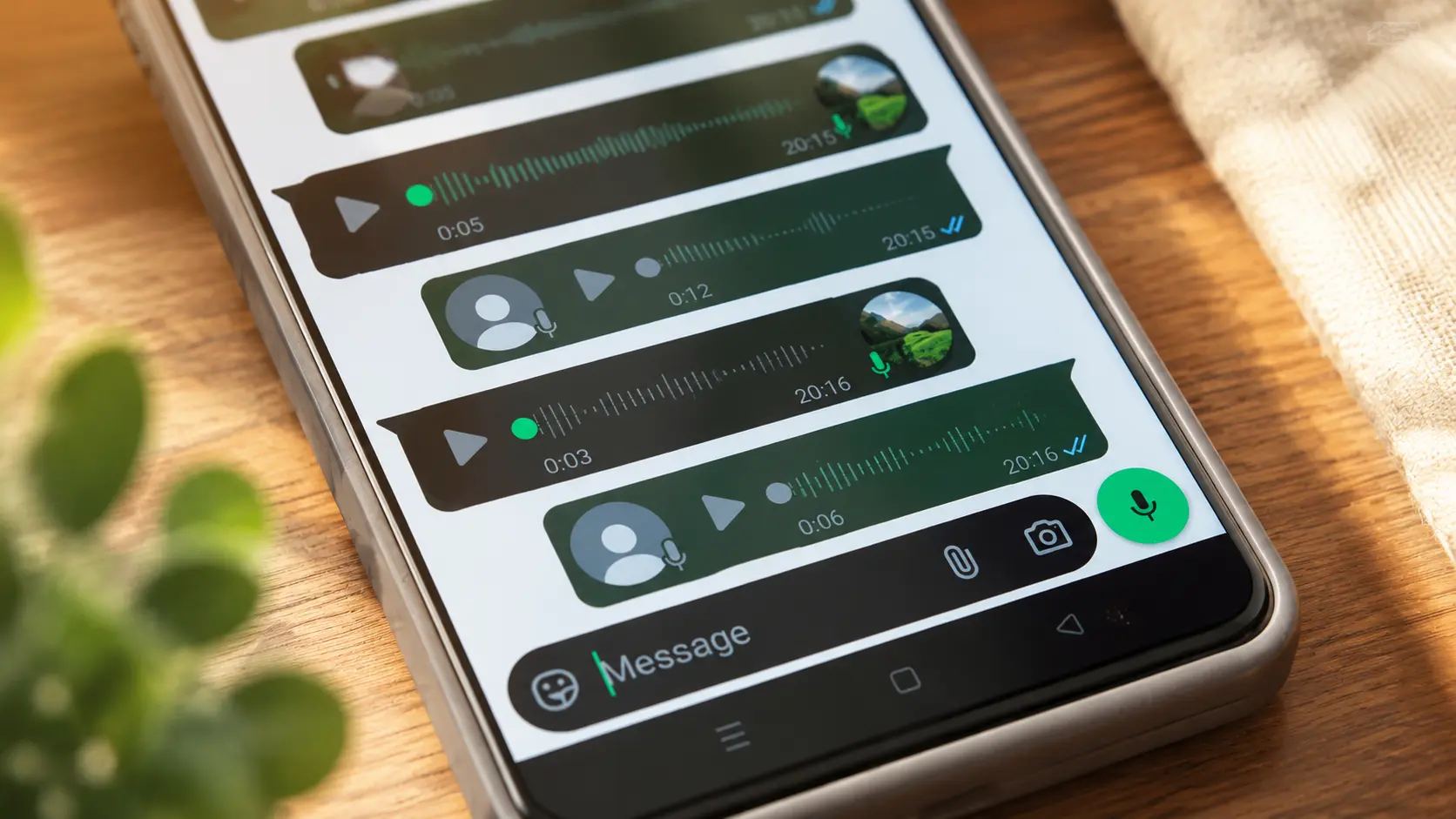
In today's era where everything is being created and generated by digital platforms and high-speed connections, we are too much dependent on instant communication loops, and somehow it is useful for us and somehow it is not. Technology was initially created to make our interactions faster and with better efficiency, but when we just ended up depending on automated transcripts, visual indicators, and continuous streaming for our everything, we don't know where we actually forgot the old, organic rhythms of human conversation and reflective silence, we don't know. This shift isn't just about convenience; it is a fundamental reconfiguration of our internal psychology. The rapid transition from text messages to multi-minute asynchronous voice notes on platforms like WhatsApp, iMessage, and WeChat has quietly birthed a new communication paradigm. Millions of users now routinely record, accelerate, and consume fragments of human speech as a primary means of connection. Yet, beneath the seamless utility of tapping a microphone icon lies a profound neurological disruption: we are externalizing our train of thought, and in doing so, we are altering the very nature of our internal consciousness.
The Asynchronous Audio Shift and the Efficiency it Provides
With digital audio messaging, keeping in touch has become easier and more efficient to broadcast the narratives of our daily day-to-day life, and also in our professional engagements, in business, and remote collaborations as well. Asynchronous communication tools are evolving beyond simple transactional text exchanges into complex personal audio archives. These audio logs allow individuals to capture emotional nuance, vocal inflections, and narrative depth without the logistical constraints or cognitive friction of a real-time phone call.
These voice features help you get emotional intimacy while managing your chaotic daily schedule and packed personal routines, making decisions on the fly for your creative projects or career. These tools work upon what is trending in the fast-paced modern lifestyle, allowing users to consume human voices at 1.5x or 2x acceleration. This hyper-efficient mode of listening lets you slice through conversational filler, letting individuals manage their relationships with the same optimized velocity they apply to processing email queues or checking software dashboards. The voice note serves as a bridge for a generation that finds text too detached but views an unscheduled phone call as an intrusive, high-anxiety emergency.
"Speak continuously and consume acceleratedly."
Consider the massive scale of this behavior. Global digital infrastructure reports indicate that billions of voice notes are sent daily across major messaging ecosystems. The immediate benefit is undeniable: it liberates the speaker from the rigid mechanics of the keyboard, letting thoughts flow as an uninterrupted stream of consciousness. For the recipient, it offers a deeply personal artifact that can be consumed at their convenience, preserving the precise emotional texture of the sender's voice—a dimension completely flattened by standard text emojis.
Cons of Relying on Asynchronous Audio Loops
However, an accelerated voice note is still a one-way broadcast, not a human-based mutual exchange which can think dynamically like an active listener and make collaborative compromises after calculating endless conversational possibilities in every real-time scenario. Recent studies in cognitive linguistics have revealed that while major messaging habits do provide rapid transfer of information, they do so by placing a heavier and lengthier cognitive load on the recipient. When a conversation is one-sided, a vast difference in interpersonal synchronization is observed.
65% — Average drop in real-time conversational retention when dialogue is replaced by unedited, long-form voice memos.
3.5 Hours — Estimated weekly time spent managing fragmented audio queues for hyper-connected smartphone users.
Data suggests that a significant number of continuous voice notes lead to communication friction because the speaker lacks an immediate feedback mechanism. Without visual nods or verbal affirmations, the speaker frequently over-explains, leading to unstructured, meandering monologues. Studies show a clear metric: nearly 2 out of every 5 long-form voice notes fail to convey their central point efficiently, leaving room for errors in social coordination and professional scheduling which, if not destructive in casual friendships, can cause heavy financial and operational losses in business settings.
Receiving these unstructured audio files and keeping track of multiple threads quickly becomes an endless loop of scrubbing through minutes of playback, attempting to extract key dates or instructions, and manually taking notes. This transforms basic communication into a tiresome chore of the day that requires excessive mental energy and focused attention, ultimately giving people major analytical fatigue and cognitive headaches in the future. The pressure to listen to a wall of unindexed audio creates a unique form of modern digital dread.
Advertisement
The Loss of Conversational Discipline and Active Listening

The core issue is that when we completely replace real-time dialogue with asynchronous audio, we lose the historical art of structural conversation and mental discipline. Real-time conversation requires us to pause, process, adapt, and hold space for another person's immediate reaction. It forces an internal filtration system where we calculate what is appropriate to say before we vocalize it. Asynchronous voice notes shatter this boundary by encouraging an unedited, raw dump of consciousness directly into another person's mental space.
Unlike classic phone conversations or face-to-face meetings, voice note messaging focuses heavily on the comfort of the speaker, not the mutual relationship. People traditionally used immediate verbal feedback loops to learn conversational pacing, patience, and empathetic resonance. By leaning heavily on unilateral audio recordings, our brains gradually become unaccustomed to the natural friction of real-time contradiction or spontaneous collaborative thinking. The simple, rhythmic balance of human interaction starts to be replaced by a collection of isolated, self-centered audio monologues.
"When communication becomes a series of uninterrupted broadcasts, we don't just lose touch with each other—we lose the capacity for patient, internal quietude."
Now, it may sound like voice notes are simply a spoken version of traditional text messaging, but no—it is the subtle psychological feedback mechanism of vocalization that changes the dynamic. Behavioral research dictates that when you speak and externalize your unformed thoughts continuously without real-time boundaries, your internal voice begins to mirror that exact unstructured pattern. The mind becomes hyper-reliant on verbalizing thoughts to organize them, rather than organizing thoughts internally before speaking. This erodes the core principle of internal mental structure and cognitive restraint, which is the foundational pillar of deep focus, memory synthesis, and personal self-regulation.
How Hyper-Accelerated Audio Alters the Inner Dialogue
Furthermore, the widespread habit of listening to voice notes at 1.5x or 2x speed is having an alarming impact on our cognitive processing. When we systematically accelerate human speech, our brain adapts to an unnatural speed of information delivery. The normal pauses, sighs, and structural cadences of human thought are purged for maximum efficiency. Over time, this conditions the auditory cortex to expect communication at a frantic, compressed pace.
The danger is that this hyper-paced consumption doesn't stop when the app is closed. Neuroplastic adaptation implies that the brain's internal processing speed aligns with its dominant environmental inputs. If you spend hours every day listening to your friends and colleagues talk at double speed, your internal monologue begins to accelerate as well. The quiet, reflective voice inside your head—the one responsible for deep contemplation, critical self-examination, and emotional regulation—becomes hurried, fragmented, and impatient. We become intolerant of natural pauses in our environment, stripping away the necessary mental blank spaces required for genuine creative breakthroughs.
Ultimately, we must ask ourselves what we are sacrificing on the altar of communication efficiency. Are we optimizing our relationships at the expense of our internal peace? When we bypass the healthy tension of live dialogue, we slip into a lifestyle where we prefer controlled monologue over vulnerable exchange. The voice inside our head should be a sanctuary of structured, deliberate thought—not a chaotic, accelerated voice note queue waiting for a response.
Read Further
[1] Tharumalingam et al. Balancing Speed and Experience — The Cognitive and Affective Impacts of Playback Acceleration in Digital Media Consumption — National Library of Medicine (PMC) — Click here
[2] Speech Speed in Audiovisual Resources in the Learning Process of University Students — A Scoping Review — National Library of Medicine (PMC) — Click here
Disclaimer: All the data and behavioral insights provided above were compiled from current internet resources, digital communication analyses, and cognitive psychology studies focusing on the social impacts of mobile technology. This analysis is presented as an educational and cultural exploration of modern communication habits and should not be interpreted as a technical psychiatric diagnosis or clinical corporate advice.
Advertisement