

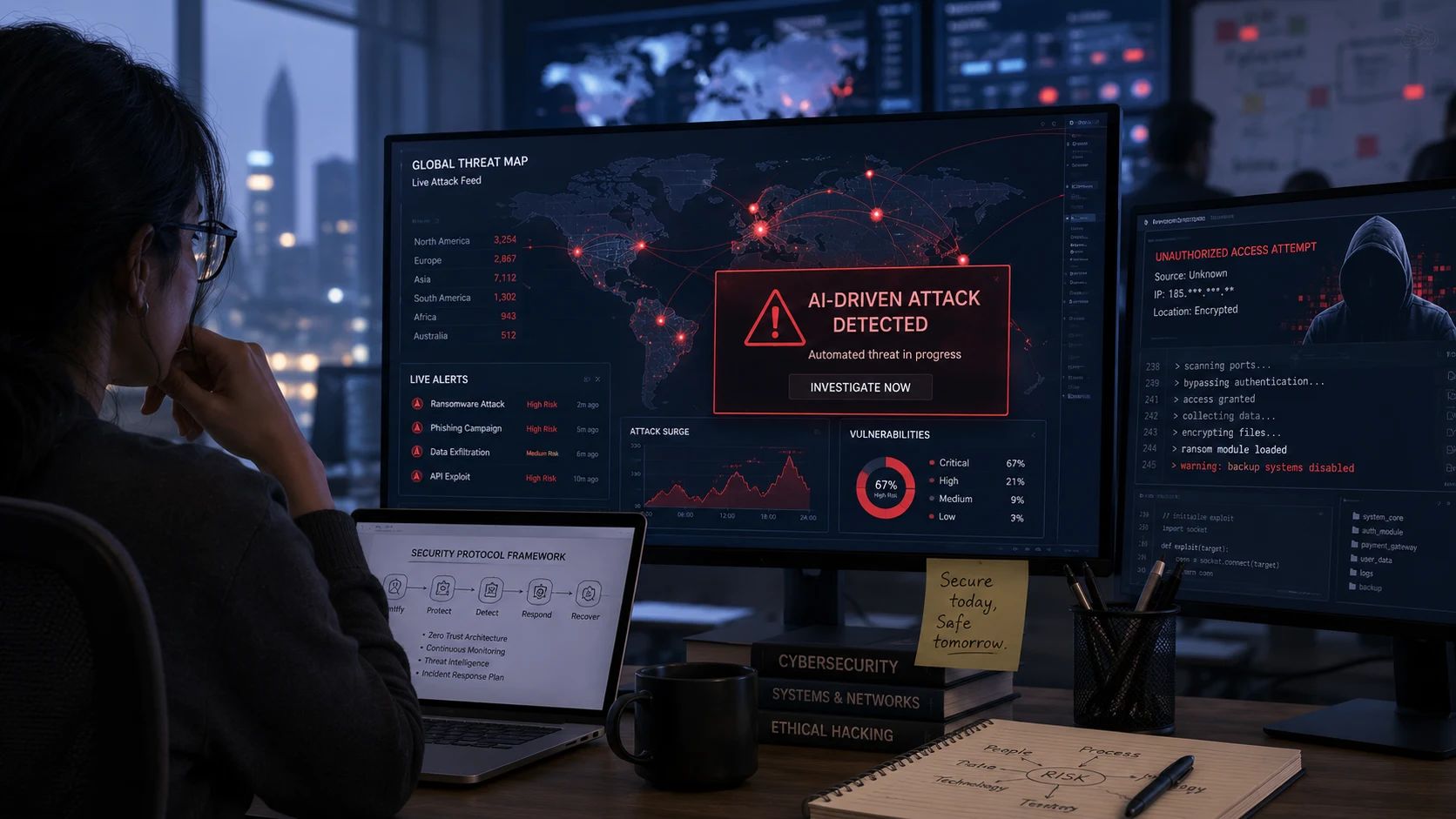
In the age of AI doing all the building, crunching, and managing, we are more reliant on automated infrastructure than ever before. That transition is incredibly conducive to speeding up your defensive posture, and it's somehow creating massive blind spots we are just not paying attention to. Initially, AI was meant to enable more speedy and more efficient human work. But when we rely completely on autonomous security tools, black-box algorithms, and automated orchestration layers for everything, we lose sight of where we left behind the age-old, disciplined practices of architectural hygiene and defensive awareness.
This all-encompassing dossier has one goal in mind: to leave you with a profound understanding of the dual-use nature confronting contemporary 2026 networks. With malicious systems now morphing into fully autonomous cyberweapons, the gap between traditional manual validation and machine-speed exploitation has never been wider. We need to think about what organizations must do with advanced artificial tools, and how we need to reconcile those with enduring, fundamental principles of system security.
Autonomous AI-Driven Attacks and Force Multiplication
As agentic AI systems became commercial through 2025 and into 2026, a new type of cyberattack became a reality: attacks that rely on unsupervised AI to conduct offensive operations autonomously. Traditional automated attacks had used hardcoded scripts that broke when dealing with unexpected defense configurations. In contrast, today's agentic systems act as autonomous threat actors — performing real-time analysis of target environments, discovering vulnerabilities, moving laterally at machine speeds, and even modifying and recompiling themselves on the fly to bypass defenses. In what seemed like a dystopian vision of the near future, the late-2025/early-2026 release of commercial agentic AI systems gave rise to a more dangerous class of threat: fully autonomous, self-directing attack agents.
This progress enables attackers to perform complex, multi-stage ransomware operations with minimal human interaction. Once upon a time, an attacker might have manually scanned a small range of IP addresses for vulnerabilities — but that's increasingly not what attackers are doing today. They are using autonomous AI agents to comb through vast subnets, exploit configuration errors, leverage zero-day bugs, and exfiltrate data. Recent industry research found that more than 53% of enterprise security leaders identify AI-powered attacks as their single hardest challenge this year. Because these attacks move at such speed, they make legacy human-in-the-loop detection approaches almost useless.
"Deploy consciously and protect intentionally."
Phishing, too, has grown far more sophisticated and personalized. Attackers use large language models to read publicly available company profiles, real-time market trends, and leaked communication logs to craft hyper-personalized messages. Agentic phishing — a subset of this broader agentic technique — is projected to be a factor in more than 42% of global security breaches in 2026. These tools can hold millions of contextual conversations in parallel across multiple platforms, including email, messaging apps, and enterprise collaboration tools, working straight through typical endpoint filtering solutions.
Cons of Over-Reliance on AI Tools for Defense
Artificial Intelligence — and we have to be clear about this — is still artificial. It lacks the capacity of a human mind to run through billions of simulations and what-ifs the way a person can when reasoning through something like a regional blackout across a complex grid. Large enterprise AI security solutions promise automated firewall state and code management, but testing has observed accuracy hovering around just 65% for these tools — which in practice means roughly 2 out of every 5 orchestration attempts go wrong structurally.
This leaves a lot of room for error in system configuration. Although a small misconfiguration in a home network might result in only a mild headache, the very same error in a corporate environment could lead to real-time operational downtime, regulatory compliance failures, or the leaking of catastrophic amounts of data. Constantly tweaking these systems can easily devolve into an endless loop of finding bugs and releasing manual patches — a daily grind that consumes more time and mental energy than conventional manual setups, leaving engineers fatigued and increasingly resistant to ongoing system administration.
| Threat Vector Category | Initial Global Damage Estimate (2026) | Suggested Primary Defensive Action |
|---|---|---|
| Ransomware & Multi-Stage Extortion | $74 Billion | Immutable Offsite Backups & Network Segmentation |
| AI-Driven Phishing & Identity Abuse | 42% of Global Breaches | Continuous Biometric Verification and Behavioral Filters |
| Supply Chain & Third-Party Risk | Incidents Have Quadrupled Since 2021 | Continuous Software Bill of Materials (SBOM) Auditing |
| Web Application & API Exploitation | ~83% of Web Traffic | Comprehensive Web Application & API Defense (WAAP) |
Advertisement
The Sprawling API Matrix and WAAP Protection Needs
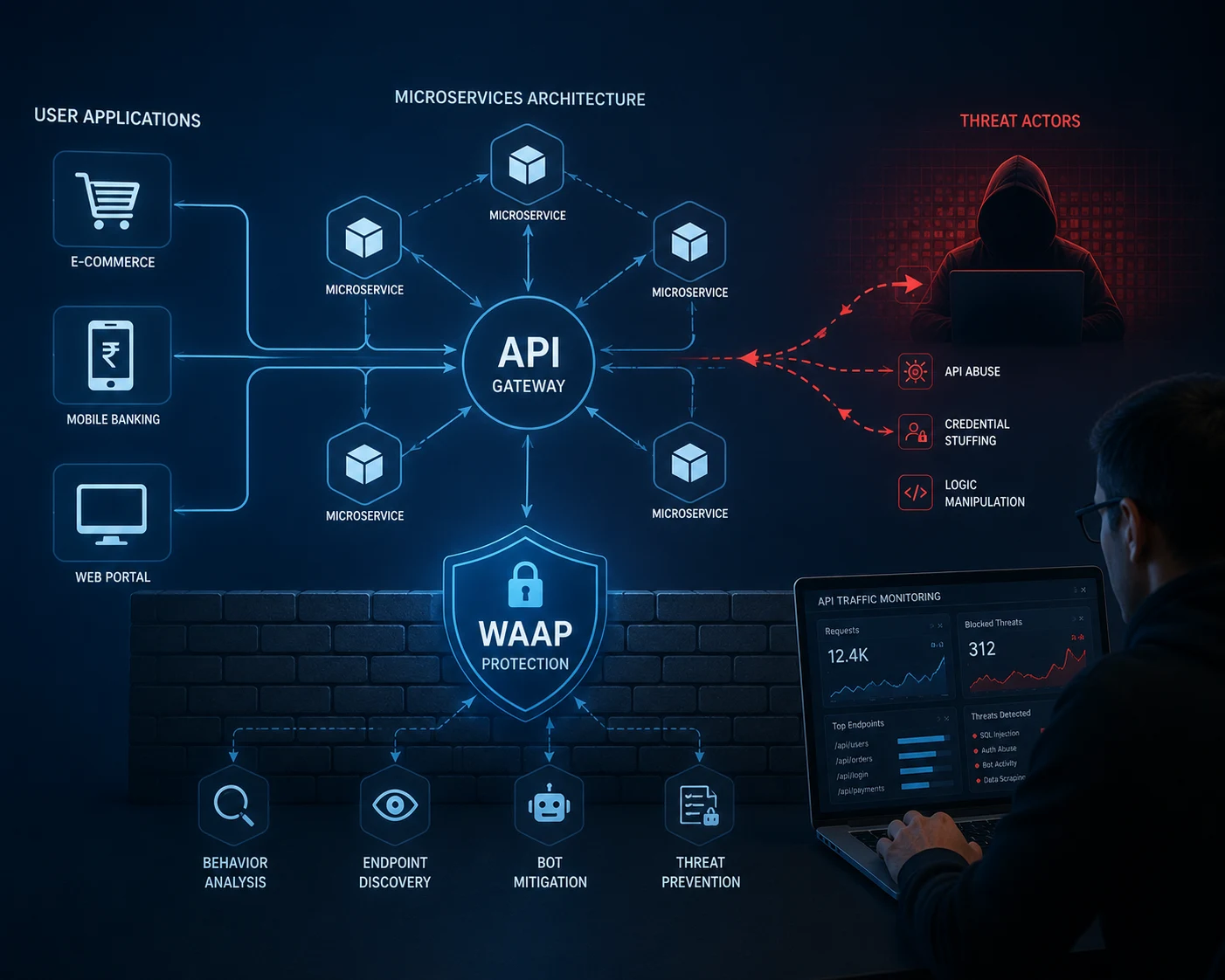
Modern cloud architecture lets microservices talk to microservices through a complex web of APIs. In 2026, APIs are the core communication backbone of digital retail, digital finance, and digital corporate platforms, attracting the attention of threat actors. Web Application and API Protection (WAAP) has transformed from a simple security option into a required control framework. Old Web Application Firewalls (WAFs) are not designed to manage the rapidly changing, contextual abuse patterns directed at modern microservice connections.
Credential abuse and logic manipulation within API calls are also heavily targeted by attackers, who take advantage of parameters without needing strong authentication privileges. This architectural gap enables bad actors to move through open API protocols while masquerading as legitimate application requests. Meanwhile, as organizations increasingly link to third-party services, corporate networks are becoming mazes of invisible integrations — and traditional edge protections don't hold up well against that. Full-scope WAAP solutions need to leverage sophisticated behavioral analysis, ongoing endpoint discovery, and automated bot mitigation to guard these emerging data routes effectively.
Identity and Biometric Deception in a Deepfake Era
Identity security has replaced traditional perimeter defense as the main battlefield in 2026. The pace of generative video and voice synthesis has greatly accelerated, weakening simple multi-factor authentication (MFA) schemes. Sophisticated deepfake impersonation and biometric spoofing are used by threat actors to convince enterprise employees and call centers to grant access to critical infrastructure. Regular human validation checks are trivial to circumvent when an attacker can arbitrarily generate a high-fidelity synthetic voice or a live video feed of a company executive.
Adding to this is the proliferation of machine identities, which already outnumber human accounts by a large margin across global enterprise environments. These non-human entities — bots, service accounts, cloud integration tokens — are regularly overlooked and, worst of all, often left unmonitored. When one machine token is compromised, it can be used by an automated process to trigger a cascade of data replication and system changes, which is why identity governance is now just as important for survival as basic network or cloud platform defense.
Top Reference Tools and Frameworks for 2026 Cyber Defense
For organizations that want to establish a flexible, forward-looking defensive posture, the following frameworks and open-source resources provide critical building blocks:
- CISA Cross-Sector Cybersecurity Performance Goals (CPG): https://www.cisa.gov/cybersecurity-performance-goals
- NIST Cybersecurity Framework 2.0: https://www.nist.gov/cyberframework
- OWASP Top 10 API Security Risks Guide: https://owasp.org/www-project-api-security/
- MITRE ATT&CK Matrix for Enterprise Systems: https://attack.mitre.org/
- FinRobot Automated Financial Security GitHub: https://github.com/AI4Finance-Foundation/FinRobot
- Cloud Security Alliance (CSA) Guidance Portal: https://cloudsecurityalliance.org/
- IBM X-Force Threat Intelligence Insights: https://www.ibm.com/x-force
Summary and Philosophical Conclusion
It might at first appear that modern security tools can automatically take care of every threat, but the real value of data protection is based on fundamental human awareness and ongoing discipline. When information security practitioners manually review, organize, and validate their defense perimeters — rather than entrusting everything to an isolated, unregulated autonomous tool — the minds of those who run the operation remain actively attuned to systemic risk. This consciously cultivated awareness generates a corporate culture of second-guessing anomalies before they lead to a catastrophic breach, which is the very foundation for enduring operational resilience and asset security.
Read Further
- Key Cyber Security Statistics for 2026 — SentinelOne
- API Security Statistics 2026: 55+ Key Facts & Data — AppSec Santa
Disclaimer: All the data and statistical projections provided above were compiled from global internet resources, industry research reports, and cybersecurity studies on evolving digital infrastructure systems. This should not be taken as an absolute quote from our official website or as direct legal/financial advice.
Advertisement