


Autonomous AI Cyberattacks and the Chaos They Provide
In the era of AI creating everything now, we are too reliant on it and it's useful for us in some ways and not so much in other ways. Well, it's useful when it is useful, and when it's not? This two-sided weapon has now been brought to bear on the dark underbelly of the web, where robotized cyberattacks have moved from a potential futuristic risk into a daily operational horror for company holders. AI was created to make our work faster and with better efficiency but when you have the likes of malicious agents just turned AI chatbots and autonomous AI features to be used in their attacks, we just don't know where we actually lost, forgot, and old methods of basic cyber cleanse and manual discipline, we just don't know.
In the first half of 2026, artificial intelligence has undoubtedly made its final leap from experimental playground to a full-fledged cyber warfare domain. Threat actors have almost entirely left behind basic text prompts and simple automation and ventured into defence-evasion advanced, multi-stage agentic operations. These are no longer simple human-authored scripts; these are adaptive algorithms that can scan enterprise networks, discover zero-day vulnerabilities, modify their source code to evade detection, and perform high-speed data exfiltration without a single bit of human input in the entire process. One massive global corporation will be brought down as a result of a breach that is either enabled or materially advanced by a fully autonomous agent-based system by mid-2026. The rapidity of attack has reduced the threat lifecycle to less than eight minutes.
A detrimental "Under-Eight-Minute AWS Takeover" was recorded by security researchers earlier this year — initiated through a minor, common misconfiguration in a public S3 bucket. Under normal circumstances, a human security analyst might have hours or days to notice the irregularity and fix the hole.
The threat actors used specialized LLMs configured as agents. These agents did live cloud resource reconnaissance, wrote custom privilege escalation scripts on the fly, and even injected stealthy backdoors into AWS Lambda functions. Everything, from gaining access to full administrative control, was achieved before the machine-generated security alerts could even land on a human's dashboard. Once inside the environment, the agents proceeded to "LLMjacking" in a big way, abusing Amazon Bedrock APIs to create high-performance GPU instances for illicit cryptocurrency mining, which ran up costs in the millions for the company in just a few hours.
Cons of Relying Solely on Automated Security Systems
AI after all is still artificial intelligence and not a real human mind that can think like humans with endless possibilities and calculations for every scenario to make decisions. A lot of modern corporations have rushed to implement defensive AI systems, convinced that the only way to combat machine speed is with another machine. But these endless loop prompts and continuous rechecking of every single record will become a painful reminder of how much you're getting wrong with each few records, and you'll be exhausted by the day, as this will be one chore too many stealing more time and headspace and giving you the constant threat of headaches and migraines down the road. Empirical data shows that the reliance on fully automated software leads to an illusion of perfect protection while creating large operational blindspots.
Recently published 2026 studies prove that the whole major AI tools do offer threat management but only with heavier and longer prompts, where you must spell out every little scenario. A significant 65% accuracy threshold is detected under dense multi-vector attacks — equal to getting it wrong in every 2nd out of 5th tries in AI defense. This creates a large margin of error in cybersecurity budgeting and threat tracking which, if not in a small home office operation but in big business, can break you in both your bank and in the eyes of the law.
Cybersecurity Metrics: Conventional vs. AI-Driven Attack Vectors (2026 Ready = 5)
| Cybersecurity Metric | Conventional Systems / Static Tools | AI-Driven Attack Vectors |
|---|---|---|
| Median Time from Access to Exfiltration | Hours to Days (Manual) | 48 Minutes (Agentic Attack Chain) |
| Phishing Email Click-Through Rate | 12% (Crafted by Humans) | 54% (AI-Tailored GenAI) |
| Global AI Cybersecurity Market Value | $30.68 Billion (2025) | $39.22 Billion (Estimated 2026) |
| AI Attacks on Organizations Reported | 45% (2024 Context) | 87% of the World (2026) |
| Prevalent Forms of AI-Powered Incidents | Standard Malware (30%) | 37% GenAI Phishing / 35% Deepfakes |
Additionally, static security products such as Static Application Security Testing (SAST) and Software Composition Analysis (SCA) are still confined to blind code analysis. Since AI attacks regularly circumvent static tools by leveraging dynamic automation, live APIs and real-time runtime execution, they are difficult to detect and effectively evade detection. According to Palo Alto Networks' findings on cloud security, a staggering 99% of respondents were security professionals who said there had been targeted attacks on their internal AI configurations. Generative AI increases an enterprise's attack surface faster than developers can secure it, demonstrating that AI-driven cyber warfare is not just a potential future threat, but a buzzkill of a day-to-day challenge.
This same pattern of agentic AI autonomously detaching institutions from meaningful human oversight plays out in corporate finance too — explored in detail in Inside India’s Data Center Boom and the AI Infrastructure Race
The Traditional Cyber Hygiene Method: Zero Trust and Human Oversight
Advertisement
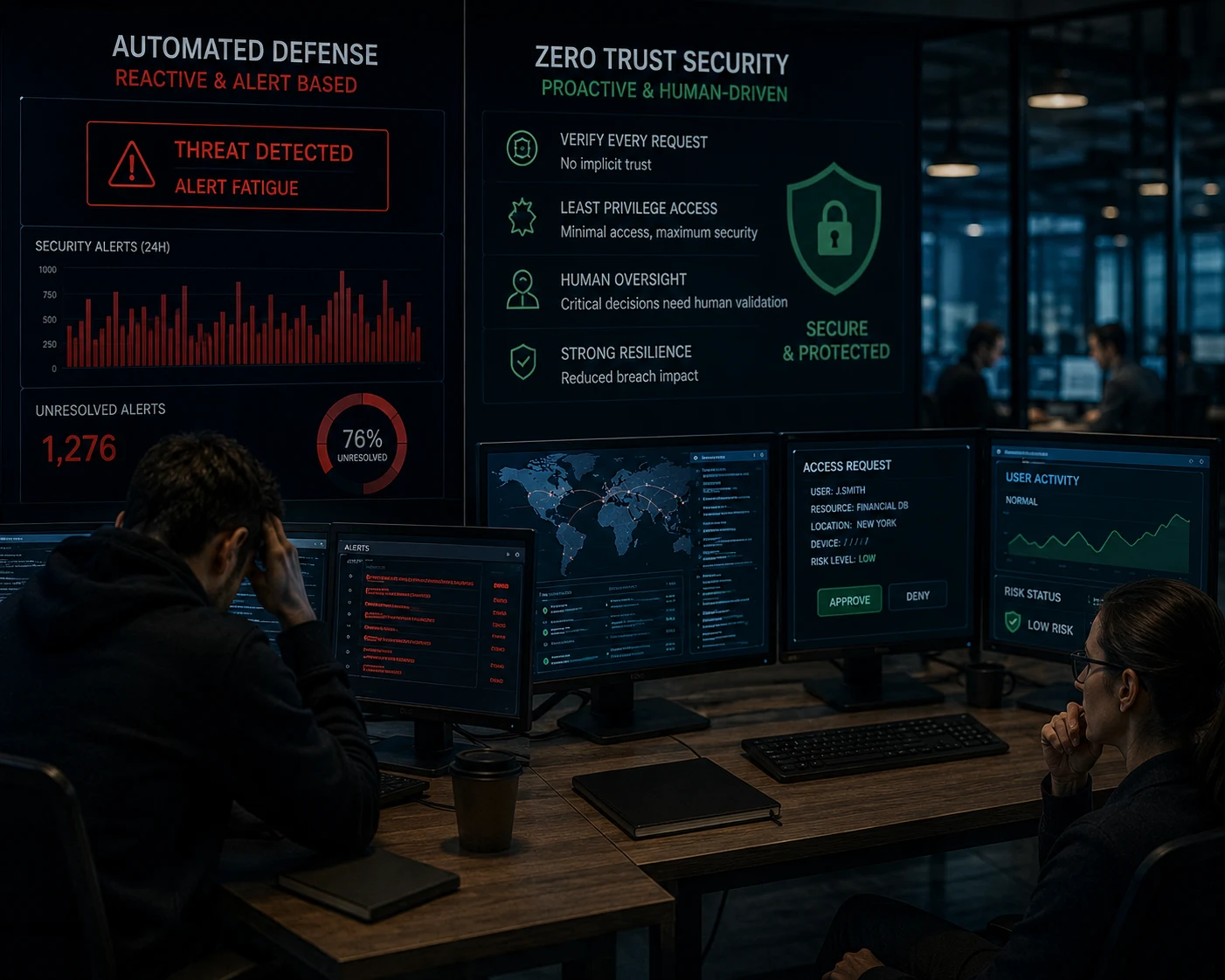
Now this may sound like a technology-laden rewrite of old IT policies but no, it is the magic of rigorous architectural discipline and human review — the understanding that you do not need automation to manually compute over your infrastructure risks; your brain will light up to what it has been told: what to do and what not to do, whether it is right or wrong to trust a user or an API token. This ultimately develops into an ironclad habit to think twice before giving someone system privileges or hooking up an outside service, which is the heart of what it takes to be successful in risk management and data salvage. Just as old-school models still focus on purposeful monitoring, the modern security landscape is shifting from a reactive orientation to an active, organized defense.
Broken Western Automation vs. Structured Zero Trust
| Broken Western Automation | Structured Zero Trust | |
|---|---|---|
| Defense Posture | Reactive: Waiting for AI triggers to fire alerts. | Intentional: Explicit permission required for every transaction. |
| Alert Architecture | Alert-Dependent: Suffers from massive alert fatigue. | Structure-Dependent: Strict architecture prevents lateral movement. |
| Accuracy Threshold | 65% Pass Threshold: Frontier models too often crack under complicated SOC situations. | Human-in-the-Loop: Critical risk validation checked by expert minds. |
| Resilience | 76% Abandonment: Organizations unable to keep pace with attack speeds. | Proven Resilience: Reduces data breach costs by $1.8 Million. |
94% of technology leaders agree that AI is the biggest driver in evolving the cybersecurity landscape, per the World Economic Forum (WEF) Global Cybersecurity Outlook 2026. Still, 87% perceive AI-based internal vulnerabilities — such as data leakage through employee use of unsanctioned LLMs — as their most growing risk. When employees paste sensitive source code or financial projections into external generative models, they aren't just making a risky move. They're circumventing every layer of defense you have. There is no governance means AI usage must be aggressively secured before it is scaled any further.
Practical Frameworks for 2026 and Beyond
To traverse this dangerous terrain, companies need a clear list of defensive instruments, platform frameworks, and monitoring tools that help protect their pipelines, APIs, and workforce infrastructure. Here are the critical tools for your cybersecurity defense journey:
1. Simbian AI Cyber Defence Product Line — simbian.ai Provides unified autonomous-agent security harnesses for real-world Security Operations Center (SOC) scenario testing.
2. OX Security ASPM — ox.security Brings active Application Security Posture Management with real-time AI attack modeling and pipeline correlation.
3. Palo Alto Networks Cortex XSIAM — paloaltonetworks.com Orchestrates AI-powered SOAR to shorten attack resolution timelines into minutes.
4. IBM Security QRadar Suite — ibm.com/security Uses advanced anomaly detection algorithms to reduce the financial impact of data breaches.
5. KnowBe4 Phishing Defense Framework — knowbe4.com Trains the human element against AI's high-fidelity generated social engineering and deepfake scams.
6. FinRobot Open-Source Cyber-Finance Registry — github.com/AI4Finance-Foundation/FinRobot An open-source repository for monitoring algorithmic compliance and automated threat behavior in transactions.
The adoption of these solutions will need an immediate shift to 2026-compliance, with full application of the EU AI Act's high-risk system requirements coming into force this year, as well as corresponding sector-based governance requirements established by international regulators. Any black-box security defense model that blindly relies on end-to-end audit trails, context lakes, and MITRE ATT&CK coordinated validation will quickly become a compliance mess.
"Verify consciously and authenticate intentionally."
The takeaway of 2026, in the end, is that the human mind cannot relinquish its duty to automated agents. The fundamental key to long-term operational success is high-speed defensive algorithms under constant human oversight. With full visibility on every asset, restricting lateral movement in pipelines, and human audit of every automated action, today's companies are the best positioned to safeguard their fortune and preserve systemic stability in an age when the machines have really learned to attack.
For a broader picture of how AI is quietly reshaping institutional financial systems alongside these security dynamics, see AI Is Quietly Taking Over Your Bank.
Read Further
-
World Economic Forum. Global Cybersecurity Outlook 2026 — AI, Geopolitical Fragmentation, and Cyber Resilience. January 2026. — weforum.org/publications/global-cybersecurity-outlook-2026
-
IBM Security & Ponemon Institute. Cost of a Data Breach Report 2025 — Zero Trust, AI, and Breach Cost Reduction. — ibm.com/reports/data-breach
Disclaimer: All the data, metrics, and case studies provided above were sourced from active 2025–2026 internet public resources, threat intelligence archives, and industrial studies conducted upon global budgeting and digital security infrastructures. This document is intended for information processing and executive literacy purposes and should not be taken as an absolute engineering blueprint or legally binding corporate counsel.
Advertisement