

Looking at big companies today, it really feels like their stock prices are often way out of sync with how much actual cash they're bringing in right now. And when you look at the giant tech companies, their whole financial setup has become this incredibly tangled web. For a long time, most people just saw Elon Musk's companies as separate things doing their own thing. Tesla was the electric car company, SpaceX was the rocket company, and xAI was the AI brainiac. That's how the market seemed to view them, anyway. But then, something happened in the middle of 2026 — a real game-changer that completely blew up that idea of them being in separate boxes, and sent a shockwave through the financial world.
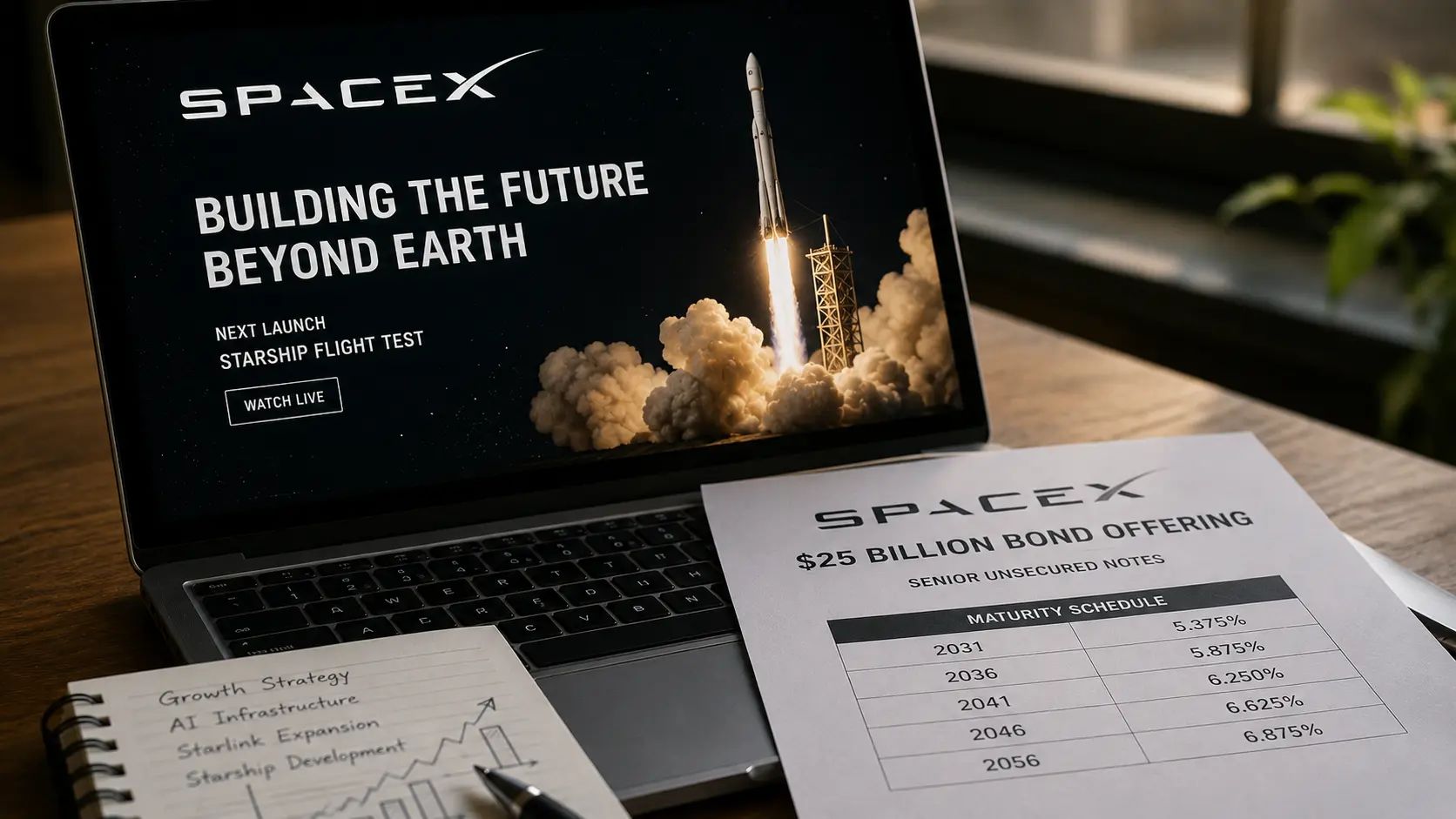
Just a couple of weeks after SpaceX pulled off the biggest IPO ever, listing on the Nasdaq as SPCX and hitting a valuation that topped $1.75 trillion, raking in almost $86 billion — they turned around and went straight into the investment-grade debt market. Nobody saw that coming. What started as a tentative $20 billion bond sale suddenly exploded into a massive, historic event: a $25 billion sale of senior unsecured debt across different maturities. Here's a company that, after its IPO, had over $100 billion in cash sitting there. And yet, they decided to go to the bond market and take on long-term debt, committing to pay it back all the way out to 2056. What's really going on here? Why would a company with so much cash suddenly want to take on such huge, long-term debts? This situation raises serious questions about corporate strategy, the tension between equity and bond markets, and what fundamental lessons about managing money — whether you're a big corporation or just managing your own finances — we can all take from this.
Autonomous AI Extensions and the Realities of Corporate Consolidation
Thinking about what happened with that huge debt, it really comes down to some pretty big changes over at Musk's operations in early 2026. Back in February, SpaceX outright brought xAI, the AI startup, and X, the social media and computing network formerly known as Twitter, under their wing. Suddenly, SpaceX wasn't just about launching rockets and satellite internet anymore. It morphed into a massive AI infrastructure operation. Building that kind of infrastructure is incredibly expensive — setting up huge data centres, acquiring the latest chips (H100s and B200s that need serious cooling), and even building local power grids just to keep up with the computing demands for training AI models.
To fund the xAI acquisition, SpaceX swung a massive $20 billion bridge loan, put together by Bank of America, Citi, JPMorgan, Goldman Sachs, and Morgan Stanley. A bridge loan is a quick way to get cash when you need it immediately, without issuing more stock — especially with that big IPO coming up in June. But bridge loans are temporary and come with steep interest rates. Being left with a $20 billion debt hanging around its neck, especially as the economy got a bit shaky later in 2026, represented a huge risk for a newly public company. It really paints a picture of what investors were actually buying into: not just a successful rocket company that decided to dabble in AI, but an enormous AI infrastructure business that also happens to run the best launch service ever built — and carrying significant debt it plans to pay off over decades.
That's where the $25 billion bond sale comes in. This happened on June 22, 2026, and was mostly about refinancing that expensive, short-term loan. The stock market was excited about the $100.8 billion cash cushion SpaceX showed off at IPO. But people watching the bond and credit markets were looking more closely at how quickly that money was being spent. In the last financial quarter of 2026, SpaceX's spending on new equipment and facilities more than doubled compared to the same period the year before — pouring money into orbital computing networks, making Starlink capable of handling massive AI data loads, and continuing Starship development. Even with $100 billion in the bank, it could disappear fast over a few years if operational revenue doesn't pick up significantly.
Cons of Using Extreme Leverage for Expansion
SpaceX managed to pull off this huge debt issuance, raking in over $90 billion in orders from institutional investors. On the surface, it looks like the bond market absorbed it cleanly. But dig a little deeper, and you see real caution. They put out five different tranches of senior unsecured notes with maturities ranging from 2031 all the way to 2056.
The interest rates they agreed to are telling. For the shortest loans, due in approximately five years, they're paying 5.35%. For the really long-term 30-year debt, they're looking at a hefty 6.65%. Moody's and Fitch rated SpaceX as Baa1 and BBB+ respectively — considered investment grade. Yet when you compare those rates to US Treasuries, these yields for SpaceX are quite a bit higher, signalling a level of nervousness about the company's long-term financial health that the equity market had not fully priced in.
Adding this much debt into a company's financial structure creates several ripple effects:
Fixed interest obligations — Unlike dividends on stock, debt payments are non-negotiable. At an average rate of around 6% on $25 billion, that's approximately $1.5 billion per year that must be paid regardless of whether rockets fly perfectly or Starlink finds eager customers.
Operational vulnerability — If SpaceX's revenue projections for fiscal 2027 don't hit the ambitious target of $68.3 billion — and they fall short of the projected $36.9 billion in fiscal 2026 revenue due to launch failures or regulatory hurdles — their ability to cover those fixed debt payments shrinks fast, potentially triggering credit rating downgrades.
Business model mismatch — Aerospace is about building rockets and fulfilling long-term government contracts that span years. Generative AI is fundamentally different. The hardware depreciates incredibly quickly; millions of dollars worth of computing power can be outdated in as little as 18 months. This means constant cycles of new equipment purchases, often financed through short-term loans that then need to be refinanced.
This massive long-term debt effectively creates a never-ending cycle of financial monitoring — much like an automated system constantly throwing up errors that needs someone to step in and fix it manually. A highly leveraged company needs constant attention to manage its credit spreads and roll over debts as they come due. If the broader economic climate sees interest rates skyrocket, refinancing the loans coming due in the early 2030s could become an incredibly difficult and expensive task.
When you look at SpaceX through the lens of its stock (SPCX) versus its debt, you see two very different worldviews. The equity market is often captivated by grand future-oriented ideas — colonising Mars, orbital AI supremacy — heavily influenced by retail investors and the sheer force of Elon Musk's personality. They overlook immediate costs and cash burn as long as revenue is growing explosively. The bond market, by contrast, takes a much more pragmatic approach. They demand a clear return to compensate for the risk of lending over many years, focusing on legal terms, repayment periods, and creditor position. They noticed the projected loss of $0.89 per share for fiscal year 2026, and recognised that locking in interest payments through 2056 creates permanent obligations regardless of future performance.
Advertisement
The Traditional Disciplines of Financial Risk Management

Looking at these massive corporations, it's easy to forget the simple, bedrock principles of money management that apply to everyone. What happened with SpaceX and their bond offering hammered home a point that's been around forever: it's not just about how much you own or how confidently you predict the future — it's about whether your financial setup can actually last.
The most enduring financial systems often hinge on being deliberate and reflective. On a personal level, something like the Japanese Kakeibo method — where you literally write down every single expense — takes spending from reactive to considered. When you're actively logging money into categories like "Needs," "Wants," "Culture," and "Unexpected," you become genuinely aware, which forces you to think before you spend and actively decide where your savings should go. It's about building a structure for your money, not just letting it flow wherever.
In mid-2026, the credit markets were like a tough personal finance coach for these big companies. While stock market participants got caught up in the excitement of a Nasdaq listing, bond investors were focused on hard facts. They essentially told SpaceX: "If you're going to take on massive, ongoing costs like building out xAI and X, you can't just treat that spending as a temporary blip." The sheer capital needed to build out data centres isn't something you stick in the "Unexpected" column — it's a huge, long-term commitment requiring a deliberate financial plan stretching out for decades.
A snapshot of SpaceX's financial position, projected for fiscal year 2026:
- $100.8 billion in cash after the IPO
- $34.1 billion in long-term debt
- $36.9 billion in projected revenue for FY2026, rising to $68.3 billion in FY2027
- Projected net loss of $0.89 per share in FY2026, narrowing to $0.24 in FY2027
- $90 billion in bond orders against a $25 billion offering — massive institutional demand, but at a premium yield that priced in real execution risk
Bridging Macro Leverage and Individual Fiscal Habits
Watching SpaceX hit the market with that debt sale really brought something home. They took this incredibly efficient engine — leverage — and crammed it full throttle into the AI race. The result was a massive push forward, but it also blurred the edges of what's actually stable underneath. It's a pattern that mirrors our own financial lives more closely than we might like to admit.
We've got all these fancy apps now, promising to manage our money automatically, even offering instant credit lines powered by AI. It creates an illusion of being in a solid financial position. You look at your available credit, or the balance in your automated investment account, and it feels like you're sitting pretty. But often, we completely forget about the interest quietly racking up — a background hum of obligations that can really add up. It's like having a super-fast car but not noticing the fuel gauge is on empty.
The real key to getting a handle on your money is pretty simple: pause and think before you spend. When a company like SpaceX commits to paying 6.65% interest all the way out to 2056, they're essentially tying up their future earnings for three decades — all to fuel this immediate drive for AI dominance. For individuals, the parallel is direct. Taking on long-term debt with high interest rates, or blindly trusting budgeting apps without understanding what they're doing, can lead to a slower but equally significant loss of control. The moment managing money stops being something we actively reflect on and just becomes another automated process running in the background, the potential for things to go seriously wrong skyrockets.
To truly build financial freedom — whether you're a CEO making big corporate decisions or someone trying to manage a household budget — we need to get back to some fundamental discipline. That means resisting the siren song of endless credit and, instead, putting energy into building actual savings. It means cutting down on unnecessary fixed costs and making sure every financial choice is geared toward long-term security, not just chasing the temporary thrill of a rising market.
After all, the math doesn't lie. Spend consciously, save with intention. Whether you're trying to get a massive rocket into orbit or just figure out your grocery list for the month, the reality of debt tends to stick around a lot longer than the initial excitement of buying something new. The 2026 SpaceX debt sale has shown that the most effective way to manage finances isn't just about having the latest tools — it's about coupling those tools with a deep, unwavering understanding of the underlying structure of your financial commitments. For anyone watching the markets right now, especially with the way stocks and bonds are moving differently, it's a clear opportunity to see what leverage actually costs — not just in the big picture, but in the nitty-gritty details, one calculated step at a time.
Read Further
[1] CNBC. SpaceX raises $25 billion in debt sale less than two weeks after IPO — Click here
[2] SpaceX Investor Relations. SpaceX Announces Pricing of $25 Billion Inaugural Bond Issuance — Click here
Disclaimer: All data and financial projections provided in this article are derived from public market trackers, institutional research reports, and mid-2026 regulatory filings including SpaceX's S-1 and Form 8-K. This analysis is purely for informational and educational purposes and should under no circumstances be construed as formal investment or financial advice.
Advertisement