


Autonomous AI Chatbots and the Efficiency They Provide
It's wild how much AI is suddenly everywhere, isn't it? We're leaning on it so heavily these days, and honestly, it's a mixed bag — useful in some ways, but maybe not so much in others. Think about big corporations today; their whole game is built around making things run smoother and faster through automation. And right at the heart of this massive shift? That's where the machine learning engineer comes in. Looking back over the last year or so, up to the middle of 2026, the tech world has seen an incredible amount of money and people move around. Financial tools that work on their own, huge language models that can handle massive scale, and code repositories that act like intelligent agents — these are no longer just flashy new gadgets. They're becoming the fundamental building blocks of how things work. They can dig into the tiny details of markets, predict how much companies will spend, keep things compliant automatically, and even decide how to invest money, all with barely any human nudging.
If you just look at the numbers on a balance sheet, the gains from these automated systems are mind-blowing. Big companies that have brought in these advanced, multi-agent systems are reporting that their basic operating costs have dropped by as much as 40%. Imagine being able to have an intelligent agent sift through, understand, and even redesign millions of lines of old code or vast amounts of financial data overnight. That's shifted the bottleneck in developing new tech. It's not about having tons of people crunching numbers anymore; it's about figuring out the best overall system design. Because these tools can track what's happening in the market in real-time and figure out the best global strategies, company boards are starting to see human employees as a flexible cost, something that can be adjusted, while treating the cutting-edge AI research models as their most valuable, permanent asset.
But here's the kicker: this deep reliance on automated thinking has created a bit of a paradox. These automated tools are only as smart as the very specific, highly skilled human researchers who are teaching them. The market has figured out that while an AI can keep repeating and scaling a pattern it already knows, it can't actually come up with the next big, brand-new idea. It can't imagine a completely different kind of system beyond what we have now, or figure out how to get past the limitations that are starting to squeeze the performance of the typical text models we use. So, what's happened? The value of the human minds behind this work has skyrocketed. We're not just talking about the usual high salaries you hear about in Silicon Valley anymore. We're seeing a whole economic shift where individual researchers are being valued as much as medium-sized companies, getting compensation packages that completely shake up traditional corporate pay structures and challenge how even the biggest global companies manage their finances.
It really boils down to this core irony in how businesses automate today: the more powerful the self-running system gets, the rarer and more unpredictable the pool of human talent needed to keep it ahead of the curve becomes. We're basically trading in thousands of general software engineers for a small group of brilliant minds who can truly grasp the underlying math and architecture.
For a closer look at how this same tension is playing out in corporate debt and financial systems, see AI Stocks Correction: Should Indian Investors Be Worried?
Cons of Using AI Tools for Budgeting and Organizational Scaling
You know, when we talk about AI, it's still very much artificial. It doesn't quite have that human spark, that ability to weigh up a million different angles before making a call like we do. We've seen this play out, especially in the world of corporate finance and how businesses manage their tech. When companies lean too heavily on these automated systems, big, fundamental weaknesses start to show up.
Some recent studies, looking at how major companies use these advanced AI tools for things like managing money or planning for growth, found something interesting. Yes, they can help, but you have to be incredibly specific with your instructions. It's like giving directions to someone who's never been to your house before — you have to spell out every turn, every landmark. If you get even a small detail wrong in how you set things up, the accuracy can drop dramatically. We're talking about getting things wrong more than a quarter of the time, which is a pretty significant hit. For everyday tasks, maybe that's not a huge deal, but when you're talking about a large business and its capital, a mistake like that could be really damaging.
And let's be clear, using these advanced AI models doesn't magically make things easier; it just changes the kind of work involved. Instead of one set of problems, you get another. You end up spending a lot of time feeding in instructions and then constantly checking the results, fixing the errors that keep popping up. It becomes this repetitive, draining task, and honestly, it's going to give the teams working on it a real headache down the line. There's this hidden cost, sometimes called the "alignment tax," that requires a whole extra layer of expensive human supervision. Imagine a company making major financial decisions based on a faulty forecast from an AI system. By the time the human watchdogs even spot the issue, profits could have taken a serious hit over several months.
This instability in the technology seems to echo in the organizations themselves. When the core systems that run a big tech company's software rely heavily on the unique knowledge of a very small group of brilliant people, losing even a couple of them can bring product development to a screeching halt. The real knowledge, the institutional memory of how things work in an AI lab, isn't just stored in the code. It's in the heads of the researchers who figured out how to train the models and fine-tune them in the first place. So, relying so much on AI actually creates a really brittle setup. It's fragile from a technical standpoint because of those accuracy limits, but it's also fragile structurally because you need an intense concentration of human expertise just to keep the whole thing running smoothly.
This dynamic is already transforming how banks and financial institutions operate. AI Is Quietly Taking Over Your Bank — And Here's the Thing Nobody Told You breaks down exactly what it means for everyday consumers.
The Great Migration: Analyzing the 2026 Core Researcher Exits
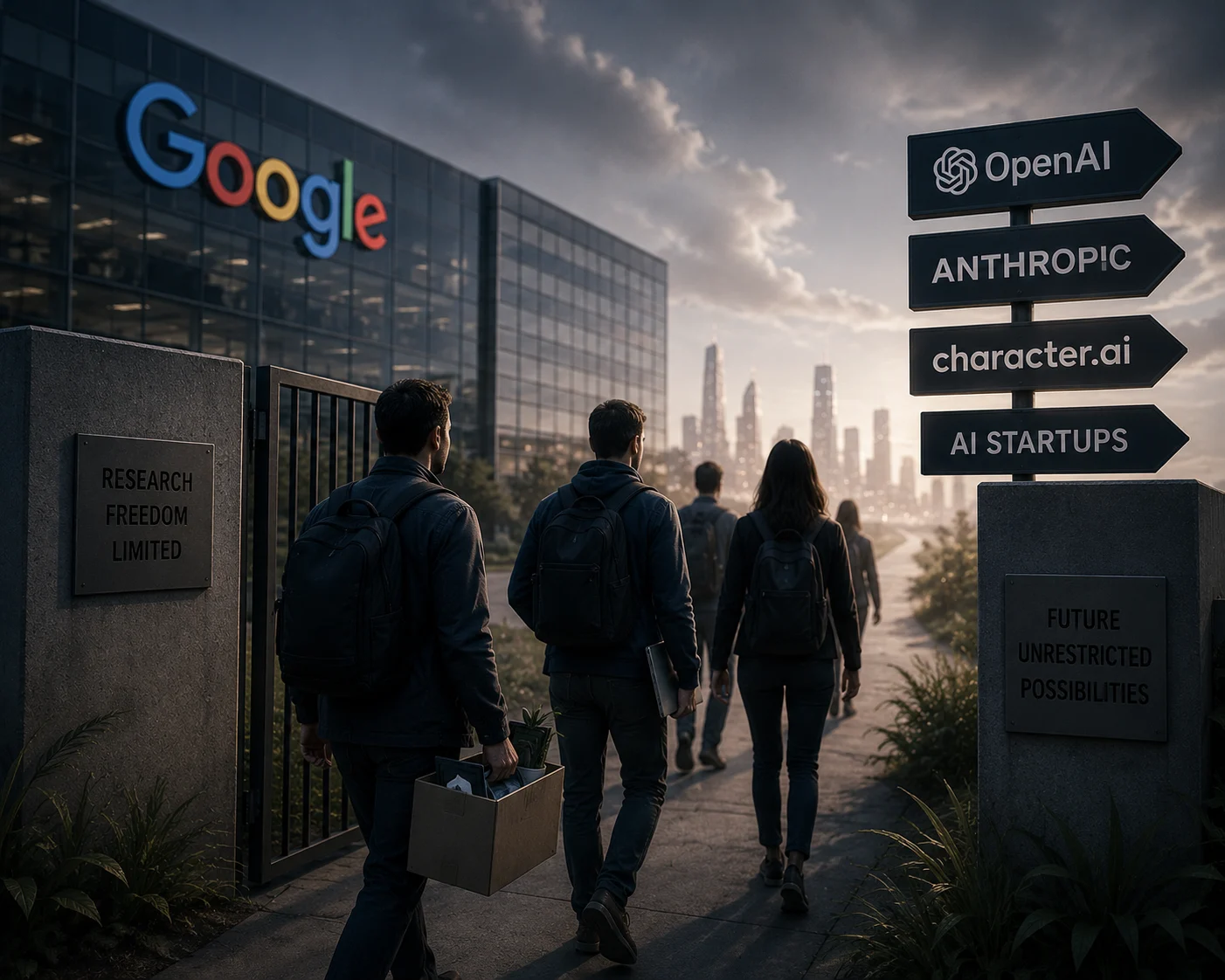
It feels like the whole AI landscape got shaken up pretty hard around June 2026. What happened was this intricate balance of top talent between Alphabet, specifically Google DeepMind, and some of the heavily funded startups just shattered. In what seemed like the blink of an eye, some of the absolute heavyweights, people who have literally written the books on artificial intelligence, just packed up and moved. And it really threw a spotlight on a weak spot that's been lurking in the background at the big tech companies: they're just not great at holding onto the real pioneers when these more focused, nimble labs come along, dangling the promise of unrestricted access to computing power, huge chunks of equity before an IPO, and the freedom to build things however they see fit, without all the corporate red tape.
The biggest gut punch to Alphabet's AI defenses came when Noam Shazeer, who was a co-lead on their flagship Gemini model family and a legendary figure for co-authoring that foundational 2017 paper, "Attention Is All You Need," officially left Google. And where did he go? Straight to OpenAI. If you look at Shazeer's journey over the last couple of years, it really tells you everything about how intense these talent wars have become, and the sheer financial stakes involved. He'd initially left Google back in 2021 to help start Character.AI. Then, in 2024, Google apparently spent something like $2.7 billion — and that was through a pretty complicated licensing and acqui-hire deal — specifically to lure him back to take the helm of the Gemini architecture. So, to see him walk out the door less than two years later, joining OpenAI, despite all that multi-billion-dollar corporate maneuvering to bring him back, it sent serious tremors through Wall Street. It hammered home the point that just throwing money at the problem isn't enough anymore to keep the best minds around.
At the same time, the scientific community was practically in a state of disbelief. Dr. John Jumper, a Vice President at Google DeepMind and someone who actually won a Nobel Prize in Chemistry in 2024 for his groundbreaking work on AlphaFold, announced he was resigning. His destination? Anthropic. Jumper's departure signals a pretty significant shift in where these talent battles are being fought. It's not just about engineers fine-tuning commercial large language models for the web anymore. This has now spilled over into the deeply scientific and biophysical aspects of AI. When people with Jumper's level of academic accomplishment and practical expertise move to places like Anthropic, they don't just bring their own brilliant minds; they often bring entire teams of researchers with them. This fundamentally changes the long-term intellectual property value of the companies they leave behind.
This kind of institutional drain was really amplified by what happened next: Jonas Adler and Alexander Pritzel also left Google DeepMind, heading to Anthropic. Adler, who had spent years honing Google's internal AI coding tools for developers, and Pritzel, who's an expert in the massive-scale pre-training techniques, represent that crucial middle layer of elite talent. These are the engineering powerhouses who can take abstract mathematical ideas and turn them into functional, scalable code that companies can actually use. From what I've heard internally, the main reason behind these multiple departures was a significant issue with compute infrastructure. Not long before Shazeer made his move, large amounts of high-performance tensor processing units (TPUs), which had been allocated to his specific exploratory pre-training team, were suddenly re-routed to the general Gemini optimization efforts. This kind of structural shift really highlights the increasing operational friction within these tech giants: when the freedom to conduct research gets overshadowed by the pressure to deliver near-term commercial products, the top talent tends to look elsewhere.
The Mathematical Valuation of Elite Human Capital
You know, when we talk about the economics behind the big scuffles for top AI talent, sticking to the usual corporate numbers just doesn't cut it. It's like trying to measure a painter by their brush cost. We need a different way of looking at things, something that quantifies what these researchers actually bring to the table, especially when it comes to processing power.
So, let's try to put a number on how valuable a top-tier AI researcher is, using what I'm calling a "capacity-to-compute" ratio. Think of it this way: we can define a researcher's core value, let's call it Systemic Architectural Worth (W_a), based on how much better they make a set amount of computing power work. It's about the efficiency boost they inject into a fixed hardware setup.
Advertisement
The formula might look something like this: W_a equals this thing called psi, which is like a personal alignment score or a unique knack the individual has, multiplied by a fraction. That fraction is the total cost of the hardware cluster — picture thousands of high-end GPUs linked together, easily costing billions — divided by the reduction in training iterations it takes to hit a certain performance mark. Then, we multiply that by the logarithm of K, where K represents how well connected the researcher is across different institutions, like their network effect.
What does this actually mean in practice? Well, if a researcher can shave off just 15% of the training time needed for a massive $10 billion compute cluster, according to this math, they're essentially worth over $1.5 billion in terms of raw computational advantage. That's a staggering figure, isn't it?
This is the kind of math that helps explain some of the wild recruitment stories we've heard. Remember when Meta was reportedly tossing around $100 million in bonuses just to poach a few people from OpenAI? And then OpenAI went and put together a multi-year deal worth more than $200 million to get Ruoming Pang back from Meta. It's not that these big tech companies are just throwing money at labor; they're really looking at the cost savings and efficiency gains their compute power achieves.
Consider it this way: if a top engineer can stop a multi-billion-dollar cluster from going haywire during a crucial three-month training phase, preventing what's known as gradient divergence, their hefty salary is essentially paid for by the electricity saved and the reduced wear and tear on incredibly expensive hardware. It's a direct economic benefit.
So, the real takeaway here is that companies should be mindful of their spending on compute resources, but they should be even more intentional about acquiring the absolute best human minds. The firms that think they can just throw more hardware at problems and replace individual brilliance with sheer scale are finding out that a billion dollars worth of servers running an unoptimized training process just churns out incredibly expensive, essentially useless, random data. It's like having a state-of-the-art kitchen but no chef — you just end up with a mess.
The Strategic Counter-Measures: Acqui-Hires and Equity Restructuring
It's really something to watch how these huge, established tech companies are trying to hold onto their territory these days. You know, the old way of doing things, where a big company would just snap up a small startup, get all its talent, and move on, that's gotten a lot harder. The regulators worldwide are really cracking down on antitrust issues, making it tough for these giants to just go on a buying spree.
So, what are they doing instead? They're coming up with these really intricate new ways to get the talent they need without triggering all the regulatory alarms. Think of it like this: instead of a full-blown acquisition, they're doing these complex "reverse acqui-hires" or making these massive deals to license technology and assets. A couple of recent examples really lay this out clearly. There was Google's initial deal involving Character.AI, which was reportedly around $2.7 billion, and then you have Microsoft bringing in the team from Inflection AI in a deal worth billions. These seem to be the new blueprints for how companies are consolidating. The way it works is pretty clever: Big Tech pays huge licensing fees to the startup's investors. At the same time, they hire the key technical people, the founders, directly into their own internal research labs. It's a way to essentially buy the brainpower while leaving the legal structure of the startup mostly untouched. This lets them sidestep the usual antitrust reviews that would normally kick in with a straightforward acquisition.
And it's not just the big players navigating these waters. The way private companies, the ones that are still pre-IPO, like OpenAI and Anthropic, are structuring themselves to compete is also pretty wild. They're constantly tweaking their internal finances to keep up with, and even surpass, the stock options and perks that publicly traded companies can offer. Take OpenAI, for example. They recently did a massive overhaul of how they handle employee equity and liquidity. In just six months, they went from a valuation of about $6.5 billion for their employee stock programs to a staggering $10 billion pool. What this really means is that they're making it easier for their employees to turn their private stock into actual cash through these corporate-sponsored buyback programs, or tender offers. It's a bit like giving them the best of both worlds: the ability to cash out like you could with public stock, but still keeping the potential for massive growth that comes with being a private, high-flying startup. It's a really powerful recruitment tool, and honestly, it's something the older, more traditional companies, with their slow-moving Restricted Stock Units (RSUs) on the public market, find incredibly hard to beat.
Elite Institutions and Frontier AI Gateways
If you're trying to get a handle on what's happening in the world of AI right now, and especially if you're involved in business or investment, it's really important to know where the key players are actually doing their work. It's not just about the ideas, but about the places where the big push for better AI and finding the right people to build it is going on.
Think of these places as the main arenas where the competition is happening. We've put together a list of the major spots that are shaping the future of AI, from the cutting edge of research to how they're bringing in the best minds.
First up, there's OpenAI. This is where a lot of the big moves in scaling up large language models are coming from, and they're really aggressive about hiring. openai.com
Then there's Anthropic. They're known for focusing on safety and capabilities, and it's become a go-to spot for top researchers, especially those who have moved on from Google DeepMind. anthropic.com
Google DeepMind is another major player. They've been around a while, doing foundational work in AI and computation. They're currently making some adjustments to their internal resources, like their TPUs, to make sure their core research stays strong. deepmind.google
Meta AI Research, or FAIR, is a big name in the open-source world. They're pushing for large, decentralized AI models and getting them out there for everyone to use. ai.meta.com
xAI is making a very strong play in scaling up AI, and they have a lot of access to powerful hardware. They're using this to attract top engineering talent. x.ai
And finally, there's Safe Superintelligence, or SSI. This organization was started by Ilya Sutskever, who was previously the Chief Scientist at OpenAI. It seems to be set up as a place for really focused, fundamental research into algorithms, without the pressure of immediate product development. ssi.inc
Future Outlook: The Fragmented Sovereign Lab Era
Looking ahead, as we try to map out where the AI economy is headed, say, into the latter half of 2026 and further out, one thing seems pretty clear: the way elite talent is spread out points towards a future that's pretty fractured, kind of a multi-polar setup. That old idea that big corporations had some kind of permanent advantage, like an unbreachable moat around their business, well, that's been pretty thoroughly debunked. We've seen it happen — prominent figures, the very architects behind some of these foundational AI models, like Noam Shazeer and John Jumper, making big moves. Their departures are a stark reminder that having the top technical minds isn't a static situation. What looks like dominance today can shift incredibly quickly. It's a really volatile landscape.
Think about it: a company that boasts the absolute best AI model right now, the one everyone agrees is leading the pack, could see its core research team completely dismantled by the end of the next quarter. What's left? Billions tied up in expensive hardware — all that silicon infrastructure — that's rapidly losing value because the very people who know how to push it forward, how to train the next big upgrade, are gone. It's like having a state-of-the-art factory with no engineers to run the machines.
This is pushing us, really fast, into what I'd call the era of the "Sovereign Boutique Lab." These are going to be these incredibly focused, well-funded research groups. They're deliberately keeping their teams small, maybe fewer than a hundred people. These aren't your typical sprawling tech companies. They're actively avoiding the massive layers of product management bureaucracy and the whole rigmarole of selling software to customers directly. Their entire game is about pure algorithmic breakthroughs and getting the foundational pre-training of models just right.
Because they can move so fast, with this kind of extreme agility, these sovereign labs are in a position to grab huge market value. How? By licensing their core intellectual property — the actual breakthroughs — to the giant enterprise companies. These big players have the reach, the distribution channels, the customer base, but they're increasingly finding they lack the in-house talent to really innovate on the cutting edge of AI. So, in this new economic reality, what's truly the most valuable asset on a balance sheet? It's not the office buildings, or the massive data centers, or even the established customer networks anymore. No, the real prize, the ultimate asset, is likely going to be the collective knowledge, the hard-won insights captured in the notebooks of the world's top machine learning architects. Their minds, their research, that's the new currency.
Read Further
-
CNBC. Google Gemini co-lead Noam Shazeer leaves for OpenAI. June 18, 2026. — cnbc.com/2026/06/18/google-gemini-co-lead-noam-shazeer-leaves-for-openai
-
CNBC. John Jumper to leave Google DeepMind for Anthropic. June 19, 2026. — cnbc.com/2026/06/19/john-jumper-to-leave-google-deepmind-for-anthropic
-
BusinessToday. From Apple to Meta to OpenAI in 7 Months: Who is Ruoming Pang? February 26, 2026. — businesstoday.in
Disclaimer: All the data, institutional movement tracking, structural analysis, and economic formulations provided above were derived from comprehensive internet resources, public corporate filings, and specialized macroeconomic studies tracking contemporary tech sector labor dynamics. This document is intended solely for educational and analytical purposes and should not be taken as an official quote from our website, an endorsement of specific private equity instruments, or definitive financial advice for capital market allocation.
Advertisement