

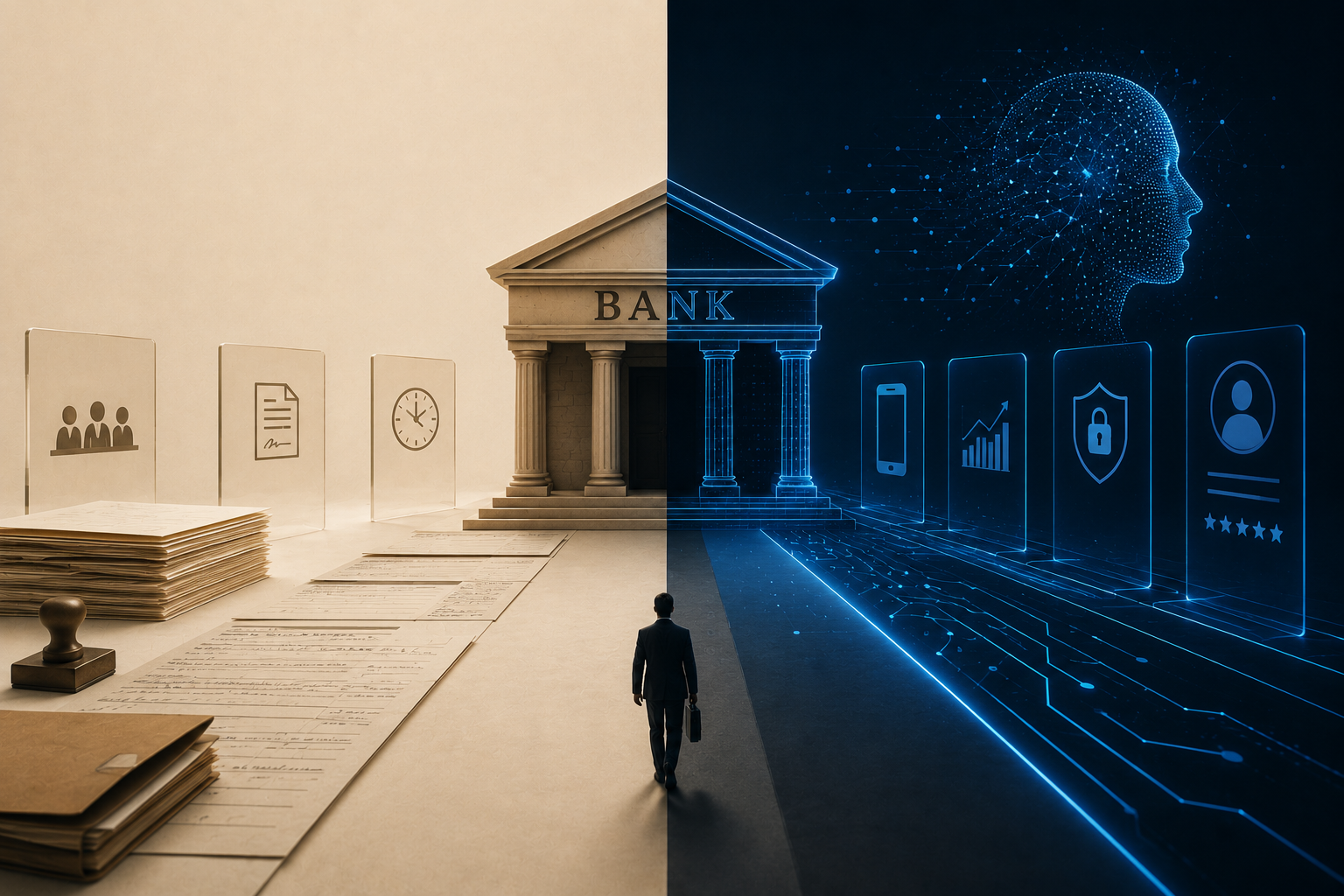
In today's world, AI is quietly reshaping almost everything — and banking is no exception. We've slowly moved from a world where you physically visited a branch to get a loan approved over several days, to one where algorithms read your payslips, check your spending patterns, and make decisions about your money in seconds. Most of us haven't even noticed it happening.
This article breaks down what AI is actually doing inside your bank, why the shift is happening faster than most people realise, and what everyday users need to understand about it.
From Rigid Rules to a Living, Learning System
Banks historically ran on old, clunky software — the kind that processed transactions overnight in large batches and couldn't think on its own. Decisions took days. Everything moved slowly and followed rigid patterns.
That is changing fast. Banks are now rebuilding their entire technology foundations around AI — not as a side feature, but as the actual core of how everything works. Think of it less like giving your bank a smart assistant, and more like replacing the whole nervous system of the institution.
The big shift: Banks used to rely on software that followed fixed rules. Now they're using AI that can learn, adapt, and make decisions — more like a human analyst, but far faster.
Your Bank Knows You Better Than You Think
Old-school banking treated everyone the same. You were either a young saver or a middle-income family, and you received the same offers as everyone else in that bracket. Nobody was really looking at you as an individual.
Now, banks analyse thousands of data points about your actual behaviour — what you spend, when you spend, what you browse — and use that to predict what you might need before you even ask. Bank of America's AI assistant Erica is a good example. It started as a basic chatbot, but today it can move money between your accounts, flag unusual charges, and suggest ways to save — far closer to a personal finance adviser than a FAQ bot.
Everyday example: Browsing property listings online? Your bank might quietly pre-approve you for a mortgage and send you an offer before you've even thought about applying.
Getting a Loan Used to Take Days. Now It Can Take Minutes.

Applying for credit used to mean paperwork, waiting, and a decision based mostly on your credit score — a number that doesn't tell the whole story, especially if you're young or new to managing credit.
AI-powered systems can now read your payslips, check your tax records, and cross-reference everything almost instantly. More importantly, they look at factors traditional scoring ignores entirely — like whether you consistently pay your bills on time, or how stable your monthly income actually is.
What this means in practice:
- Over 90% faster loan processing at many institutions
- Fairer access to credit for people with non-traditional financial histories
- Fewer human errors — AI spots inconsistencies that analysts can miss
When AI Gets It Wrong
AI is still artificial intelligence — not a human mind that can weigh the real emotional and social context of every situation. Fraud detection systems are still prone to blocking completely legitimate purchases. Ever had your card declined abroad for no apparent reason? That's often AI firing on blunt pattern-matching rules rather than genuine intelligence.
Advertisement
And when an AI rejects your loan application, the frustrating part is that the system might not be able to explain it in plain language — you simply get a "the algorithm said no." Regulators in Europe, particularly under the new AI Act, are now requiring banks to prove their systems operate fairly and without bias. Getting that right is genuinely hard.
Fighting Fraud in Real Time
Fraud used to be caught after the fact. You'd notice a suspicious charge on your statement, call the bank, and spend a week sorting it out. Modern AI now analyses the full picture with every transaction — your device, your location, your typical patterns, and even the network of accounts involved. It can detect a fraud ring or money laundering scheme in seconds, often before any money leaves your account.
Why this matters to you: Fewer false alarms blocking legitimate purchases. Faster detection of actual fraud. Less time on hold with customer service.
What Happens to the People Who Work at Banks?
If AI can do all this, what actually happens to the humans? The honest answer is that roles are changing — not disappearing entirely. The shift is towards smaller teams who manage and oversee networks of AI tools, stepping in for complex situations and making judgment calls that machines still can't reliably handle.
Think of it like air travel. Planes can largely fly themselves now, but we still want pilots in the cockpit — especially when things get complicated.
The future of banking is humans and AI working together, not one replacing the other.
The Bottom Line
- Your bank is becoming smarter and more proactive — anticipating your needs rather than just reacting to them
- Loan decisions are faster and more inclusive, looking beyond your credit score
- Fraud detection is sharper, but false alarms and over-blocking remain real problems
- AI accountability matters — banks need to explain decisions, not hide behind them
- The future of banking is human and AI in partnership, not competition
References
1. Core Banking Trends 2026: AI, Resilience & Real Time Transformation 10x Banking · 2026
2. AI in Banking 2026: Scaling Agentic Workflows for Core Modernization Aspire Systems · 2026
3. Generative AI in Banking: 7 Real-World Use Cases across Consumer Retail Frameworks Ideas2IT · 2026
4. Inside the Bank: How Artificial Intelligence is Changing Banking Operations MIT Sloan Executive Education · 2026
5. AI in Banking: Applications, Benefits and Deep Financial Examples Google Cloud · 2025
6. Top Banking Trends for 2026: The Emergence of the 10x Bank Accenture · 2026
Disclaimer: All data provided was sourced from publicly available research on AI in banking. This article is for informational purposes only and does not constitute financial advice.
Advertisement