

In an age of inflationary generative and agentic architectures dictating the structural nature of industries, we are now more reliant on AI than ever. From the viewpoint of 2026, AI is not just a chatbot or an efficiency multiplier fashioned for text summarization; it has evolved into fully autonomous, proactive agents engaged in wider mission-styles that could eventually include complex reasoning, cross-application execution, and critical national infrastructure. But as entire global economies race toward these self-driving structures, the equilibrium of pace-based automation versus human intentionality is the defining issue of our era.
This article examines how external policy, internal corporate governance, and regional responses are evolving in the face of these technology tectonic shifts, drawing lessons from the significant global AI summits held throughout 2026. From Singapore to Geneva, and New Delhi to Brussels, the global community is converging on one conclusion: abstract regulation has died, replaced with practical modes of technological absorption and verification.
The 2026 Paradigm: Moving Beyond Theoretical Ethics to Practical Governance
Over the years, international debates on artificial intelligence were heavily influenced by high-level ethical guidelines. Endless iterations of principles emphasizing fairness, accountability, transparency, and security were drafted by organizations and nation states. But as the industry that had built these theoretical frameworks experienced a dizzying succession of hype-fueled launches of "Agentic AI" — systems that directly negotiate contracts, adjust financial portfolios, run power grids, and interface with citizens with far less human intervention — these frameworks were found wanting. There is a measurable movement toward concrete, implementable 2026 shifts.
"Abstracted ethical principles that are not empirically benchmarked are effectively corporate poetry," noted one prominent voice in the open-source ethics community. "The name of the game is operational proof and regional infrastructure resilience."
A key impetus behind this shifting perspective is the acknowledgment that autonomy systems are playing a statistical probability game, not a deterministic one. Recent research on enterprise-level agentic tools — tools that can act on behalf of a user in the real world, as opposed to merely providing information — paints a nuanced picture: when it comes to basic execution tasks, these tools display remarkable performance, but when it comes to multi-stage contextual reasoning, they frequently exhibit structural failings. In many complex, business-wide deployments, the success rate is around 65% when working through long-horizon, multi-scenario processes without human intervention. This suggests that roughly 2 out of every 5 complex agentic decisions need to be corrected programmatically or with human intervention — a source of substantial financial and operational risk if left completely unchecked.
The Pillars of Global Dialogue: Major AI Summits of 2026 Explained

A series of internationally synced summits were scheduled in 2026, each focused on specific areas of the AI ecosystem. These summits united leaders, researchers, corporate officers, and civil society advocates to establish trans-border coalitions and actionable engineering standards.
A. The India AI Impact Summit 2026 (New Delhi)
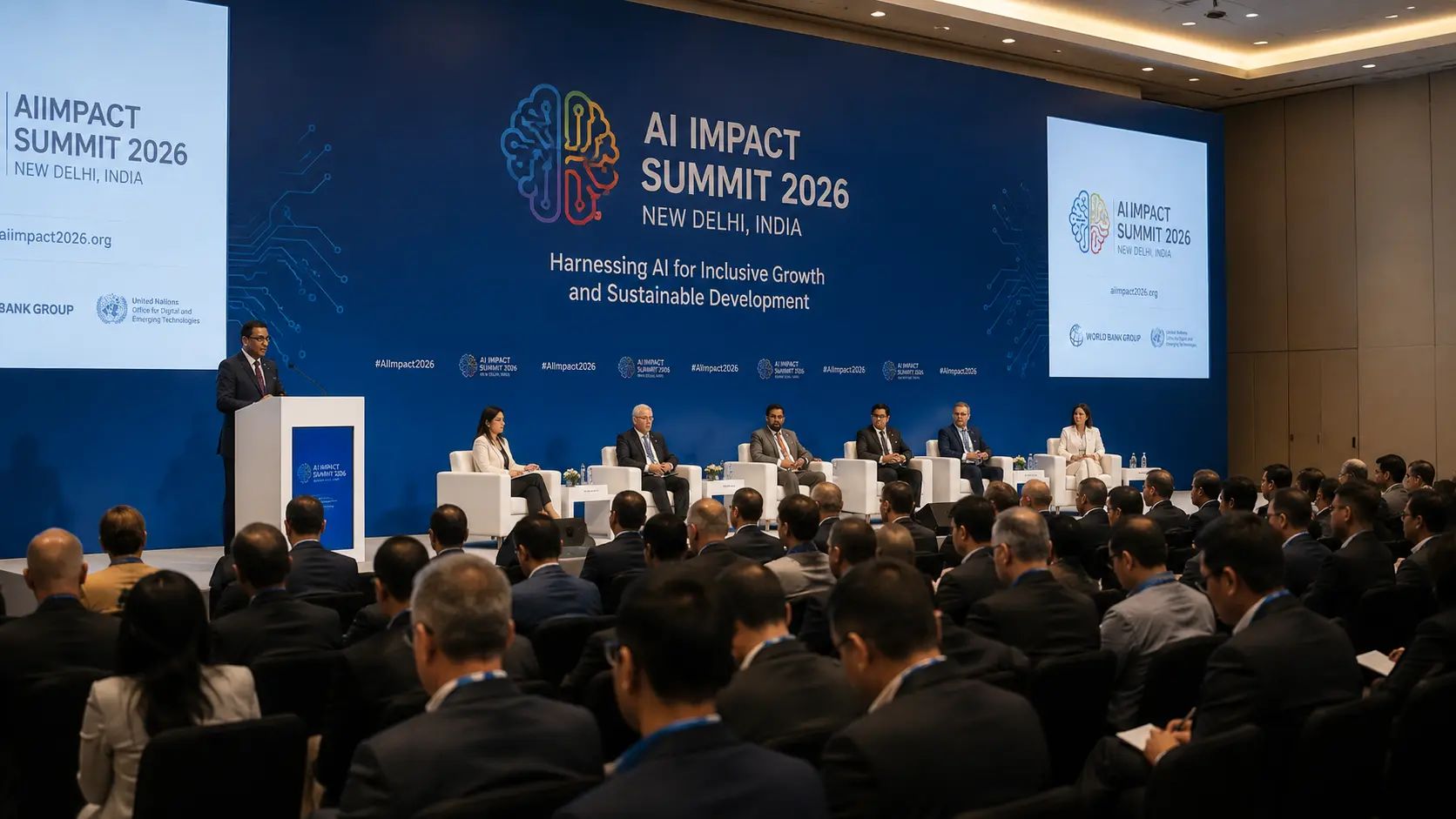
Held at Bharat Mandapam in New Delhi from 16 to 21 February 2026, this event marked a major shift in middle-tier diplomacy — the first summit in the ongoing global AI summit series to be hosted by a Global South nation. In collaboration with the World Bank Group and the United Nations Office for Digital and Emerging Technologies, the conference shifted its emphasis away from compute-monopolistic "frontier leadership" models and toward institutional absorption capacity. The central theory was straightforward: long-term geopolitical advantage does not belong to the countries that build the biggest foundation models, but to those best able to bring lightweight, open-source architectures into public services, healthcare, road safety, and education.
B. The AI for Good Global Summit 2026 (Geneva)
Hosted by the International Telecommunication Union (ITU) in partnership with more than 50 UN agencies and the Swiss government, the 2026 summit in Geneva focused squarely on linking global innovators with key public-sector decision-makers. The event was geared toward advancing the Sustainable Development Goals (SDGs) through applied, impactful, "right on the problem" AI solutions — as opposed to letting futuristic, mega-compute platforms dictate the agenda.
C. The Global Conference on AI, Security and Ethics 2026 (Geneva)
Held at the Palais des Nations in Geneva on 18–19 June 2026 and organized by UNIDIR, this conference bridged the technical and diplomatic communities to explore the turbulent confluence of AI and international security. Key tracks looked at how to build responsible AI principles into engineering product lifecycles, AI resilience offline, and the alarming level of escalation around synthetic media and deepfakes in geopolitical conflict zones.
| Name of the Summit | Location | General Global Theme | Involved Key Stakeholders |
|---|---|---|---|
| India AI Impact Summit | New Delhi, India | Inclusive Growth & Infrastructure Absorption | World Bank, MeitY, UN Digital Office, Global South Leaders |
| AI for Good Global Summit | Geneva, Switzerland | SDG Acceleration and High-Level Coordination on AI and ICTs | ITU, 50+ UN Agencies, Swiss Government, Academic Labs |
| UNIDIR AISE26 | Geneva, Switzerland | Military AI Governance & Counter-AI Technology | Diplomats, Defense Researchers, Civil Society, AI Labs |
| AAAI 2026 | Singapore | Theoretical Advances and Neural Architectures | World AI Research Community, Top Academics |
| The International AI Summit | Brussels, Belgium | Developing EU AI Act Compliance & Geopolitics | European Commission, Technology Founders, Market Economists |
Advertisement
Key Paradigms: Frontier Capabilities vs. Institutional Absorption Capacity
Among the most profound conceptual frameworks to be distilled from the 2026 summits is that of frontier model scale versus societal absorption. The tech industry has been in a brute-force, parameter-count, compute-cluster scaling race for years. However, the mid-2026 summit discussions made clear that the most powerful raw compute capabilities are largely useless if a society or organization has no domestic industry, no localized data streams, and no trained workforce adequate to safely absorb the technology.
In public education, for example, data from global development banks indicated that lightweight, localized AI tutors on edge devices produced learning gains equivalent to nearly an extra year of formal schooling. These architectures don't require multi-billion-dollar data centers; they leverage efficient open-source architectures built around localized languages and cultural contexts. As a result, sovereign compute networks and open data frameworks are increasingly supplanting centralized, proprietary APIs.
The Security and Ethical Frontier: Deepfakes and Autonomous Systems
With the decreasing cost and increasing availability of AI tools capable of producing hyper-realistic synthetic media, the security world has become more fragile. At the UNIDIR security conference, detailed technical briefs revealed the neglected facets of the "human element" in cybersecurity. Malicious actors are no longer writing just automated malware; they are using agentic systems to run continuous, multi-vector phishing and social engineering campaigns that adapt in real time based on the victim's responses.
"We have to incorporate offline resilience and strong, cryptographic validation tools into our infrastructure," one security researcher observed at the conference. "Plainly, depending on real-time detection models is a losing game when it comes to next-generation synthetic media."
The inability of international fora — such as the informal exchanges on AI in the military domain held in Geneva alongside the UNIDIR conference — to arrive at legally binding, enforceable limitations is indicative of a dangerous reality. As declarations of ethics multiply, the actual use of autonomous capabilities continues to outstrip oversight. So the concern has shifted to defensive engineering: creating counter-AI verification tools, localized data fabrics, and offline-resilient operational workflows that can survive extended digital disruption.
Prominent Global Repositories and Platforms of 2026
For professionals, policymakers, and researchers working at the forefront of defining, deploying, or analyzing the developments codified this year, the following institutional repositories and open platforms are useful starting points:
- World Bank Group AI Development Initiative — Focuses on supporting and evaluating the real-world economic outcomes of localized AI application in the developing world.
- ITU AI for Good Platform — An online portal serving as a global marketplace for open-source AI models, dataset sharing, and interdisciplinary matchmaking based on the UN Sustainable Development Goals.
- UNIDIR Security and Ethics Forum — Delivers ongoing research, expert assessments, and policy briefs on lethal autonomous weapons systems and cyber resilience frameworks.
- The International AI Summit Repository (Brussels) — Tracks the convergence of regulatory standards, regional compliance documentation, and global market pressures.
- FinRobot Open Foundation — An open-source collective devoted to training specialized, low-latency financial models aimed at reducing prompt dependency and token exposure.
The Future Roadmap: Balancing Automated Progress with Human Intentionality
In the end, the underlying problem that emerged from all the 2026 summits is not a technical issue but a philosophical one. As agentic AI increasingly takes over administrative, financial, and strategic workflows, humans face the unique risk of atrophying the very operational discipline and structural oversight needed to govern it. Just as manual ledgers in traditional finance once fostered deeper understanding and behavioral discipline, modern systems must ensure AI does not supplant human responsibility.
The roadmap for the rest of 2026 and beyond calls for a hybrid architecture. Intelligent agents will continue to play the central role in computation speed and optimization within autonomous systems, but they need to be embedded in transparent verification processes interpreted by human intent. Through building domestic infrastructure, calling for open-source standard validation, and valuing systemic resilience over reckless feature scaling, the global community can help ensure AI is a driver of inclusive progress rather than a source of fragmentation.
Read Further
- India AI Impact Summit 2026 — Wikipedia, updated 2026
- Global Conference on AI, Security and Ethics 2026 — UNIDIR, June 2026
Disclaimer: The detailed analysis provided in this report is compiled strictly from public summit records, institutional announcements, and technology governance research. This document is intended entirely for educational and analytical purposes and must not under any circumstances be construed as definitive legal, policy, or investment advice.
Advertisement