

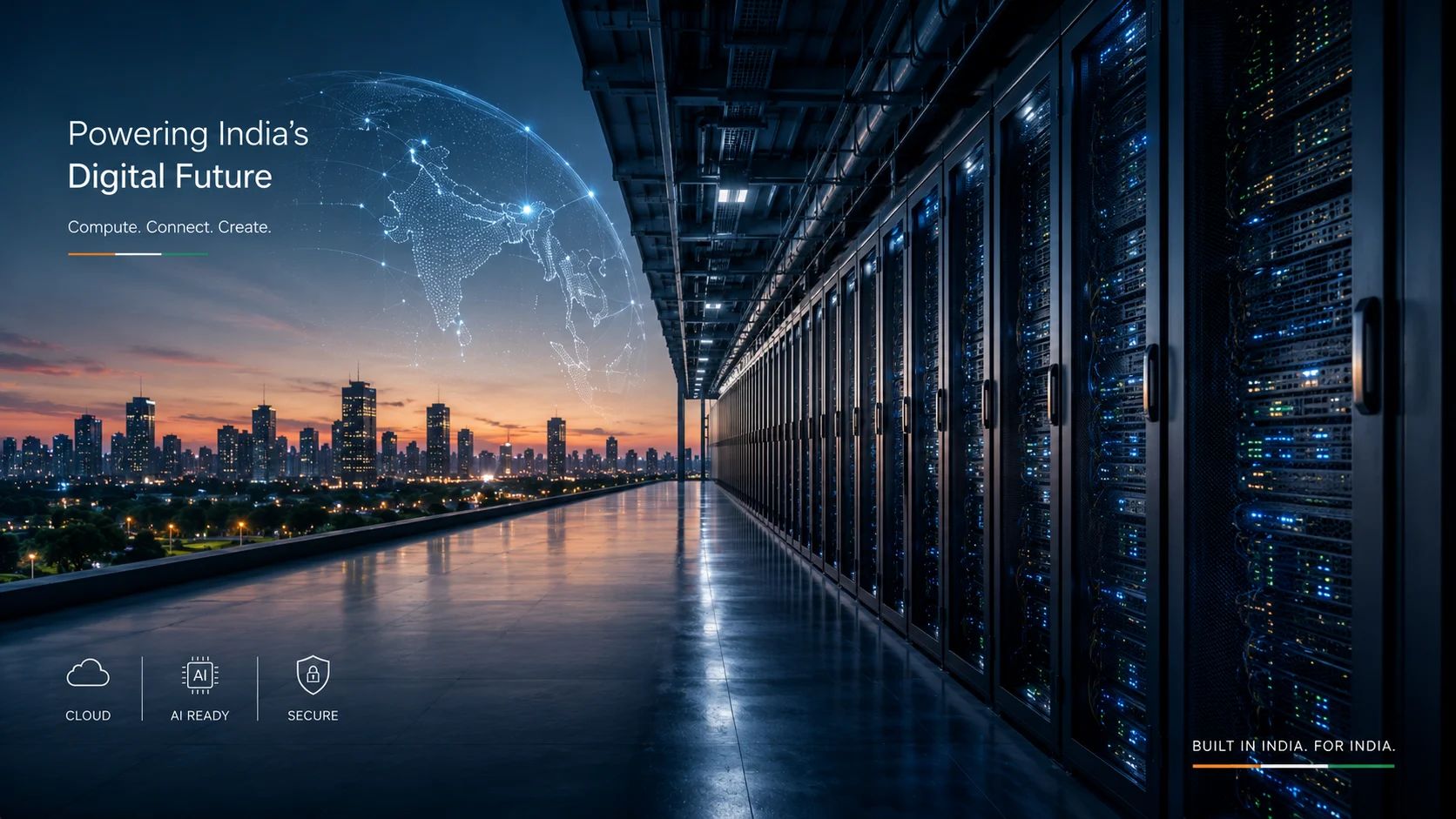
India's data centre capacity is projected to triple from 1,100 MW to over 3,300 MW by 2028, backed by a Rs. 45,000 crore investment pipeline from Adani, Reliance, and global hyperscalers. The stated objective is data sovereignty — keeping Indian data processed on Indian soil. The unstated risk: building massive AI compute infrastructure without a domestic semiconductor supply chain means India's "sovereign cloud" will run entirely on imported chips, creating a new and deeply uncomfortable category of strategic dependency.
The Hyperscale Surge: Quantifying India's Digital Backbone
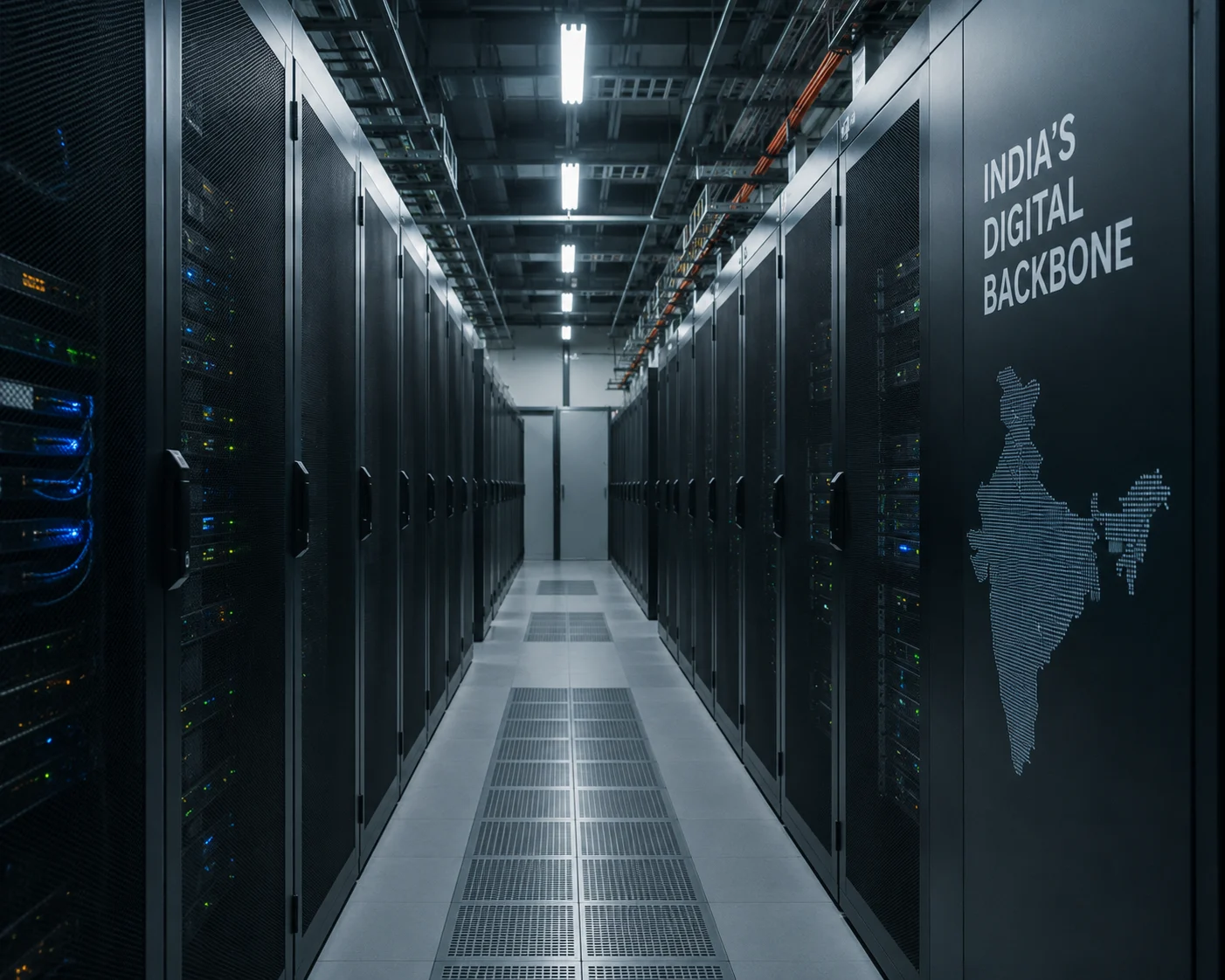
The acceleration of India's data center industry is entering a truly transformative phase. Driven by continuous enterprise migration to the cloud, the implementation of strict data localization frameworks under the Digital Personal Data Protection (DPDP) Act, and the exponential rise of generative AI inference and training workloads, the quantitative metrics tell an undeniable story of expansion. Historically, India's data center footprint was modest, lingering at a total capacity of roughly 296 Megawatts (MW) in 2016. Fast forward to the present day in 2026, and the country's live operational colocation capacity has shattered expectations, crossing a baseline of 1.6 Gigawatts (GW) to 1.7 GW of active IT load capacity. This represents a monumental multi-fold growth trajectory over the past decade.
According to comprehensive industry assessments by major rating institutions including CareEdge Ratings and Knight Frank, this is only the foundational layer of an upcoming structural boom. India's co-location data center capacity is firmly projected to quadruple over the next few years, marching aggressively toward approximately 4.0 GW by 2030. Reaching this milestone will demand a massive capital expenditure (Capex) injection of approximately ₹2.3 trillion (over $28 billion USD). This investment super-cycle is complemented by extraordinarily high absorption levels, with asset utilization consistently tracking above 90% across prime hyperscale hubs. The sheer scale of consumer demand is acting as a natural multiplier; per-smartphone monthly data consumption across India's 900+ million internet users has touched an astronomical 32 Gigabytes (GB) and is forecast to approach 62 GB by 2030, accelerated by 5G networks, video streaming, and ubiquitous AI touchpoints.
"Build robustly and compute locally: the dual imperative governing India's infrastructure evolution."
| Infrastructure Dimension | Historical Baseline (2016) | Current Status (2025–2026) | Projected Horizon (2030–2031) |
|---|---|---|---|
| Aggregate IT Capacity (GW) | ~0.29 GW | 1.6 – 1.7 GW | 4.0 – 9.0 GW (Inc. Enterprise / Edge) |
| Estimated Cumulative Capex | N/A | ~₹1.2 Lakh Crore | ~₹2.3 to ₹2.5 Lakh Crore |
| Average Rack Density | 3 – 5 kW per rack | 8 – 12 kW per rack | 25 – 40+ kW (AI-ready clusters) |
| Primary Cooling Method | Chilled Air Systems | Hybrid Air / Direct-to-Chip | Liquid Immersion & Closed-Loop Direct |
| Data Usage per User / Month | Under 5 GB | ~32 GB | ~62 GB |
The AI Infrastructure Race: Racks, GPUs, and Liquid Cooling
The traditional cloud computing ecosystem relies heavily on horizontal scaling, where standard applications run on centralized central processing units (CPUs) with predictable energy requirements. Generative AI, large language models (LLMs), and computer vision pipelines completely break this old operational architecture. To compute deep learning frameworks efficiently, data centers must deploy dense clusters of specialized accelerators, such as NVIDIA H100, H200, or Blackwell architectures, alongside localized custom silicon. This shift has initiated an internal technology race focused squarely on rack density and thermal management.
Standard data center racks historically operated at an average density of 5 to 8 Kilowatts (kW). However, advanced AI clusters running parallel processing operations push rack densities to 25 kW, 40 kW, and even up to 100 kW per single enclosure. Traditional forced air-cooling systems are completely inadequate at these levels; they cannot dissipate heat fast enough to prevent thermal throttling in high-end silicon. Consequently, Indian data center operators are undergoing a radical re-engineering phase, rapidly transitioning toward liquid-cooling mechanisms. This includes Direct-to-Chip (D2C) cooling, where coolant fluids are pumped directly to a cold plate resting on the processor, as well as full immersion cooling, where server chassis are entirely submerged in dielectric fluid baths. Adopting these advanced thermodynamics adds up to an estimated $800,000 USD per MW in incremental capital expenditure, raising the barrier of entry for infrastructure developers but unlocking true AI-ready capabilities.
Pillars of the Boom: Major Players Shaping the Cloud Landscape
This capital-intensive race has attracted a powerful mix of specialized domestic conglomerates, sovereign-backed global operators, and hyperscale joint ventures. These entities are actively securing massive land parcels, high-voltage sub-station access, and fiber routing across prime commercial corridors. For anyone looking to understand or track the deployment of digital infrastructure within the nation, monitoring these principal infrastructure platforms is essential:
Top 12 AI & Data Center Infrastructure Providers in India
- Yotta Data Services — Renowned for its massive Tier-IV hyperscale campuses in Navi Mumbai and Greater Noida. Yotta made headlines by ordering thousands of NVIDIA AI chips to provide GPU-as-a-Service to domestic startups and enterprises.
- AdaniConnex — A joint venture between Adani Group and EdgeConnex, targeting multiple gigawatts of capacity across Chennai, Noida, Mumbai, Hyderabad, and Pune, leveraging the parent group's massive renewable energy generation portfolio.
- CtrlS Datacenters — India's home-grown pioneer in Rated-4 data centers, currently executing a major multi-city expansion strategy to double its operational footprint with sustainable, AI-compatible architectures.
- NTT Data Services — One of the largest market-share holders in India's colocation industry, building vast hyperscale campuses in Mumbai, Chennai, and Bengaluru, backed by dedicated subsea cable landing stations.
- Digital Connexion — A strategic joint venture involving Brookfield Asset Management, Reliance Industries, and Digital Realty, bridging massive global institutional capital and deep local connectivity assets.
- ST Telemedia Global Data Centres (STT GDC India) — A major player with an extensive multi-city operational presence, supporting several of the world's largest hyperscale public cloud providers across India.
- CapitaLand Investment (Bridge Data Centres) — Singaporean institutional real estate capital expanding rapidly into India with large-scale projects tailored specifically for hyperscale occupants.
- Tata Communications — Leveraging its globally dominant subsea fiber network to expand edge and core compute infrastructure for international and local enterprise clients.
- Netmagic Solutions — An integrated part of the global NTT footprint, operating as a deeply embedded managed service and cloud hosting pioneer across urban centers.
- AWS India (Amazon Web Services) — Continually investing billions of dollars to expand its sovereign cloud regions, focusing intensely on multi-availability zone deployments in Hyderabad and Mumbai.
- Google Cloud India — Expanding its massive commercial data center leases and edge footprints in major metros to anchor its Gemini-led generative AI enterprise ecosystem locally.
- Microsoft Azure India — Securing substantial land holdings in regions like Telangana and Maharashtra to construct dedicated, high-security hyperscale cloud facilities for corporate and public sector workloads.
Advertisement
Regional Hegemony: From Coastal Hubs to Emerging Clusters
The geographic distribution of data center infrastructure within India is highly concentrated, governed by access to international subsea fiber cables, robust regional power grids, and close proximity to major commercial enterprises. Mumbai and Navi Mumbai remain the undisputed heavyweights of the landscape, accounting for approximately 47% of the nation's live operational capacity. This dominance is anchored by Mumbai's position as the financial capital, excellent power supply reliability, and critical submarine cable landing stations that connect India directly to the Middle East, Europe, and Southeast Asia.
Chennai ranks as the second-largest hub, commanding roughly 12% to 15% of total capacity. It serves as a vital low-latency gateway to East Asia due to its direct subsea cable arrivals. Concurrently, Hyderabad and Bengaluru are experiencing a major surge in hyperscale deployments. Hyderabad has emerged as a preferred destination for massive multi-acre greenfield campuses due to its highly stable seismic zone characteristics, supportive land allocation policies, and aggressive corporate investments by global cloud giants. Bengaluru, the technology capital, anchors intensive edge-compute nodes and engineering design facilities, although it balances growth against local resource constraints. Meanwhile, the Delhi-NCR cluster satisfies essential public sector, regulatory, and corporate demands across northern India.
"As computation concentrates in key metros, regional resource management becomes the true arbiter of sustainable growth."
The Friction Points: Power Grid Hunger, Water Stress, and Regulatory Dynamics
Despite the highly optimistic growth trajectories, the rapid deployment of AI-ready infrastructure faces severe real-world constraints. Data centers are incredibly resource-intensive operations. A 100 MW facility consumes as much electricity as a medium-sized city. As thousands of power-hungry AI racks are turned on, the local electrical grid experiences intense stress. To maintain their global sustainability mandates, hyperscale operators are demanding massive volumes of green power. This has triggered a rush to secure long-term Power Purchase Agreements (PPAs) with renewable energy providers, utilizing India's expanding solar and wind capacity, which crossed 254 GW recently. However, grid transmission bottlenecks and battery storage limitations present persistent operational risks.
An even more urgent crisis is developing around water consumption. High-density data centers rely heavily on evaporative cooling towers to maintain optimal operating temperatures, consuming millions of liters of water daily. Strikingly, over 60% of India's current and upcoming data center capacity is located in regions categorized as highly water-stressed. Metros like Pune, Chennai, and Hyderabad face recurring seasonal water shortages, leading to public pushback and environmental audits regarding water diversion to server farms. The industry must rapidly shift toward closed-loop water systems or air-cooled chillers, even if this requires trading off energy efficiency.
On the regulatory front, the landscape is highly dynamic. The Union Budget 2026–27 introduced a historic policy to position India as a global digital infrastructure leader: a comprehensive tax holiday extending up to 2047 for eligible foreign cloud service providers that operate through India-based data center infrastructure. This long-term fiscal certainty is explicitly designed to anchor high-value digital operations within domestic borders, moving away from a reactive model and providing international capital with decades of structural visibility.
The Sovereign Play: IndiaAI Mission and Geopolitical Imperatives
At the highest levels of governance, computing capacity is no longer viewed merely as a commercial asset; it is recognized as a vital pillar of national security and strategic autonomy. Relying entirely on foreign cloud zones or overseas hardware clusters leaves an economy highly vulnerable to supply chain disruptions, geopolitical shifts, and data export dependencies. This realization underpins the government's comprehensive IndiaAI Mission, which has catalyzed over $250 billion USD in announced public and private investments across AI infrastructure, compute systems, and domestic semiconductor packaging plants through the India Semiconductor Mission (ISM 2.0).
By establishing a robust, sovereign computing foundation, India aims to build highly customized, localized large language models that reflect its rich linguistic diversity and address core domestic challenges in agriculture, regional public health, and localized financial inclusion. The overarching goal is clear: to democratize access to advanced computational resources, ensuring that domestic startups, academic institutions, and public entities can build cutting-edge artificial intelligence systems without facing cost barriers or relying on external infrastructure. The race is no longer just about building data centers; it is about establishing a sustainable, sovereign compute layer that will power the nation's digital economy for decades to come.
Read Further
- India's Data Center Capacity Set to Quadruple to 4 GW by 2030 — CareEdge Ratings, March 2026
- India's Data Centre Pipeline Jumps to 8.33 GW — Knight Frank India Report, June 2026
- IndiaAI Mission — Ministry of Electronics and Information Technology (MeitY), Government of India
Disclaimer: The detailed analytical data and industry facts provided within this article were compiled from verified public infrastructure resources, national policy releases, rating agency reports, and macroeconomic sector studies current as of mid-2026. This content is for informational and educational purposes only and does not constitute formal financial, investment, or corporate engineering advice.
Advertisement