


In today's era where everything is being optimized, engineered, and driven by state-led efficiency models, we are becoming increasingly dependent on systemic overrides to solve planetary crises. Somehow, these massive technological updates are phenomenally useful for human economic accounts, and somehow, they are fundamentally disruptive to ecological equilibriums that have stood for millennia. Humanity creates interventions to make resource consumption faster, cheaper, and with far higher systemic efficiency. Yet, when we end up deploying massive infrastructure overhauls without a holistic impact checklist, we completely lose track of the older, quiet balances that dictate our natural world. We simply do not know what we are breaking until the silence of the dawn confirms the loss.
This article provides an analytical look into India's monumental energy transition under the Domestic Efficient Lighting Programme (DELP)—famously executed as the UJALA (Unnat Jyoti by Affordable LEDs for All) initiative. While the program stands out as a world-class case study in carbon reduction, corporate coordination, and fiscal efficiency, it has simultaneously brought about a silent environmental phenomenon: the total disruption of the nocturnal biome. As over 300 million LED lamps rewrite the physical and structural illumination profiles of India's cities, highways, and rural regions, an urgent question remains unaddressed: What happens to the biological networks that rely explicitly on the dark?
The Automation of Efficiency: The UJALA Framework and Market Displacement
In the mid-2010s, India faced a critical dilemma: skyrocketing peak electricity demand coupled with carbon-intensive generation grids that heavily drained public finances and environmental capacity. The response was an aggressive infrastructure optimization strategy. Instead of relying on passive, slow-moving regulatory adjustments or market-driven volunteer adoption, the Indian government deployed Energy Efficiency Services Limited (EESL), a joint venture of public sector undertakings, to forcefully reset the consumer electronics landscape. Through massive aggregate procurement models, the UJALA scheme engineered a sharp market disruption. By purchasing LED bulbs in lots of tens of millions, the state crashed the market price of a high-quality LED bulb from approximately ₹310 down to less than ₹40. This structural intervention completely democratized luminous access across economic strata, leading to the rapid decommissioning of highly inefficient incandescent filaments and toxic, mercury-laden Compact Fluorescent Lamps (CFLs).
367.9M+ — Total LEDs distributed
47.7K GWh — Annual energy saved
3.88M t — CO₂ avoided annually
The statistical magnitude of this operation is unprecedented globally. Millions of households replaced orange-wavelength, low-lumen incandescent strings with bright, crisp, high-temperature white light. Municipalities across all states quickly synchronized their street lighting grids, swapping out old high pressure sodium vapor lamps for high-intensity blue-rich LED clusters. On paper, the algorithmic returns of this operation were flawless: peak load demands dropped significantly, domestic utility bills decreased by billions of rupees collectively, and India's nationally determined contributions (NDCs) under the Paris Climate Agreement received an immediate structural boost.
The Photometric Core: Why Blue Light Shifts the Biological Paradigm
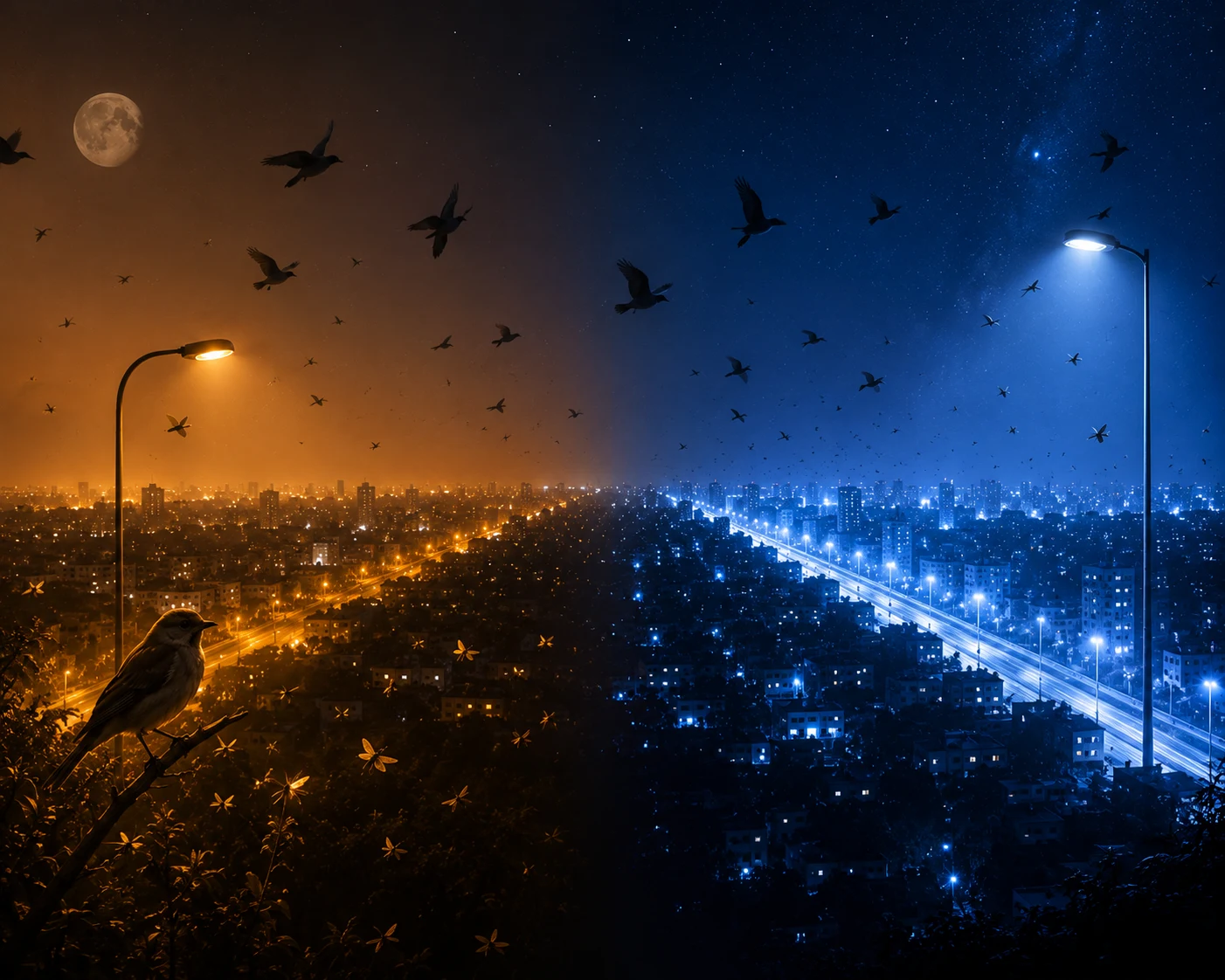
To understand why this technological triumph transformed into an ecological crisis, one must analyze the raw physics of illumination. The older incandescent bulbs and high-pressure sodium streetlights operated predominantly on the warmer spectrum, emitting long wavelengths of light that concentrated heavily in the amber, yellow, and red zones (λ ≈ 580–650 nm). While these systems were undeniably energy-wasteful, losing over 90% of their electricity to thermal radiation, their soft, desaturated glow mimicked natural post-sunset ambient temperatures.
Conversely, standard commercial LEDs achieve high luminous efficacy by pairing a solid-state blue LED chip (usually gallium nitride) with a yellow phosphor coating. This chemical pairing yields a sharp, high-energy peak in the short-wavelength blue spectrum, centered directly around λ ≈ 440–460 nm. When humans read the color temperature of these units, labeled as "Cool White" or "Daylight" (ranging from 4000K to 6500K), our eyes interpret it as crisp clear vision. However, to the biological architecture of the avian, insect, and mammalian world, this wavelength spike acts as a severe neurological disruptor.
"The core paradox of modern ecological engineering lies right here: the exact short-wavelength blue intensity that makes the solid-state LED an elite tool for saving human electricity makes it a devastating weapon against biological circadian rhythms."
Short-wavelength blue light penetrates the atmosphere with high dispersion, causing a massive amplification of urban skyglow. When millions of these bulbs are deployed simultaneously across thousands of contiguous urban and semi-urban landscapes, the baseline darkness of the night sky disappears. The natural lunar and celestial cues that have guided migrations, reproductive cadences, and predator-prey dynamics for millions of years are effectively overwritten in less than a single human generation.
Cons of the Unchecked Photon: The Unintended Avian and Insect Collateral
Avian physiology is exceptionally sensitive to light. Unlike humans, birds possess advanced retinal structures that include specialized photoreceptors capable of detecting ultraviolet and short-wavelength light with profound precision. Many of India's native and migratory birds rely heavily on the earth's geomagnetic field paired with stellar navigation maps to execute seasonal flights. When they encounter intense, highly concentrated domes of blue-rich LED skyglow, their internal biological compasses fail.
Advertisement
Studies indicate that high-intensity blue light disrupts the production of melatonin, a vital hormone responsible for controlling the sleep-wake cycles and seasonal biological triggers in birds. This suppression triggers a state of chronic physiological stress, causing migratory birds to stray off-course, fly into urban centers, and circle illuminated high-rises until they collapse from sheer physical exhaustion. Municipal zones that updated their street lighting infrastructure under the UJALA mandate noticed immediate disruptions in local avian nesting behaviors: urban songbirds now sing at abnormal hours of the night, expending vital energy reserves required for daylight foraging and defense.
The Disruption of Avian and Insect Vectors
| Spectrum Type | Wavelength Range | Primary Usage Group | Ecological Vector Impact Rating |
|---|---|---|---|
| High-Pressure Sodium (Warm) | 580nm – 630nm | Legacy Infrastructure | Low Disruptive Index (α = 1.2) |
| Cool-White Solid-State LED | 440nm – 460nm | UJALA / Modern Streetlights | Critical Disruption Index (α = 5.8) |
| Narrow-Spectrum Amber LED | 590nm – 610nm | Ecological Preservation Zones | Negligible Disruption Index (α = 0.4) |
Furthermore, the insect population—which forms the absolute baseline of India's agricultural and avian food chains—is facing an unprecedented evolutionary trap. Insects exhibit strong positive phototaxis to short-wavelength blue and ultraviolet light. The replacement of old amber streetlights with 300 million point sources of high-intensity blue light has created localized ecological black holes. Millions of nocturnal pollinators, including vital macro-moths and beetles, are drawn away from their natural forest and crop environments toward these urban light sources, where they die of exhaustion or fall easy prey to opportunistic predators. This massive drain on insect biomass directly compromises the food supply of insectivorous birds, initiating a cascade of decline across trophic levels.
The Lost Night: Merging Efficiency with Ecological Restraint
Just as relying blindly on autonomous financial algorithms can introduce structural errors into household or corporate books if human intuition is eliminated, relying solely on single-metric carbon metrics can lead to severe biological imbalances. We have saved megawatts of electricity, but we have lost the night. This does not mean humanity must retreat to incandescent dark ages; rather, it demands a transition from raw, unchecked efficiency to intentional, structurally disciplined illumination.
Modern ecological engineering offers highly effective alternatives that harmonize energy savings with biological safety. The primary solution involves the immediate deployment of Narrow-Spectrum Amber (NSA) LEDs or warm-tinted fixtures filter-rated below 2700K in ecological buffer zones, suburban areas, and highway corridors. These advanced solid-state fixtures retain the extreme power efficiency of traditional LEDs but entirely eliminate the dangerous λ = 450 nm blue spike, shifting the emission output back to the harmless amber spectrum.
"True progress dictates that we must illuminate our world consciously, and safeguard the dark intentionally. Efficiency without structural empathy is merely another form of resource exhaustion."
Additionally, implementing shielding standards on outdoor fixtures ensures that light is directed precisely onto walkways and roads, rather than scattering upwards into the upper atmosphere to generate skyglow. Incorporating automated dimming protocols into municipal lighting networks—where street illumination scales down by 40% during low-traffic windows from 1:00 AM to 5:00 AM—can dramatically lower physiological stress metrics for regional wildlife while preserving all human safety requirements.
Conclusion: The Architecture of Balance
India's distribution of over 300 million LED bulbs stands as an extraordinary milestone in administrative capability and green asset deployment. It proves that targeted national initiatives can reshape physical infrastructure at a velocity that matches the global climate crisis. Yet, as the night sky turns from its historical deep ink into a persistent, hazy blue-gray dome, we are reminded that true sustainability cannot survive inside a single-variable spreadsheet. When we design infrastructure solely around human resource mathematics, we overlook the silent populations that keep our biosphere operational.
By upgrading our lighting networks from unshielded high-blue arrays to intelligent, warm-spectrum, ecologically shielded networks, India can establish a global template for holistic conservation. We must realize that the ultimate success of human engineering is not measured solely by how effectively we conquer the dark, but by our willingness to preserve the natural rhythms of life that require the dark to survive.
Read Further
[1] Press Information Bureau, Government of India / Ministry of Power. UJALA — 10 Years of Energy-Efficient Lighting: Distribution, Energy Savings & CO₂ Reduction Figures — Click here
[2] Owens, A.C.S. & Lewis, S.M. The Impact of Artificial Light at Night on Nocturnal Insects: A Review and Synthesis — National Library of Medicine (PMC) — Click here
References and Query Logs: Document compiled using data models from India's National Program Dashboard (UJALA / EESL) and ecological impact registries tracking avian migration and short-wavelength phototoxicity index mapping.
Advertisement