

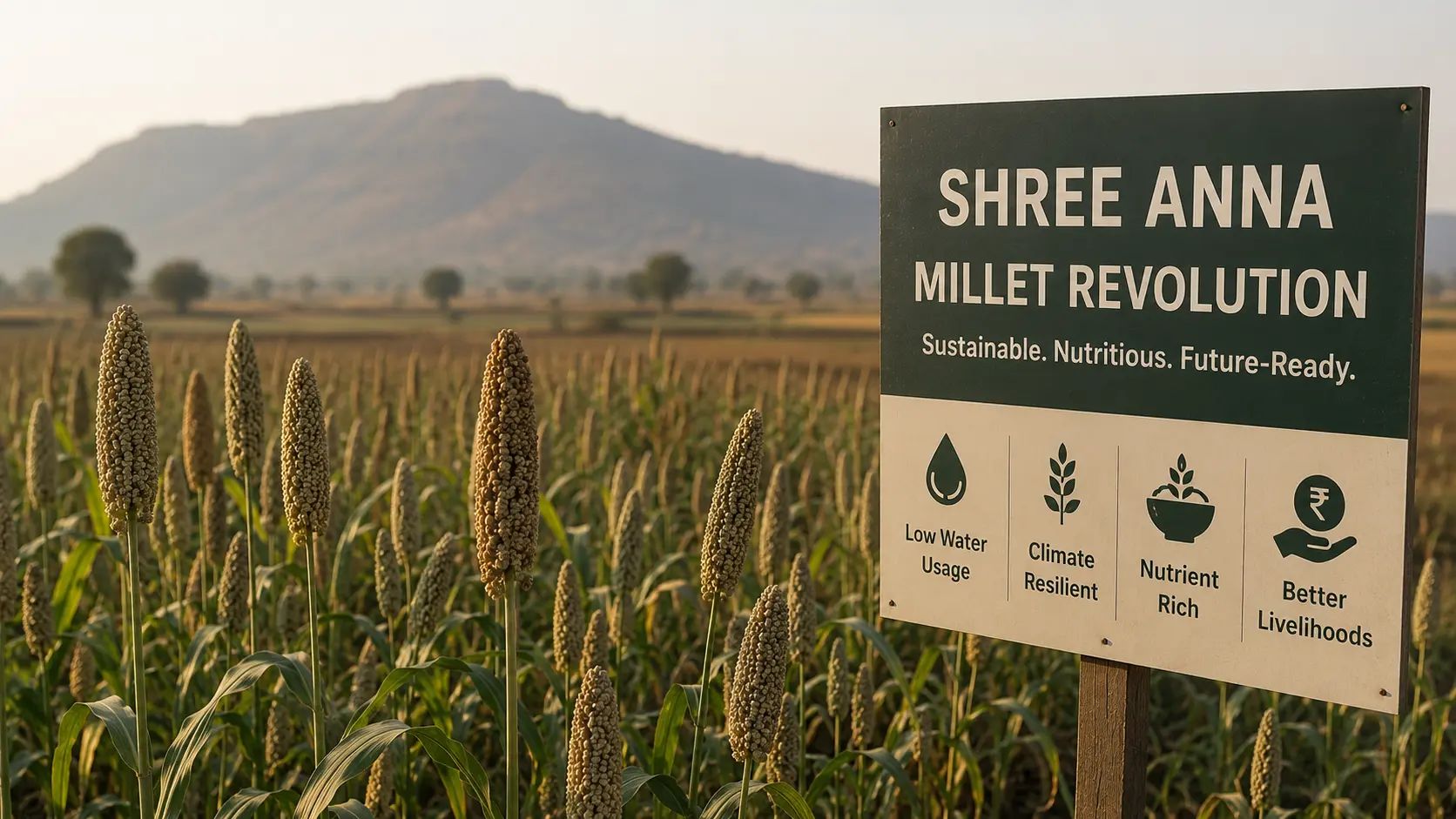
Governments face increasing pressure to secure access to food as the global supply is disrupted by climate swings, extreme weather events, and geopolitical rivalries, leading to a recalibration of national food security. India's agricultural system has been locked in an extreme dependency on the traditional duopoly of the Green Revolution for more than 50 years: high-yielding variants of rice and wheat. Even though this singular approach helped turn India from a hungry labour economy into one of the world's leading exporters of food grains, it has surreptitiously introduced systemic weaknesses now threatening the country's long-term environmental and financial security.
The combination of water-intensive cultivation, rapid soil degradation, and high chemical input costs has motivated a search for alternatives. Enter the ancient, modest, and obstinately hardy traditional grains: millets. This entire policy white paper delves into the reasons why today's destructive intensive monoculture is collapsing under the mega weight of climate stress and roller coaster commodity markets, and why the age-old millets — collectively packaged as Shree Anna — are being revived en masse to protect the Indian economy and public health in 2026. That is not just a different crop pattern; it is an economic and environmental necessity that will recalibrate the national primary sector.
The Modern Green Revolution Crisis and the Limits of Intensive Farming
Indian farming has borrowed heavily from resource-intensive techniques for decades. Rice and wheat enjoy ample institutional support, with subsidised power and minimum support prices (MSP). Yet the economics of running this model in 2026 are turning into a point of diminishing returns. The long-term growth of water-thirsty crops in rain-starved and over-exploited aquifers has made regions like Punjab, Haryana, and western Uttar Pradesh a climate disaster in the making. To produce just one kilogram of irrigated rice, farmers use anywhere between 3,000 and 5,000 litres of water — an estimate that is completely untenable in a country where groundwater levels are receding at alarmingly high rates every year.
Intensive farming is also far more reliant on massive chemical inputs. The rising cost of fertiliser subsidies — which the central budget has to bear to protect farmers from soaring global prices — is a perennial drain on public finances. The expenses of pesticides, genetically improved seeds, and heavy machinery are causing traditional cash crops like cotton to evolve into enduring, high-risk bets at the farm level. Cotton is often planted for up to 180 to 185 days and demands continual pest control and stable moisture regimes. When an errant rain shower or heatwave comes by, the entire capital investment of the farmer gets wiped out, binding rural financial institutions in a precarious balancing act — one at the edge of collapse that might very well spread contagiously to micro-finance networks across the country.
In contrast, the rural economic system's machinations in 2026 are already skewing toward risk aversion and cash flow preservation. As input markets fluctuate and labour shortages begin to impede crop harvesting, the susceptibilities of monoculture resource-based systems are laid bare. It is this reality that has made policymakers and agro-ecologists look forward by reviving a crop group that through minimal intervention can grow and give predictable results in the face of systemic weather challenges.
"The modern intensive farm system is resource-intensive and climate-exposed. Millets provide a working pivot: less input stress, quick maturity cycles, and financial resilience."
The Strategic Ascent of Millets: Climate-Resilient "Shree Anna"
Millets are a radical departure from the current input-intensive, reactive model of farming to a climate-resilient, structure-dependent system. Officially named Shree Anna to reflect their national importance, these ancient grains — Pearl Millet (Bajra), Sorghum (Jowar), Finger Millet (Ragi), along with small millets such as Kodo, Kutki, and Foxtail — have evolutionary traits that enable them to tackle 21st-century environmental issues and food insecurity.
Their broad-scale structural agronomic benefits transform the whole equation for rainfed farming. They are extremely water-efficient — arguably the most efficient crops in terms of water consumption. In contrast to rice, which needs to be flooded with water, millets are largely dryland crops that can be grown with as little as 350 to 500 millimetres of rainfall. Their deep, fibrous roots enable them to access deep moisture in the soil, and they are inherently resistant to drought. Their fast-maturing nature ensures versatile crop sequencing. Pearl Millet (Bajra) matures in a mere 90 to 95 days — half the time required for traditional cotton or late-stage rice. This rapid response enables small landholders to pursue agile triple-crop rotations, such as Bajra–sarson–moong farming, thereby boosting land-use efficiency as well as household income streams.
| Key Metric | Figure |
|---|---|
| India's record millet production in 2024–25 | 18.59 MMT |
| Less water needed vs paddy cultivation | 70% |
Millets, from an investment angle, drastically reduce the cost of cultivation for farmers. They thrive in marginal, fragmented soils affected by topsoil erosion where wheat or maize would fail. As evolutionary survivors, they have a high natural resistance to local pests and weeds, which means fewer costly chemical treatments. In other words, millets shift the burden of survival from chemical inputs to the intrinsic biological resilience of the crop. For a stressed agrarian economy looking to reduce production risk and input costs, this adjustment is a strong lever for ensuring stable rural livelihoods.
The Economic and Geopolitical Imperative: Post-Harvest
Looking beyond what farmers are growing, millets are becoming a significant driver of India's export strategy and industrial food processing ecosystem. The Ministry of Agriculture and APEDA reported a record 357.73 million metric tonnes of total food grain output for 2024–25, with millets themselves contributing a solid 18.59 million metric tonnes. States like Rajasthan, Maharashtra, Uttar Pradesh, and Karnataka are leading the charge on production.
To maximise this output, the government has invested heavily in post-harvest infrastructure through major programmes:
- Krishionnati Yojana — ₹8,000 crore earmarked for 2025–26, supporting crop diversification and processing facility development
- Pradhan Mantri Rashtriya Krishi Vikas Yojana (PM RKVY) — ₹8,500 crore for 2025–26
- Production Linked Incentive Scheme for Millet-Based Products (PLISMBP) — ₹793.27 crore approved, targeting 29 major food processing companies
Advertisement
This institutional support has encouraged a major pivot toward finished consumer products — breakfast items, puffed snacks, and premium organic gluten-free flours — which command significantly higher international prices than raw grain.
Pearl Millet (Bajra) — grown primarily in Rajasthan, Uttar Pradesh, and Gujarat. Targeted for bulk exports, flour, and livestock feed. Matures in approximately 90 days and handles extremely dry conditions.
Sorghum (Jowar) — Maharashtra, Karnataka, and Madhya Pradesh are its main growing regions. Used globally in brewing, gluten-free snacks, and bio-ethanol. A dual-purpose grain with high processing stability.
Finger Millet (Ragi) — primarily cultivated in Karnataka, Uttarakhand, and Tamil Nadu. Targeting the premium health food and infant nutrition market in Western countries. Its high calcium content commands a significantly higher price per tonne.
Small Millets (Kodo and Kutki) — Madhya Pradesh and Chhattisgarh are top producers. Finding their place in niche organic exports and functional health foods. Can grow in degraded, low-fertility soils.
India is leveraging its position as the world's top millet producer to capture a growing share of the global health food market. Premium millets like Ragi target health-conscious consumers in the US, UK, Canada, and UAE. Getting into these markets requires strict quality controls and organic certifications, but the payoff is substantially higher profit margins per tonne compared to conventional wheat or rice — turning hardy grains into high-value global trade assets.
Nutritional Renaissance: Reclaiming Public Health through Traditional Grains
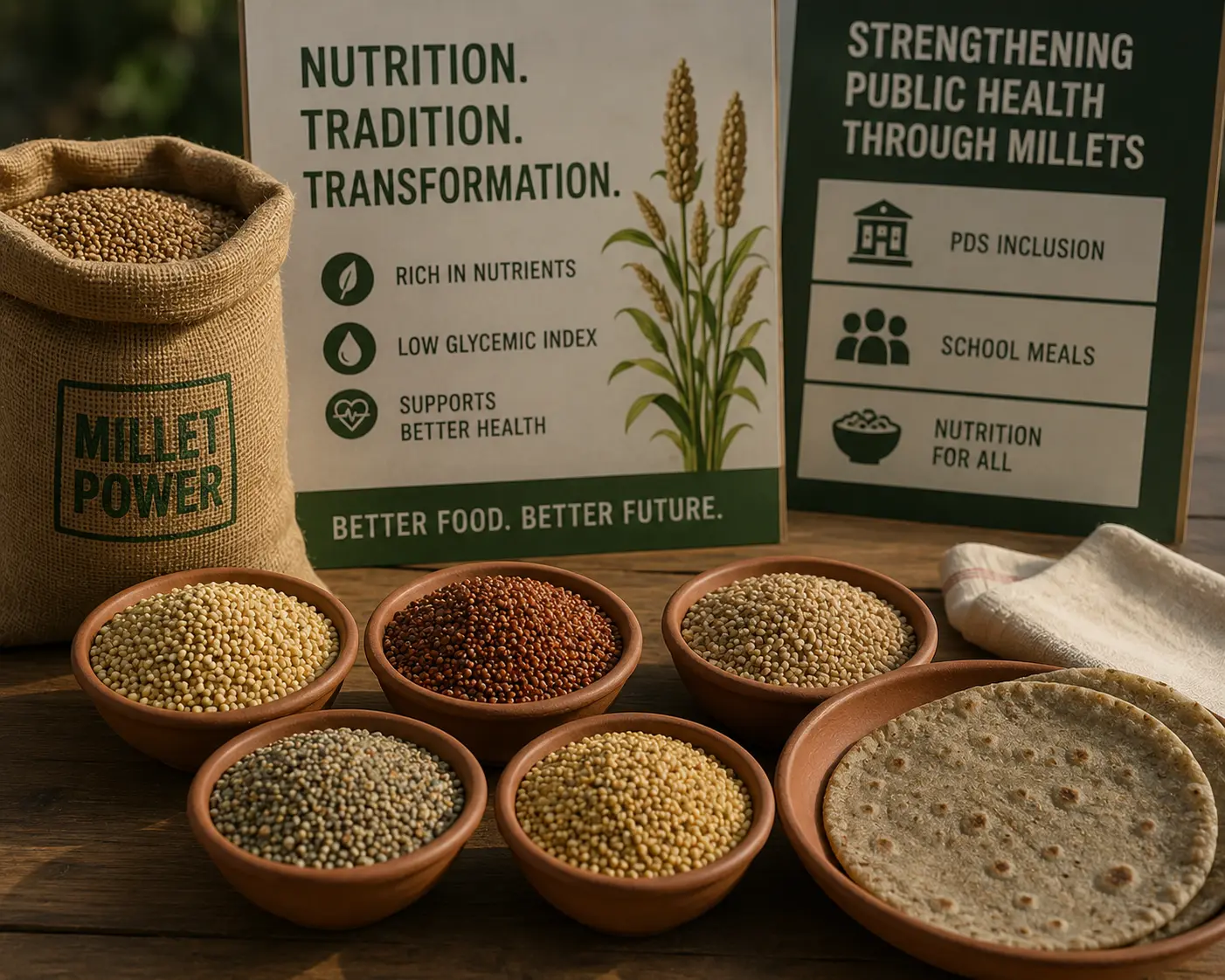
For so long, Indian diets — both urban and rural — have leaned heavily on polished rice and fine wheat flour. On the surface, it might seem like sufficient nutrition, but the reality is more complicated. There is the simultaneous occurrence of micronutrient deficiencies alongside a surge in lifestyle diseases — type-2 diabetes and cardiovascular conditions — affecting all demographics. Processed grains play a significant part in this double burden.
Millets stand out nutritionally because of their low glycaemic index (GI). The carbohydrates in millets break down much more slowly in the body, preventing the sharp blood sugar spikes associated with polished white rice — a critical advantage for those managing diabetes or metabolic conditions. Beyond glycaemic control, millets are packed with vital micronutrients: iron, zinc, and magnesium. They are a rich source of dietary fibre, which is crucial for digestion and overall gut health. Finger millet (ragi) has significantly more calcium than wheat or rice — especially valuable for mothers and young children.
This understanding is beginning to influence official policy. Millets, once barely a footnote in national food distribution, are now being integrated into the National Food Security Act framework, the Public Distribution System, and school lunch programmes — with major scale-up initiatives expected to accelerate through 2026. This shift offers India a genuine opportunity to improve public health outcomes for the most vulnerable, boost farmer incomes in dryland regions, and ease the long-term burden on the healthcare system from widespread malnutrition and chronic disease.
Institutional Obstacles and the Road Ahead
Even with positive momentum, scaling millet cultivation nationally is not straightforward. For decades, the entire system — research, subsidies, infrastructure, and farmer training — has been built around rice and wheat. Shifting that ingrained structure requires serious time and effort. Consumer preferences for finer, more processed grains also pose a challenge, requiring substantial awareness campaigns and culinary education. For small farmers, access to certified high-yield seeds remains difficult, and local milling and hulling equipment is not universally available. Post-milling shelf life is shorter than conventional grains, which complicates distribution.
India's agricultural policymakers have responded with a comprehensive approach for 2026. Agricultural budget allocation has grown from approximately ₹219 billion in 2013–14 to a massive ₹1.3 trillion earmarked for 2026–27. A key part of this plan directs funding to women's self-help groups and farmer producer organisations (FPOs) to acquire local hulling and milling equipment — processing millets close to the harvest site, reducing transportation costs, extending flour shelf life, and keeping a larger share of profits within rural communities.
Simultaneously, dedicated research centres like the Indian Institute of Millets Research (IIMR) are developing new seed varieties focused on yield enhancement, weather resilience, and the preservation of the natural toughness that makes millets so structurally superior.
At its heart, bringing millets back in a meaningful way is about restoring balance to a farming system that has been under severe pressure. It is the combination of ancient agronomic knowledge, modern processing technology, and supportive institutional policy — building a food system capable of withstanding climate shocks and economic disruptions, ensuring the country can reliably feed its population and sustain vibrant rural economies for the long haul.
Read Further
[1] Press Information Bureau, Government of India. Shree Anna for Shreshta Bharat — Empowering India through Millets (August 2025) — Click here
[2] Press Information Bureau, Government of India. Record Foodgrain Output 2024–25: Final Estimates of Crop Production — Click here
Disclaimer: The analysis, data points, and policy assessments presented in this document are synthesised from current 2025–2026 public agricultural data, including updates from the Press Information Bureau (PIB), the Ministry of Agriculture & Farmers Welfare, and APEDA export roadmaps. Budget numbers reflect the structural shift toward the ₹1.30 lakh crore agricultural allocation for the 2026–27 fiscal year. This document is intended for research and educational purposes and does not constitute formal commercial investment or trade advice.
Advertisement