

It's a funny thing, isn't it? We're living in an age where AI seems to be everywhere, churning out content and making decisions for us. It's become such a big part of our lives, and honestly, it's a bit of a mixed bag. Some days it feels incredibly useful, and other days, well, you just wonder.
Coming into 2026, there was this almost unbelievable wave of optimism washing over the global financial markets. What was powering it, you ask? Largely, it was the phenomenal growth of the semiconductor sector. Huge amounts of money were being poured in, not just from the usual players but from major hyperscalers and institutional investors. This influx of capital pushed the market value past a staggering $923 billion in 2025. That's a pretty wild 26% jump from the year before. And the buzz was so strong, with early predictions confidently stating the industry would hit the $1 trillion mark by the middle of 2026, that the big tech-focused stock indexes seemed completely invincible. But then, as the second quarter of 2026 was winding down, reality hit hard. A sudden, widespread tech sell-off occurred, and the Philadelphia Stock Exchange Semiconductor Index took a massive hit, dropping 7.9% in just one week. That was the biggest weekly fall we'd seen since early 2025. This brings up some big questions about how we navigate this AI-driven world. What should we be doing with these new AI tools, and perhaps more importantly, when should we be sticking with the tried-and-true, traditional methods for understanding market potential? It's about figuring out this underlying paradox we're seeing and understanding why the global chip stock sector suddenly found itself in such choppy waters.
These AI financial tools, the ones used by big companies and enterprises, they're not just simple prediction machines anymore. They've evolved into these complex networks that can act on their own. They've directed billions of dollars into technology infrastructure, refining investment portfolios, forecasting company earnings, and basically demanding more and more processing power – faster and at a higher cost. But this heavy reliance on one particular way of doing things, this single architectural approach, has created some serious bottlenecks throughout the entire economic system. That recent market correction really underscored a crucial point: while the long-term trend towards digital automation and more sophisticated chip packaging is definitely here to stay, the immediate economic realities have been violently shaken loose from what people were expecting in the short term. Investors are now facing a trifecta of major structural challenges. First, there's the tough realization that the massive investments being made in AI hardware aren't yet translating into quick commercial returns. Second, there are significant imbalances in the supply chain, partly because of memory chips being used in a way that cannibalizes other parts of the market. And third, the global trade environment has become really aggressive, with immediate threats of new tariffs popping up.
Looking at the performance metrics for the key sectors as of the second quarter of 2026, we saw the SOX index drop 7.9% in a single week in June. Meanwhile, hyperscalers were running their capital expenditures at an estimated $600 billion for 2026. On the memory side, DRAM revenue actually spiked by 177% year-over-year. And perhaps a concerning statistic, the error rate for AI projections has reached a threshold of 65%.
The AI Hype Meets the ROI Reality Check
It seems like the tech world has been in a bit of a frenzy lately, doesn't it? A lot of the recent jitters in the market can actually be traced back to how companies are thinking about getting their money back from all these big tech investments. You know, that whole "return on investment" thing. For a while there, especially through 2024 and 2025, it felt like every tech company was gripped by this intense fear of missing out, or FOMO as we call it. This led to an absolutely massive surge in spending on new technology, especially for cloud infrastructure. We're talking about a projected $600 billion being poured into cloud provider infrastructure by the end of 2026. Data centers have been packed to the gills with the latest and greatest GPUs and specialized chips designed for specific tasks.
But here's the rub: when the financial results for the second quarter of 2026 started rolling in, something interesting became clear. While the companies that make these chips, the semiconductor vendors, are reporting insane backlogs and raking in record profits, the businesses actually buying them are finding it hard to show a clear path forward for making money from the software they're building with all this new hardware. They're struggling to justify the huge upfront costs.
Now, most companies that build these enormous data centers don't expect to see their investment paid back in just the first year. That's pretty standard. However, what financial analysts are pointing out is that over a more typical business timeline, you'd expect to see a clear and predictable increase in how much software is being adopted and used down the line. But recent surveys of businesses indicate that turning all these complex generative AI and agent-based workflows into actual revenue is taking longer than anyone predicted.
Think about it: deploying these advanced autonomous chatbots and automated processes requires constant, heavy monitoring of prompts. What was sold as a sort of effortless tool is turning into a demanding, time-consuming task. When businesses that are clients of these software providers run into system errors or get inconsistent results, they tend to pull back on their integration plans. This slowdown, this friction, has made its way back to Wall Street. Now, there's a growing concern that future data center projects might be put on hold or significantly scaled back in the last part of 2026. It's like the excitement was running ahead of the practical reality.
You can see how this would play out. When growth is this explosive, but it's built on less-than-solid ground, and the initial excitement starts to fade, a market correction often becomes unavoidable. It's not just a possibility; it's almost a given.
And on top of all that, we're running into some very real physical constraints. The capacity of the power grid is becoming a significant bottleneck for building new data centers. We're seeing a shift towards a model where high-end server hardware is sold in smaller quantities but at a much higher profit margin. But if the basic infrastructure, like the electricity and cooling systems, can't handle the immense demands of these new data centers, then orders for advanced chips could face immediate cancellations. Investors who had been betting on these tech stocks to grow by 25% or more every single year, indefinitely, are suddenly realizing that the technology sector isn't immune to the natural cycles of capital investment that affect every other industry. What we're witnessing is a classic shift away from a period of speculative frenzy towards a phase where the practical, structural realities of the market are being tested. And unfortunately, this transition is leaving a lot of highly leveraged growth portfolios in a very exposed position.
The Great Cannibalization: Memory Shortages and Consumer Tech Slack
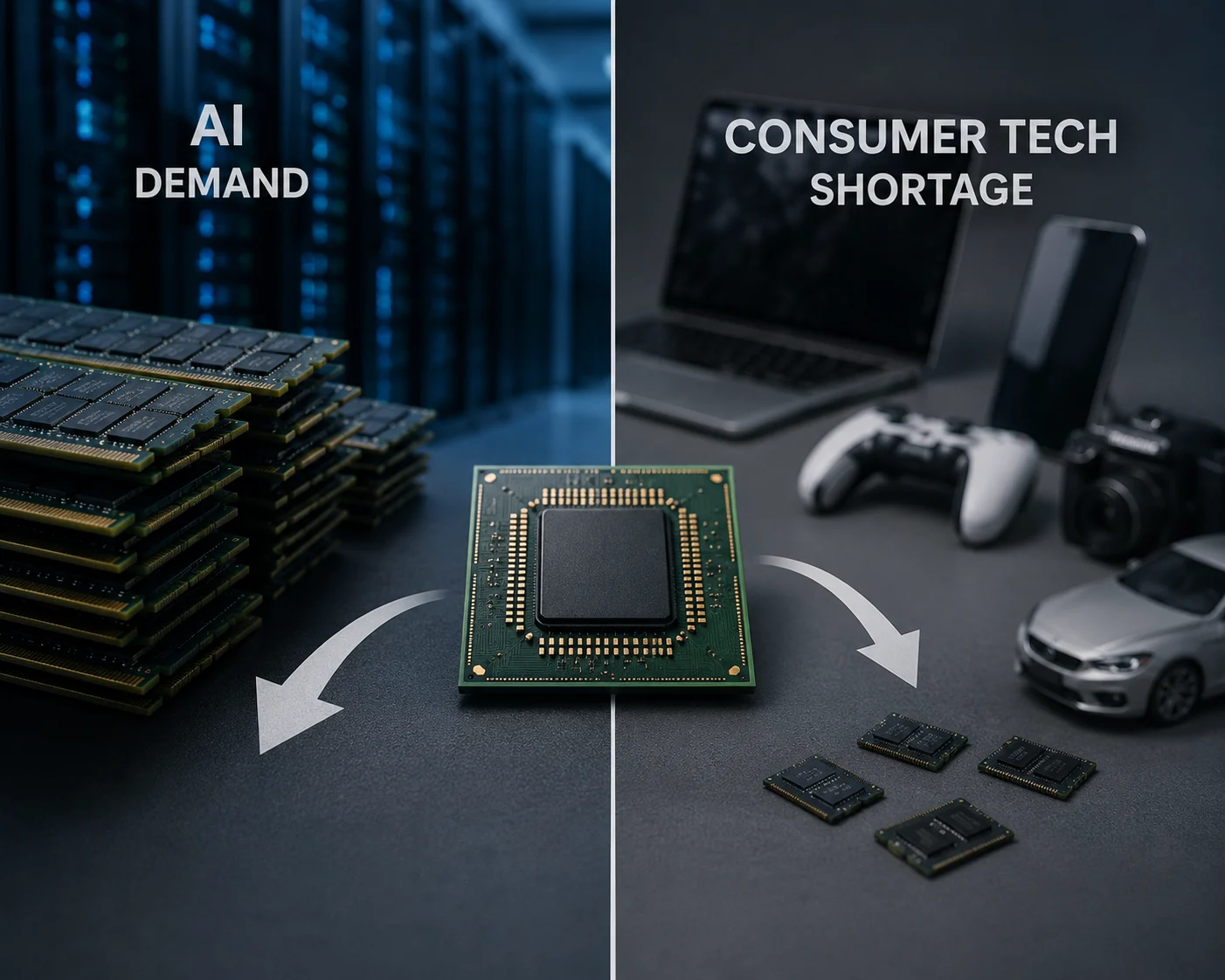
It's interesting, isn't it, how everyone's talking about AI? That narrative has completely taken over the conversation, overshadowing this massive underlying issue happening in the wider semiconductor world. We're talking about a fundamental shift, a real structural problem where memory capacity is being cannibalized, almost entirely. Think about the numbers: projections show the global memory sector raking in a staggering $594.7 billion by 2026. A huge chunk of that, $418.6 billion, is expected to come from DRAM alone, nearly tripling its current revenue.
What's driving this surge? It's the big cloud players, the hyper-scalers. They're not looking for just any components anymore; they're demanding a specialized, premium class. I'm talking about High-Bandwidth Memory, or HBM, and enterprise-grade DDR5 modules. Now, producing these advanced chips isn't a simple task. It eats up a lot more wafer space, and they require incredibly complex packaging. Because of this, the big foundries, the manufacturing powerhouses, have made a strategic pivot. They're aggressively shifting their production lines away from the standard parts we see in everyday consumer electronics and pouring them into these high-margin, AI-focused orders.
This deliberate shift in how resources are allocated at a macro level is having a ripple effect, causing serious shortages downstream for everything that isn't directly tied to AI. We're seeing consumer platforms suddenly grappling with component price spikes. In fact, memory prices are expected to shoot up by over 50% by the middle of 2026. This imbalance is really hitting the traditional computing sectors hard, and the financial implications are becoming unavoidable.
Take personal computing, for instance. Major chip designers for legacy processors have already put out cautious guidance for the second quarter of 2026. They're explicitly pointing to a severe lack of essential memory components as the main roadblock, the critical bottleneck preventing them from shipping standard PCs. It's not just a minor hiccup; it's the core issue.
And it's not just PCs. Smartphone manufacturers are facing supply chain halts. Leading mobile chipset providers have been informing global markets that their revenue forecasts are being revised downward. The reason? Smartphone original equipment manufacturers, or OEMs, simply can't get their hands on the balanced set of parts – the bill of materials – they need to build their standard inventory. You can't build a phone if you're missing key components.
Even the automotive and industrial sectors are feeling the pinch. Foundries that are set up for advanced packaging processes are now so backlogged with these premium orders that they're struggling to allocate capacity for older, more mature analog and discrete chip production. This is directly stalling any full-scale recovery for industries that rely heavily on automotive components and industrial machinery.
This whole dynamic creates this really high-stakes paradox for global supply chains. On one hand, the overall semiconductor market seems to be expanding, pushing past previous limitations, and showing incredible growth. Yet, the very sectors that have historically been the volume drivers – things like everyday laptops, mainstream smartphones, and standard edge computing devices – are facing a forced contraction. It's like the industry has put all its operational eggs, and its investment capital, into the AI basket. In doing so, they've inadvertently choked off the foundational consumer product channels, the ones that used to provide that steady, predictable baseline support, especially during those times when the economy would normally slow down.
Geopolitical Fractures and Tariff Turbulence
It feels like the semiconductor industry is going through a rough patch lately, and it's not just about how companies are managing their own product lines internally. There's a much bigger storm brewing, fueled by a noticeable spike in global regulatory hurdles and governments stepping in with trade restrictions. As we move into the latter half of 2026, it's becoming pretty clear that where and how international chips get made is right in the middle of a fierce legislative battle.
Leaders around the world seem to be placing a much higher value on bringing chip manufacturing back home, within their own borders, rather than relying on the established global supply chains. This shift is really forcing the massive chip foundries, the big players in the industry, to consider building complex and often redundant facilities in expensive domestic locations. Now, these new domestic production plans are often propped up by substantial government subsidies, thanks to various national capital acts. However, this move isn't without its own set of serious challenges. We're talking about significant risks when it comes to actually getting these projects off the ground, the sheer difficulty of construction, and the tough competition for skilled talent. All of these factors are starting to cast a shadow over future cash flow projections for the medium term.
And then there are the recent trade policy announcements. These have really sent tremors through the technology sector across the globe. We're hearing about executive threats to implement aggressive tariff structures, with potential penalties as high as a staggering 100% for companies that continue to use manufacturing facilities overseas without specific local production commitments. This has sent portfolio managers scrambling to reassess the long-term profitability of their investments. The intricate and, frankly, quite delicate network of suppliers providing essential chemicals, materials, and the highly specialized lithography equipment is still very much concentrated in specific areas. The worry is that if just one country decides to restrict the flow of crucial rare gases or advanced optical components, the operational capability of even the most advanced chip fabrication plants on the planet could grind to a halt, potentially within a matter of weeks. The market is starting to wake up to this geopolitical risk, and it's beginning to price it into the value of these companies. It's becoming increasingly apparent that just throwing money at structural issues, like production bottlenecks, isn't a simple fix when the cross-border policy environment is actively working against international collaboration.
Valuations, Volatility, and the Cyclical Trap
Looking at this purely from a money standpoint, the big hit semiconductor stocks are taking right now? It boils down to them being priced way too high before. Seriously, the Philadelphia Semiconductor Index shot up by a wild 94% by the middle of 2026. That was the biggest yearly jump we'd seen since the dot-com bubble went nuts back in 1999. Meanwhile, the rest of the stock market looked pretty tame by comparison. This meant a ton of big money, the institutional kind, got crammed into just a handful of tech companies that were really flying high. When everyone is piled into the same few places, even a small hiccup in how a company is doing can set off a massive domino effect, sending prices tumbling.
On top of that internal stock market stuff, the global economic picture is also changing. Inflation is sticking around, and businesses are still spending a lot of money. This has central banks, especially the US Federal Reserve, on edge. They've even hinted at possibly raising interest rates later in 2026 to try and calm down industries that are going a bit overboard. Now, higher interest rates are generally bad news for growth stocks that already have very high valuations. It makes those future earnings, which are expected way down the road, worth a lot less today. If investors can get a steady, reliable return from government bonds, they're a lot less likely to bet on tech companies with really high stock prices based on future potential. So, you see this big shift where money moves out of those expensive chip stocks and into safer areas or companies that are more reasonably priced. It's just the market adjusting to a tighter financial environment.
At the end of the day, the semiconductor world is getting a reminder – like it has before – that it can't completely break free from its ups and downs. While new AI technologies are definitely changing the game for long-term demand, the practicalities of building massive, expensive factories, dealing with limited raw materials, and keeping finance chiefs happy are still very much tied to how normal markets work. This current slowdown? It's actually a necessary and healthy breather. It's shaking out the excess speculation and pushing the tech sector to make sure its actual operations are in sync with real, sustainable customer needs.
References & Further Reading
- Why AI and Semiconductor Stocks Stumbled — Axios
- What Triggered the Recent Semiconductor Sell-Off — Kavout (citing Deloitte and IDC data)
- Wall Street's Hottest Trade Is Cracking in a Trillion-Dollar Wipeout — Yahoo Finance