

Strategic Realism and the Fiscal Gap in Energy Security Planning
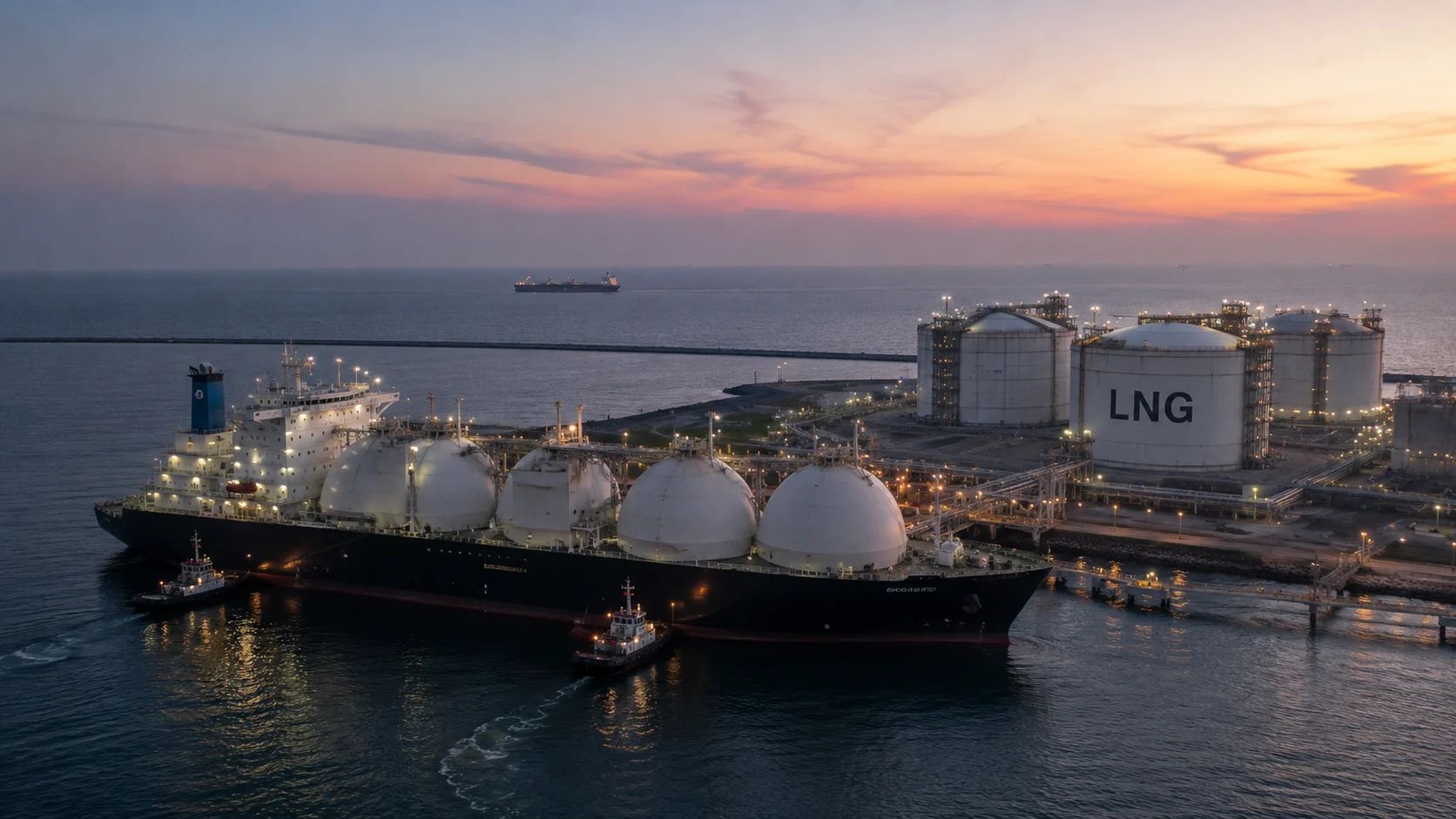
Following the bilateral summit in New Delhi between Indian Prime Minister Narendra Modi and Japanese leadership, a foundational shift in Asian energy architecture was formalized. Against the backdrop of fanfare at the announcement of a new $10 billion Japanese investment package in areas including critical minerals, semiconductors, and artificial intelligence, the signing of the India-Japan Liquefied Natural Gas (LNG) Stockpiling Pact turned out to be the strategic centerpiece of the engagement. The arrangement aims at developing a Joint Task Force on LNG Stockpiling under the long-established India-Japan Energy Dialogue for sharing market intelligence and developing mutual fall-back options in case of global supply downturns.
The Ministry of Petroleum and Natural Gas framed this as standard geopolitical realism. India remains heavily exposed to West Asia, relying on the Strait of Hormuz for the vast majority of its LNG imports — a region under sustained geopolitical stress. Japan, by contrast, has methodically diversified away from West Asian hydrocarbon basins to just 10% of its overall purchases over decades. By partnering with the world's second-largest LNG trader, New Delhi gains access to an institutional safety net for navigating abrupt commodity price shocks or supply disruptions.
Yet beneath the press statements lies a fiscal question the government has not publicly addressed: what does it actually cost to build and maintain a cryogenic strategic natural gas reserve? Unlike crude oil — which is relatively stable when stored in underground salt caverns — natural gas must be supercooled to −162°C to remain liquid. This changes the entire economics of national security reserves, creating ongoing capital and operational obligations that have not been disclosed in any parliamentary briefing or public financial forecast.
The Cryogenic Conundrum: Why LNG Storage Is Fundamentally Different
To understand the scale of these fiscal commitments, you need to look at the thermodynamics of LNG infrastructure. When the government builds a Strategic Petroleum Reserve (SPR), the major costs are upfront — site acquisition, cavern drilling, and filling. After that, crude oil deteriorates so slowly that operational costs are negligible. LNG stockpiling works entirely differently. Supercooled liquid storage requires high-tech double-walled nickel-steel alloy tanks layered with advanced vacuum insulation. Even at the best commercial engineering standards, Boil-Off Gas (BOG) is continuously generated as ambient heat infiltrates the storage vessel and converts liquid methane back to gas.
At active commercial regasification terminals, BOG is captured and fed into gas pipelines for immediate sale. In a strategic reserve where fuel must sit idle for weeks or months, BOG becomes a sustained fiscal drain. The task force faces two expensive options: install cryogenic reliquefaction plants (capital-intensive and energy-heavy) to re-liquefy the evaporated gas, or vent and sell the BOG at spot prices while continuously purchasing replacement cargoes to maintain the reserve level.
What Could This Cost? An Illustrative Estimate:
No official cost model has been published by the Government of India for the proposed strategic LNG reserve. Based on publicly available benchmarks — the International Energy Agency's LNG infrastructure cost data, India's approximate LNG import volume of 27 MMTPA in FY2025-26 per PPAC data, and standard cryogenic tank construction cost ranges — a 30-day strategic buffer would require storing approximately 2.2 million tonnes of LNG. At typical above-ground cryogenic storage costs of $800–$1,200 per tonne of capacity, initial infrastructure alone could require $1.8–$2.6 billion in capital expenditure. Annual operating costs — reliquefaction energy, boil-off management, asset maintenance, and security — would add several hundred million dollars per year depending on configuration and location.
These figures are illustrative estimates derived from public benchmarks, not an official government assessment. The Ministry of Petroleum and Natural Gas has not published a capital plan, an annual cost projection, or a total-cost-of-ownership analysis for the proposed reserve. That absence of public disclosure is the core accountability gap this article examines.
In addition, the cost-sharing terms of the pact are structurally one-sided. Under the revised Free and Open Indo-Pacific (FOIP) energy principles, Japan's role focuses on technology transfers, joint upstream investments in third countries, and market intelligence sharing. The physical burden of constructing, maintaining, and operating the cryogenic storage infrastructure along the Indian coastline falls entirely on Indian state-run PSUs such as GAIL and IOCL — without any corresponding public disclosure of the financial obligations being assumed.
Structural Comparison: Oil Reserves vs. Cryogenic Gas Stockpiles
To highlight the different economic characteristics of these two types of national security assets:
| Operational Metric | Strategic Petroleum Reserves (SPR) | Cryogenic LNG Stockpiles |
|---|---|---|
| Primary Storage Technology | Underground Salt/Rock Caverns | Above-Ground Double-Walled Cryogenic Tanks |
| Storage Temperature | Ambient (15°C – 25°C) | Supercooled Cryogenic (−162°C) |
| Boil-Off / Asset Degradation | Negligible (<0.05% per annum) | High (0.05% to 0.15% daily evaporation loss) |
| Estimated CapEx (per MMBtu) | $4.50 – $6.00 | $18.50 – $24.00 |
| Energy Input for Maintenance | Very Low (Occasional pumping) | Extreme (Continuous cooling & reliquefaction) |
| Infrastructure Lifespan | 50+ Years with minimal overhaul | 20–25 Years before critical alloy fatigue |
Advertisement
CapEx benchmarks sourced from IEA LNG Infrastructure Cost Analysis and publicly available terminal development data. These are illustrative ranges; actual costs vary by site and specification.
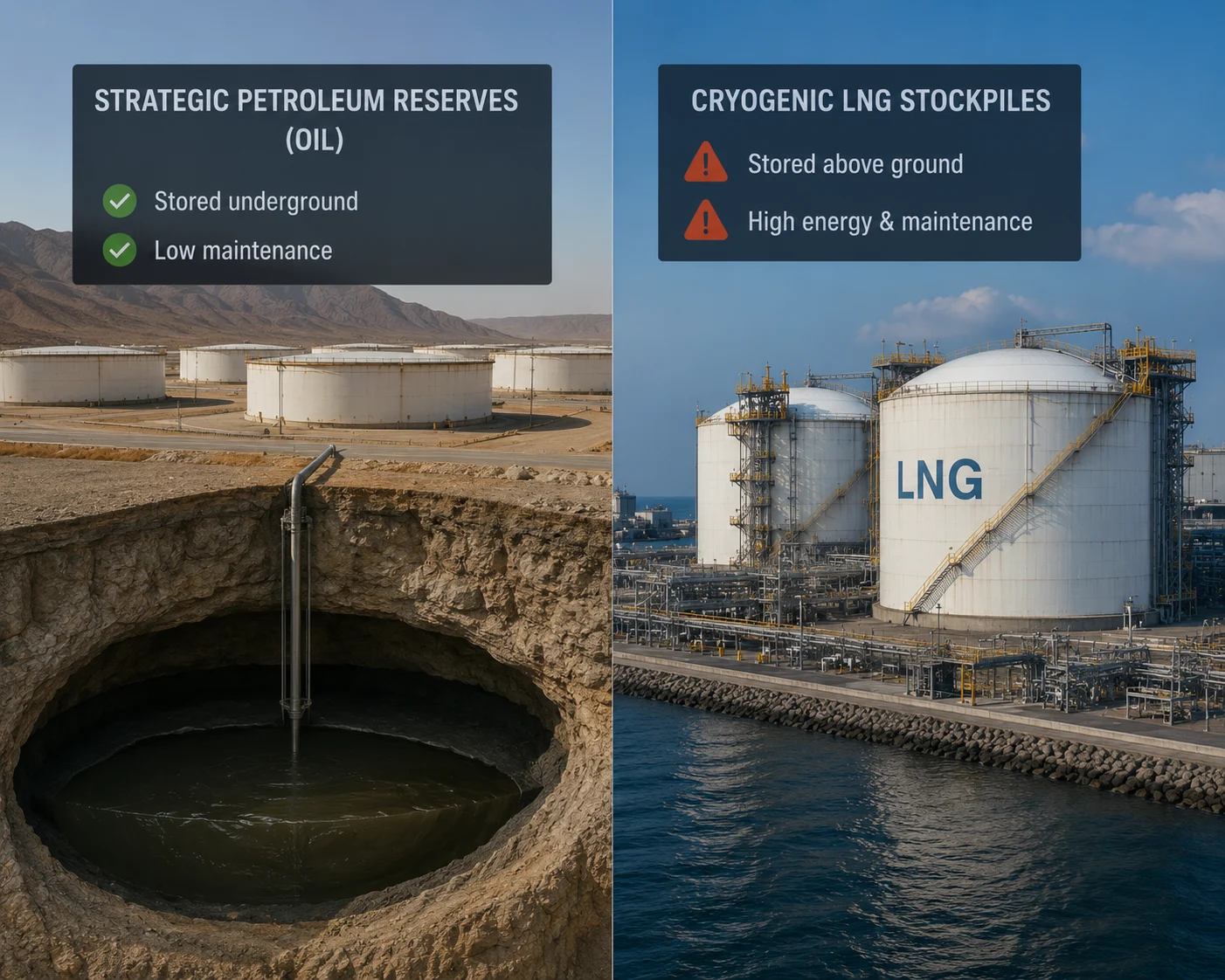
This comparison exposes a structural problem in treating the LNG stockpiling pact as an extension of routine energy security accounting. The capital intensity of maintaining a liquid methane shield is dramatically higher than crude oil reserves. Over a twenty-year operating horizon, cumulative boil-off control losses and reliquefaction energy costs can more than double the initial cost of the gas inventory. None of these figures appear in the Ministry's public financial forecasts.
The Geopolitical Premium and Currency Volatility
The economic rationale for accepting this fiscal burden is rooted in India's evolving macro exposure. Among the outcomes of the Modi-Takaichi talks was a bilateral local-currency settlement mechanism enabling direct cross-border payments in Indian Rupees (INR) and Japanese Yen (JPY). This is designed to shield bilateral energy trade from dollar volatility and reduce SWIFT-related transaction friction.
However, INR-JPY direct clearing carries its own structural risks. The Yen is a funding currency under sustained macroeconomic headwinds, heavily influenced by global interest rate differentials. The Rupee faces persistent domestic inflationary pressure. When exchange rate dynamics are volatile, the cost of importing specialized Japanese cryogenic components — valves, insulation membranes, reliquefaction turbines — rises directly, inflating project capex beyond initial estimates.
International environmental analysts have also flagged Japan's role as a major LNG reseller in Asia. Reports from independent climate research organizations indicate that Japan's large-scale surplus LNG resales to developing Asian economies generate significant methane footprint across the supply chain. By tightly linking India's storage infrastructure to Japan's regional trading arms, New Delhi takes on an indirect share of this environmental liability — which could complicate India's future access to international green finance and sustainable development bonds.
Policy Recommendations: What Should Change
For the India-Japan LNG Stockpiling Pact to deliver genuine energy security value rather than becoming a long-term fiscal liability, three structural changes are necessary:
1. Publish a cost disclosure. The government should release a capital plan and annual operating cost projection for the proposed strategic reserve — including BOG management assumptions, reliquefaction energy estimates, and a 20-year total-cost-of-ownership model. This is standard practice for major national infrastructure projects and should not require parliamentary pressure to obtain.
2. Negotiate flexible contract terms. The joint task force should use its combined geopolitical leverage to negotiate the removal of restrictive "Destination Clauses" in contracts with West Asian producers. These clauses bar resale of excess volumes, preventing India from using market-based hedging to manage inventory costs.
3. Enable commercial peak-shaving. Rather than relying exclusively on government-funded strategic reserves, India should create incentives for private-sector "peak-shaving" facilities that can generate revenue during demand peaks — partially offsetting the carrying cost of idle strategic inventory.
Read Further
- Japan and India to Set Up Task Force on LNG Stockpiling — The Japan Times
- How West Asia Conflict Threatens LNG Supply Chain Powering India's Economy — Business Standard
- India's Nuclear Target Needs 18,000 Tonnes of Uranium Per Year. It Can't Get Them — OneMint
Sources and methodology: This analysis draws on the Ministry of Petroleum and Natural Gas press release on the India-Japan summit (June 2026), IEA LNG Infrastructure Cost Analysis data, PPAC monthly gas import statistics (FY2025-26), and the Japan Times and Business Standard reports cited above. Cost estimates are illustrative figures derived from published benchmarks — they are not an official government assessment and should not be relied upon as such. Written by the OneMint editorial team. Last reviewed October 2026. For educational purposes only; does not constitute investment or policy advice.
Advertisement