

In today's global macroeconomy, where zero-carbon base-load power is the absolute gold standard for sustaining advanced technological infrastructure, industrial manufacturing, and hyperscale artificial intelligence ecosystems, nations are racing toward deep nuclear diversification. Yet, a striking paradox manifests when we balance paper-thin policy projections against tough geological variables. We live in an era where strategic targets are easily generated by executive decree and economic modeling, making us heavily dependent on ambitious numbers, without addressing where the physical raw materials will actually come from. India's recent legislative and structural shifts, highlighted by the milestone provisions of the SHANTI Act and massive allocations in the Union Budgets, clearly demonstrate a desire to aggressively expand the nation's nuclear fleet. The state has outlined an aggressive roadmap to scale its installed atomic capacity from a modest base of approximately 8,880 MWe to a massive 100 GWe by the centenary of its independence in 2047. This represents an unprecedented ten-fold scaling of an indigenous nuclear grid that took over six decades to construct. However, when we strip away the optimism of structural milestones and investment frameworks, we run directly into a severe supply-side problem: a massive domestic deficit of uranium ore.
"To scale an atomic empire from 8.8 GW to 100 GW requires more than just capital, policy, or political will. It requires an ocean of fissile material that India simply does not possess within its borders."
The Mathematics of a 100 GWe Grid and the Fissile Gap
The scale of India's energy challenge becomes clear when looking at the cold numbers of reactor physics and consumption rates. Conventional nuclear infrastructure, particularly the Pressurized Heavy Water Reactors (PHWRs) and imported Light Water Reactors (LWRs) that form the near-term foundation of India's grid expansion, are completely dependent on steady, highly secure uranium fuel cycles. At present, India's operational fleet consumes hundreds of tonnes of uranium annually, which is already a difficult target for domestic mines to sustain.
When the target scales to 100 GWe of baseline nuclear capacity, the consumption metrics grow exponentially. Comprehensive tracking and fuel lifecycle models reveal that achieving and maintaining a 100 GWe nuclear infrastructure will require between 18,000 and 20,000 tonnes of elemental uranium per year. To put this figure in perspective, 18,000 tonnes represents nearly one-third of the entire global annual production of uranium. For a single nation to capture and consume such a massive share of global supply requires either total domestic supply independence or flawless, unimpeded international trade pipelines. India possesses neither.
18,000+ tonnes — the estimated volume of uranium fuel required every year to support a 100 GWe nuclear grid by 2047.
~33% of total global annual output — India's targeted fuel requirement compared against the entire planet's current annual extraction volume.
The core structural problem lies in the design architecture of India's current expansion phase. While the long-term dream focuses on advanced fuel-breeding cycles, the short-to-medium-term rollout relies heavily on the fleet-mode deployment of indigenously developed 700 MWe PHWRs, alongside large-scale foreign imports like the Russian VVER-1000 units. These reactors operate on a once-through or direct-use fuel cycle that demands constant replenishment of fresh fuel assemblies. Every additional gigawatt connected to the grid introduces a permanent, non-negotiable yearly fuel liability. If the fuel pipeline experiences even a brief disruption, the capital efficiency of these multi-billion-dollar installations drops sharply, leaving strategic grid assets idle.
The Domestic Bottleneck: Jaduguda and the Limits of Indian Ore
To understand why India cannot simply mine its way out of this dilemma, one must look at the geological realities managed by the Uranium Corporation of India Limited (UCIL). India's primary domestic source of uranium remains the historic Jaduguda mine in the Singhbhum Shear Zone of Jharkhand, which has been in continuous operation since 1967. While Jaduguda and its adjacent fields represent a triumph of domestic engineering, they suffer from a major structural flaw: extremely low ore grade. In global uranium mining, Tier-1 deposits in regions like Canada's Athabasca Basin or Kazakhstan boasts ore grades where the actual uranium concentration can exceed 1% to as high as 15% of the total rock mass. In sharp contrast, Indian uranium deposits are notoriously low-grade, frequently yielding less than 0.05% of usable uranium per tonne of extracted ore. In mathematical terms, to extract just one single kilogram of pure domestic uranium, UCIL must mine, crush, mill, and chemically treat more than two thousand kilograms of hard rock. This low concentration drastically increases the domestic production costs, limits the extraction speed, and creates a large volume of mill tailings that require intensive environmental management and long-term monitoring.
| Mining Region / Deposit | Primary Exploitation Entity | Typical Ore Grade (% U) | Relative Extraction Cost / Complexity |
|---|---|---|---|
| Athabasca Basin (Canada) | Global Commercial Vendors | 1.00% – 15.00% | Highly Economical / Ultra-High Concentration |
| Kazakh Steppes (Kazakhstan) | State-backed In-Situ Recovery | 0.05% – 0.10% | Low-cost In-situ Acid Leaching |
| Jaduguda / Singhbhum (India) | UCIL (State Sector) | 0.03% – 0.05% | High-cost Deep Underground Mechanical Mining |
| Tummalapalle (Andhra Pradesh) | UCIL (State Sector) | 0.04% – 0.05% | Complex Alkaline Leaching / Carbonate Host Rock |
Furthermore, expanding deep underground mines like Jaduguda, which has pushed past vertical depths of 900 meters to become one of the deepest operating mines in the country, presents severe structural limits. The physical laws of geology cannot be overridden by policy goals. As mines grow deeper, the ventilation demands, hoisting complexities, and thermal gradients scale exponentially. New discoveries, such as the Tummalapalle carbonate-hosted deposits in Andhra Pradesh, offer larger overall tonnage but introduce complex alkaline leaching requirements that slow down production. The domestic fuel chain is simply too narrow to handle the massive requirements of a 100 GWe rollout.
Advertisement
"When your domestic ore grade hovers at a fraction of a percent, achieving self-sufficiency isn't just an industrial challenge; it is a geological impossibility."
The Geopolitical Loom: The Danger of Sovereign Import Reliance
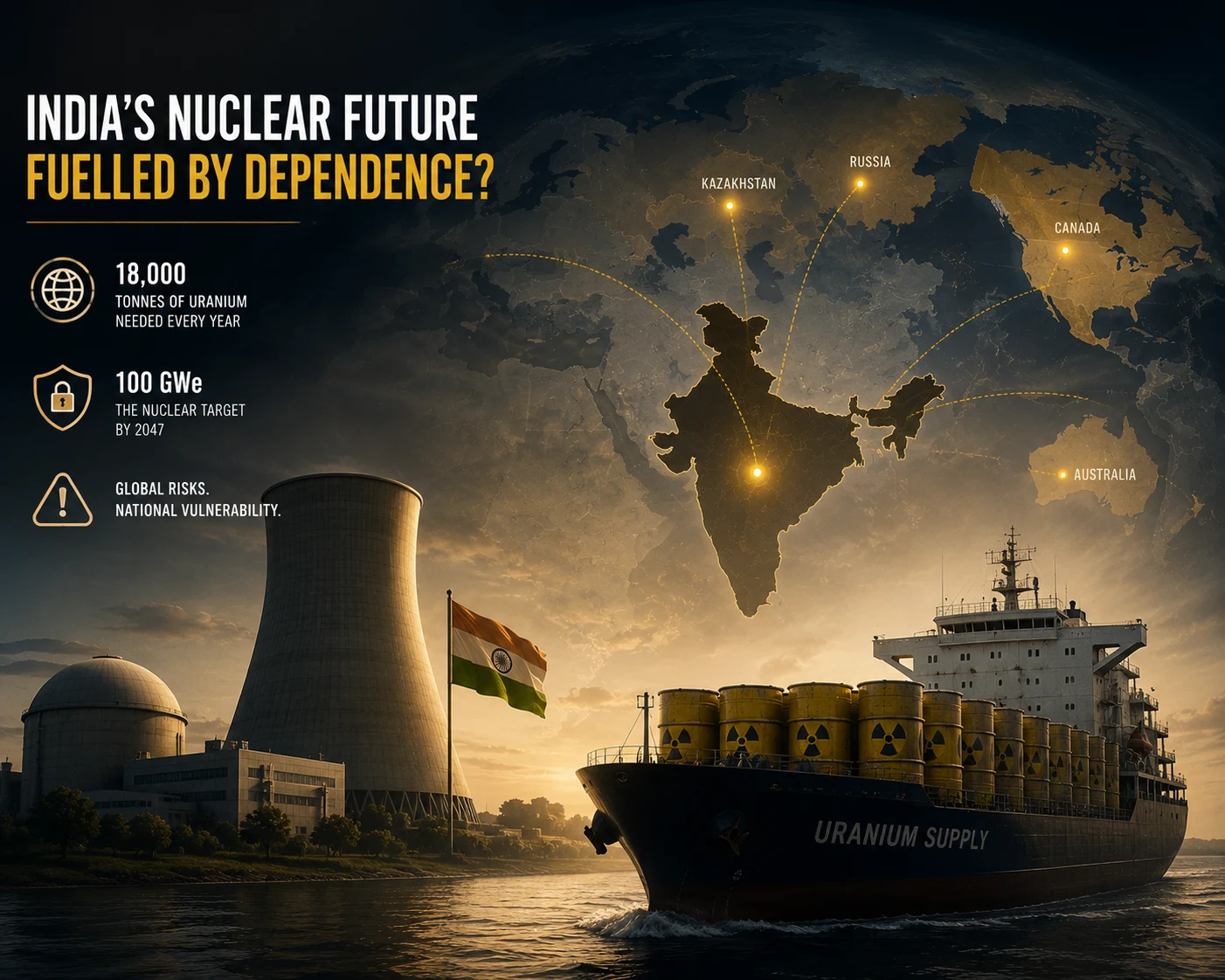
Because domestic extraction cannot support the target, India's nuclear roadmap is highly dependent on international procurement contracts. For decades, India found itself excluded from global atomic trade due to historical strategic standoffs. The 2008 civil nuclear waivers provided temporary access, allowing New Delhi to ink fuel supply agreements with sovereign producers like Russia, Kazakhstan, Canada, and Uzbekistan. However, swapping a domestic supply deficit for total dependence on foreign imports creates severe geopolitical vulnerabilities. The global uranium market is not a simple commodity exchange; it is a highly concentrated, geopolitically sensitive domain. A massive surge in global reactor construction, combined with unstable supply chains, means that competition for long-term fuel off-take agreements has intensified. If India enters this market needing to secure 18,000 tonnes annually, it will compete directly with well-funded state players and western utilities. Any disruption in trade access, shifts in foreign policy alignments, or maritime transport blockades could instantly jeopardize the reliability of India's baseload power grid.
This reality exposes a deep contradiction in the execution of India's clean energy transition. The push for 100 GWe is framed around energy security and cutting fossil fuel imports. Yet, by building a massive fleet of uranium-dependent reactors without a domestic fuel supply, the state simply trades an economic dependence on imported coal and gas for an absolute strategic dependence on imported foreign uranium. This reliance makes the national power grid vulnerable to external geopolitical pressures.
Structural Waves: SMRs, the SHANTI Act, and the Thorium Bridge
Recognizing the limitations of the traditional state-monopoly approach, the government has launched major structural and legislative overhauls. The introduction of the SHANTI Act represents a significant break from old policies, clearing the path for private capital deployment, operational partnerships, and corporate joint ventures in a sector that was once completely sealed off from commercial enterprise. This legislative shift is backed by a massive estimated capital requirement of ₹25 trillion to fund the 2047 target, an investment scale that requires drawing on private balance sheets. A key part of this strategy is the rapid development and deployment of indigenously designed Small Modular Reactors (SMRs), backed by targeted allocations like the ₹20,000 crore research and development mission announced in the Union Budgets. By shifting focus toward modular units like the BSMR-200, strategic planners hope to bypass the long deployment timelines and massive upfront capital demands of gigawatt-scale plants. Yet, even these smaller installations cannot escape the core problem of fuel access: they still require uranium. In fact, many advanced SMR concepts rely on specialized High-Assay Low-Enriched Uranium (HALEU), a material whose production chain is even more concentrated globally than that of natural uranium fuel.
Ultimately, India's long-term energy independence relies entirely on the final stage of its historic Three-Stage Nuclear Programme. The country holds some of the world's largest deposits of thorium along its coastal monazite sands. The core scientific strategy relies on a progression through specific cycles:
Stage I utilizes natural uranium in PHWRs to breed plutonium.
Stage II deploys Fast Breeder Reactors (FBRs), utilizing a mixed-oxide fuel of plutonium and depleted uranium to breed more fissile fuel. The equation can be visualized through the fundamental breeding reactions where fertile isotopes capture neutrons to become fissile assets:
238U + n → 239U → 239Np → 239Pu
And the eventual foundation of Stage III relies on converting abundant thorium into fissile uranium-233:
232Th + n → 233Th → 233Pa → 233U
The recent criticality of the 500 MWe Prototype Fast Breeder Reactor (PFBR) at Kalpakkam represents a crucial breakthrough into Stage II. However, scaling this up to a commercial level faces significant hurdles. Fast breeder technology is notoriously complex, demanding advanced liquid sodium cooling systems, precision metallurgy, and cost-effective fuel reprocessing. The transition from breeding plutonium to launching a commercial, self-sustaining thorium-based Stage III fleet will take decades of intense work. India cannot rely on a theoretical thorium future to fix a very real uranium shortage today.
Read Further
- India's Nuclear-Focused SHANTI Bill Completes Legislative Process — World Nuclear News
- India Is Building 100 GWe of Nuclear Capacity. The Fuel Question Has Not Been Answered — Nuclear Business Platform
- Prototype Fast Breeder Reactor, Kalpakkam — Wikipedia
Disclaimer: All data, factual assessments, and projections presented in this monograph are synthesized from public energy policy studies, geological survey records, and international nuclear market analysis. This analysis is compiled for educational and research reference and does not constitute a formal investment brief or sovereign advisory.
Advertisement