

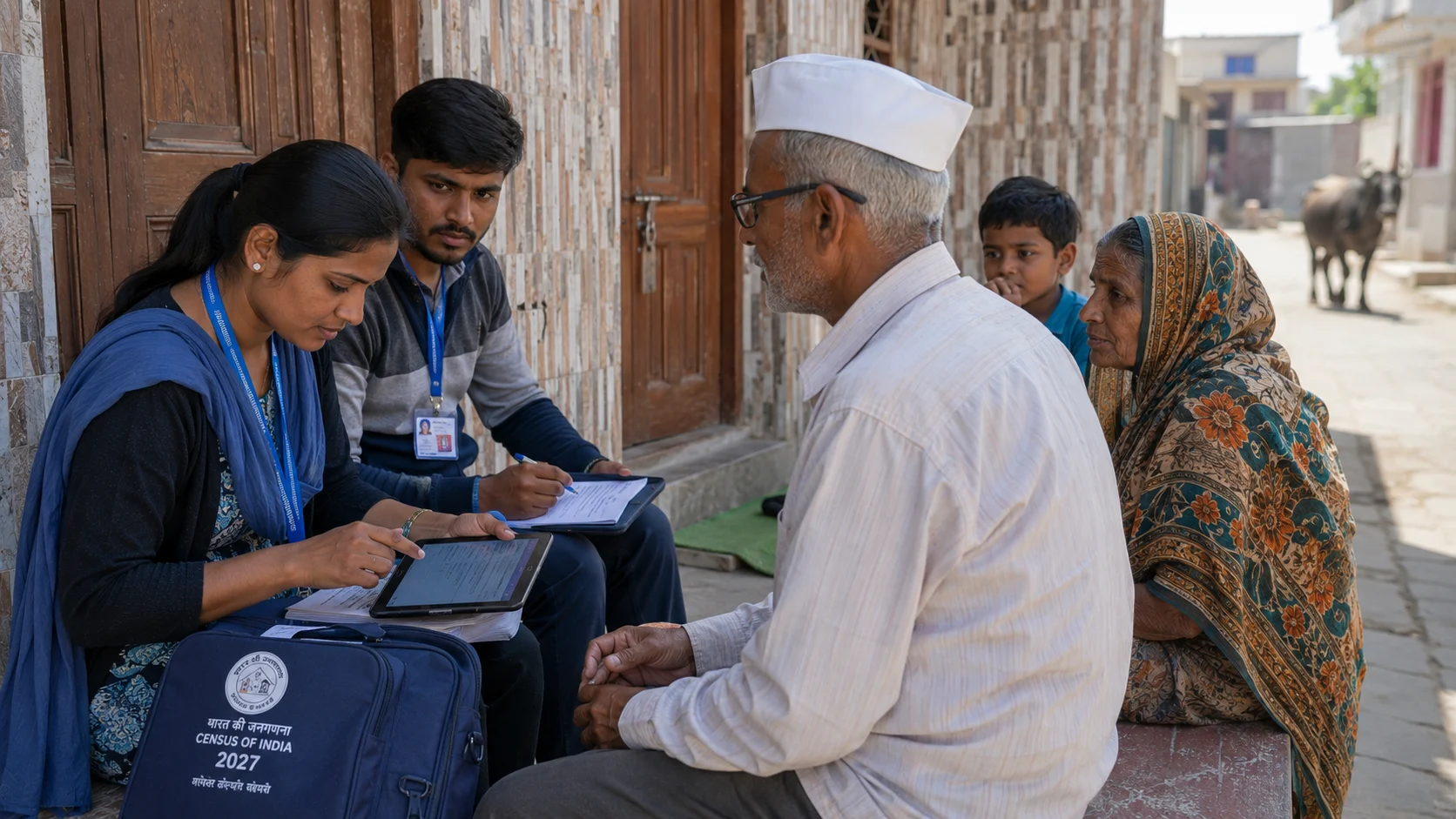
In an era of rapid geopolitical change and governance performance increasingly being gauged through constant data feeds and real-time layers of validation, we are increasingly reliant on automated models to explain demographics. In some ways this over-dependence is assisting us in rapid welfare thinking, and in others it is creating a structural gap where historical tracing frameworks are blurred. We have moved into a strange space where traditional manual processes are being replaced by full-blown cloud solutions, yet we are still trying to figure out how the very building blocks of population dynamics and community records are shifting right under our feet.
This article is intended to give you a high-level overview of the giant change in India's tracking of demography. It deconstructs the administrative machinery, data paradigms, and socio-political contours that are shaping the historic Census 2027 alongside the monumental Caste Enumeration exercise across key blocks in 2026.
Autonomous Digital Infrastructure and the Staggering Efficiency It Provides
As Census 2027 launches its design, collecting demographic data has shifted from binders of paper to a hyper-smart, real-time ecosystem. As the 16th Indian Census ever and the 8th since Independence, this gigantic exercise signals a complete paradigm shift in state logic and structural planning. The event, initially set for 2021 but delayed due to several global health crises, has returned — not as a simple late project but as a comprehensive restructuring of state observation.
The contemporary digital system extends beyond traditional field reports to a mobile data collection interface suite, a common control system, and cloud-based database solutions. Fieldworkers, numbering over 30 lakh trained personnel, are conducting house-to-house collection through specialized data entry interfaces. These tools enable immediate field validation, reducing post-collection data cleaning schedules from years to minutes. The addition of a separate self-enumeration web portal gives citizens a 15-day period to submit their information at their own convenience — before the physical household visit — enhancing both accuracy and community involvement.
Core Digital Pillars of Census 2027
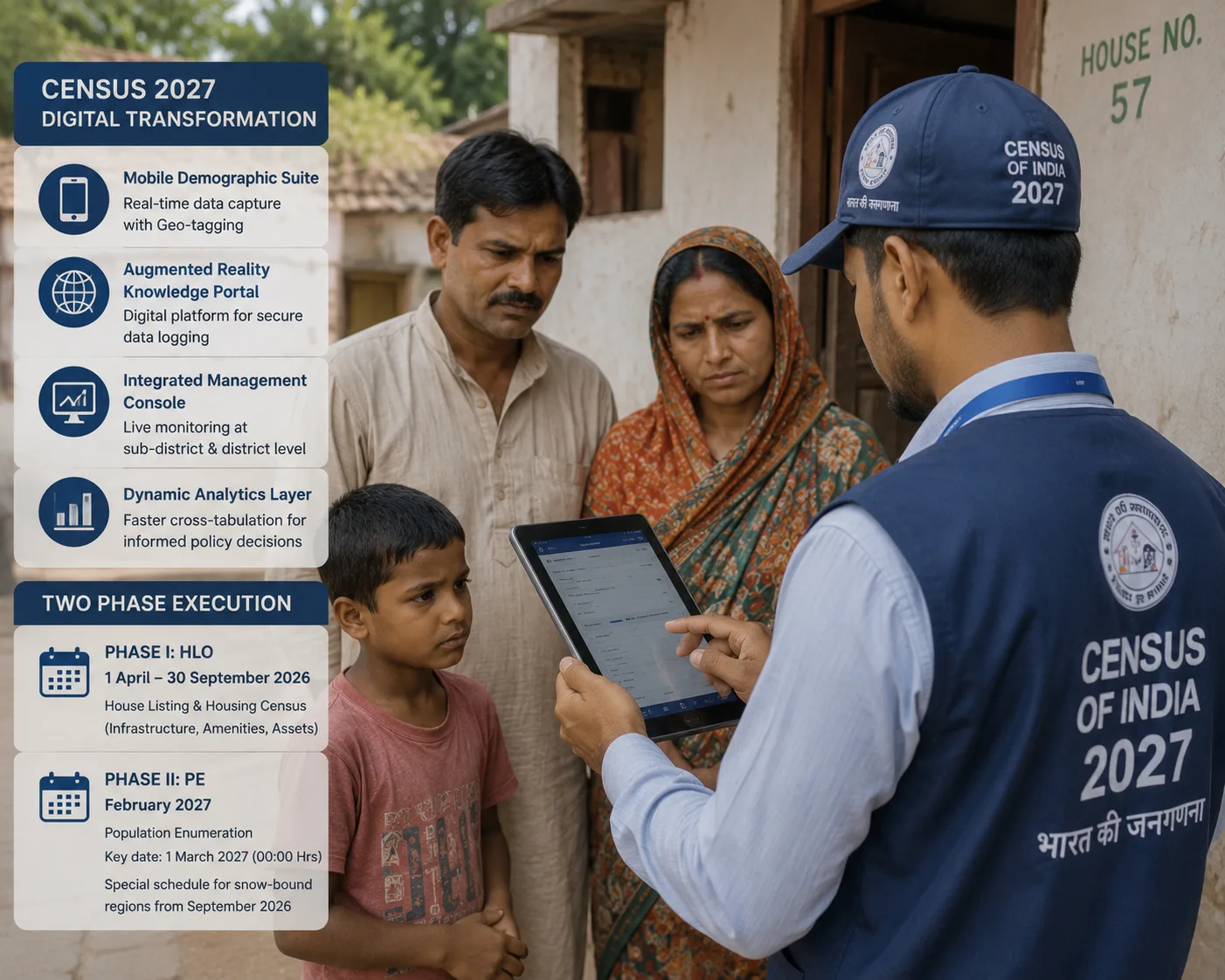
Mobile Demographic Suite: Removes physical form weaknesses and logs real-time geo-tags for verified buildings, with data collection available on both Android and iOS platforms across 16 regional languages.
Augmented Reality Knowledge Portal: An innovative digital platform offering households directly accessible data-logging capabilities through secure, multi-factor authenticated protocols.
Integrated Management Console (CMMS): Officers at sub-district, district, state, and national levels can track enumeration progress, field performance, and operational readiness through a live integrated dashboard.
Dynamic Analytics Layer: Facilitates accelerated cross-tabulation of demographic, economic, and cultural factors — allowing for immediate policy response based on near real-time data streams.
The execution is structured across two distinct operational phases. Phase I — the Houselisting and Housing Census (HLO) — was officially launched on April 1, 2026, and extends until September 30, 2026, atop customized 30-day cycles legislated by independent State and Union Territory governments. In this stage, details concerning construction materials, infrastructure investment, utility access, and living standards are recorded. Phase II — the Population Enumeration (PE) — will take place nationwide in February 2027, with the national reference anchor fixed at 00:00 hours on March 1, 2027. Early schedules are designated for high-altitude, snow-bound regions including Ladakh, parts of Jammu & Kashmir, Himachal Pradesh, and Uttarakhand, with Phase II activities commencing in September 2026 to achieve universal inclusion before severe seasonal changes.
The Structural Divide: Traditional Systems vs. Digital Enumeration
| Traditional Headcount System | Census 2027 Paradigm | |
|---|---|---|
| Data Collection | Reactive & Paper-Bound: relied heavily on manual registers, leading to extensive storage challenges and physical deterioration risk | Dynamic & Digital-First: employs cloud-synchronized databases with real-time tracking of 30 lakh enumerators |
| Timeliness | Time-Lag Deficit: data display often took 3 to 5 years, resulting in policies based on lagging information | Instant Validation: near real-time data streaming supports micro-targeted resource allocation |
| Accuracy | High Error Margin: subject to manual entry errors, double entries, and contradictions in field tracking | Geo-Tagged Precision: distinctive structural markers allow every dwelling unit to be mapped cleanly |
| Flexibility | Fixed Field Schedules: once forms are printed, difficult to accommodate migratory moves or local weather changes | Flexible Staggered Timelines: allows unique operating cycles such as the snow-bound protocols of September 2026 without disjointure |
"Count seamlessly, think objectively, and spread resources fairly."
Historic Inclusion: Caste Enumeration 2026–2027
What sets this census exercise apart from those conducted since Independence is the inclusion of Caste Enumeration in Phase II of the process. Although India has consistently enumerated Scheduled Castes (SCs) and Scheduled Tribes (STs) to comply with constitutional provisions, a full-blown survey of all castes has not been undertaken by an Indian census since the pre-independence count of 1931.
This historic revision comes after extensive policy consultations and heated bureaucratic discussions on replacing legacy projections with solid empirical evidence. The Phase II questionnaire will include a number of validated, specific fields to safely capture precise caste declarations. Using predefined dropdown menus with options based on regional validated caste directories — plus text boxes for rare sub-castes — the digital form eliminates the spelling discrepancies and classification chaos that crippled earlier societal surveys. This organised model allows for surgical policy design, taking social welfare discussions from emotional speculation to statistical fact.
Potential Complexities and Friction Points in Digital Enumeration of Demographics
Running a program of this magnitude via digital-only channels introduces new frictions. Even the most sophisticated algorithmic models are constrained by rigid software rules and do not possess the human-like situational flexibility needed to interpret the infinite subtleties of rural communities. Recent pilot testing across various regional blocks suggests that an exclusive dependence on structured drop-down menus — without sufficient field flexibility — may complicate responses, more so when vernacular labels at the local level differ from formal administrative lists. A gap of up to 5% due to administrative error was observed in early mock field trials, typically arising from heavy multi-layered prompts or complex naming combinations. In a population matrix of India's scale, an error of this margin can misclassify thousands of households and create significant misallocations in regional welfare funds. Additionally, maintaining stable connectivity over rugged, low-signal territory turns the act of logging into an endless cycle of offline caching and manual syncs — potentially overwhelming field workers and stalling data uploads.
Read Further
- Census 2027 — Phase I Official Launch: World's Largest and First Digitally Conducted Census Begins — Press Information Bureau (PIB), April 1, 2026
- Census 2027: India's First Digital Enumeration Exercise — Detailed Digital Architecture, Two-Phase Strategy, and Caste Enumeration Framework — Press Information Bureau (PIB), April 25, 2026
- India to Conduct First Fully Digital Census in 2027; Nationwide Exercise Begins April 1 — DD News (Doordarshan National), June 2026
Disclaimer: All the data and analytical points provided above were synthesized from official government notifications, verified administrative statements, and public internet resources. This document serves as a comprehensive educational and informative report and should not be construed as direct legal or official state advice.