

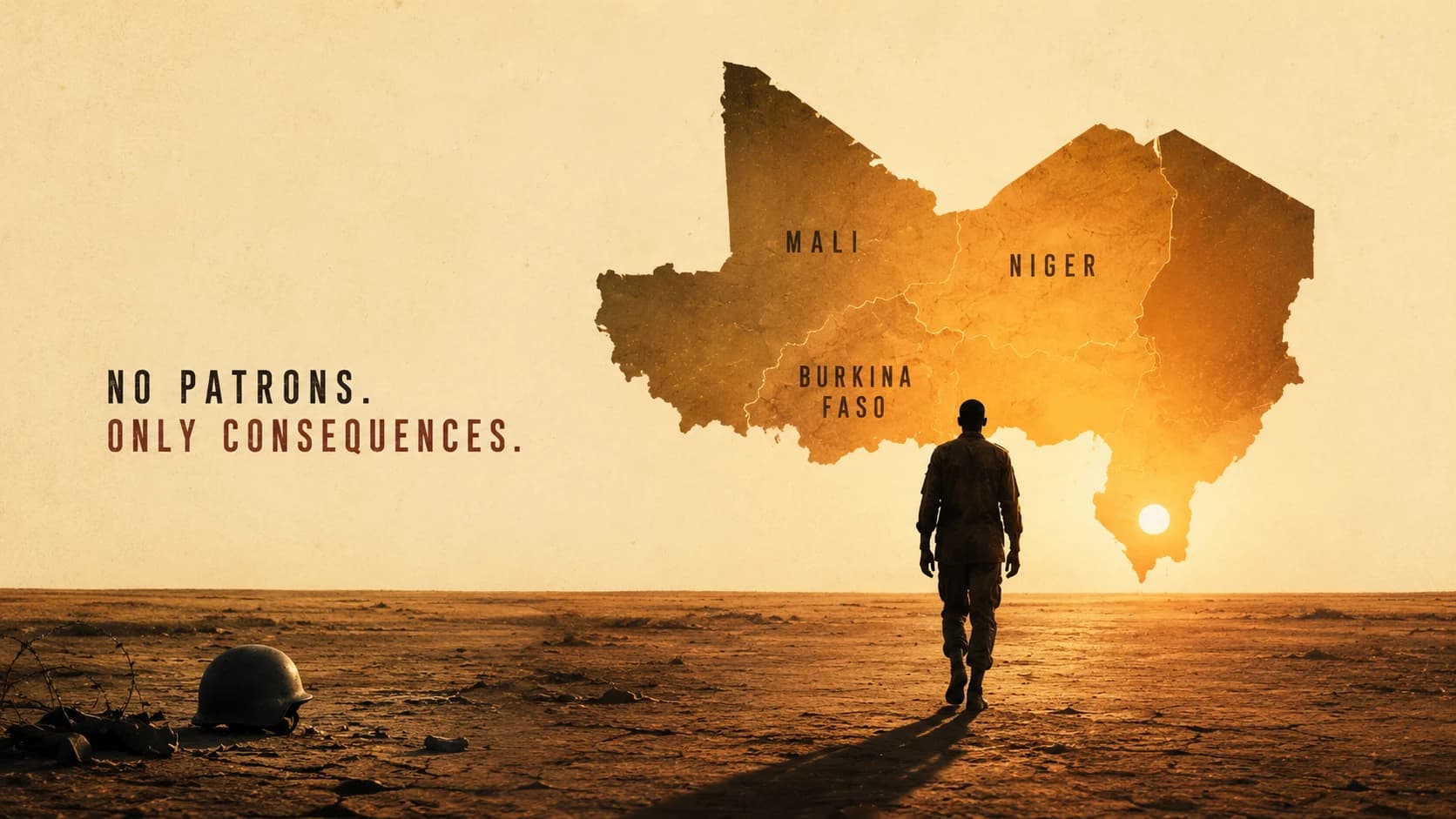
In today's globalized political arena, where security alliances, cross-border pacts, and international structural aid are tightly woven into the very fabric of statehood, we find ourselves hyper-dependent on global superpowers to maintain local balances of power. Somehow, this systemic architecture is deemed useful for stabilizing volatile landscapes, and somehow, it is entirely counterproductive, locking developing nations into permanent cycles of asymmetric reliance. Historically, external intervention was introduced to suppress threats faster and with greater logistical efficiency. However, when regional governments end up relying perpetually on foreign militaries, deep-seated diplomatic garrisons, and Western monetary institutions for their everyday survival, an unsettling shift occurs. We don't know where we actually forgot the raw, fundamental exercise of authentic domestic governance and true structural autonomy; we don't know.
This comprehensive inquiry is structured specifically to make you look beneath the polished surface of traditional diplomatic reporting. It is designed to get you completely aware of what transpires when a contiguous geographic belt consciously decides to dismantle centuries of postcolonial architecture, choosing the radical unknown of absolute patron expulsion over the comfortable compromises of systemic subordination. This is the unfolding chronicle of the West African Sahel — specifically the triumvirate of Mali, Burkina Faso, and Niger — and their high-stakes, historically unprecedented experiment in patron-free collective existence.
"Sovereignty is not an abstraction negotiated in foreign capitals; it is a physical reality claimed when the last foreign boot leaves your soil."
The Multi-Tiered Fractures of the Old Security Architecture
For over a decade, the standard paradigm for security management across the semi-arid expanses of the Sahel was fundamentally externalized. Following the destabilization of Libya in 2011, a violent surge of insurgent movements, ranging from Al-Qaeda affiliates like Jama'at Nusrat al-Islam wal-Muslimin (JNIM) to factions of the Islamic State in the Greater Sahara (ISGS), systematically weaponized the vast, unmonitored desert corridors. The immediate remedy championed by the international community was structured around heavy Western supervision. This manifested primarily through France's Operation Barkhane, which deployed thousands of highly trained counter-terrorism troops, alongside the United Nations' multi-billion-dollar stabilization mission, MINUSMA, and secondary strategic outposts engineered by the United States military. Yet, under this multi-layered umbrella of foreign protection, the internal security landscape did not stabilize; it aggressively decayed. The structural flaw of this architecture lay in its reactive nature. Foreign forces operated within strict, highly insulated tactical mandates that optimized clinical surgical strikes but entirely ignored the underlying political economy of the insurgency. Local state capacity was inadvertently hollowed out. While elite Western units executed high-altitude drone operations and precision raids, the foundational ground forces of Mali, Burkina Faso, and Niger were systematically relegated to secondary defensive holding patterns, starved of organic intelligence networks, heavy offensive weapon systems, and real tactical agency.
This friction reached its breaking point between 2020 and 2023. A succession of sharp, populist military overthrows shook the state capitals of Bamako, Ouagadougou, and Niamey. The newly formed military juntas explicitly pointed to the total failure of the Western security apparatus as their existential justification for altering the status quo. They argued that despite a decade of foreign intervention, militant networks had successfully expanded their operational territory, cutting off vital commercial lines and trapping major urban centers in near-perpetual blockades. The old security architecture was officially declared broken.
90 Days — Average timeline for systemic breakdown of old regional military treaties post-coup.
23% — Historical average of domestic territory directly administered by states under foreign tutelage.
3.6% — Estimated structural growth of organic rural intelligence pipelines before the 2023 pivot.
The Logistics of Expulsion: Evicting the Superpowers
What followed was not a standard bureaucratic renegotiation of diplomatic terms, but a rapid, systematically executed cascade of total expulsions. In rapid succession, the military leadership of the Sahelian states did what many conventional political analysts deemed functionally impossible: they ordered the immediate, unconditional withdrawal of the French Armed Forces, terminated the legal mandates of European tactical task forces, and systematically forced the shutdown of critical Western surveillance hubs, including the United States' highly advanced Drone Base 201 in Agadez, Niger. To fully understand the staggering logistical and administrative weight of this transition, we must look directly at the structural indicators that define these three nations. They do not possess the sprawling coastal economies of their maritime neighbors, yet they share a deeply unified, hyper-contiguous geographic challenge. Below is a rigorous breakdown of the structural realities under which this patron-free experiment was launched:
| Sovereign Metric Indicator | Burkina Faso | Republic of Mali | Republic of Niger |
|---|---|---|---|
| Total Territorial Landmass (km²) | 274,200 | 1,240,192 | 1,267,000 |
| Geographic Climate Profile | Semi-arid / Sahelian | Hyper-arid / Desert | Hyper-arid / Saharan |
| Core Sovereign Asset Base | Industrial Gold, Zinc, Manganese | Artisanal & Industrial Gold, Phosphates | High-Grade Uranium, Crude Oil, Coal |
| Post-Expulsion Security Framework | AES Mutual Defense Pact | AES Mutual Defense Pact | AES Mutual Defense Pact |
| Primary Displaced Foreign Partner | France / Barkhane Mandate | UN MINUSMA / France / United States | AFRICOM / France |
The operational mechanics of these expulsions forced an immediate administrative vacuum. For years, the international community had warned that the abrupt departure of Western logistics would instantly collapse the host states' structural capabilities. The tracking of multi-spectral aerial intelligence, the maintenance of advanced helicopter fleets, and the secure coordination of battlefield medical evacuations were all profoundly dependent on external corporate and military contractors. By evicting these entities, the Sahelian states effectively chose to go completely blind on their northern and eastern desert frontiers, betting everything on their ability to forge alternative, highly transactional security arrangements that did not require the surrender of domestic political self-determination.
The Emergence of the Alliance of Sahel States (AES)
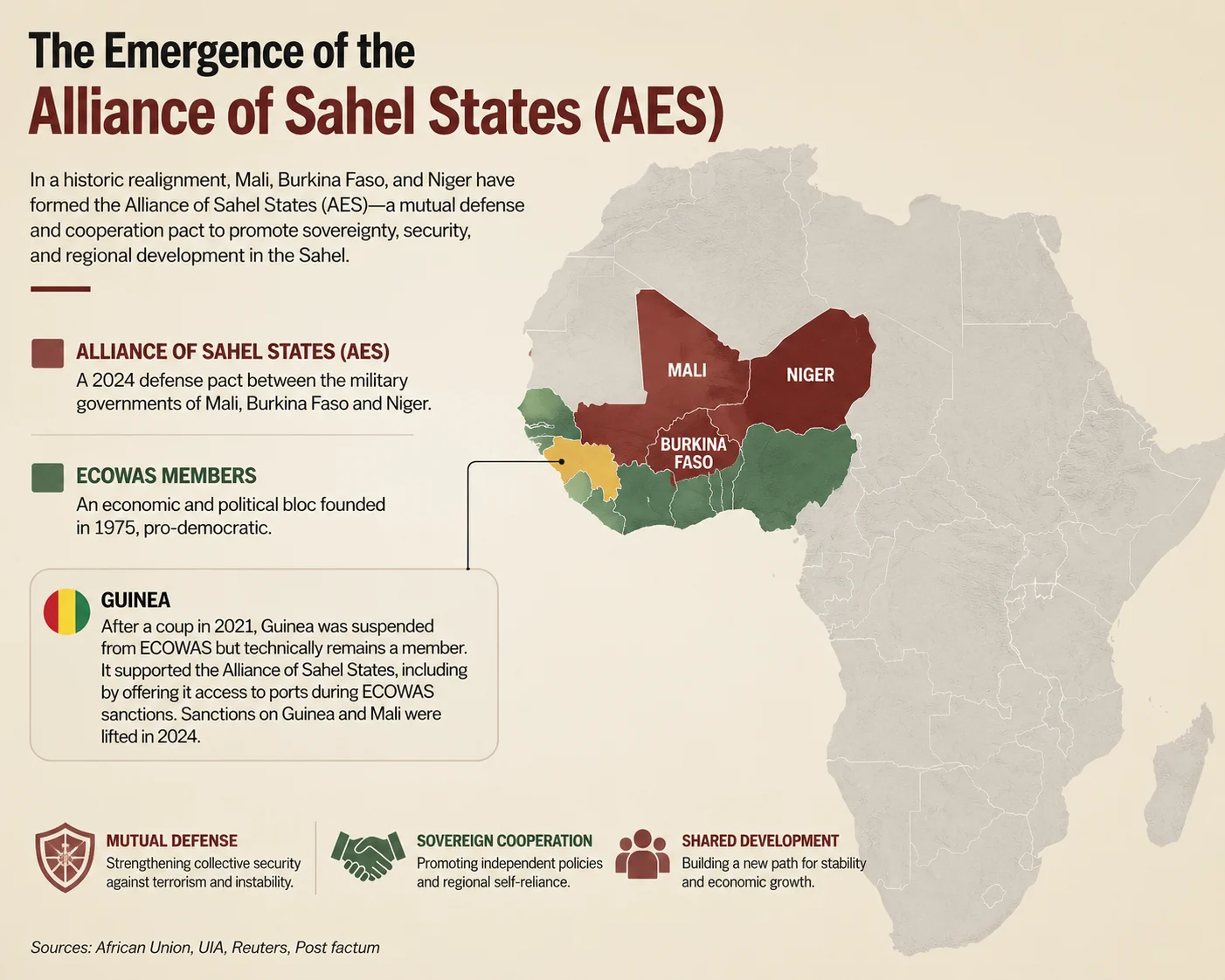
Faced with intense economic sanctions from the Economic Community of West African States (ECOWAS) and an aggressive diplomatic freeze from the Western bloc, the three insulated regimes took a historic step toward institutionalizing their defiance. On September 16, 2023, they signed the historic Liptako-Gourma Charter, officially giving birth to the Alliance des États du Sahel (AES). This was not a loose, symbolic diplomatic grouping; it was structured as an unyielding mutual defense pact and an explicit economic collective designed to build a completely independent security architecture in West Africa. The AES fundamentally shifts the axis of regional solidarity away from post-colonial coastal dependencies. The alliance operates on a clear, rigid principle: an attack on the sovereignty or territorial integrity of any single member state is legally recognized as an existential threat to all three.
By pooling their military resources, coordinating direct cross-border operations without seeking external approvals, and harmonizing their intelligence gathering, the AES states have effectively created a unified land block that spans over 2.7 million square kilometers. This vast space is explicitly closed off to traditional Western intervention, rewriting the rules of engagement in the African interior. Furthermore, the alliance has steadily expanded its structural mandate beyond basic military cooperation. The states have actively initiated concrete steps toward complete macroeconomic decoupling. This includes advanced plans for a unified regional currency to completely replace the CFA Franc — a currency deeply tied to the French treasury — the establishment of an integrated sovereign investment bank, and joint infrastructure initiatives targeting energy self-reliance and cross-border trade networks. The experiment has evolved from an emergency defensive shield into an active, highly ambitious blueprint for structural self-reliance.
Advertisement
"The Liptako-Gourma architecture represents the first true attempt in the modern era to redraw African security lines entirely from the inside out."
The Paradox of the New Partners: The Shadow of Private Military Formations
However, no state can operate in a complete geopolitical vacuum, especially when fighting complex, fast-moving insurgencies. In their pursuit of absolute autonomy from Western oversight, the AES administrations encountered a stark, immediate limitation: the urgent necessity for advanced tactical equipment, heavy combat aviation, and immediate satellite intelligence pipelines. To fill this critical void without entering into sweeping, legally binding state-to-state treaties that could compromise their hard-won independence, the Juntas turned to highly specialized, private external security networks — most notably the reorganized structures of Russia's Africa Corps and various private military companies (PMCs).
This transition introduces a deep structural paradox into the entire patron-free narrative. In recent academic assessments, it has been demonstrated that while these alternative private military mechanisms do provide rapid, highly unconstrained offensive combat assistance, they bring a completely different set of structural distortions. Statistics show that major private military deployments provide immediate tactical field support but demand highly complex transactional concessions, often involving direct access to lucrative natural resource extractions, such as industrial gold mines in Mali and Burkina Faso. Furthermore, the structural accuracy of relying on autonomous private actors introduces a distinct margin of operational volatility. Data compiled across recent counter-insurgency operations reveals a stark reality: approximately 2 out of every 5 tactical operations conducted through unstructured, high-risk private military partnerships encounter severe coordination errors or intelligence gaps when encountering decentralized militant networks. In household budgeting or personal finance, an error can be mitigated; in the ruthless sphere of national defense, a 40% operational error margin can lead directly to devastating territorial breakthroughs and severe losses of civilian lives. The constant need to manage, audit, and renegotiate these private transactions can quickly transform into a highly exhausting administrative chore, consuming vital hours of statecraft and creating intense friction within the domestic military commands.
The Harsh Economic Frontiers of Absolute Isolation
Beyond the battlefield, the ultimate survival of the Sahelian experiment is being decided on the unforgiving terrain of macroeconomics. By severing ties with traditional development partners, the AES states voluntarily cut themselves off from critical concessional lending facilities, including the World Bank, the International Monetary Fund, and major European development funds. This has forced an immediate, incredibly painful restructuring of domestic fiscal policy across all three nations. Instead of relying on external structural debt to bridge their massive annual deficit gaps, Mali, Burkina Faso, and Niger have been forced to maximize internal revenue generation with aggressive focus. This has triggered a complete overhaul of their national mining and asset codes. Juntas have systematically renegotiated historical extraction contracts with multinational corporations, demanding vastly elevated state royalties, mandating 50% domestic ownership of all processing facilities, and enforcing strict local content laws that require foreign corporations to route their supply chains exclusively through domestic businesses.
While this has significantly increased immediate sovereign cash flows, it has also caused a sharp slowdown in long-term foreign direct investment, as international markets react with intense caution to the region's highly unpredictable legal landscape. The daily reality for the average citizen in this patron-free space is characterized by profound economic austerity. Inflation across vital imported commodities has risen sharply due to the disruption of traditional regional trade routes. Yet, there is an undeniable, powerful ideological current that continues to sustain the experiment. The population largely views these economic hardships not as signs of government failure, but as the necessary, unavoidable price of true national liberation. The collective psychology has shifted from a state of reactive compliance with external economic mandates to a state of highly conscious, intentional structural survival.
Structural Synthesis: Is Self-Reliance Historically Viable?
When we look dispassionately at the structural reality of the Sahel today, we are witnessing a profound race against time. The traditional Western system of security management was indisputably broken — it was a reactive, deeply dependent model that pacified symptoms while allowing the core disease of state decay to spread unchecked. The Japanese philosophy of household management, Kakeibo, teaches us that true control over one's destiny requires absolute awareness, meticulous internal tracking, and the complete elimination of unexamined, wasteful dependencies. In many ways, the AES states are attempting a macro-political version of this ethos: they are forcing their societies to spend their blood and treasure with absolute consciousness and save their sovereign assets with unyielding intentionality.
Yet, the structural stakes could not be higher. If the Alliance of Sahel States can successfully suppress the insurgent threat using their pooled military assets, while simultaneously stabilizing their fragile fiscal systems through aggressive resource nationalism, they will provide an incredibly powerful, disruptive blueprint for the entire African continent. They will prove that it is entirely possible to break the invisible, post-colonial chains of geopolitical tutelage and survive. If, however, they collapse under the combined weight of economic isolation, internal operational errors from private military dependencies, and relentless militant pressure, the region risks falling into an unprecedented phase of fragmentation, leaving behind a vast, entirely ungoverned space in the heart of Africa.
Read Further
- Charter of Liptako-Gourma Establishing the Alliance of Sahel States — Official Treaty Text, Embassy of Mali
- Burkina Faso, Mali and Niger Have a New Defence Alliance: An Expert View of Its Chances of Success — The Conversation
- U.S. Withdrawal from Niger Completed — Official AFRICOM Statement
Sovereign Analytical Disclaimer: The comprehensive data, structural breakdowns, and geopolitical assessments compiled in this report are derived entirely from active open-source international intelligence trackers, regional economic indices, and historical multi-spectral studies of West African governance. This document is intended strictly for rigorous academic, geopolitical, and strategic analytical purposes, and must not under any circumstances be interpreted as direct actionable policy or financial advisory.
Advertisement