

The Illusion of a Corporate Revival and the Q1 FY27 Mirage
In today's Indian macroeconomic context, there is a growing dependence on aggregate headline metrics where unchecked data presentation can obscure underlying structural realities. Much like modern automated algorithms that are chemically efficient yet lack the contextual nuance afforded by human review over longer timeframes, headline corporate growth numbers can hide deep corporate weaknesses.
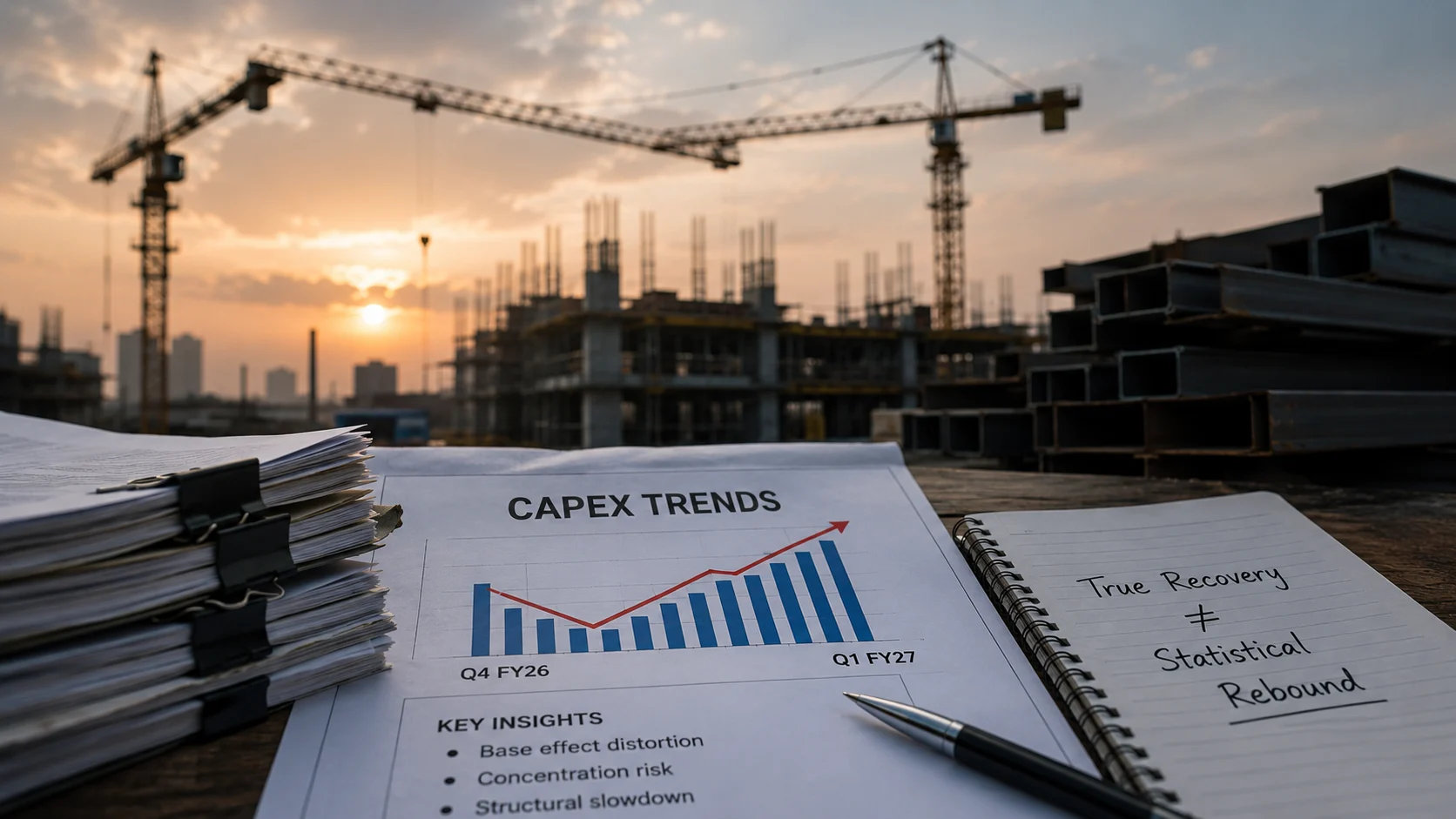
Today, as corporate analysts applaud a seeming recovery in private-sector capital expenditure (capex) in the first quarter of the 2026–27 financial year (Q1 FY27), a sober analysis shows we are observing a classic statistical mirage. The image of a booming revival in private investment does not correspond to any discernible broad-based industrial capacity build-up. Rather, it is a consequence of a highly compressed base period affected by structural anomalies in public policy.
The key statistic underpinning the Q1 FY27 narrative is a quarter-on-quarter increase in project registrations and investment announcements following a sharp slip in Q4 FY26. However, the immediate history tells a very different story. Q4 FY26 saw an epic collapse in total capex announcements — including both public and private sectors. Total capital expenditure during that quarter declined 54.9% year-on-year to a disturbing low of ₹9.1 lakh crore, the sharpest quarterly decline in over five years.
When an economy measures its "recovery" for a quarter based on a contraction of over half its baseline volume, then its growth rate is not only mathematically inflated but economically meaningless. This focus on sequential comparison also distracts from a troubling structural issue: India Inc. is not signing up for a collective capital revival. Rather, it is competing to fill an acute gap created by a transitory public policy paralysis.
To see in the Q1 FY27 increase a long-term private-sector growth story is to confuse a small mathematical correction for genuine economic momentum. The wider business environment remains constrained — reeling from a drop-off in private consumption in rural and semi-urban areas, soaring real interest rates, and global macroeconomic uncertainties that compel the typical mid-sized firm to preserve its cash rather than plant the first seed of a new factory.
"Growth without structural dispersion is really just an arithmetic optical illusion. When the baseline is formed on an extreme statistical low, the subsequent height signifies no real elevation."
Under the Hood: The NSO Survey, Concentrated Duopolies, and the 16.5% Structural Decline
To get a real sense of the gap between corporate rhetoric and on-the-ground reality, one must go directly to the government's own statistical agency and examine its forward-looking indicators.
The National Statistical Office (NSO) conducted a full survey of capital expenditure plans across more than 5,300 functioning firms nationwide, and the results are at odds with the story of a private capex recovery. According to the NSO survey, which covered 5,366 operational enterprises, overall private sector capex plans for 2026–27 are expected to shrink by a substantial 16.5% in nominal terms.
The provisional total capital expenditure for FY26 was a respectable ₹11.43 lakh crore, but the declared aim for FY27 has fallen to ₹9.55 lakh crore — an implied cut in absolute new asset spending of nearly ₹1.88 lakh crore, reflecting deep-rooted caution across Corporate India.
More revealing still is the concentration of the commitments that were made. If you dig into the list of companies that did commit to capital allocation, the figures are vastly piled onto a hyper-exclusive duopoly. In 2025–26, the Adani Group and Reliance Industries Limited (RIL), the top two business houses in the country, together spent an estimated ₹3.2 lakh crore in capital expenditure (Adani Group at ₹1.76 lakh crore, Reliance Industries at ₹1.44 lakh crore). Between these two promoter-led behemoths lies a stranglehold of more than 28% of the entire private capital expenditure base of the nation.
| Component of Capex Metric | Preliminary FY26 Actuals | FY27 NSO Plans / Estimates | Shift in Percentage (%) |
|---|---|---|---|
| Total Private Capex | ₹11.43 Lakh Crore | ₹9.55 Lakh Crore | -16.45% |
| Top Two Conglomerates (Adani + RIL) | ~₹3.20 Lakh Crore | ~₹3.10 Lakh Crore (Est.) | -3.12% |
| Rest of Corporate India | ₹8.23 Lakh Crore | ₹6.45 Lakh Crore | -21.62% |
| Q4 FY26 Total Capex Announcements | ₹9.10 Lakh Crore | Not Applicable (Historical Base) | -54.90% (YoY) |
So when less than 0.05% of Indian companies account for nearly a third of all domestic capital formation, the idea of a "private sector recovery" becomes an empty buzzword. If we strip out the overwhelming capital roll-outs of these top two conglomerates, the rest of corporate India's capex is being cut by over 21% year-on-year. Most mid-tier companies are focusing their scarce capital pools predominantly on value enhancement to existing assets (38.36%) or simple capacity upkeep — as opposed to investing in new greenfield manufacturing units. The share of manufacturing in corporate capex proposals visibly slid from 50.2% to 44.4%, suggesting a distinct structural pull away from core heavy industries.
The Government's Project Pause and the Base-Effect Trap
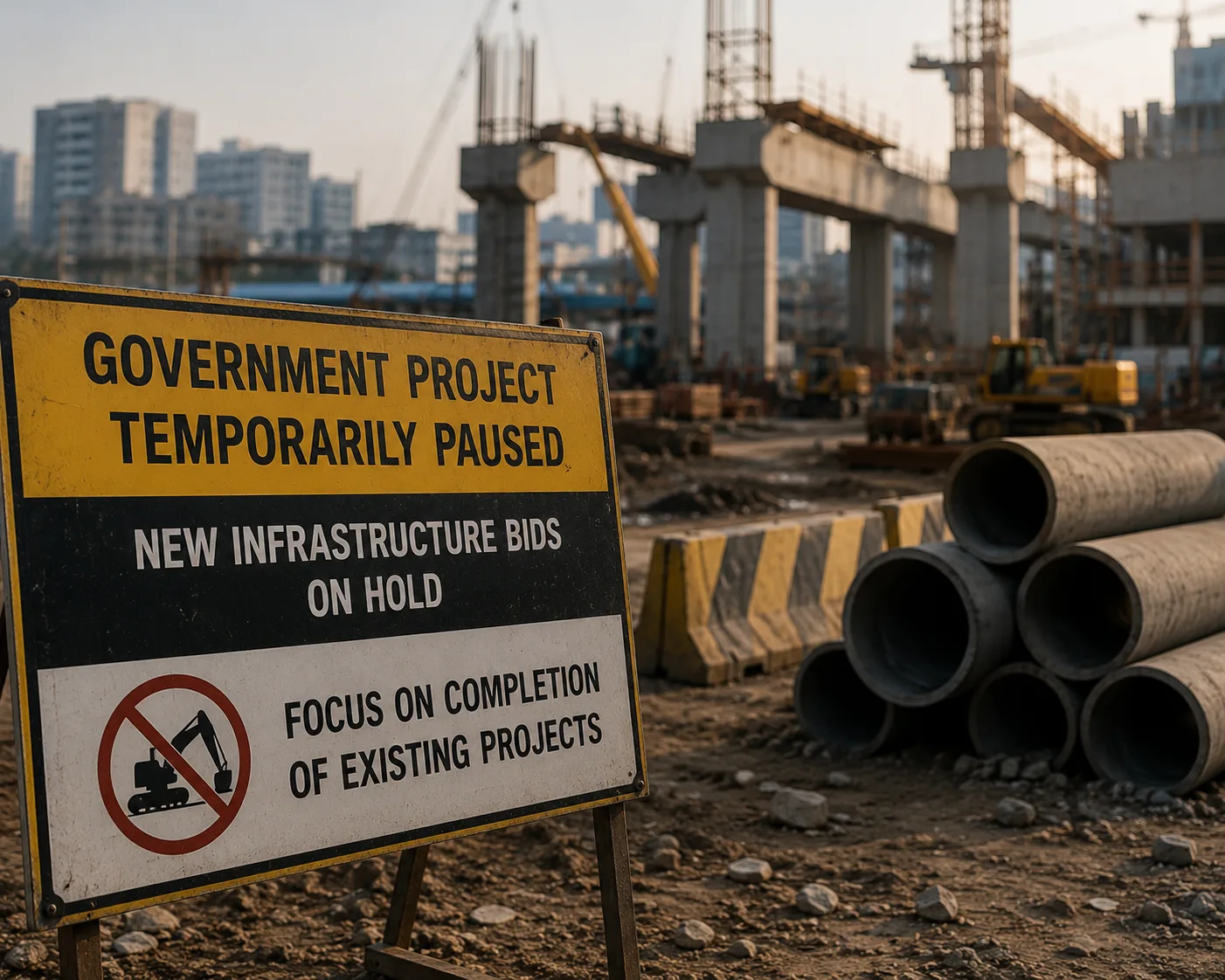
The backdrop against which all of this unfolded was a months-long deferral of government projects in late 2025 and early 2026, resulting in a dramatic statistical overhang. In the interest of aggressive fiscal consolidation — with the Union targeting a fiscal deficit of 4.4% of GDP for FY26 — the government placed a moratorium on fresh heavy infrastructure bids, directing ministries to focus on completing existing projects rather than sanctioning new ones.
Union capital outlay had ballooned dramatically over the past half-decade, soaring from ₹2.63 lakh crore in FY18 to an unprecedented ₹11.21 lakh crore in FY26. But the speed with which the pipeline ground to a halt in the final four months of FY26 was extraordinary. Ministries stopped placing new orders entirely and front-loaded money expenditure into the early part of the fiscal, creating an artificial vacuum in the project sanctions pipeline.
This government-engineered slowdown trickled immediately into the private suppliers of the ecosystem. Because private capital spending in India is so closely tied to public infrastructure orders — where a single rupee of government spending ordinarily generates significant private demand for cement, steel, and heavy machinery — the sudden dent in public sanctions caused a remarkably uniform drop in private new project registrations. This dynamic created an artificial statistical trough.
When the new fiscal year began in April 2026 (Q1 FY27) and the government published its revised budget allocations of ₹12.2 lakh crore, even a slight revival in routine project clearing was quickly interpreted as a sign of a profound macroeconomic turnaround by automated statistical monitors.
From a numerical perspective: if an economy moves from a normal period (V₁) to an artificially suppressed period (V₂) due to an administrative hiatus, its eventual return to something resembling normality in period (V₃) will produce an enormous positive delta. This is what is known as the base-effect trap. The core private industrial engine is not spinning any faster — it is simply responding to the opening of public valves that had been welded shut for two quarters.
To say private animal spirits have returned based on these Q1 FY27 numbers is to mistake a bureaucratic pressure release for structural economic growth.
Read Further
- Private Capex Intentions Dip 16.5% to ₹9.55 Trillion in FY27: NSO Survey — Business Standard, March 2026
- Capex Growth Hits 5-Year Low: Q4FY26 Investment Declines 54.9% — Forbes India, April 2026
- How Budget 2026 Can Nudge India Inc into Higher Capex Investments — The Federal, January 2026
Disclaimer: All data and analytical perspectives provided above were compiled from government statistical surveys, public corporate filings, and macroeconomic research studies. This article is strictly for educational and informational purposes and should not be construed as financial, investment, or policy advice.