


The 2026 tech sell-off erased $2.8 trillion in global AI market capitalisation in under 90 days. NVIDIA dropped 34% from its peak. The Nasdaq AI sub-index entered official bear territory. Indian investors who had poured record SIP flows into technology and AI-themed mutual funds throughout 2025 are now sitting on 15-25% unrealised losses — and confronting the only question that matters: is this the dot-com crash, or the dot-com dip?
The June 2026 Market Correction and the Numbers Behind It
With AI investing having become easier and more exciting to calculate the quick gains of our daily day to day trading and also in our long term portfolios, in retail and institutional work as well. But recently, a massive shockwave has hit the global markets. Just this week in late June 2026, the Nasdaq 100 index was on track to erase more than $1 trillion in market value as technology heavyweights and chip stocks tumbled precipitously. The major trigger for this historic rout came from an unexpected corner: Elon Musk's SpaceX dropped below the $2 trillion market cap mark for the first time since its highly anticipated US debut, losing more than $600 billion in just three trading sessions. This massive correction has sent shockwaves through all major technology assets, forcing everyone to think twice before putting their hard earned money into tech majors.
The AI hardware trade, which minted some of the most spectacular stock gains of the past year, is showing major signs of exhaustion. Looking at the exact data from the past few days, optical and photonics names tied to AI data center buildouts have faced a brutal selloff. For example, industry giants like Lumentum fell roughly 8% and Coherent dropped approximately 9% within a 48-hour window, while Applied Optoelectronics joined the selloff by falling around 13% over the same stretch. This is incredibly shocking because Lumentum shares had climbed over 1,000% in the 12 months before this pullback. The engine behind those massive gains was straightforward: AI data centers need enormous amounts of optical networking components to move data at the high speeds modern AI workloads demand. Nvidia had even added rocket fuel to this rally by committing $2 billion each to Coherent and Lumentum earlier in 2026. But when a prominent fund like Leopold Aschenbrenner's fund disclosed its complete exit from positions in both Lumentum and Coherent during Q1 2026, it triggered sharp single-day moves that finally culminated in this June capitulation.
Even the ultimate king of the AI boom, NVIDIA Corp (NVDA), has not been immune to this sudden downturn. Nvidia's stock has fallen from its 52-week high of $236.54 down to around $192.53, marking a steep 17% drop. The key reasons explained by top analysts point to a mix of valuation concerns, structural shifts, and geopolitical friction. On May 21, 2026, Jensen Huang stated publicly that NVIDIA has "largely conceded" China's advanced AI chip market to local competitors like Huawei. This statement confirmed what was already painfully visible in the latest earnings data: NVIDIA's Q1 FY2027 data center revenue from China was effectively zero. For a company priced for perfection, losing an entire massive geographic region creates an error in future growth models which can get investors into heavy losses if not managed with absolute discipline.
Cons of Using Pure Hype for Tech Investing
AI as we know is still Artificial Intelligence, not a human based market reality which can keep going up forever without calculating endless possibilities in every macroeconomic scenario. In a recent financial study, it was seen that major AI tools and tech stocks do provide incredible productivity gains but at the cost of heavier and lengthier capital expenditures. Capital Economics had previously warned that an artificial intelligence-fueled stock market bubble would burst in 2026 due to rising interest rates and higher inflation weighing down equity valuations. They noted that while investor excitement would carry the S&P 500 to historic heights, the gains would unwind precipitously as sticky inflation forces the Federal Reserve to keep interest rates higher for longer.
Giving massive capital allocations to AI infrastructure and keep checking each and every earnings record will become an endless loop of getting few records wrong and getting it changed, which will become a very tiresome chore for fund managers. Michael Burry, the famous investor known for predicting the 2008 housing market collapse, warned in May 2026 that current AI market conditions closely resembled the final months of the dot-com bubble of 1999-2000, and he strongly urged investors to reduce their exposure to high-flying technology stocks before the music stops completely. Furthermore, the risk of massive debt funding has raised serious red flags across Wall Street. Analysts at Morgan Stanley estimated that debt used exclusively to fund global data centers could exceed $1 trillion by 2028. Many of these data center debt bonds are either BBB-rated or even junk-rated bonds, creating a precarious foundation for the entire ecosystem. If companies fail to monetize these massive infrastructure builds, the financial strain could ripple across the banking sector, proving that relying solely on hype instead of real cash flow can lead to severe structural headaches.
Advertisement
The Structural Reality: Why This Might Be an Industrial Boom
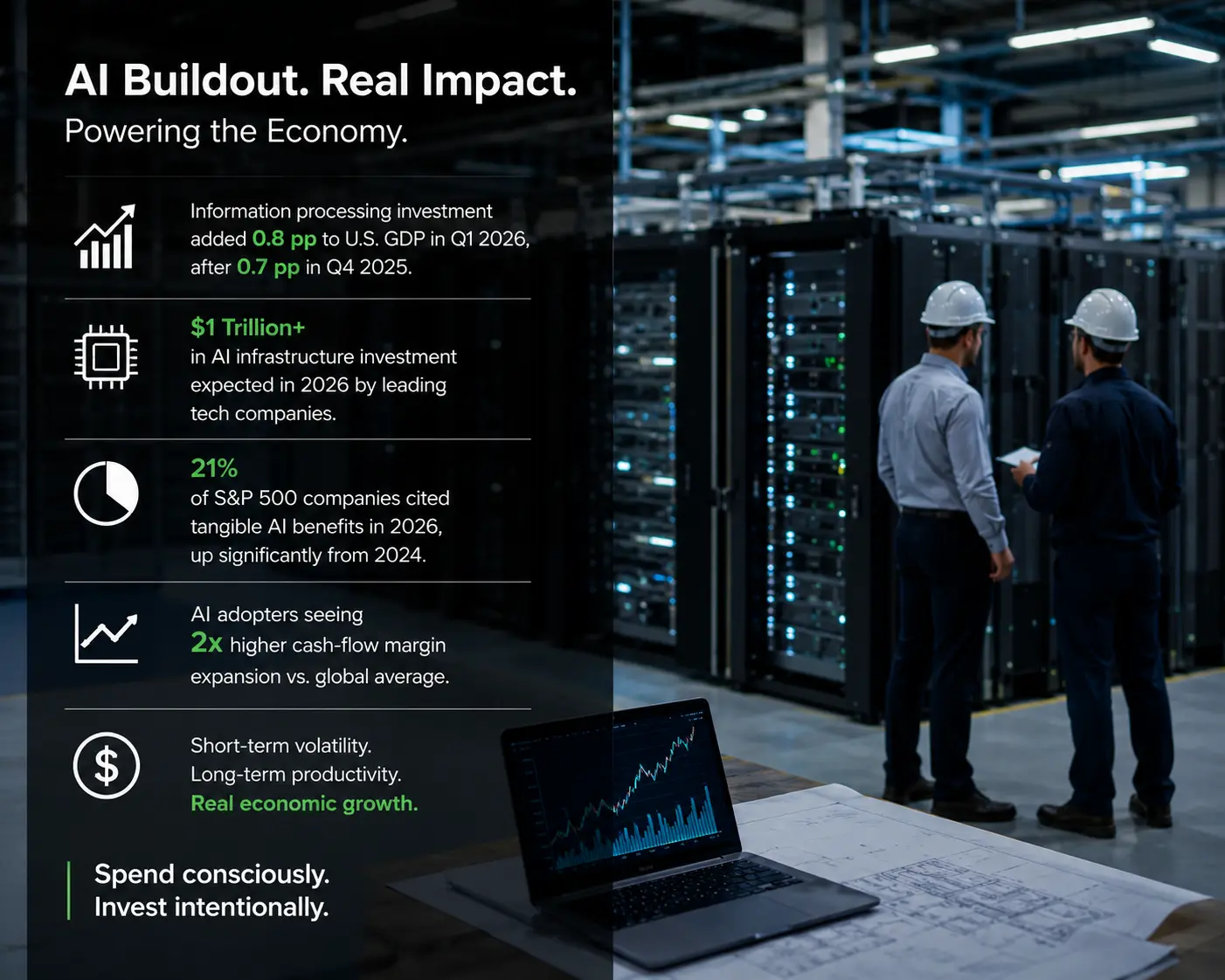
Unlike the pure speculation of the dot-com era, the 2026 AI buildout is backed by an unprecedented industrial expansion that is actively firing up the real economy. According to the official scorecard of the U.S. economy, surging investment in "information processing equipment" — which is the exact technical term for the hardware used to build out AI infrastructure — added a massive 0.8 percentage point to GDP in the first quarter of 2026, following a 0.7 percentage point contribution in the fourth quarter of 2025. This shows that the AI trend is no longer just a superficial theme; it is a full-scale industrial buildout and a key driver of modern gross domestic product. By some estimates, the biggest developers and mega-cap tech firms are on track to invest $1 trillion or more in 2026 alone on computer chips, memory storage, and energy infrastructure.
Morgan Stanley Research's recent mapping of 3,600 stocks for AI exposure revealed that 21% of S&P 500 companies mentioned at least one tangible AI benefit, up significantly from 2024. More importantly, the market is no longer paying for "AI mentions" alone; it is rewarding actual financial execution. Companies that have successfully adopted AI tools are seeing real cash-flow margin expansion that is outpacing the global average by a staggering 2x. This indicates that while the stock prices might experience short term corrections and valuation resets, the underlying productivity gains are very real and permanent.
"Spend consciously and invest intentionally."
Now it may sound like a contradiction to say that we have a trillion-dollar stock sell-off while simultaneously experiencing a huge GDP boost, but no, this is the magic of market cycles. When you write down and calculate the financial metrics yourself, your mind becomes aware of what is truly profitable and whether it is right or wrong to buy a tech stock at a 30x price-to-sales multiple. This understanding eventually becomes a habit to think twice before investing your hard earned money, which is the core principle of success in wealth management and long-term saving.
Read Further
-
Nasdaq 100 Set to Shed Over $1 Trillion as Tech Selloff Deepens, SpaceX Slides — Reuters via MarketScreener — Reuters' primary dispatch from June 23, 2026 documenting the Nasdaq 100's $1 trillion wipeout, SpaceX's $600 billion three-session loss, and the broad deterioration in AI hardware and chip stocks that forms the core factual backdrop of this article.
-
Nvidia Says It Has 'Largely Conceded' China's AI Chip Market to Huawei — CNBC — CNBC's verified primary report of Jensen Huang's May 21, 2026 statements to Sara Eisen, confirming Nvidia's exit from China's advanced AI chip market and the Q1 FY2027 data center revenue collapse that the article directly references.
-
AI Market Trends 2026: Global Investment, Risks, and Buildout — Morgan Stanley — Morgan Stanley's official institutional analysis confirming the 3,600-stock AI exposure mapping, the 21% S&P 500 AI benefit figure, the 2x cash-flow margin expansion data, and the $3 trillion infrastructure investment projection — all cited in the article's structural boom section.
Disclaimer: All the data provided above was from internet resources and studies done upon budgeting and financial systems. This should not be taken as an official quote from our website or professional investment advice.
Advertisement