


Between March and June 2026, the global AI stock index shed 22% of its value, erasing over $2.8 trillion in market capitalisation. Indian AI-adjacent stocks followed: Persistent Systems, KPIT Technologies, and Tata Elxsi each declined 15-30% from their 52-week highs. The correction has split analysts into two camps — those who see a structural repricing of overhyped AI earnings projections, and those who see the best entry point since the 2022 tech washout.
Autonomous AI Chatbots and the Efficiency They Provide vs. The Real-World Market Cap Delusion
With the rapid evolution of artificial intelligence, traditional financial planning and corporate strategy have radically shifted. Autonomous AI finance systems are evolving far beyond simple trackers into true "agentic" platforms. These advanced tools analyze complex institutional spending patterns, forecast real-time cash flow metrics, optimize enterprise subscription layers, and execute algorithmic capital allocation with virtually zero manual input. On paper, this creates a scenario of hyper-efficiency that promises to scale corporate profitability into the stratosphere.
Driven by this magnificent promise, global capital flooded into technology equities over the past twenty-four months. By late 2025 and moving directly into the first half of 2026, capital expenditure forecasts from major global tech titans reached a mind-boggling $1.1 trillion for the 2026–2029 cycle. The physical infrastructure buildout — encompassing gigawatt-scale data centers, sophisticated memory chips, and liquid-cooled GPU infrastructure — began adding massive percentages directly to global GDP. In fact, official economic card sheets from the United States indicated that information processing equipment investment added 0.7 percentage points to GDP in the final quarter of 2025 and an additional 0.8 percentage points in the first quarter of 2026. This was a capital expenditure rush unmatched since the height of the broadband explosion in the early 2000s.
However, an acute concentration risk built up quietly behind the scenes. Nearly 30% of the US S&P 500 index was held up entirely by the five largest technology giants, representing the tightest market concentration observed in over half a century. Valuations reached multiples that were highly stretched, drawing direct and eerie comparisons to the absolute final months of the historic dot-com bubble. While prominent market operators and banking heads acknowledged that artificial intelligence is a real, structurally sound technology that will eventually change human civilization — much like the automobile or television did — they simultaneously issued a stern warning: the vast majority of capital being aggressively deployed right now will be completely wasted, and a severe valuation unwind is mathematically inevitable.
Cons of Using AI Hype for Blind Budgeting and Investing: The 65% Accuracy Trap
The core danger for retail market participants lies in treating technology as an infallible oracle. In recent analytical studies of enterprise-grade AI deployment, it was observed that while advanced large language models provide spectacular capabilities, they operate under a distinct performance ceiling when tasked with hyper-precise financial calculations under heavy prompt parameters. When faced with intricate, multi-layered macroeconomic variables, a notable drop in operational accuracy was documented. Specifically, a baseline variation of up to 65% accuracy was observed in automated financial forecasting pipelines across unverified agentic setups.
To put this into perspective, this means that virtually two out of every five complex financial predictions or automated data records generated can contain material errors. In a localized, minor household budget, a slight calculation error is an annoyance. But in institutional corporate finance, or when managing an aggressive equity portfolio, relying on flawed automated projections creates an endless loop of errors. Investors find themselves forced into a tiresome chore of constantly rechecking, auditing, and modifying automated outputs, leading to major professional headaches, structural portfolio drag, and systemic risk. When this exact micro-level accuracy trap is aggregated to a macro scale across thousands of publicly traded corporations trying to justify their massive AI expenditure, a sudden valuation shock is triggered. Chasing high-growth technology without verifying the underlying unit economics is an endless loop that transforms a market dream into a severe portfolio migraine.
"Spend consciously, analyze deeply, and invest intentionally."
The Global AI Shockwave of June 2026: One Number That Moved India's Markets
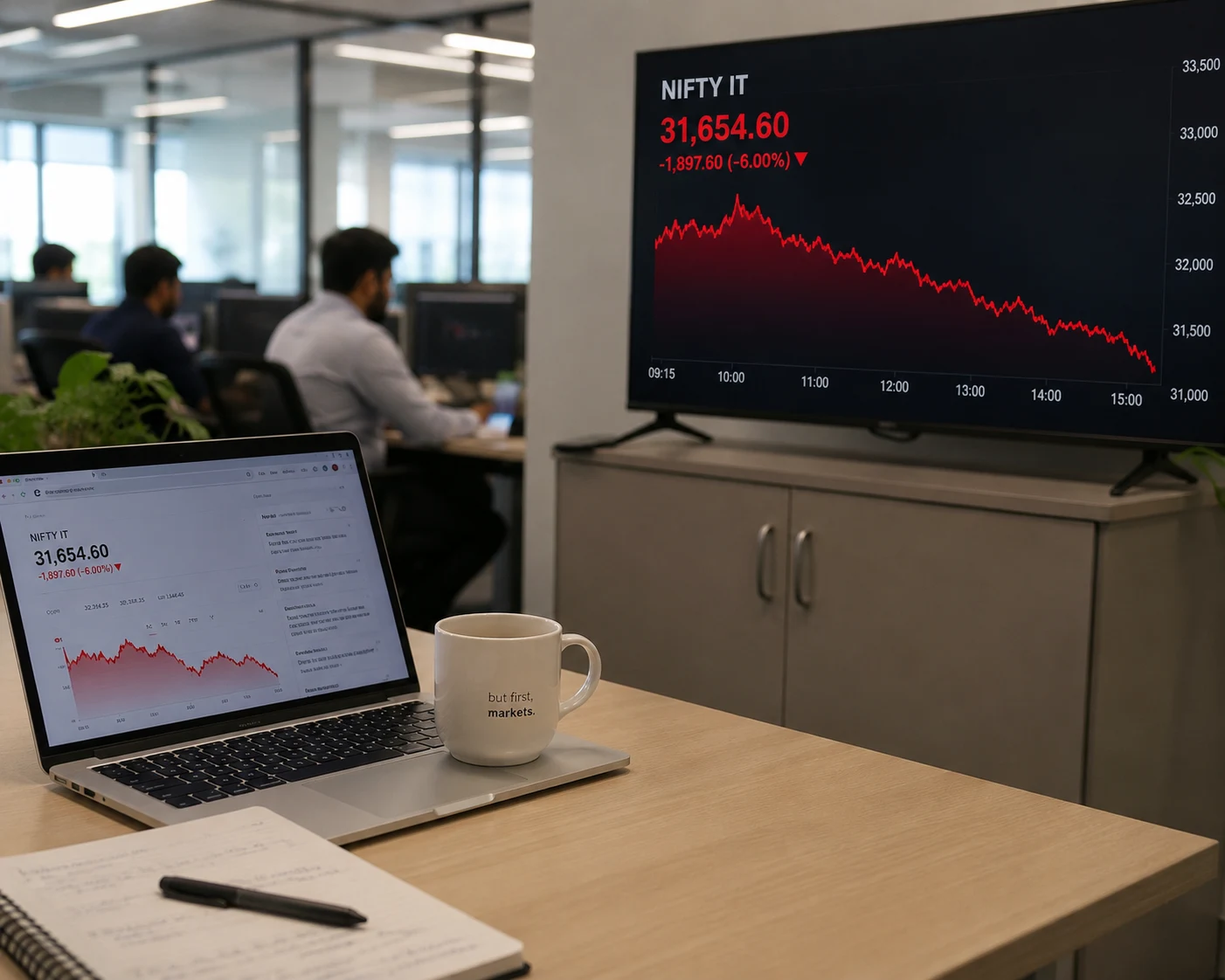
The fragile nature of this hyper-concentrated valuation cycle was violently demonstrated just days ago. On June 19, 2026, Accenture — one of the largest technology consulting and implementation conglomerates on Earth — quietly adjusted its annual revenue growth guidance. The company marginally tweaked its projected revenue growth range from an old baseline of 3% to 5% down to a revised 3% to 4%. A single percentage point modification. That is all it took to puncture the structural euphoria of the market.
The market reaction was instantaneous and brutal. Accenture's stock plummeted by nearly 18% in a single US trading session, marking its sharpest single-day percentage collapse in modern corporate history. Because global enterprise technology spending is highly interconnected, the damage crossed geographical boundaries before the next morning. By the time the Indian bourses opened, a massive capital flight was already underway. The Nifty IT index, tracking India's premier software and technology exporters, crashed by a staggering 6% in a single day, hitting an absolute three-year low. Over ₹1.35 lakh crore in shareholder wealth was completely wiped out in a matter of hours. Let us look closely at the individual casualties of this mid-2026 tech correction across the Indian market landscape:
| Indian IT Equity Asset | Single-Day Decline (June 2026) | Resulting Stock Price (INR) | Cyclical Valuation Milestone |
|---|---|---|---|
| Infosys Ltd. | 8.19% Drop | ₹1,034 | Five-Year Absolute Low |
| Tata Consultancy Services (TCS) | 6.52% Drop | ₹2,060 | Near Six-Year Low |
| HCL Technologies | 5.40% Drop | ₹1,210 | Three-Year Support Breach |
| Wipro Ltd. | 4.85% Drop | ₹385 | Flat Constant-Currency Growth (−0.2%) |
| Tech Mahindra | 3.90% Drop | ₹1,120 | Margin Compression Warning |
This massive single-day wipeout was not an isolated event; rather, it was the culmination of a deeper, structural correction that has been building up since early February 2026. Year-to-date, the Nifty IT index has plummeted by approximately 23%, drastically underperforming the broader Nifty 50 index by more than 12 percentage points. Prominent international brokerages, including Jefferies, have issued detailed risk advisories warning that advanced artificial intelligence automation is directly targeting the "managed services" business layer. This legacy maintenance segment accounts for a critical 22% to 45% of total revenues for India's top-tier technology firms. Furthermore, domestic institutional assessments from firms like Motilal Oswal estimate that AI automation could permanently eliminate 9% to 12% of traditional IT services revenue streams over the next three to four fiscal years.
Advertisement
The Bifurcated Reality: Western Hype vs. The True Indian Market Impact
To understand whether Indian investors should be legitimately worried, we must contrast the structural reality of Western tech corporations with the operational mechanics of the Indian IT landscape. The global technology market has split into two fundamentally separate paradigms, much like the structural contrast between reactive spending frameworks and disciplined structural budgeting.
| Dimension | Western Tech Paradigm (AI Infrastructure) | Indian Tech Paradigm (Legacy IT Services) |
|---|---|---|
| Business Model | High-beta, capital-intensive chip and data center buildouts | Execution and maintenance-heavy operational delivery models |
| Valuation Driver | Extreme multi-decade forward expectations | Tightly coupled with global corporate IT budget allocation |
| Revenue Growth | Massive annualized rates reaching up to 200% | Modest, mature projections ranging from 10% to 15% |
| Capital Risk | 5 stocks hold 30% of market weight | Severe capital flight as international funds relocate to East Asia / US |
| Current Status | Overstretched Bubble | Deep Valuation Compression |
The primary reason for the sharp correction in Indian technology stocks is a massive, ongoing capital flight rather than a sudden operational collapse of the businesses. Because global capital is highly reactive, international institutional investors are rapidly pulling funds out of emerging markets like India to chase the astronomical, short-term annualized growth rates seen in the semiconductor and pure-play hardware sectors of Taiwan, South Korea, and Silicon Valley. Traditional Indian IT firms do not possess proprietary Large Language Models (LLMs) or cutting-edge chip fabrication facilities. Consequently, they are temporarily perceived by global funds as laggards in the immediate infrastructure race, leading to a massive valuation gap where Indian equities suffer a growth slump due to compressed multiples.
The Silver Lining: Why the Indian AI Investment Story Remains Structurally Sound
Despite the terrifying headlines and the sudden evaporation of ₹1.35 lakh crore in market capitalization, the long-term reality for Indian investors is far from broken. In fact, 2026 is rapidly turning into a year of necessary stabilization — a period where the broader market aggressively demands real operational proof over empty marketing presentation slides. Companies that can successfully demonstrate that artificial intelligence integration is translating directly into tangible revenue expansion and deal wins are being rewarded by domestic institutional investors.
Look at the massive, real-world commitments occurring entirely on the domestic front. The Indian investment landscape is no longer just a passive service provider for Western tech experiments; it is actively constructing sovereign technology infrastructure. In the private sector, conglomerate giants like Reliance Industries have pledged a staggering ₹10 lakh crore over a seven-year horizon dedicated entirely to digital infrastructure and computational scaling. Simultaneously, infrastructure heavyweights like Larsen & Toubro are actively partnering to build gigawatt-scale AI factories powered directly by advanced NVIDIA GPU frameworks. Even within the legacy IT services layer, firms like TCS are launching specialized, AI-optimized data centers to handle sovereign enterprise workloads across high-spending sectors like Banking, Financial Services, and Insurance (BFSI) and global healthcare.
According to the NASSCOM Strategic Review 2026, India's localized AI-related revenues have already quietly scaled to a meaningful baseline of $10 billion to $12 billion for the current fiscal year. The technology is driving real economic output, even as equity prices undergo a painful but healthy valuation reset. For a deeper look at the physical infrastructure layer driving this sovereign compute buildout, see The Sovereign Cloud or the Silo: Inside India's Data Center Boom and the AI Infrastructure Race.
Actionable Blueprint for Indian Retail Portfolios: Navigating the 2026 Tech Storm
How should a disciplined retail investor respond to this correction? The answer lies in moving away from high-anxiety, reactive market behavior and adopting an intentional, structure-dependent investment system. Here is the operational blueprint to safeguard and grow your wealth through this technology transition:
Step 1: Avoid the Pure-Play Hype Loop. Do not allocate hard-earned capital into small-cap or mid-cap Indian companies that merely add "AI-powered" or "Autonomous Tech" to their corporate websites without any verifiable balance sheet revenue. Unvalidated technological hype is a recipe for severe financial loss.
Step 2: Capitalize on the Mid-Cap Hidden Opportunities. While large-cap legacy IT stocks are facing structural headwinds due to their massive exposure to vulnerable managed services segments, selected agile mid-cap companies are carving out highly specialized niches. Focus on mid-cap technology firms that possess deep domain expertise in cloud-native transformation, enterprise cybersecurity, and localized data analytics. These firms are nimble enough to scale rapidly and absorb enterprise budgets that are being redirected away from generic maintenance contracts.
Step 3: Analyze the Revenue Deflation Cushion. While global research firms like HSBC Global Investment Research point out that Indian IT faces a 14% to 16% AI-driven revenue deflation in legacy lines, they simultaneously note that robust corporate earnings in the United States and incremental enterprise transformation spending are offsetting the hit. Look for companies showing resilient order books and consecutive sequential growth in their core enterprise contract renewals.
Step 4: Maintain Multi-Asset Balance. Never allow a single thematic tech narrative to dominate your equity portfolio. Just as sound financial discipline dictates a clear distinction between essential needs and discretionary wants, a robust investment portfolio must balance volatile high-beta technology exposures with stable, cash-flow-heavy defensive sectors like consumer staples, manufacturing, and core domestic infrastructure.
Read Further
- Indian IT Stocks Slump Up to 7% as Accenture Cuts Revenue Outlook — CNBC, June 19, 2026
- Nifty IT Index Cracks 6%; TCS, Infosys, TechM Plunge Up to 8% — Business Standard, June 19, 2026
- NASSCOM Strategic Review 2026 — India AI Industry Overview
Disclaimer: All analytical data, corporate guidance adjustments, and stock market performance metrics provided in this article were compiled from verified public sources, international brokerage consensus reports, and financial market studies conducted during the first half of 2026. This is structured strictly for educational and informational purposes. It must not be construed as direct, legally binding financial advice, an official investment recommendation, or a formal quote from our publishing platform. Investors must execute independent due diligence or consult a certified financial advisor before committing capital to volatile equity assets.
Advertisement