


In today's complex macroeconomic landscape, the financial markets are navigating a sea of unprecedented structural transformations. As we progress through 2026, the global financial system is confronting a stark divergence between traditional legacy asset behaviors and next-generation capital allocators. Much like the pivot from autonomous systems to deeply disciplined personal frameworks, institutional "Smart Money" is undergoing an intense re-evaluation of its baseline strategies. We are living in a period where relying strictly on passive indexes or historical baseline formulas is proving insufficient; the market moves according to shifting geopolitical realities, altered energy constraints, and highly volatile technology valuations that catch the retail sector off guard.
This comprehensive report breaks down the underlying forces driving market turbulence in 2026, the specific data points causing institutional realignment, and the precise vehicles where elite asset managers are deploying multibillion-dollar tranches to preserve and expand purchasing power.
The Return of Macro Volatility: Oil, Inflation, and AI Valuations
The year 2026 has brought the financial community face-to-face with a stark reality: market stability is no longer an inherent default state. Driven by escalating global supply chain realignments and significant fluctuations in foundational energy commodities, crude oil prices have repeatedly broken through structural ceilings, threatening to touch the critical $100 per barrel threshold. This surge in energy inputs has reignited sticky structural inflation expectations, forcing global central banks to keep benchmark interest rates higher for longer than early-decade consensus models predicted. The 10-year U.S. Treasury yield remains stubbornly anchored near the 4.0% to 4.5% mark, completely upending traditional bond portfolio durations and causing considerable friction across public equities.
"Liquidity has to earn its place in 2026. Returns are coming unevenly, making diversification, proactive risk management, and behavioral control far more essential than aggressive return chasing."
Simultaneously, the hyper-growth narrative surrounding Artificial Intelligence (AI) stocks is facing an intense valuation reckoning. While the period between 2023 and 2025 was marked by explosive, indiscriminate capital deployment into any firm utilizing a neural network framework, 2026 is defined by a rigorous focus on actual monetization metrics. Major earnings updates from semiconductor heavyweights like NVIDIA have triggered steep intraday market swings, highlighting a profound split among market participants between pure optimism and empirical skepticism over massive corporate capital expenditures. Smart money is no longer buying into the abstract promise of technology; instead, it is tracking the exact return on invested capital (ROIC) of enterprise AI deployments, noting that compute demand continues to exceed physical hardware and energy grid supply capacity across major data hubs. Recent data points indicate that standard algorithmic strategies that succeeded over the past decade are yielding high error rates. Academic and institutional tracking reports reveal that a significant proportion of auto-balancing retail portfolios are experiencing performance mismatches due to unexpected sector rotations, with historical correlations breaking down completely under these new interest rate and commodity paradigms.
The Multipolar Shift: Capital Fleeing to Resilient Horizons
The institutional investment community is rapidly moving away from a unipolar, U.S.-centric allocation model toward what leading global strategists designate as the Multipolar World Theme. Geopolitical events are no longer dismissed as mere headline risks; they are recognized as definitive portfolio risks that directly impact structural supply lines, defense requirements, and national technological sovereignty. Leading hedge funds and sovereign wealth funds are executing structural shifts out of over-concentrated, highly valued Western technology sectors and reallocating capital into international markets where underlying valuations reflect far better intrinsic margins of safety. Prominent market analyses underscore that the depreciation of primary fiat currencies — including the U.S. Dollar, Euro, and Japanese Yen — has distorted nominal portfolio values. While retail investors look at raw index levels and perceive a growing account balance, institutional analysts calculate real purchasing power, observing that true global wealth is fleeing overvalued equity domains. Large scale macro-allocators are systematically shifting capital into emerging markets that control essential natural resources and localized tech supply hubs. This trend toward regionalization is giving rise to a capex super-cycle focused heavily on localized semiconductor fabrication, critical minerals mining, and sovereign infrastructure projects across Europe, the Asia-Pacific region, and Latin America.
| Asset Class Grouping | Retail / Passive Allocation Trend | Smart Money / Institutional Stance | 2026 Expected Real Return | Outlook |
|---|---|---|---|---|
| U.S. Large-Cap Public Equities | High concentration (Chasing tech momentum) | Tactical trimming, sector rotation focus | Compressed (~4.7% forward projected) | High vulnerability due to interest rates |
| Long-Term Government Bonds | Default safe haven assumption | Underweighting duration, barbell strategies | Flat to negative real yield potential | Capital erosion risk if inflation persists |
| Physical Gold & Hard Assets | Reactive buying during crises | Strategic accumulation, permanent insurance | Strong performance (Outperforming fiat) | Secular upward trend as monetary hedge |
| Private Infrastructure & Alternatives | Very low allocation (<5% portfolio share) | Aggressive expansion (15% to 20% target) | Projected 10% annual yields, inflation-hedged | High-conviction compounder |
Advertisement
Where Smart Money Is Moving: Infrastructure, Alternatives, and Hard Assets
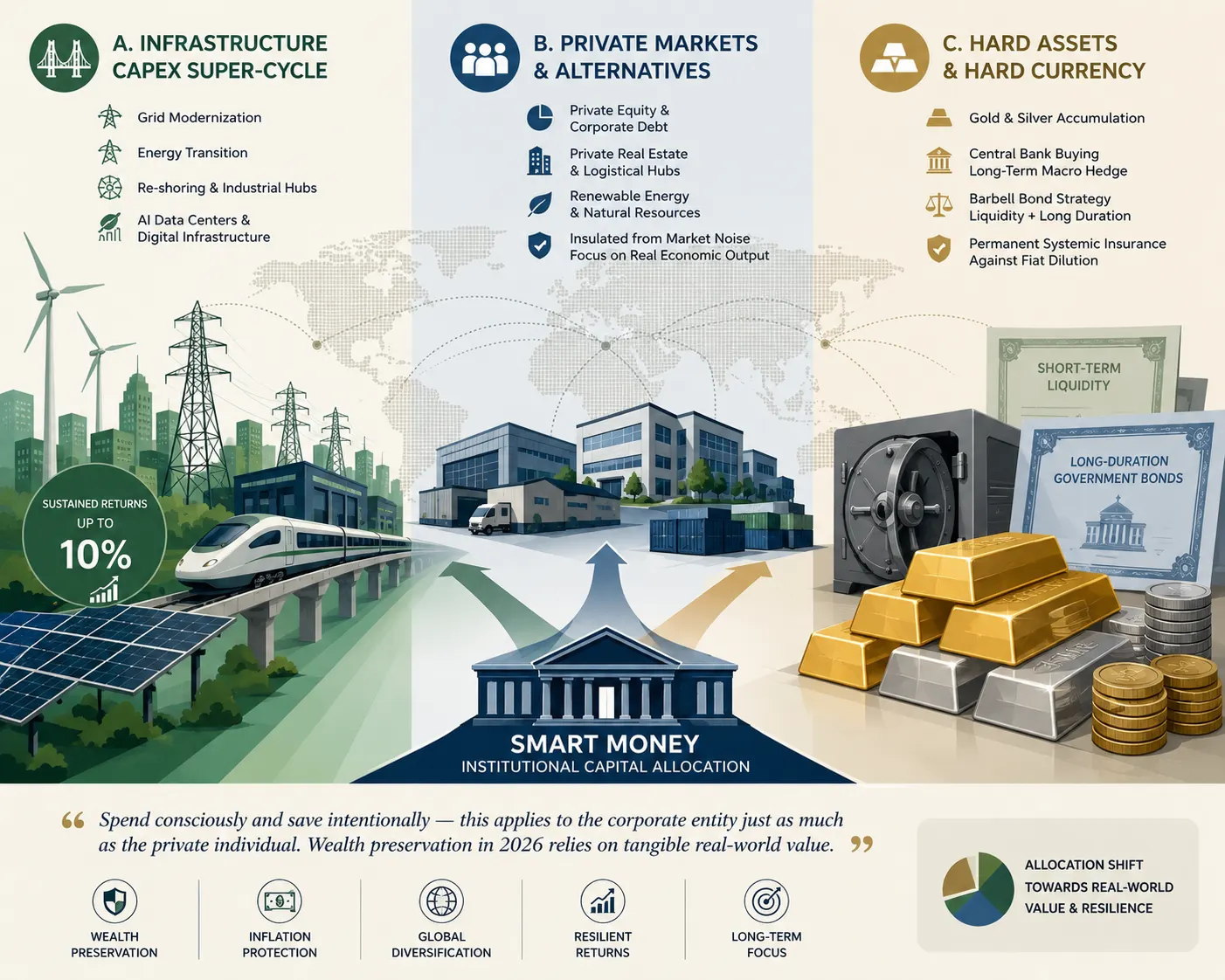
Faced with high equity valuations in public markets and severe duration risks in standard fixed-income bonds, institutional vanguard capital is migrating rapidly into three prominent domains:
A. The Infrastructure Capex Super-Cycle
If there is one absolute consensus among multi-billion-dollar sovereign funds in 2026, it is the prioritization of structural infrastructure. The convergence of grid modernization, regionalized manufacturing re-shoring, and massive energy consumption by global AI data centers has created an unprecedented long-term capital requirement. Leading asset management firms, such as Brookfield and Macquarie, project sustained annual returns of up to 10% for utilities and smart-grid infrastructure projects. This sector has effectively become the "new fixed income" for institutions, providing predictable, long-term cash flows that are frequently indexed directly to inflation rates, thereby shielding capital from the eroding value of fiat paper.
B. Institutionalization of Private Markets
Private equity and alternative investments are no longer considered exotic allocations for high-net-worth individuals; they have officially moved into the mainstream of corporate treasury and endowment management. Prominent investment banks project that allocations to alternative, semi-liquid structures will rise from a historical baseline of 5% to an aggressive 15-20% of institutional portfolios. These vehicles utilize specialized structures to open up access to corporate debt financing, private real estate logistical hubs, and localized renewable energy production fields. Smart money prioritizes these assets because they insulate wealth from the short-term noise, emotional panic, and daily price volatility of public equity exchanges, allowing capital to compound based on real economic output.
C. Hard Currency Accumulation
Recognizing the ongoing dilution of major sovereign currencies, astute allocators are continuing to expand their positions in tangible hard assets. Physical gold and silver have established solid baselines, driven by persistent buying from major central banks and long-term macro hedge funds. Rather than treating precious metals as speculative trading vehicles, smart money treats them as permanent systemic insurance. Concurrently, institutional investors are utilizing precise barbell bond strategies — combining short-term liquidity instruments for reliable accrual with long-duration government paper held strictly for tactical upside — ensuring they remain agile enough to capitalize on sudden liquidity contractions across global banking pipelines.
"Spend consciously and save intentionally — this applies to the corporate entity just as much as the private individual. Wealth preservation in 2026 relies on tangible real-world value."
In summary, the landscape of 2026 requires an absolute departure from complacent investing strategies. As macro volatility intensifies across energy sectors and public equities face rigorous structural stress tests, the institutional elite are moving away from fiat-dependent models and heavily positioning into infrastructure, private alternatives, and real hard assets. By understanding where the smart money is moving, forward-thinking market participants can properly structure their portfolios to weather the volatility and capture sustainable long-term value.
Read Further
- Treasury Yields Snapshot: June 26, 2026 — Advisor Perspectives / dShort
- 2026 Private Markets Outlook — BlackRock Institutional Insights
Disclaimer: All the data, trends, and sector analyses provided above were compiled from various global economic research resources, institutional outlooks, and market studies. This comprehensive report is for informational purposes only and should not be construed as official financial advice or a binding quote from our organization.
Advertisement