

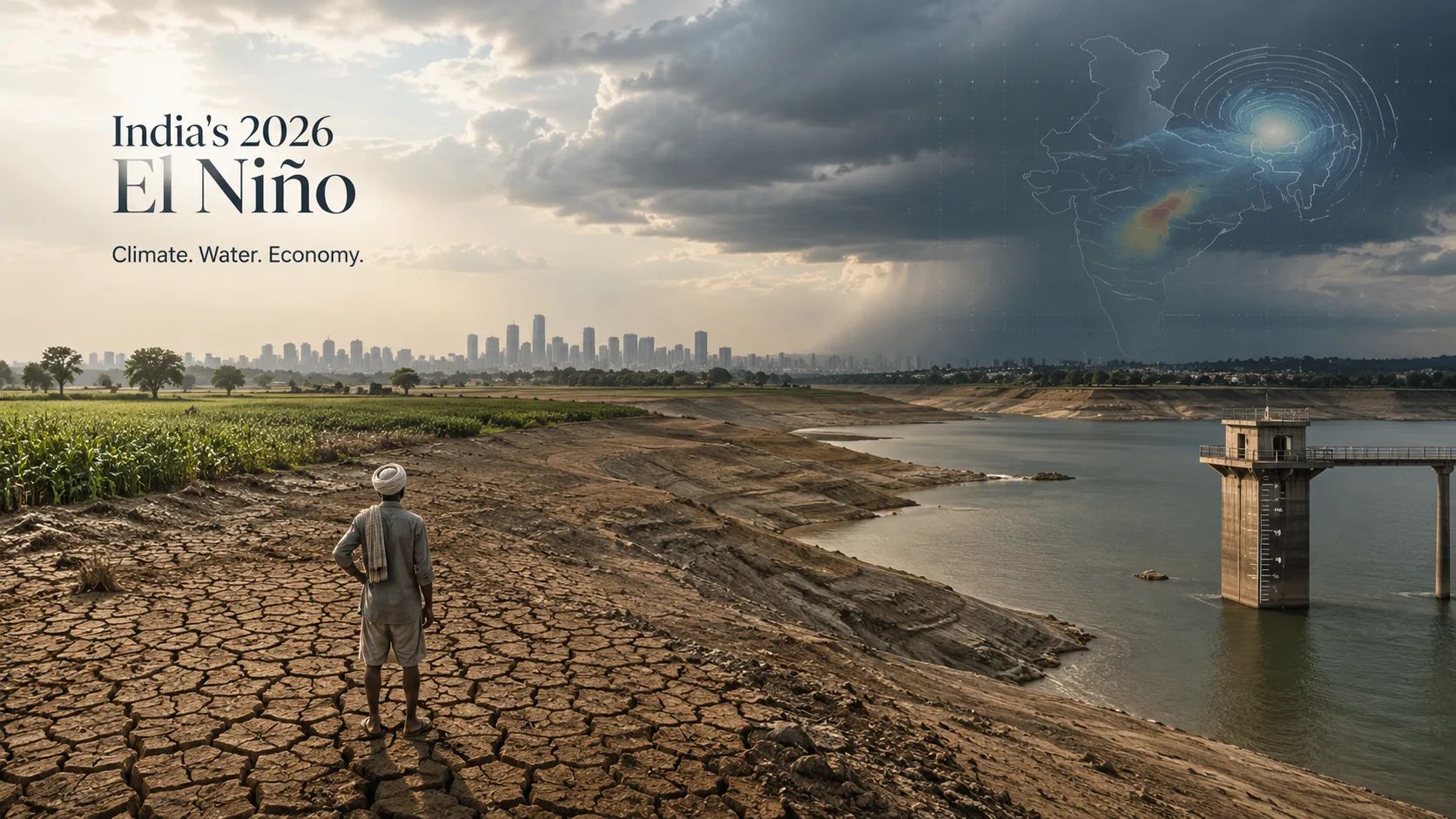
India's fiscal deficit, rural employment numbers, and headline inflation all hinge on a single atmospheric variable: whether the 2026 monsoon delivers 96% of its long-period average rainfall or 88%. The difference between those eight percentage points represents approximately Rs. 2.5 lakh crore in agricultural output — more than the combined annual revenue of India's five largest IT services companies. In this country, climate is not merely an environmental concern. It is, quite literally, the finance minister.
Advanced Weather Models and the Predictive Efficiency They Provide
With modern meteorological tech, predicting the economic impact of seasonal trends has become significantly easier and more efficient. Financial institutions, agricultural tech firms, and risk managers use sophisticated automated forecasting systems to calculate the micro-expenses of our day-to-day lives, corporate logistics, and international supply chains. These advanced systems do not just monitor temperatures; they evolve into proactive asset platforms that analyze multi-decade data sheets, track soil moisture trends via satellite data, forecast global commodity pipelines, and even automate asset allocation in agricultural derivatives with minimal manual input. These tech systems help retail businesses and macro investors get continuous financial advice while managing large portfolios and bank statements. Decisions can be made on the fly for retail markets or logistics paths based on what is currently trending in international weather patterns. By utilizing smart and successful advancements in predictive analytics, modern enterprises feel fully prepared to capture market upside while eliminating downside risks. Tools like the India Meteorological Department's (IMD) updated dynamic forecasting models, integrated satellite telemetry grids, and automated moisture sensors across rural states give the illusion of absolute control over the production cycle.
"The Indian monsoon is not merely a meteorological event; it is the lifeline of the subcontinent's economy, supporting hundreds of millions of livelihoods. When the monsoon falters, the consequences ripple far beyond dry fields."
Yet, despite these highly detailed simulations, an inherent vulnerability remains. Technology can predict the storm, but it cannot make it rain. Corporate supply chains might have automated dashboards, but when a structural climate disruption arrives, the algorithmic efficiency begins to unravel, revealing that the real foundation of the economy is still tethered to traditional soil and sky.
The Shockwaves of El Niño: Agriculture, Sowing Shocks, and Food Inflation
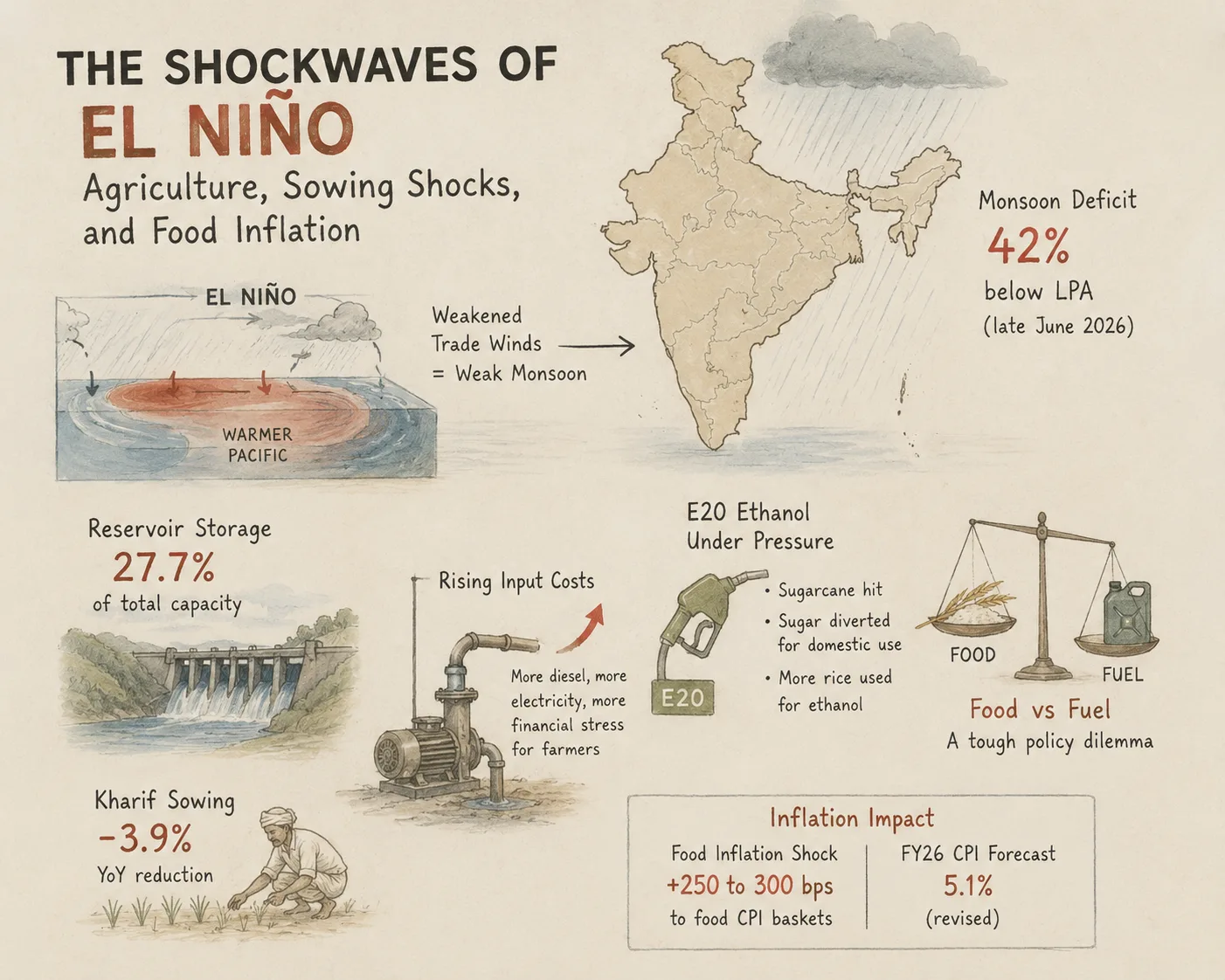
The core reality of India's economic machinery is that nearly half of the nation's net sown area remains entirely rain-fed. When a strong El Niño pattern emerges in the equatorial Pacific, it alters global atmospheric circulations and weakens the easterly trade winds over the Indian Ocean. This suppresses the Southwest Monsoon, leading to a delayed, highly deficient, and unevenly distributed rainfall pattern across the subcontinent. By the third week of June 2026, cumulative rainfall across the country was running a staggering 42% below the long-period average — substantiating a deficit far wider than initial soft-landing predictions.
Key Economic Metrics & Climate Indicators (June 2026 Data)
- National Monsoon Rainfall Deficit: 42% below long-period average (as of late June 2026)
- National Reservoir Water Storage: Dropped sharply to 27.7% of total active capacity
- Kharif Sowing Reduction: 3.9% year-on-year drop across major agricultural regions
- Projected Food Inflation Shock: +250 to 300 basis points addition to food CPI baskets
- Revised FY26 Headline CPI Forecast: Elevated to 5.1% due to climate-driven supply disruptions
This deficit immediately translates into an agricultural shock wave. The delayed arrival of critical rain severely suppresses the sowing acreage and productivity of essential Kharif crops, including rice, pulses, cotton, soybeans, and sugarcane. To compensate for empty skies, small and marginal farmers are forced into heavy groundwater extraction. This triggers an immediate, sharp spike in rural input costs due to the extensive diesel and electricity consumption required to run irrigation pumps. Profit margins are aggressively eroded, creating deep pockets of rural financial distress. Furthermore, the domestic shock leaks directly into industrial fuel strategies. India's ambitious E20 blending program, which aims for 20% ethanol integration in petrol, relies heavily on sugarcane and maize feedstocks. With El Niño heavily restricting sugarcane output and forcing the government to prioritize domestic sugar stocks to avoid severe food shortages, the production of sugar-based ethanol is projected to hit a major bottleneck. The state is forced to divert significantly more rice for ethanol production, compounding the strain on the national food balance sheet and triggering a classic food-versus-fuel policy dilemma.
Advertisement
The Rural Squeeze: FMCG Demand Slowdown and Broader Macro Crisis
Because food constitutes a massive, sensitive portion of the Consumer Price Index (CPI) basket in India — accounting for close to 37% — any supply-side shock in cereals, vegetables, and pulses aggressively drives headline inflation upward. A rainfall deficit of 10% can add up to 300 basis points directly to food inflation, eroding the purchasing power of low- and middle-income households. When families are forced to spend a significant portion of their daily budget on basic food survival, discretionary spending is instantly put on hold. This creates an immediate contraction in rural demand, slowing down consumption for fast-moving consumer goods (FMCG), two-wheelers, entry-level passenger vehicles, and structural agri-inputs. This structural squeeze creates a direct threat of stagflationary pressure: slowing industrial growth paired with sticky, climate-driven inflation. For the Reserve Bank of India (RBI), persistent food inflation completely restricts monetary policy flexibility. The central bank cannot lower interest rates to stimulate a cooling economy if food costs keep headline CPI elevated around 5.1%. Instead, borrowing remains expensive, corporate margins contract under rising raw material inputs (such as edible oils and packaging commodities), and the wider economic momentum slows down.
"Monsoon is India's true Finance Minister. It determines food production, water availability, livelihoods, and the ultimate path of macroeconomic growth."
No matter how many digital tools or financial dashboards we use to map our corporate assets, the entire macro structure remains dependent on the physical reality of water. When the reservoirs dry up to 27.7%, it affects not only fields but water-intensive heavy industries and hydropower generation, which accounts for nearly 9% of India's electricity grid. The economy is reminded that climate resilience requires deep structural investments — like rainwater harvesting and water table preservation — rather than pure reliance on electronic trackers.
In conclusion, while predictive systems and automated tools give us unparalleled efficiency in tracking and reacting to financial changes, they cannot replace physical infrastructure and ecological discipline. True resilience in 2026 lies in combining modern predictive analytical tools with aggressive, authentic ground-level water management and climate-adaptive agriculture. We must spend consciously on infrastructure and save our natural resources intentionally if we wish to survive the volatile cycles of a changing planet.
Read Further
- El Niño Concerns: The Potential Impact of a Weak Monsoon on India Compared to the US-Iran Conflict — Observer Voice, June 2026
- India's Weak Monsoon and Preparedness — Akka IAS, June 2026
Disclaimer: All the data and analytical points provided above were gathered from reputable climate research studies, meteorological data updates, and macroeconomic outlooks. This report should be treated as an educational and analytical brief on climate-economic interactions and not as direct financial or policy advice.
Advertisement