

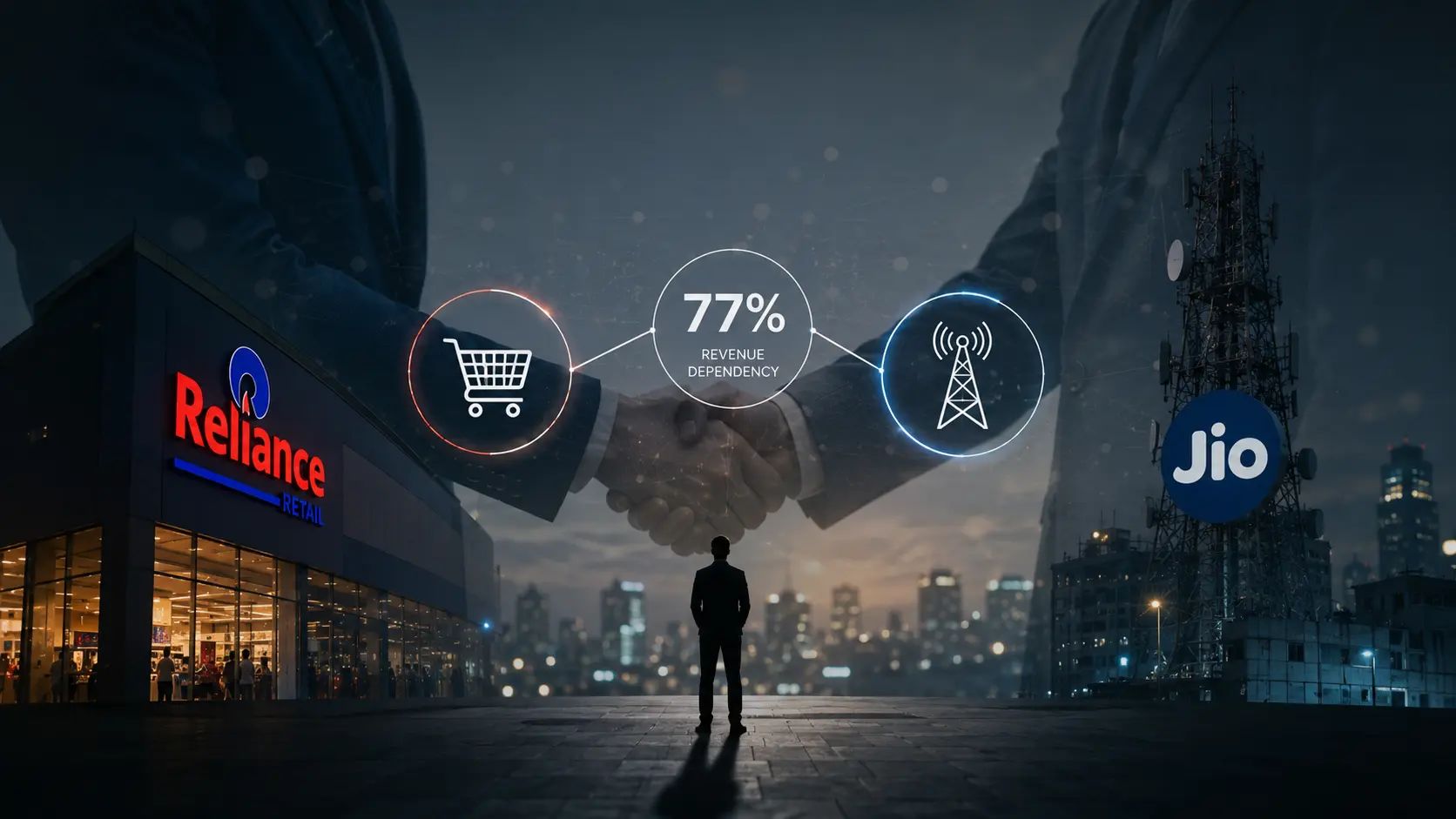
In the contemporary architecture of Indian mega-conglomerates, the operational boundaries between telecommunications, digital infrastructure, and brick-and-mortar retail have blurred into a highly integrated ecosystem. At the epicenter of this structure sits Reliance Industries Limited (RIL), which controls Jio Platforms Limited and Reliance Retail Ventures Limited (RRVL). While each subsidiary presents an independent growth narrative to public credit markets and institutional private equity investors, a deep structural lookup reveals a profound layer of financial interconnectedness. Specifically, Jio's digital network serves as the primary transaction highway, payment ledger, and consumer acquisition engine for Reliance Retail's massive cross-country footprints.
This arrangement has generated a systemic captive dependency structure. For minority shareholders holding equity stakes at various levels of the corporate pyramid — or in public tracking instruments — this integration complicates standalone fundamental analysis. Traditional corporate valuation treats telecom and retail as distinct business verticals with unique risk-return profiles, localized margin constraints, and separate asset turnover cycles. Telecommunications operates as a highly leveraged, capital-intensive utility with recurring, subscription-based cash flows. On the other hand, consumer retail functions on a variable-cost framework sensitive to inventory logistics, supply-chain bottlenecks, and localized discretionary spending shifts. When the internal revenue models reveal that a substantial majority of operational processing, digital commerce fulfillment, and backend technical solutions within Jio are fundamentally dependent on or routed through the retail affiliate network, the traditional diversification discount gets inverted into an unpriced structural concentration risk.
"In a nested corporate empire, transparency isn't just about what is published on the formal balance sheet; it's about what remains hidden in the internal transaction channels between sister entities."
The 77% Blindspot: Revenue Reliance and Systemic Corporate Governance Risk
The core of the structural concern lies in the sheer volume of intra-conglomerate commercial transactions. Analytical estimates indicate that up to 77% of certain specialized enterprise B2B segments, data-traffic pipelines, and payments processing infrastructure revenues inside Jio's ecosystem are heavily integrated with or generated by Reliance Retail's digital touchpoints, omnichannel commerce solutions, and physical fulfillment networks. This magnitude of single-counterparty commercial exposure within a single promoter-led group breaks the classic assumption of independent operational resilience. Should the consumer retail segment face a multi-quarter macro-economic slowdown, credit tightening, or supply-side structural shock, the downstream financial impacts would instantly propagate into Jio's top-line numbers through localized enterprise contracts and data infrastructure utilization fees.
| Vertical Segment Analysis | Estimated Captive Dependency Ratio | Primary Transaction Vector | Governance Pricing Impact |
|---|---|---|---|
| Digital B2B Infrastructure | 77% | Intra-group Cloud & Logistics Pipelines | High Pricing Asymmetry |
| Consumer Data Traffic Route | 64% | JioMart-to-Consumer Endpoints | Opaque Transfer Pricing |
| Payment Gateway Integration | 58% | Captive Retail Point-of-Sale Nodes | Compressed Standalone Margins |
From a governance perspective, this dynamic shifts the analysis from traditional fundamental performance to the opaque realm of Transfer Pricing Mechanisms and Related Party Transactions (RPTs). Under normal market guidelines, RPTs must occur strictly on an arm's-length basis to prevent value migration between entities. However, when an unlisted enterprise handles such massive captive volume, verifying the true market clearing price of data routing, software licensing, and digital terminal connectivity becomes exceptionally difficult for outside analysts.
Minority investors are left with a fundamental blindspot: they cannot easily determine whether Jio is subsidizing the expansion of the retail footprint through discounted infrastructure pricing, or conversely, whether retail is artificially lifting Jio's platform metrics through high internal fees. This circular economic exposure creates a closed-loop financial structure where structural stress can quickly spread, yet remain hidden from conventional quarterly balance sheet reviews. The scale of this dependency is no longer speculative — at the 49th AGM notice filed in June 2026, Reliance Industries sought shareholder approval for over ₹16.64 lakh crore in internal transactions between Jio and Reliance Retail spread over five fiscal years, with the largest single flow of over ₹13 lakh crore directed from Reliance Retail to Reliance Jio for telecom services sold through its retail network.
Advertisement
Minority Shareholders and the Pricing Asymmetry in Unlisted Captive Ecosystems
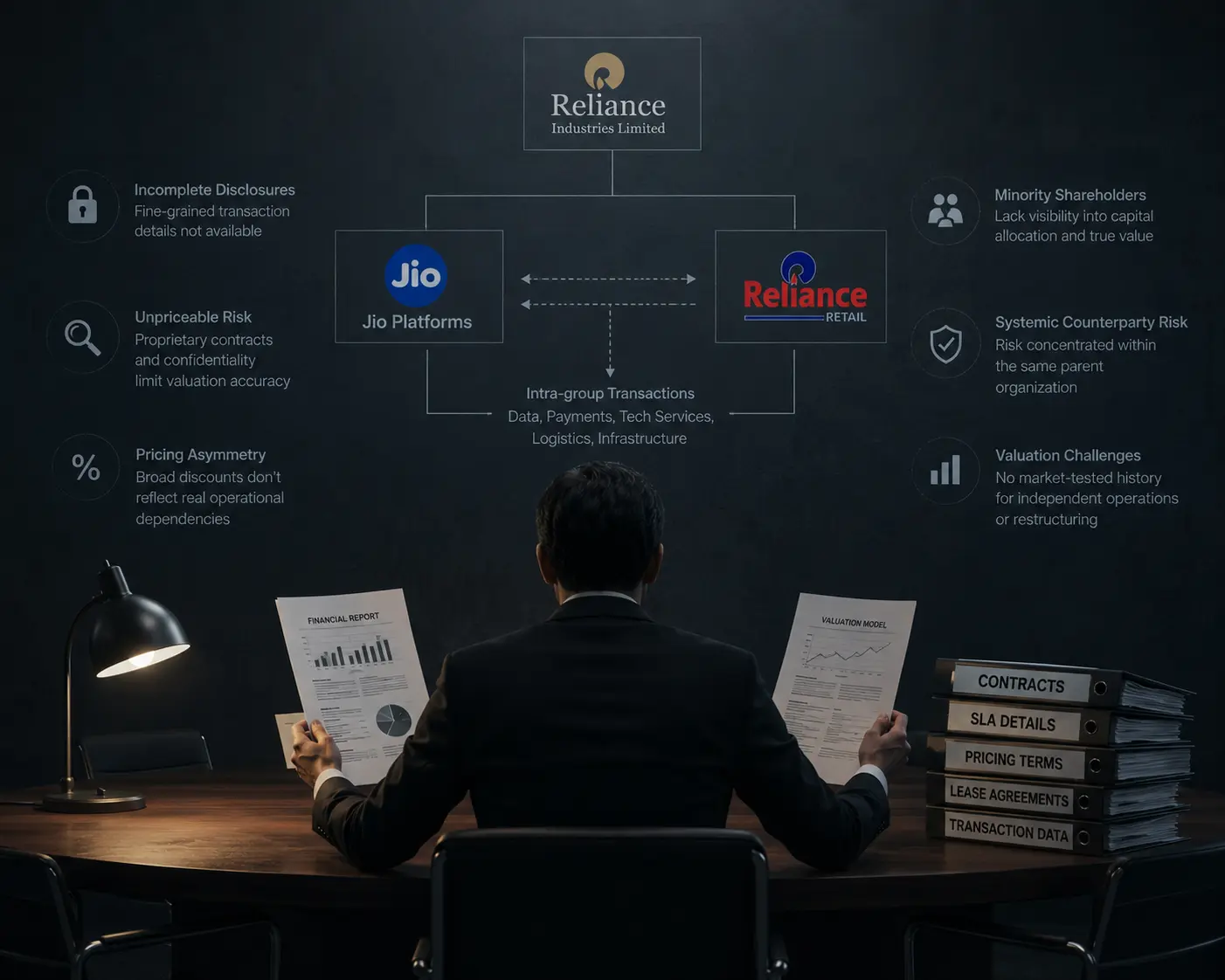
The primary victims of this structural opacity are the minority public and private equity holders who are forced to assess valuation models with incomplete parameters. In situations where subsidiaries remain unlisted public limited companies or are wrapped inside a larger holding architecture, standard public disclosure mandates do not capture the fine-grained transactional details required to build reliable risk-adjusted discount models. Instead, investors are forced to apply broad holding company discounts or generic sector multiples that completely fail to account for the unique operational dependencies link by link.
The risk is essentially unpriceable because the underlying contractual frameworks — including SLA penalties, long-term transmission tariffs, and technology lease renewals between Jio and Reliance Retail — remain strictly proprietary and confidential. Consequently, equity risk premium calculations for independent arms of the conglomerate are frequently misstated. Minority shareholders cannot easily verify if capital allocation decisions are being executed to maximize the value of the specific entity they own, or if capital is being structurally redirected to support the broader corporate group's long-term strategic positioning.
This pricing asymmetry is exacerbated during corporate restructuring events, capital reduction programs, or eventual spin-offs. Without a transparent, market-tested history of independent commercial operations, any valuation assigned to minority stakes during restructuring remains a mathematical derivation based on internal management guidance rather than genuine open-market price discovery.
"When systemic counterparty risk lives entirely within the same parent organization, standard credit default swaps and traditional liquidity cushions fail to protect the minority stakeholder."
Strategic Mitigation Paths: The Urgent Need for Segment Dissociation
To restore institutional confidence and enable accurate public valuation models, the conglomerate must introduce deliberate and structured reporting frameworks aimed at segment dissociation. First, both Jio Platforms and Reliance Retail must radically expand their quarterly financial statement notes to include granular, transactional line-item disclosures of all intra-group revenues, clearing tariffs, and shared infrastructure usage metrics. By publishing normalized, external-equivalent market pricing for internal data and retail transaction channels, the management can prove to the global financial community that both entities function on genuine arm's-length terms.
Second, as both businesses mature into independent pillars of the Indian economy, the corporate governance roadmap should prioritize full, independent public listings for each entity on national stock exchanges. A public listing enforces rigorous disclosure requirements, subjects related-party transactions to mandatory minority shareholder approval votes, and subjects the entire ecosystem to real-time institutional price discovery. Only by fully untangling the captive financial loops and subjecting the internal 77% dependency structures to the transparent discipline of public equity markets can the underlying corporate governance risks be accurately priced, minimized, and ultimately managed for the benefit of all stakeholders.
Read Further
- Reliance Industries Integrated Annual Report 2025–26 — Official Corporate Disclosures, Financial Highlights, and Subsidiary Performance Data, RIL.com
- SEBI's 2025 Related Party Transactions Overhaul: Balancing Ease of Doing Business and Investor Protection — IndiaCorpLaw, August 2025
- Reliance Industries Seeks Shareholder Approval for ₹16.64 Lakh Crore Intra-Group Transactions — 49th AGM Coverage, Upstox News, May 2026
Disclaimer: All the data, metrics, and analytical perspectives provided above were derived from publicly available corporate disclosures, SEBI regulatory frameworks, and financial market studies. This analysis is compiled for educational and comprehensive informational purposes only, and should under no circumstances be taken as an official financial quote, absolute market directive, or explicit investment advice from our publication platform.
Advertisement