

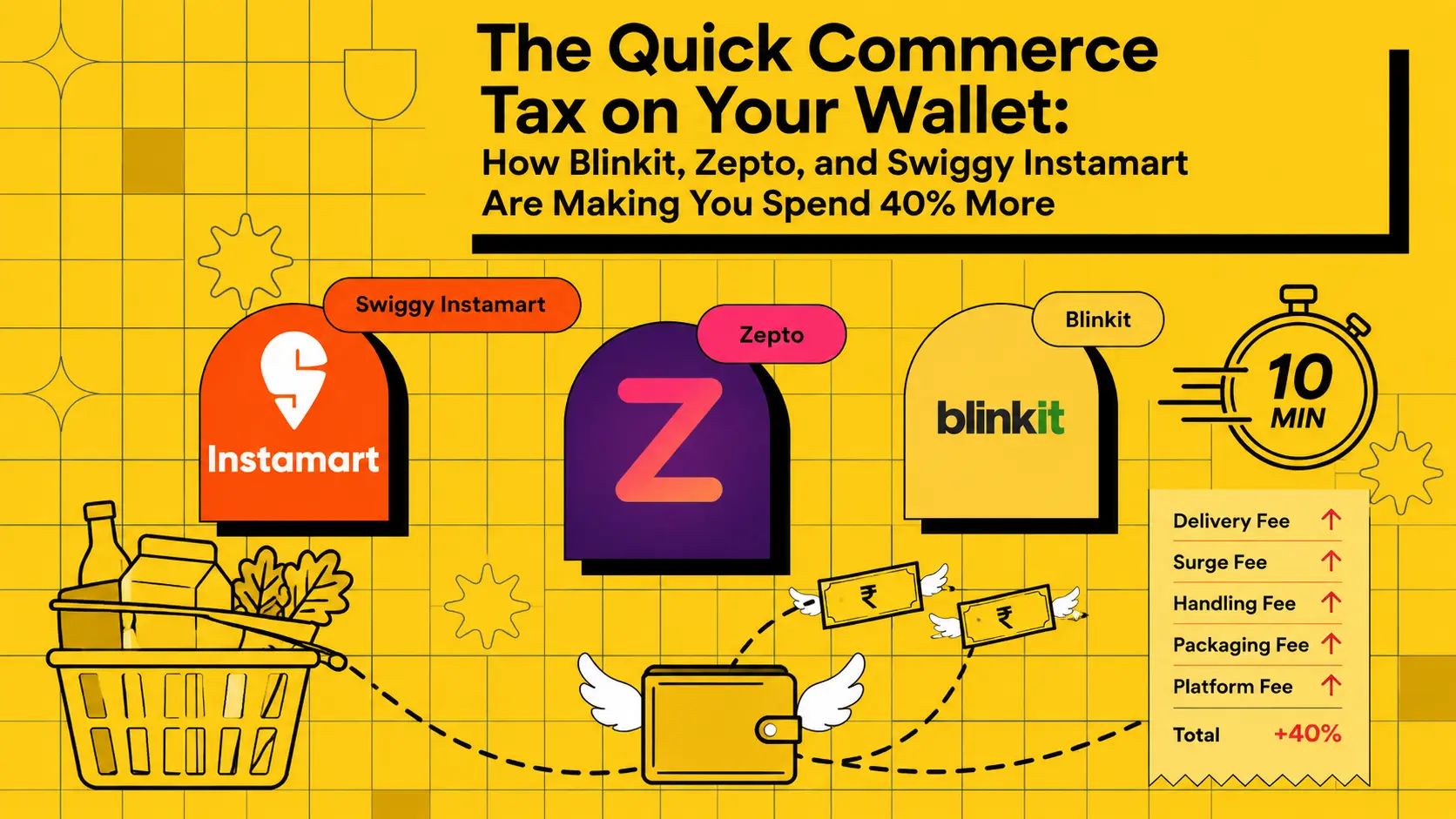
In today's fast-paced era where everything is being optimized, packaged, and delivered by dark stores and rapid logistics networks, we have become heavily dependent on convenience. Somehow, getting a packet of milk or a single lemon delivered to our doorstep in 7 minutes flat is incredibly useful for our busy routines. But somehow, looking closely at our bank statements at the end of the month reveals a completely different story. It is a story of capital leakage, artificial urgency, and a silent tax that we are willingly paying for speed.
Quick commerce — or Q-commerce — is something that was originally created to solve genuine household emergencies. It was designed to help you when you ran out of formula in the middle of the night, or when you realized mid-recipe that you forgot the ginger-garlic paste. But when we ended up depending on platforms like Blinkit, Zepto, and Swiggy Instamart for our absolute everything — from daily groceries and electronics to clothes, cosmetics, and late-night snacks — we entered an entirely different psychological trap. We don't know exactly where or how we forgot the old, traditional methods of deliberate household management, retail discipline, and mindful spending. We just drifted into it.
This article basically is going to get you all thoroughly aware about what is happening behind those shiny tracking maps, how the quick commerce architecture operates to inflate your average order values, and what we should do to balance modern technological convenience with authentic, original methods of budgeting and managing our hard-earned finances.
10-Minute Dark Stores and the Efficiency They Provide
With quick commerce platforms, managing immediate requirements has undeniably become easier and more logistically efficient. We no longer need to budget half an hour of our evening to change clothes, pull out the car or scooter, navigate through local traffic, find parking, and stand in long billing lines at local supermarkets just to fetch four or five items. In terms of sheer mechanical efficiency, the dark store model is a masterpiece of modern operational engineering.
Autonomous algorithmic systems and highly localized supply hubs allow these apps to evolve far beyond simple digital grocery storefronts. Today, they function as hyper-responsive predictive delivery machines. They analyze real-time demand patterns, forecast neighborhood supply shortages, optimize rider routes to the millisecond, and refresh their catalogs based on current weather conditions, cricket matches, or holiday trends with virtually zero lag. If it starts raining, the app dashboard immediately shifts to highlight tea, coffee, and savory snacks. If it is a hot summer afternoon, ice creams and cold carbonated beverages dominate your viewport. They do all the heavy operational thinking for you.
These apps help you save time while managing your domestic inventories, making decisions effortless for busy corporate workers, homemakers, and students alike. They operate upon what is trending in the micro-market and help you choose from thousands of SKUs spanning fresh produce, dairy, gourmet foods, smartphone chargers, toys, and pharmaceutical essentials. They ensure that whatever your mind desires is resting on your kitchen table before you even fully realize the weight of your purchase decision.
The Major Q-Commerce Players Dominating Your Screen:
- Blinkit (Formerly Grofers, now completely integrated into Zomato's ecosystem)
- Zepto (The pure-play hyper-growth specialist that revolutionized the 10-minute dark store standard)
- Swiggy Instamart (The micro-delivery arm leveraging a massive unified food and delivery fleet)
- BigBasket BBnow (Tata's rapid response framework tackling the ultra-fast retail sector)
These are the primary hyper-local delivery engines that millions of urban consumers use daily to initiate their shopping journeys with a single tap. Yet, while their infrastructure represents the absolute peak of modern technological advancement, it hides a devastating financial downside for the average household ledger.
"Convenience is the ultimate product. People will gladly bankrupt their future self to satisfy their present impatience."
The True Hidden Cost: Cons of Using Ultra-Fast Delivery Apps
Artificial intelligence and data science algorithms are, at their core, engineered to maximize platform revenue, not your personal savings. They do not possess a human mindset that can think empathetically like a traditional accountant or make spending decisions after calculating the endless long-term possibilities of your financial health. They look at you as an active data point to be optimized for maximum Average Order Value (AOV) and order frequency.
| Expense Dimension | Traditional Local Market / Monthly Buying | Quick Commerce Ecosystem (Blinkit / Zepto / Instamart) |
|---|---|---|
| Pricing Premium | MRP or discounted wholesale rates; high transparency | Dynamic pricing; frequent 5–15% markups on loose items & produce |
| Ancillary Fees | Zero additional charges. Own transport cost only | Delivery fee + surge fee + handling charge + packaging tax + platform fee |
| Cart Inflation Mechanics | Strict physical lists; physical cart weight creates limits | Progressive "free delivery" bars; AI cross-selling nudges |
| Purchase Frequency | Once a week or once a month (planned) | 3 to 5 times a week on pure impulse (unplanned) |
In recent consumer spending studies conducted across Tier-1 urban micro-markets, a staggering trend has come to light. Regular users of quick commerce apps show an immediate 35% to 43% increase in their total monthly grocery and discretionary expenditures compared to when they purchased items via traditional physical formats or standard next-day slot delivery apps. This translates to an average 40% wallet premium — a literal "convenience tax" that drains individual liquidity. And much like the invisible tax that low-income households quietly absorb on everyday essentials, this Q-commerce premium is invisible by design — too small in any single transaction to trigger alarm, yet devastating in aggregate.
Why does this happen? The answer lies in the subtle behavioral traps coded directly into the user interface:
The Free Delivery Threshold Illusion: When you open an app to buy a bottle of milk worth ₹35, the interface immediately alerts you that you are just ₹165 away from unlocking "Free Delivery." To avoid paying a ₹30 delivery fee, your brain rationalizes adding a package of premium cookies, a bottle of flavored yogurt, or an extra bag of chips that you never originally needed. You end up spending ₹200 to save ₹30. This calculated nudge alters consumer psychology, making everyday choices highly inefficient for your long-term bank balances.
Micro-Transactions and Fee Stacking: Every time you place an order, you aren't just paying for the items. You are hit with an array of micro-charges. A ₹5 platform fee, a ₹9 variable handling charge, a ₹15 high-demand surge fee because it is peak hours, and a ₹12 protective packaging charge. Because these numbers seem small — just a few single-digit coins — our minds fail to register them as major losses. However, if a household places 20 quick orders a month, these invisible micro-fees alone pile up to anywhere between ₹600 and ₹1,200 a month, completely wasted on logistics overhead.
The Disappearance of the Friction Point: In traditional retail, if you want ice cream at 11:30 PM, you have to get out of bed, wear shoes, find an open store, pay hard cash, and walk back. This physical effort acts as a friction point that allows your rational mind to step in and stop the impulse. Quick commerce removes every single piece of friction. With biometric authentication and unified payments interfaces (UPI), you go from absolute impulse to completed financial transaction in less than three seconds. Giving in to these instantaneous prompts transforms budgeting into an endless loop of corrective micro-actions, where you spend your days checking records, regretting small orders, and struggling to patch financial leaks. It turns money management into a tiresome chore that induces major headaches and financial anxiety.
Advertisement
The Traditional Counter-Weight: The Kakeibo Method of Reclaiming Control
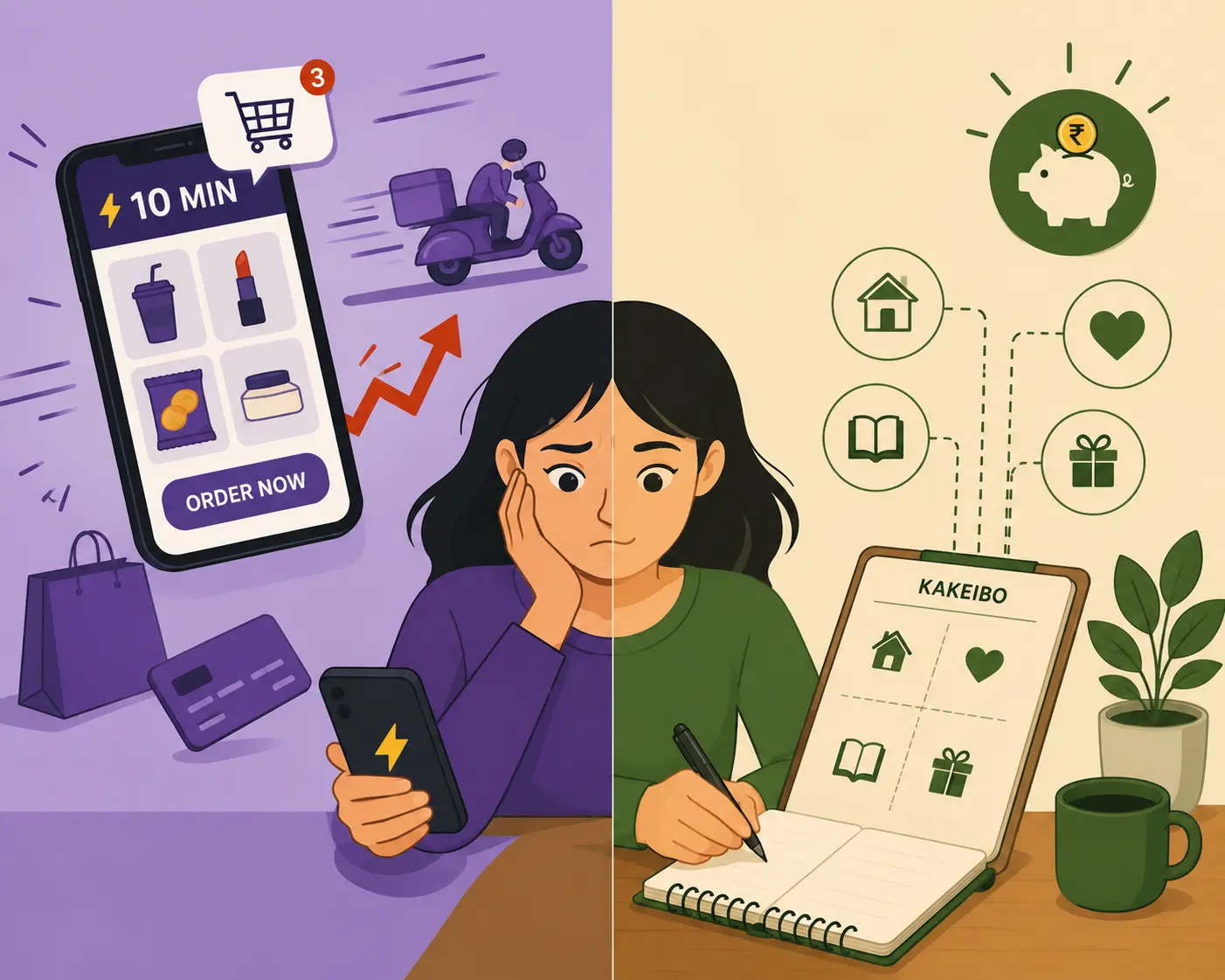
To break free from this hyper-optimized consumer wheelhouse, we have to look back at the lost wisdom of deliberate finance. Kakeibo (sometimes spelled Kakebo) is a highly respected, traditional Japanese method of budgeting and household money management. The word itself comes directly from the rich history of Japanese domestic life: Kake translates closely to household financial accounts, and Bo means a physical notebook or diary. Together, it represents the physical book of household financial awareness.
Kakeibo was originally created all the way back in 1904 by Hani Motoko, who is historicized as Japan's very first female journalist. She introduced this structured framework to the public through a popular women's magazine to empower ordinary households, especially women, to manage their hard-earned money with meticulous care during Japan's rapid modernization and industrialization period. The primary goal of her notebook system was simple yet profoundly transformative: to encourage deeply mindful spending, drastically improve family saving habits, eliminate hidden or unnecessary purchases, and help individuals cultivate an internal sense of unwavering financial discipline.
| Western / App-Driven Budgeting | The Traditional Japanese Kakeibo |
|---|---|
| Reactive: Tracks money after it has already left your account | Proactive: Requires deliberate journaling before spending occurs |
| Automated: App categorizes everything; your brain stays completely passive | Manual: Handwritten records force active neurological reflection |
| Impulse-Friendly: Stores cards and enables instant one-click checkouts | Friction-Rich: Builds a mental wall between raw desire and action |
| Stat-Heavy: Shows complex pie charts but fails to change core spending habits | Mindfulness-Centric: Focuses heavily on the emotional 'why' behind purchases |
Unlike modern financial apps that simply scan your text messages and show you colorful graphs of your past damage, Kakeibo focuses heavily on reflection, emotional awareness, and absolute spatial presence. It does not look at your money as just a set of clean mathematical calculations. It looks at it as an extension of your life energy. People who follow the pure Kakeibo tradition utilize a physical handwritten notebook and monthly planning sheets that require them to sit down at the beginning of each month and answer four deceptively simple, grounding questions:
- How much total money do I have coming in this month?
- How much money would I genuinely like to save and put away?
- How much money am I actually spending in my daily life?
- How can I actively improve my relationship with my capital next month?
A true Kakeibo planner forces you to divide your entire monthly expenditure into four distinct, unshakeable pillars. The first pillar is Needs, which covers absolute essentials without which you cannot survive — rent, insurance, base food items, utility bills, and basic medicine. The second pillar is Wants, which holds non-essential comfort items like trendy clothes, new gadgets, premium household decor, and optional streaming services. The third pillar is Culture, which is specifically set aside for intellectual and personal growth — books, museums, educational courses, and music lessons. The final pillar is Unexpected, which accommodates completely random or irregular expenses like medical emergencies, sudden car repairs, or wedding gifts.
Now, to a generation raised on automated smartphone tools, this might sound like nothing more than an outdated, slow, written version of an excel sheet. But this is exactly where the absolute magic of Kakeibo comes into play. Neurological studies prove that when you physically write down an item name and its cost with a pen on paper, your brain is forced to slow down. It processes the transaction with full awareness. You are forced to feel the weight of that money leaving your possession. When you manually write down that you spent ₹450 on a single tub of quick-commerce gourmet ice cream at midnight, your mind becomes fully aware of the absurdity of the action. It forces you to pause, look inward, and evaluate whether that purchase brought real value or was simply a passing emotional whim. This ritual eventually builds a habit of thinking twice before clicking 'Order,' which is the core principle of long-term success in money management and wealth creation.
"Spend consciously and save intentionally. Do not let speed dictate your scarcity."
Striking the Balance: How to Rule the Algorithm Instead of Being Ruled
The goal is not to completely delete your Blinkit, Zepto, or Swiggy Instamart apps and live a life of extreme deprivation. Technology exists to serve us, to give us back our time, and to ease our burdens. The critical challenge is ensuring that we do not trade our financial freedom for a few minutes of artificial convenience. We must learn to inject intentional structural friction back into our digital transactions. If you want to protect your wallet from the 40% quick commerce premium, you can adopt a few simple, highly effective behavioral guardrails:
The 120-Minute Cooling Rule: Every time you add an item to a quick commerce cart that was not part of your planned weekly staples, force yourself to close the app and wait at least two hours. Because these platforms thrive entirely on intense, short-lived impulse triggers, you will find that in 80% of cases, your desire completely vanishes after 120 minutes. The artificial urgency fades, and you save your money effortlessly.
The Weekly Consolidation Ritual: Instead of opening an app three times a day to buy items piecemeal, establish a fixed day — like Sunday morning — to perform a full review of your kitchen and household needs. Create a definitive physical list in a notebook, log onto a platform, buy everything in a single consolidated order that easily clears the free delivery bar, and close the app for the rest of the week. This single shift completely eliminates stacked platform fees, handling fees, and surge pricing from your life.
By marrying the unmatched logistical speed of modern agentic delivery systems with the timeless, meditative mindfulness of the traditional Kakeibo journal, you can build a financial fortress that enjoys the benefits of the modern world without succumbing to its commercial traps. Rule your spending with purpose, or the algorithm will gladly rule it for you.
Read Further
- Kakeibo — Origins of the Japanese Household Ledger Method, Hani Motoko, 1904 — Wikipedia
- Impact of India's Growing Quick Commerce Industry on Consumers and Gig Workers — ResearchGate / Academic Research Paper, 2026
- Quick Commerce Platforms Raise Consumer Fees as Ultra-Fast Delivery Becomes a Lifestyle — Storyboard18, 2026
Disclaimer: All the data, metrics, and analytical insights provided above were compiled from comprehensive internet consumer behavior resources, retail logistics case studies, and modern macroeconomic studies tracking urban personal finance trends. This content is for educational and awareness purposes only and should not be taken as an official quote from our web domain or as professional, legally binding financial advice.
Advertisement