

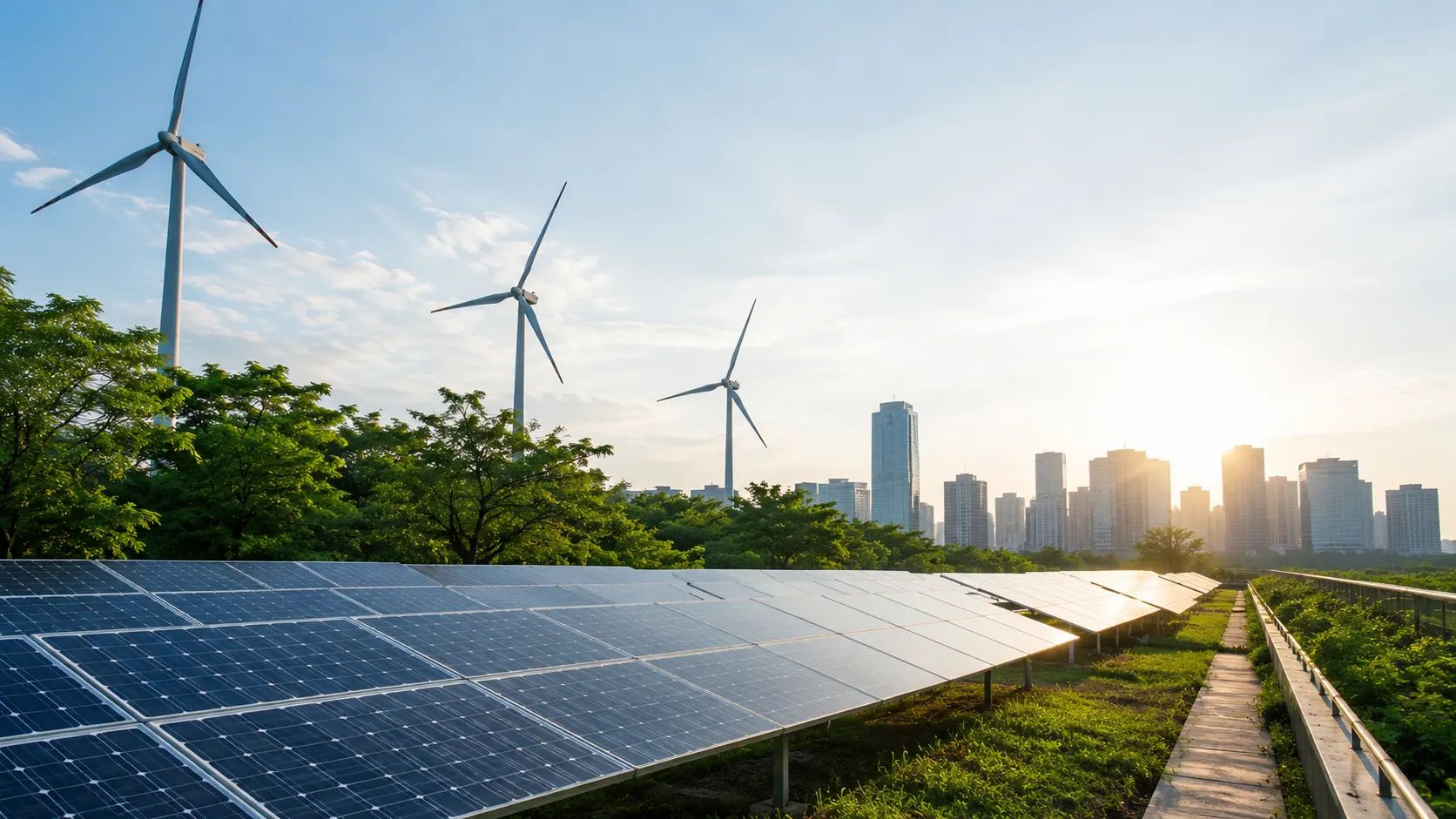
Now that we're scaling operations massively and powering them on massive digital infrastructure in corporate undertakings, we increasingly rely on elaborate, technological solutions to environmental problems. It's somehow very good for our productivity, and it's somehow presenting us with deep, hidden problems we frequently ignore. As companies blindly race toward next-generation solutions such as automated carbon accounting and AI-powered smart grids, what do we know about where we actually left behind the lost, time-honored means of managing resources, real waste reduction, and genuine operational discipline?
This article is going to make you aware of what we ought to do with advanced energy technology and with the authentic, traditional means of corporate sustainability and resource stewardship. The tightrope walk between these two worlds is no longer a trend for public relations; it is the very basis of financial survival and competitive action by 2026.
Autonomous AI Technology and the Energy Transition Efficiency It Provides
Sustainable infrastructure now offers the convenience of easier and more reliable calculation for monitoring environmental indicators. The elaborate carbon footprint of our day-to-day corporate life — and far more so across global finances, global business supply chains, and industrial processes — is now being actively handled by software systems. Market tools for autonomous energy intelligence are quickly advancing beyond rudimentary spreadsheet trackers and becoming "agentic" applications capable of analyzing real-time grid emissions, predicting peak load demand, automating corporate power purchase agreements (PPAs), fine-tuning facility heating and cooling loops, and providing microinvestment advice for carbon credit portfolios with little input from users.
The result is a flow of insightful answers to operational questions — "can I maintain sustainability metrics while running potentially resource-intensive operations for my restaurant or bar, by myself, without a specialist?" — that genuinely understand resource statements and implicitly protect you from making high-stakes, unsustainable decisions for your company, your production plants, or your warehousing logistics. These platforms have a strong dependence on what is trending in the world's carbon market, and provide corporate executives with a menu of intelligent, high-impact solutions to transform their long-term ESG journey.
Renewables made up a dramatic 61% of net new power-generating capacity worldwide, with utility-scale solar driving the pack, adding more than 27 gigawatts of alternating current capacity across new project cycles. Recent reports also show that 82% of companies receive direct, quantifiable business benefits from decarbonization activities, with returns of over $221 million per largest enterprise on average. This tidal wave of clean capacity needs to be managed autonomously to handle the complexity of today's power systems.
Here are some of the leading clean energy technologies and strategic platforms worth exploring to help get your corporate sustainability journey started:
- EnergyOS Smart Grid Optimizer: An energy management solution that automatically carries out time-of-use power shifting across multi-site industrial plants.
- SustainiChain Traceability Frameworks: Advanced blockchain and ledger solutions that enable full Scope 3 emissions visibility, inclusive of raw material source locations.
- CarbonTrade Automated Market Integrations (AMIs): AI-enabled portals that assess and purchase high-quality, verified carbon credits that directly align with local needs.
- GETs (Grid-Enhancing Technologies): Technologies based on dynamic line rating and advanced power flow control to make the best use of existing distribution lines.
- V2G (Vehicle-to-Grid) Systems: Bidirectional charging infrastructure enabling commercial electric vehicle fleets to serve as battery backup during grid stress.
"Optimize digitally, but ground your operations in true circularity."
Cons of Using Purely Tech-Driven Tools for Sustainability
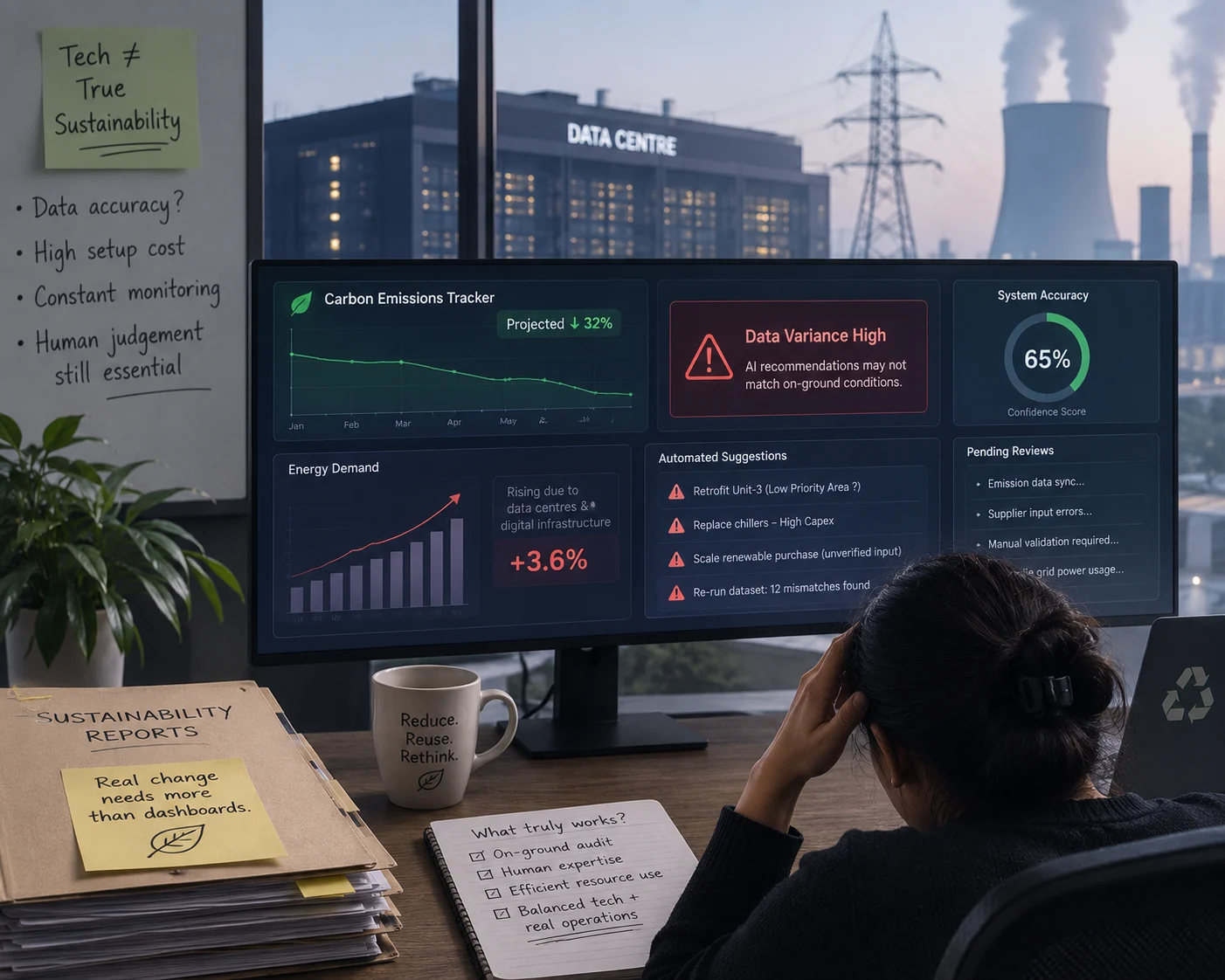
Cutting-edge automated green tech is, as we suspected, still software-driven AI — not a human-centric mentality that can think broadly like veteran operational leaders and make localized choices after running through countless physical scenarios on every plant floor. Industry reviews in recent years have shown that the largest automated carbon platforms are genuinely comprehensive in data management, but only when assigned much heavier and longer setup parameters, where every micro-variable has to be manually specified.
A full 65% accuracy rate was reported even at this level in early-stage automated plant audits — meaning that roughly 2 out of every 5 times, equipment retrofits based on software recommendations are off by a wide margin, leaving a fairly significant error range in financial budgeting. If not detected early, this can cause heavy losses in corporate capital expenditure. In addition, these systems can create a digital dashboard nightmare — an endless cycle of tracking errors, reviewing automated discrepancies, and reworking bad data inputs. Issuing commands and monitoring every automated record becomes a tedious daily task, consuming more human time and operational effort than expected, and giving operations managers real headaches and administrative migraines in the long run.
Advertisement
Perhaps most importantly, the rapid growth of AI-driven data centres has outpaced the surge in electricity demand, leading to power sector emissions rising unexpectedly by 3.6% in areas where traditional baseload generation is still strongly relied upon. This creates a remarkable paradox: running heavy computation to calculate carbon reductions while overloading the electrical grid.
The Traditional Sustainability Method: True Circularity
Sustained business success was, long before the days of real-time digital dashboards, defined by the principles of localized circularity and relentless resource stewardship. The idea has origins in early industrial practices, where waste was not treated as an inherent cost of doing business but as a fundamental failure of operational protocol. Traditional design was heavily influenced by reflection, consciousness, and senior engineering culture — not shallow dashboard metrics. Historically, people relied on hand-written layout sheets, building maintenance records, and manual resource flow diagrams to follow raw materials through procurement to end-of-life processing.
Four foundational pillars empower a circular operations planner to achieve true circularity: Reduce, Repair, Recover, and Redesign.
- Reduce: Avoiding unnecessary packaging, manually optimizing logistics routes, and reducing fuel consumption as a baseline, before turning to expensive upgrades.
- Repair: Lengthening the functional life of physical plant and manufacturing equipment rather than succumbing to accelerated obsolescence cycles.
- Recover: Creating direct closed-loop supply chains in which manufacturing scrap is melted down, re-extruded, or otherwise fed back into production.
- Redesign: Designing products from the outset so they can be fully disassembled, composted, or recycled without intricate chemical sorting.
This traditional mentality may sound like a grind, analog predecessor to contemporary automated carbon software tools — but it possesses the genuine magic of sustainable management. When corporate teams go to the factory floors, manually count material scrap rates, and purposely design out waste, their organizational mindset snaps to attention about what they are working with. They develop a sense of whether an input is operationally productive or ultimately wasteful. This behavior eventually becomes a second-nature cultural mindset to "stop and think" before melting down business resources or spending on extraneous capital infrastructure. This is the fundamental tenet of long-term success in corporate asset protection and resource preservation.
Key Takeaways for Corporate Action:
- Get visibility first: Establish structured baselines before jumping into multi-million-dollar software overhauls.
- Shift before you replace: Instead of immediately ramping up production via untested infrastructure, work on tweaking your current schedules and machinery runtimes.
- Inject the Human Element: Software is an efficiency multiplier, but true discipline resides with the team in the field.
In the end, the numbers speak for themselves. Although pure tech adoption can help streamline short-term utility costs, automated grid management companies that pair their tools with traditional, structural circularity will enjoy vastly reduced operational risk. They hedge themselves against volatile energy market spikes and the high costs of digital dependencies, enabling their business to remain truly sustainable for decades to come.
Read Further
- Majority of Businesses Report Economic Returns From Decarbonisation — edie, September 16, 2025
- Renewable Capacity Highlights 2026 — International Renewable Energy Agency (IRENA)
Disclaimer: All the data and statistical projections provided above were compiled from global sustainability research, industry decarbonization surveys, and energy market reports. This should not be taken as an absolute quote from our official website or as direct legal/financial advice.
Advertisement