


Introduction: The Structural Reset of Corporate India's Capital Allocation
In the current environment of global macroeconomics, corporate capital allocation has evolved from a rudimentary discretionary tool into a hyper-calibrated engineering practice. Much as modern tech stacks schedule automated workflows rather than relying on trial-and-error management, market rules now set the liquidity and alpha-creation building blocks for institutions. The Securities and Exchange Board of India (SEBI) changed the ground rules with its far-reaching policy recast. Introducing an engineered framework for open-market share repurchases, as of August 1, the regulator has nudged the whole ecosystem from speculative, open-ended notifications to highly predictable, structured liquidity intervals.
Editor's note: The SEBI board approved this framework on June 19, 2026. The August 1, 2026 date refers to the effective implementation date.
Historically, corporate buybacks were framed in two ways: the tender offer process, which operates as an equitable, pro-rata distribution mechanism, and the stock exchange or open-market approach, which gave corporations far more flexibility but also led to information asymmetries. SEBI had previously laid out a gradual glide path for phasing out exchange-based open-market buybacks and had even considered banning the route for good, citing structural issues around investor equity and duration weaponization. The macro-financial backdrop was then dramatically altered by comprehensive tax reforms. With buyback proceeds now taxed in the hands of shareholders as capital gains rather than as a corporate distribution tax, the regulatory imperative pivoted away from abolishing the route entirely and toward the aggressive management of it.
This August 1 framework is a measured reintroduction of exchange-based buybacks, with robust structural guardrails that resemble a firm calendar bid for institutional market makers. For quantitative asset managers, large passive exchange-traded funds (ETFs), and institutional asset managers operating on a best-efforts rather than firm-commitment basis, it is much more than a simple compliance rewrite — it is a seismic market micro-structure shift. Because the new rules impose shortened timeframes for execution, a strict pace of capital deployment, and homogenized information flows, the company repurchase has transformed from an unpredictable corporate event into a tap on liquidity. This structural reset has given prominent passive index funds the opportunity to take on positions that dwarf what they would have earlier — building some of the largest overweight bets across major index constituents poised to trigger buyback programs through the end of 2025 and well into 2026.
"Systematic liquidity models do not chase market sentiment; they follow structural rules which make capital placement an absolute mathematical certainty."
Mechanics of the August 1 Framework: Tightening Timelines and Capital Utilization Mandates
To get a complete picture of why there is such an aggressive flow of passive capital toward these structural plays, it is important to look at the exact micro-structural mechanics introduced by SEBI. The traditional open-market buyback mechanism had been under fire for being an opaque, long-dated option play for the corporate board at times. Companies could announce a maximum buyback size, put a wide price cap on the upper side, and then, for the better part of a year, execute a few minimal-volume trades inside that range — using the announcement itself as a psychological floor to prop up tumbling share prices. The August 1 framework strips away this discretionary opacity and replaces it with rigid operational parameters that penalize market inefficiency.
The main driver of this predictability is the compression of the operating timeframe alongside inflexible minimum deployment thresholds. Under the new regime, the full life cycle of an open-market buyback through stock exchanges is expected to be completed within a narrow operational window of 66 trading days. Corporate treasuries are also under a legal obligation to deploy at least 40% of the total allocated capital in the first half of the offer period. This single provision dashes all symbolic or purely defensive buyback declarations. If a company declares a buyback of ₹1,000 crore, it is under legal obligation to forcefully put through buy orders to the tune of hundreds of crores in non-discretionary purchases through the regular trading terminal within the first few weeks of the offer window.
Key Strategic Parameter: The removal of a distinct, segregated trading window for buyback execution now results in corporate bid flows being embedded within the regular market liquidity pools. Since corporate matching orders now go through regular price-time priority mechanisms, the structural bid can be seen as a direct multiplier for daily trading volume — and therefore, a significant reduction in impact cost for concurrent institutional accumulators.
In addition, SEBI's directive brings disclosure transparency akin to a real-time data feed for institutional trading desks. Listed entities must provide detailed execution analytics at the end of each trading day, including the exact number of shares acquired, the volume-weighted average price (VWAP) obtained, and the unused balance of funds. Instead of the usual delay in corporate messaging, quant systems can simulate the exact pace of exhaustion of the buyback bid day-to-day, generating a statistical arbitrage window in which informational asymmetry converges to zero.
| Regulatory Feature | Legacy Framework (Pre-Reform) | Revised Framework (Post-August 1) | Range and Impact on Institutions |
|---|---|---|---|
| Maximum Offer Duration | Extended up to 6 months | Strictly capped at 66 trading days | Compresses capital injection and fuels volume intensity |
| Minimum Earmarked Capital | 50% deployment target with loose windows | Minimum 40% deployment in first 33 days | Creates an inescapable, extremely front-loaded institutional bid |
| Trading Interface | Isolated, non-transparent book building | Normal order book via standard matching | Directly enhances standard liquidity by reducing institutional execution drag |
| Reporting Frequency | Periodic / delayed disclosure files | Daily real-time close disclosures | Aids quantitative systematic monitoring of residual buying power |
The Predictable Calendar Bid: Why Index Funds are Overweight into 2026
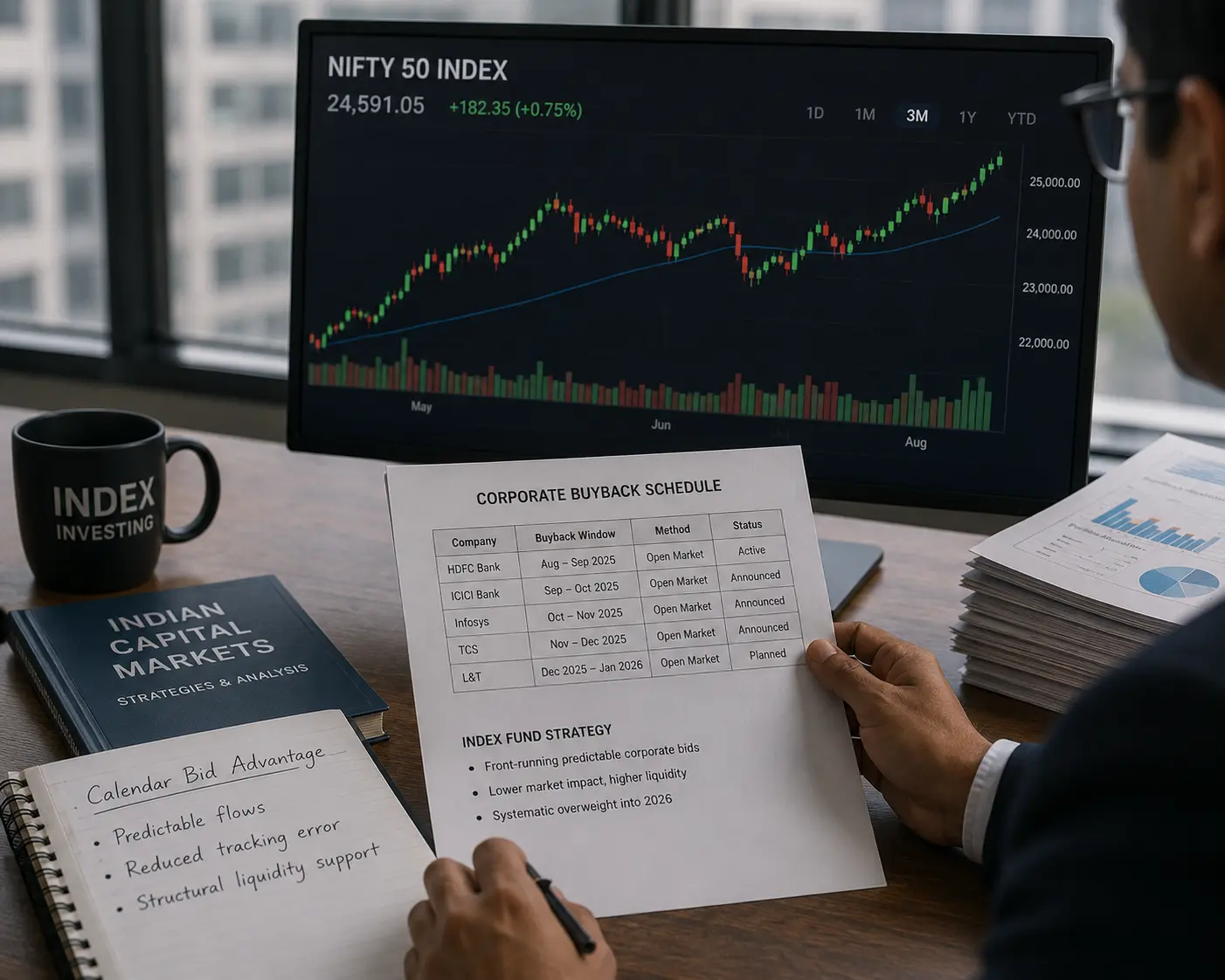
For large pools of passive assets, index funds, and tracking portfolios, the ultimate challenge is managing tracking error while executing trades with optimal liquidity. When an index fund receives inflows, or an underlying index goes through quarterly rebalancing, the portfolio manager needs to buy massive amounts of shares without driving the market price to an unsustainable high. SEBI's August 1 reform introduces a neat answer to this dilemma by instituting what quants call a "Predictable Calendar Bid." Because the desks that service institutions know exactly when corporate buybacks have to execute, they can forecast market liquidity with a level of detail never before possible.
Passive index fund holdings are systematically overweighting these positions into 2026 because the front-loaded corporate bid subsidizes market liquidity. When a heavyweight component within the Nifty 50 or the BSE Sensex executes an open-market buyback under the new timelines, the corporate treasury becomes the ultimate non-discretionary buyer of last resort. Index fund managers know that buying simultaneously with this corporate flow allows them to digest large blocks of equity with little downside tracking risk. The corporate bid creates an empirical buffer, soaking up transient institutional sell-side pressure and seeding a high-probability path of upward drift in the asset's float-adjusted market capitalization.
This dynamic is further reinforced by the changing nature of index weightings themselves. Because open-market repurchases immediately reduce a company's outstanding share capital, the total number of shares outstanding falls rapidly within the narrow 66-day window. For free-float market-capitalization-weighted indices, this creates an interesting technical paradox: while the total share count is falling, the strong buying pressure usually means the stock price booms against its broad sector peers. Index funds tracking these benchmarks are forced to constantly reposition. By moving their portfolios into an overweight position ahead of the announced calendar bid window, asset managers are able to consistently capture the regulatory-driven upside from the corporate demand squeeze, maintaining these structured overweights as a core performance driver into 2026.
Advertisement
"In modern structured markets, alpha is no longer just about finding an undervalued balance sheet — it is about indexing your capital to unavoidable regulatory flows."
Taxation Alignment and Institutional Advantage: Capital Gains vs. Deemed Dividends
To understand why this structure can persist beyond two years and even into late 2026, it helps to examine the tax-system triggers that led SEBI to bring the mechanism back. Earlier, the Indian corporate world was governed by a much more punitive Buyback Distribution Tax (BDT) regime, under which the issuing company paid tax at a rate of 20% on the distributed premium, plus surcharge and cess — effectively pushing the rate above 23% on the distributed amount — while the receiving shareholder faced no tax. This regime imposed a robust administrative and capital drag directly on corporate balance sheets, discouraging companies from returning capital through large-scale, frequent market mechanisms.
Legislative changes have since brought a full break with the past, aligning the Indian market with ordinary international practice on corporate capital returns. Buyback proceeds are now uniformly treated as a capital transaction for the individual investor, classified as capital gains computed on the holder's actual acquisition cost. For asset managers operating at an institutional scale, foreign portfolio investors (FPIs), and domestic mutual funds, this opens up a favorable yield-optimization terrain:
A. LTCG Optimization: With long-term holdings taxed at a flat LTCG rate of 12.5%, institutional asset managers can build multi-year accumulation blocks that exit through the buyback offer on the corporate side, vastly outperforming normal dividend distribution yields.
B. Removal of the BDT Drag on Double Taxation: Corporates are fully exempt from the front-loaded BDT liability and can devote 100% of their cash holdings directly to buying shares, significantly increasing the total size of the corporate bid pool.
C. Tax-Efficient Capital Slicing: Institutional investors can selectively choose which tranches of their equity inventory to part with on the corporate offer, earning maximum after-tax returns through tax-loss harvesting and cost-basis management.
This structural alignment generates a strong, self-reinforcing flywheel: corporate entities have more untaxed cash to deploy within the rigid 66-day timeframe, while large index trackers and institutional funds get a highly efficient capital gains mechanism suited to their substantial liquidity needs. The combination of structural predictability and tax efficiency is why sophisticated global macro capital has branded this reform a multi-year structural tailwind extending deep into 2026.
Structural Risk Factors and Systemic Constraints: The Institutional Blindspots
Though the structural benefits under the August 1 regime are numerous, a sophisticated market participant will need to consider the inherent risks and system-wide limitations that could interrupt these automated capital flows. Think of it like relying on an uncalibrated algorithmic engine: depending blindly on the corporate-buyback bid without assessing capital limitations can leave portfolios facing heavy execution headwinds. The major risk driver is the compressed 66-day period itself. If a business experiences unforeseen operational or macro stress halfway through its buyback cycle, the front-loaded execution requirement can trigger sudden, volatile capital-preservation conflicts.
Another critical institutional blindspot is the risk of outright execution failure and the regulatory penalties that follow. If a company is unable to invest the legally required 40% of its capital in the first 33 trading days due to significant market disruptions or extended trading halts, it faces regulatory scrutiny and potential forfeiture of escrow funds. For an index fund that has assembled an aggressive overweight position anticipating that non-discretionary corporate bid, a regulatory pause or operational failure can translate into severe capital traps — stranding the fund with an illiquid asset absent the succor of the corporate buyer of last resort.
Metric of Systemic Vulnerability: Quantitative estimates show that under extreme macro conditions, the price-time priority matching engine can be subjected to substantial spread widening. Because companies now buy through normal market order books rather than a separate facility, intense corporate buying can inadvertently cause short-term pockets of price inflation — a temporarily raised cost basis that then collapses right when the 66-day offer window ends.
Finally, the shrinking of free-float capitalization poses a long-run structural danger for index-following strategies. As corporates buy back shares rather than institutional investors, the availability of shares for public institutional investors decreases. If a stock's free float falls below key index-inclusion thresholds, it may become subject to automatic underweighting at the next index review. This creates a complex structural trap, where an asset enjoys extreme short-term buyback support only to face massive, non-discretionary institutional selling pressure a year down the road as index funds are compelled to rebalance their allocations downward.
Strategic Roadmap for Corporate Treasuries and Asset Managers into 2026
As the market transitions fully into this new structural era, navigating the landscape successfully into 2026 requires a highly disciplined, multi-layered strategic roadmap. Corporate treasuries must completely redesign their internal capital allocation workflows. Instead of treating a buyback as a passive, long-term discretionary option, financial officers must approach it as an intense, front-loaded capital-execution sprint. Companies must establish sophisticated algorithmic execution desks capable of distributing massive capital blocks smoothly through standard market order books without distorting localized price discovery mechanisms.
For institutional asset managers and quantitative index fund architects, the strategic imperative centers on advanced predictive modeling. Portfolios must deploy predictive analytics engines that constantly monitor corporate cash balances, free cash flow generation velocity, and tax-basis configurations across major index constituents. By identifying potential buyback candidates months before an official board announcement, institutional funds can establish low-cost foundational positions, ensuring they are perfectly placed to harvest the structural liquidity premiums generated by the mandatory 66-day calendar bid.
Ultimately, the SEBI August 1 reform marks the dawn of a more sophisticated, rule-governed capital market ecosystem in India. By eliminating historical inefficiencies, enforcing extreme transparency, and aligning tax structures with global standards, the regulator has created a highly structural marketplace where corporate actions operate with mechanical precision. For the forward-looking asset manager, this structured calendar bid represents one of the most reliable capital market plays of the late 2020s — a predictable structural current that passive index funds are highly rational to ride deep into 2026.
Read Further
- Sebi Board Brings Back Open-Market Share Buybacks; Eases Debt Listing — Business Standard, June 19, 2026
- SEBI Reintroduces Open Market Buybacks: New Rules, Taxation, And Investor Impact Explained — Outlook Money, June 22, 2026
Disclaimer: The detailed analysis provided in this report is compiled strictly from public regulatory frameworks, historical market structures, and quantitative capital market studies. This document is intended entirely for educational and analytical purposes and must not under any circumstances be construed as definitive financial, legal, or investment advice.
Advertisement