

In the globalized theater of corporate finance, capital structure management is rarely just an exercise in balancing assets and liabilities. Instead, it represents a dynamic chess game where macroeconomic crosscurrents, interest rate differentials, and currency fluctuations dictate the survival and dominance of corporate titans. Over the past decade, Reliance Jio Infocomm, under the broader umbrella of Jio Platforms, has acted as India's ultimate digital disruptor. By executing massive capital expenditure programs to secure nationwide spectrum, construct state-of-the-art 4G and 5G network fabrics, and develop extensive cloud environments, Jio transformed the digital landscape. However, this relentless expansion required a bottomless pit of capital expenditure, leading the company to borrow heavily across both local and international credit markets.
As Jio Platforms prepares to orchestrate what is poised to be India's largest-ever Initial Public Offering (IPO), targeting a massive capital raise between $3.8 billion and $4 billion (approximately ₹35,000 to ₹37,700 crore), a critical revelation has emerged from its draft filings. Unlike conventional corporate listings where primary capital is earmarked directly for immediate asset acquisition or research and development, the single largest allocation of Jio's primary proceeds will flow back into its capital architecture. Specifically, the company intends to utilize ₹27,500 crore ($2.9 billion) of the net proceeds to prepay and retire external commercial borrowings (ECBs) held by its telecom arm, Reliance Jio Infocomm. These loans, heavily denominated in US Dollars (USD) and Japanese Yen (JPY), date back to the aggressive network and spectrum financing cycle of 2022.
This strategic financial maneuver is not merely a debt reduction exercise; it is a profound foreign exchange (forex) bet. By leveraging local equity markets at historically premium valuations to wipe out hard-currency foreign liabilities, Jio is executing an intentional currency hedge. This report provides a detailed breakdown of the macroeconomic realities, structural details, and strategic implications of Jio's balance sheet reconfiguration. For an understanding of how Jio's broader conglomerate structure creates governance risks for minority investors across the Reliance ecosystem, read our analysis of Jio's 77% Reliance Retail Revenue Dependency and the Governance Risk Minority Shareholders Cannot Price.
Autonomous Financial Restructuring and IPO Proceeds Allocation
The scale of the upcoming Jio Platforms IPO highlights the sheer financial depth currently unfolding within the Indian capital markets. Planned to surpass the previous historical high set by Hyundai Motor India's $3.3 billion listing in October 2024, Jio's multi-billion-dollar market debut represents a milestone for domestic equity capital markets. The underlying strategy of the capital allocation structure shows a clear emphasis on derisking over raw, unhedged cash consumption:
Total Capital Mobilization: The public issue is expected to raise between $3.8 billion and $4.0 billion, bringing an influx of fresh liquidity directly into the entity's treasury rather than executing a pure Offer for Sale (OFS) that benefits existing holding entities.
Earmarked Debt Retirement: According to the Draft Red Herring Prospectus (DRHP), a designated ₹27,500 crore ($2.9 billion) will be deployed specifically for the prepayment of long-term external commercial borrowings, eliminating a substantial portion of the company's legacy foreign liabilities.
Residual Capital Deployment: The remaining capital pool is systematically carved out for general corporate purposes, including the build-out of next-generation artificial intelligence infrastructure, large-scale data center establishments, and pilot projects in the 6G telecom space.
Strategic Realignment Point: Through this architecture, Jio is using highly valued local equity to pay down high-exposure foreign currency debt. This structure allows the company to minimize traditional debt servicing hurdles and redirect future operational cash flows into deep tech sectors like AI, advanced broadband infrastructure, and edge computing.
The 2022-Era Foreign Currency Debt Portfolio (USD & JPY Loans)
To fully understand the mechanics of this corporate forex play, one must analyze the origin and structure of the debts being retired. In 2022, the Indian telecom sector underwent a massive capital expenditure push as operators prepared for the multi-band 5G spectrum auctions. To fund these intense capital requirements, Reliance Jio Infocomm looked beyond domestic credit lines, tapping international syndicates for highly competitive dollar- and yen-denominated external commercial borrowings. The total outstanding principal of the targeted facilities exceeds ₹30,000 crore, of which Jio plans to immediately settle ₹27,500 crore using the IPO proceeds.
These borrowings consist of three highly structured loan facilities backed by a premier syndicate of global banking institutions, including Australia & New Zealand Banking Group (ANZ), Bank of America, Barclays, BNP Paribas, and Citibank. A major structural challenge of these loans is their maturity profile and multi-currency exposure:
Maturity Horizon: All three primary international loan facilities are legally scheduled for final bullet repayments between March and June 2028. By moving to retire these facilities early, Jio is wiping out nearly two years of future interest obligations and eliminating macro volatility risks well ahead of time.
The Multi-Currency Mix: The debt structures are tied to both the US Dollar (USD) and the Japanese Yen (JPY). While JPY-denominated debts initially offered phenomenally low nominal interest rates due to Japan's historic yield curve control policies, recent shifts in global monetary policy have introduced major exchange rate volatility.
| Loan Facility | Primary Syndicate Lenders | Original Maturity Window | Allocated IPO Proceeds | Currency Exposure |
|---|---|---|---|---|
| Facility A (USD Spectrum Track) | Citi, Bank of America, Barclays | March – June 2028 | Part of ₹27,500 Crore Pool | High USD Exchange Risk |
| Facility B (JPY Equipment Line) | BNP Paribas, ANZ Banking Group | Mid-2028 | Part of ₹27,500 Crore Pool | JPY Volatility / Interest Pivot |
| Facility C (Syndicated Commercial ECBs) | Global Consortium Mix | Early 2028 | Long-Term Full/Partial Prepayment Balance | Cross-Currency Settlement Risks |
The Mechanics of the Forex Bet: INR Equity vs. Foreign Debt
The underlying financial philosophy driving this retirement strategy centers on an implicit macro-currency play. When a corporate entity carries significant unhedged or partially hedged liabilities in a foreign currency while earning its core revenues in a domestic currency, it remains permanently exposed to currency mismatch risks. In Jio's case, its subscriber revenue base is entirely domestic, generated in Indian Rupees (INR).
Let the total outstanding foreign debt in domestic terms be represented as:
D(total) = Σ (L(f) × E(f))
Where L(f) represents the loan principal in foreign currency terms (USD, JPY) and E(f) represents the spot exchange rate expressing the cost of the foreign currency in INR terms. If the Indian Rupee undergoes structural depreciation against the USD or experiences a sharp contraction against a rebounding Yen, the effective value of D(total) increases automatically in INR terms without any changes to the underlying operational mechanics. By shifting away from foreign debt obligations, the corporate treasury effectively locks in a zero-exposure baseline for these legacy instruments:
ΔD(total) / ΔE(f) = 0
This completely removes the balance sheet's exposure to future macro swings. The trade-off is clear: Jio is passing up the potential savings that would occur if the Indian Rupee strengthened significantly by 2028, choosing instead to pay off the debt early at current exchange rates. Given the ongoing volatility in global currency markets and shifting central bank policies, this is an intentional, risk-managed hedge designed to protect its financial foundation from unexpected global market shifts.
Furthermore, this strategy addresses the changing dynamics of global interest rates. The era of cheap foreign capital has shifted dramatically. With the US Federal Reserve maintaining higher baseline interest rates to manage inflation, and the Bank of Japan gradually moving away from its historic ultra-loose negative interest rate policies, the cost of servicing rolling or floating-rate ECBs has risen sharply. By using local equity capital to pay down these debts, Jio eliminates both its foreign exchange risk and its exposure to global interest rate volatility.
Macroeconomic Implications and Balance Sheet Transformation
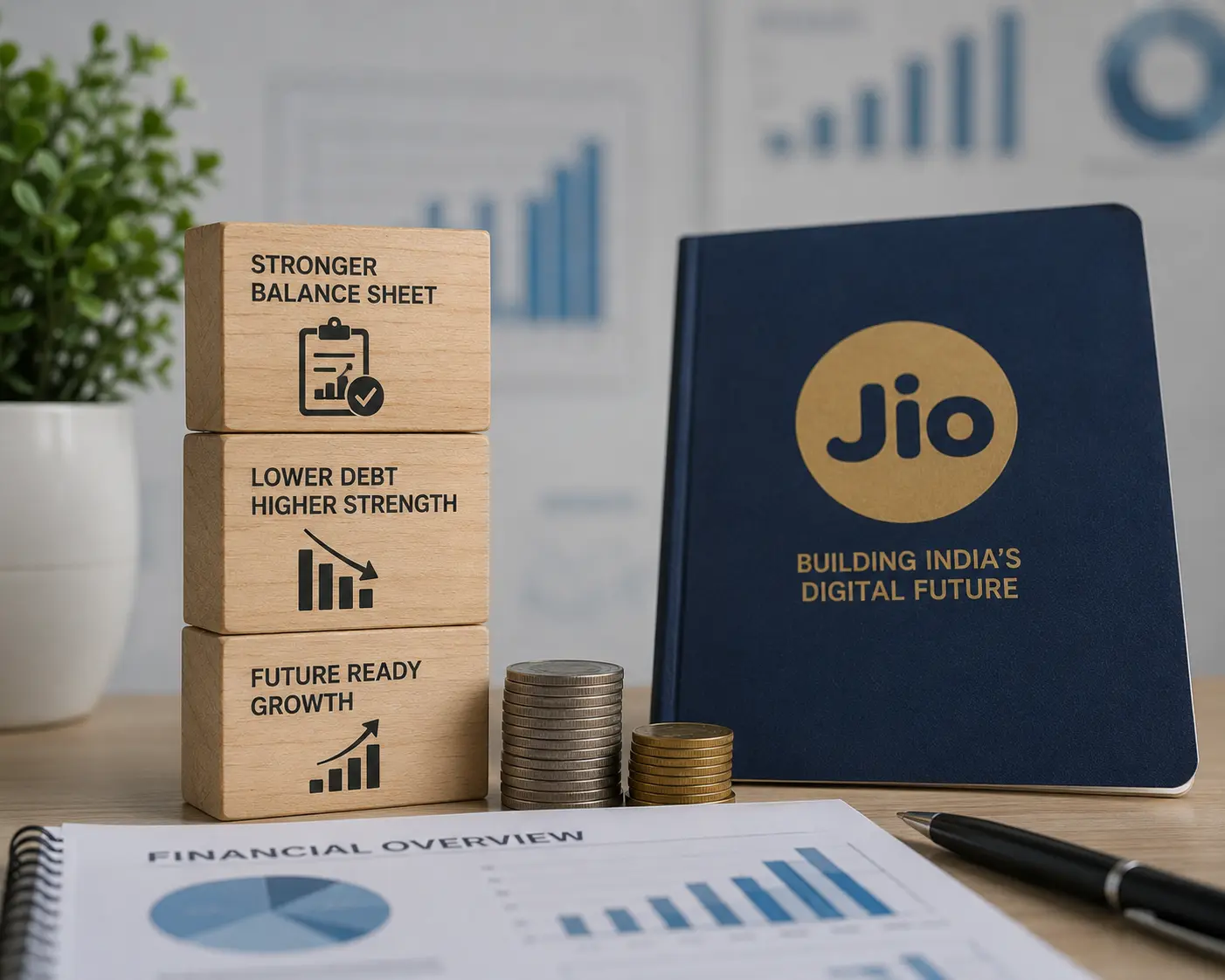
The broader impact of this capital restructuring on Jio's financial health is clear. The company's net debt position has already shown a strong downward trend ahead of the public listing, falling to ₹27,579 crore as of March 2026, down from ₹45,273 crore in March 2025 and ₹48,440 crore in March 2024. A successful allocation of the IPO proceeds will virtually eliminate its remaining foreign currency exposure.
"A cleaner corporate balance sheet yields lower overall corporate leverage ratios, drives down annual debt-servicing outlays, and unlocks a premium investment grade profile that allows the enterprise to execute its next multi-billion dollar capital expenditure push with unmatched ease."
This debt reduction strategy significantly improves Jio's debt-to-equity metrics, placing it in an advantageous position as it moves into capital-intensive industries like AI infrastructure, commercial 6G architecture development, and cloud data networks. The company is transitioning from a traditional telecom provider into a comprehensive digital ecosystem player. This strategic pivot requires deep financial flexibility, which is directly enabled by removing short- and medium-term foreign currency risks from its balance sheet.
Read Further
- Jio Platforms Files for India's Largest-Ever IPO, With Nearly $3 Billion Earmarked for Debt Repayment — The Next Web, June 2026
- Jio IPO DRHP Filed With SEBI: Fresh Issue of 27 Crore Shares, ₹27,500 Crore for ECB Repayment — Sahi, June 2026
- Jio Platforms Plans $3B Debt Reduction from IPO Proceeds in India's Largest-Ever Offering — Crypto Briefing / Markets Analysis, June 2026
Disclaimer: This analytical document is generated based on consolidated financial market resources, public draft red herring prospectus data points, and macroeconomic studies. It does not constitute formal investment advice, financial underwriting, or a corporate endorsement by our editorial board.