

An unwritten morning ritual plays out on trading floors and in equity research cubicles throughout the financial markets of Mumbai, Singapore, and London. Analysts look at the Unified Payments Interface (UPI) — India's flagship digital infrastructure run by the National Payments Corporation of India (NPCI) — and dismiss it as a zero-revenue utility. Because domestic peer-to-peer and merchant transactions enjoy no MDR (merchant discount rate), the general consensus is that overseas UPI expansion will be just a soft-power diplomatic win, a warm digital embrace with diaspora communities, with no immediate equity cash flow. It is a very bad misunderstanding.
When a payment rail travels across borders, it ceases to be a domestic utility and immediately transacts in a high-margin world of foreign exchange spreads, intermediary correspondent clearing, and proprietary treasury corridor monetisation.
To understand why the Street has completely mispriced this dynamic, it is helpful to understand how cross-border money actually works. Conventional remittance channels have long been preyed upon by legacy oligopolies such as Western Union and SWIFT-enabled correspondent banks that regularly siphon out in the range of 3% to 7% as total costs in the form of concealed FX markups, intermediary wire fees, and delayed settlement floats. When NPCI International Payments Limited (NIPL) collaborates with overseas central banks and financial switches — such as PayNow in Singapore, PayNet in Malaysia, or the Instant Payment System (IPS) in Mauritius — it forges straight, low-latency API connections that eliminate traditional multi-hop correspondent chains. Skipping the correspondent bank does not mean the FX spread disappears. Instead, the liquidity provider, the foreign switch operator, and the settlement bank gain a significant multi-basis-point gross spread on each transaction, forging an attractive, highly scalable revenue pool that is currently traded under the radar of public market valuations.
Etymologically and historically, payment rails can be understood as the application of national sovereignty and the economic reach of its currency zones. The word rupee itself derives from the Sanskrit rūpya, a silver coin used across the ancient Indian subcontinent for millennia — a uniform rule of mercantile trust directly linked to metal purity and sovereign issuance. Today, digital UPI rails replace silver with immediate cryptographic and API-level completion, but the underlying economic gravity is exactly the same: who controls that settlement corridor captures the rent. As UPI scales rapidly via Gulf Cooperation Council (GCC) corridors, Southeast Asian remittance lanes, and burgeoning African alliances in 2026, the equity thesis for exposed listed infrastructure providers is evolving from speculative volume growth to robust, cash-generating foreign exchange spread capture.
Breaking Down the Cross-Border FX Spread: Operations, Models, and Margin Collection
One of the most enduring myths in fintech equity research is that cross-border transactions are priced like domestic UPI fees. Within India, the Zero-MDR mandate by the Reserve Bank of India (RBI) compels payment service providers (PSPs) and app operators such as PhonePe, Google Pay, and Paytm to bear the cost of transactions without direct merchant commissions, monetising instead on cross-selling avenues like mutual funds, insurance, and personal lines of credit.
Cross-border UPI transactions are governed by a wholly different set of commercial and regulatory rules. When an Indian living in Dubai sends a remittance to a relative in Kerala on a UPI-linked corridor, a conversion from UAE Dirhams (AED) to Indian Rupees (INR) is required. This conversion builds in a wholesale-to-retail FX spread that usually hovers between 50 and 150 basis points, shared among all players domiciled in the corridor ecosystem.
To measure this revenue pool, analysts must use a rigorous four-part framework: Corridor Addressable Volume (V) multiplied by Average Ticket Size (ATS), factored by FX Spread Capture Rate (S), and netted off Interchange and Routing Fees (I). In mathematical terms, total annual corridor gross profit:
GP = V × S − I
Traditional correspondent banking sees a series of intermediary banks take their cut at each hop, slowing the final payout and increasing friction costs. At UPI international linkages, NIPL cuts the distance to a bilateral API handshake, minimising overall expenses for the end consumer and maximising net margin for licensed aggregators and liquidity providers. In the India–Singapore PayNow corridor, for instance, settlements occur in near real-time over linked bank accounts, enabling treasury desks to earn automated FX margins without holding expensive multi-day Nostro and Vostro positions.
"The domestic UPI market is seen as a zero-sum public utility by the market, not understanding that every cross-border API bridge becomes a private-label FX conduit in which treasury spreads flow directly to licensed settlement partners."
Mapping the Corridor Ecosystem: GCC, Southeast Asia, and African Remittance Lanes
Geographic concentration is now the single most important factor to model when thinking about UPI cross-border revenue pools. The global remittance landscape is not uniform; the majority of remittance corridors are dominated by a few high-density lanes where migration trends, bilateral trade, and currency flows result in large, predictable transaction volumes.
The most powerful engine of all is the Gulf Cooperation Council (GCC) corridor — the UAE, Saudi Arabia, Oman, Qatar, Kuwait, and Bahrain — which represents more than 30% of India's total inbound remittances, surpassing $100 billion. Traditionally, blue-collar and professional diaspora workers in these countries depended on well-known exchange houses like Al Ansari or UAE Exchange, paying hefty percentage fees and accepting poor FX rates without real-time alternatives. The introduction of UPI linkages across the GCC transforms this microeconomy by instantly channelling funds from diaspora bank accounts directly to Indian bank accounts operating on UPI.
In Southeast Asia, the ground-breaking link between India's UPI and Singapore's PayNow was established in January 2023 and has served as the national template for instant cross-border retail payments. Rather than traditional wire transfers, the UPI-PayNow integration enables users to send money using only a mobile number or Virtual Payment Address (VPA) — with transparent, upfront FX conversion rates. Following Singapore, Malaysia (via Payments Network Malaysia Sdn Bhd — PayNet) and Thailand (via PromptPay) have strategically expanded the addressable market.
Furthermore, new African corridors — anchored by bilateral negotiations with countries such as Mauritius, Kenya, and Tanzania — are emerging as the next frontier of development, as exports of digital public infrastructure bundle with trade-finance settlement systems to displace US dollar supremacy in regional trade invoicing.
Advertisement
"The geographic concentration in the GCC and Southeast Asian remittance lanes provides an immediate and sharply focused stream of revenues for those licensed treasury operators capable of handling high-velocity micro-transactions."
To assess the technical mechanics and market dynamics of companies operating within these corridors, securities and treasury professionals will need institutional research platforms and filings. Here are the key analytical tools for monitoring corridor rollout:
- MAS Fintech Reports — UPI-PayNow real-time linkage: technical and governance aspects
- Regulations & Statistics, Central Bank of the UAE — policies and bilateral currency swap agreements under which Dirham-Rupee local currency settlement mechanisms operate
- PayNet Insight — technical and business overview on Malaysia-India cross-border payments with merchant QR standards interoperability
- Bank of Thailand Payment Systems Reports — cross-border QR code payments and retail real-time settlement linkages between PromptPay and UPI
- Central Bank of Kenya Financial Sector Stability Reports — regulatory insights tracking East African digital payment corridors and bilateral fintech cooperation agreements with India
- Committee on Payments and Market Infrastructures (CPMI) — BIS analytical working papers on fast payment system interconnection and global wholesale CBDC initiatives
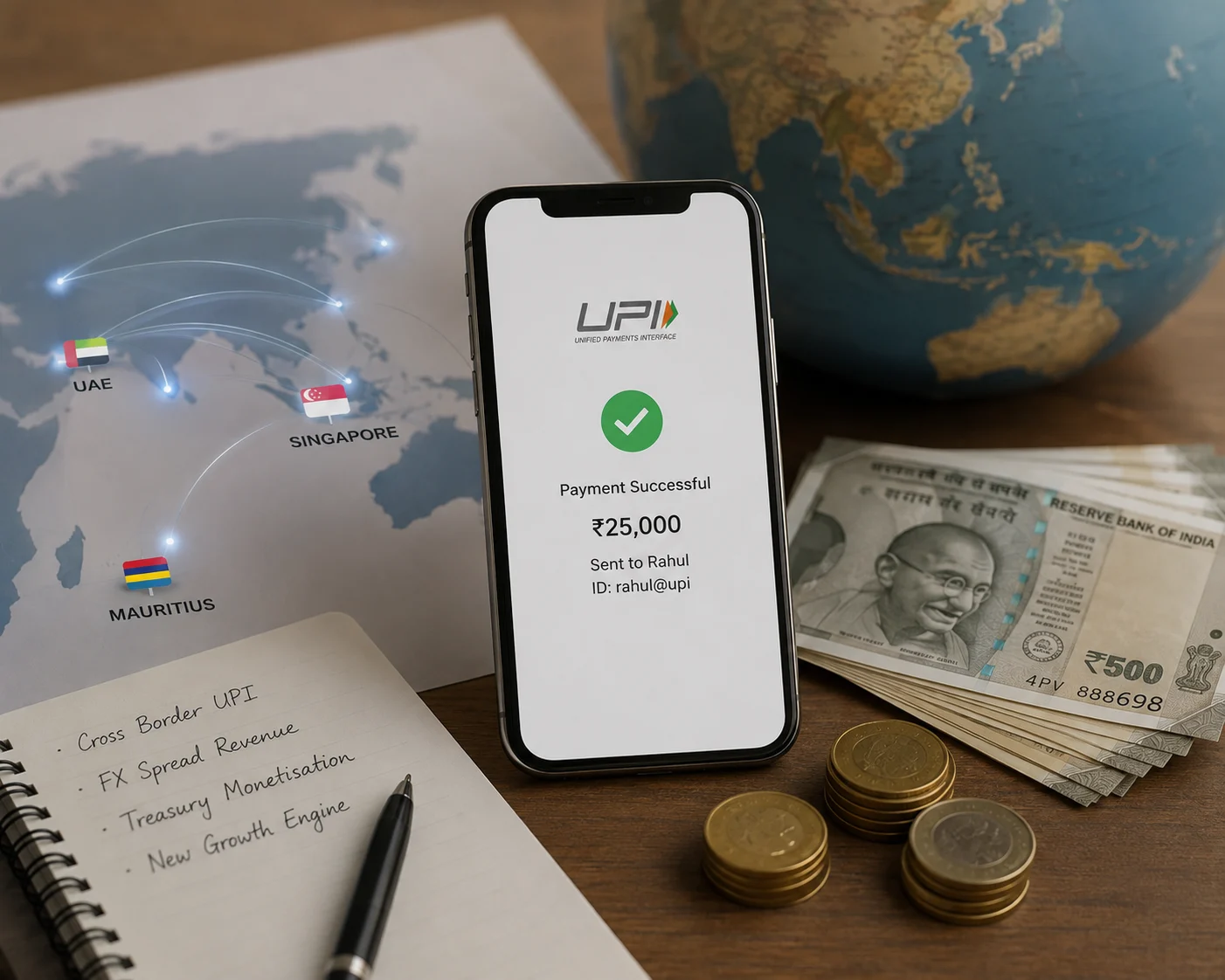
Valuation Disconnect and Corporate Exposure: Who Are the Winners?
The whole equity story hinges on a massive valuation disconnect. Public markets at the moment treat listed fintech infrastructure providers, payment gateway aggregators, and enterprise treasury software vendors like domestic-margin businesses constrained by the zero-MDR regulatory cap in India. So when these companies announce global partnerships with NIPL or foreign central banks, sell-side analysts often brush off the announcements as PR exercises with no meaningful earnings impact. This is a serious analytical mistake.
Although domestic transaction volumes generate top-line user engagement, international cross-border corridors are the engine of high-margin EBITDA growth through foreign exchange spread sharing, liquidity management fees, and value-added corporate treasury services.
Look at the structural position of the largest infrastructure providers and banking behemoths that serve as clearing members and liquidity providers on NIPL's international operations. Companies like Axis Bank, ICICI Bank, State Bank of India, and global technology aggregators collaborating with NPCI have their own proprietary treasury desks which take the FX risk and keep the spread. As transaction flow in a particular corridor grows from tens of millions to billions of dollars a year, a conservative capture rate of 75 basis points in FX will net a few tens of millions of dollars in high-margin net revenue. Because traditional valuation metrics apply a blended, low-margin domestic multiple to these businesses, the market is effectively applying zero value to their nascent cross-border treasury monetisation machines.
"Wall Street and Mumbai analysts are misestimating cross-border UPI by applying domestic zero-MDR multiples to firms that are furiously generating high-margin foreign exchange spreads."
Regulatory Headwinds, Competitive Threats, and Macro Risks
Every equity thesis is strengthened by an honest, brutal assessment of downside risk and structural constraints. Although the economic promise of cross-border UPI corridors is enormous, the route to monetisation is challenging with complicated regulatory barriers, geopolitical sensitivities, and competitive pressure.
Cross-border transactions are by definition a subject of national sovereignty. Foreign central banks are understandably wary of allowing foreign-based payment rails to plug directly into their national financial systems without AML, KYC, and data localisation requirements. Therefore, bilateral talks between the RBI and foreign central banks often drag on, subject to changes in political attitude, diplomatic relations, and regulatory guidelines.
The competitive context is also becoming increasingly fierce. While UPI has taken over the bilateral remittance corridor between India and certain partner countries, it faces established competition from global card networks (Visa and Mastercard), cross-border remittance unicorns (Wise, Remitly), and an emerging wave of stablecoin-based payment rails leveraging blockchain technology. Stablecoin settlement protocols provide near-instantaneous, 24/7 cross-border transactions with minimal FX friction — offering strong appeal to tech-savvy merchant ecosystems and digital-native traders. Should regulatory friction hinder the growth of UPI corridors as stablecoin adoption surges in emerging financial markets, the FX spread revenue stream may face significant pressure before traditional financial institutions have had the opportunity to fully instrument their treasury infrastructure.
"Expansion of cross-border payments is a political minefield; sovereign friction, stringent AML mandates, and the rising tide of stablecoin rails genuinely threaten long-term margin capture."
Conclusion
The evolution of India's digital payments was long shaped by the home story of high-volume utility and zero-MDR inclusion. Yet, as UPI passes national borders and builds a dense network of bilateral corridors around the Gulf, Southeast Asia, and Africa, a radical economic transformation is underway. The market's failure to price in this transition gives a rare equity opportunity for investors who can separate the domestic utility that is unmonetised from the very cash-rich, high-margin foreign exchange spread capture of cross-border corridors.
"When sovereign rails cross borders, public utility gives way to private profit; those who capture the FX spread are the next chapter of global financial architecture."
Read Further
[1] NPCI International Payments Limited. UPI-PayNow Linkage — Official Overview and FAQs — Click here
[2] Reserve Bank of India. UPI-PayNow Linkage — Regulatory Framework and FAQs — Click here
Disclaimer: All of the above data were taken from publicly accessible internet resources and research. This should not be taken as professional financial, medical, or legal advice.
Advertisement