

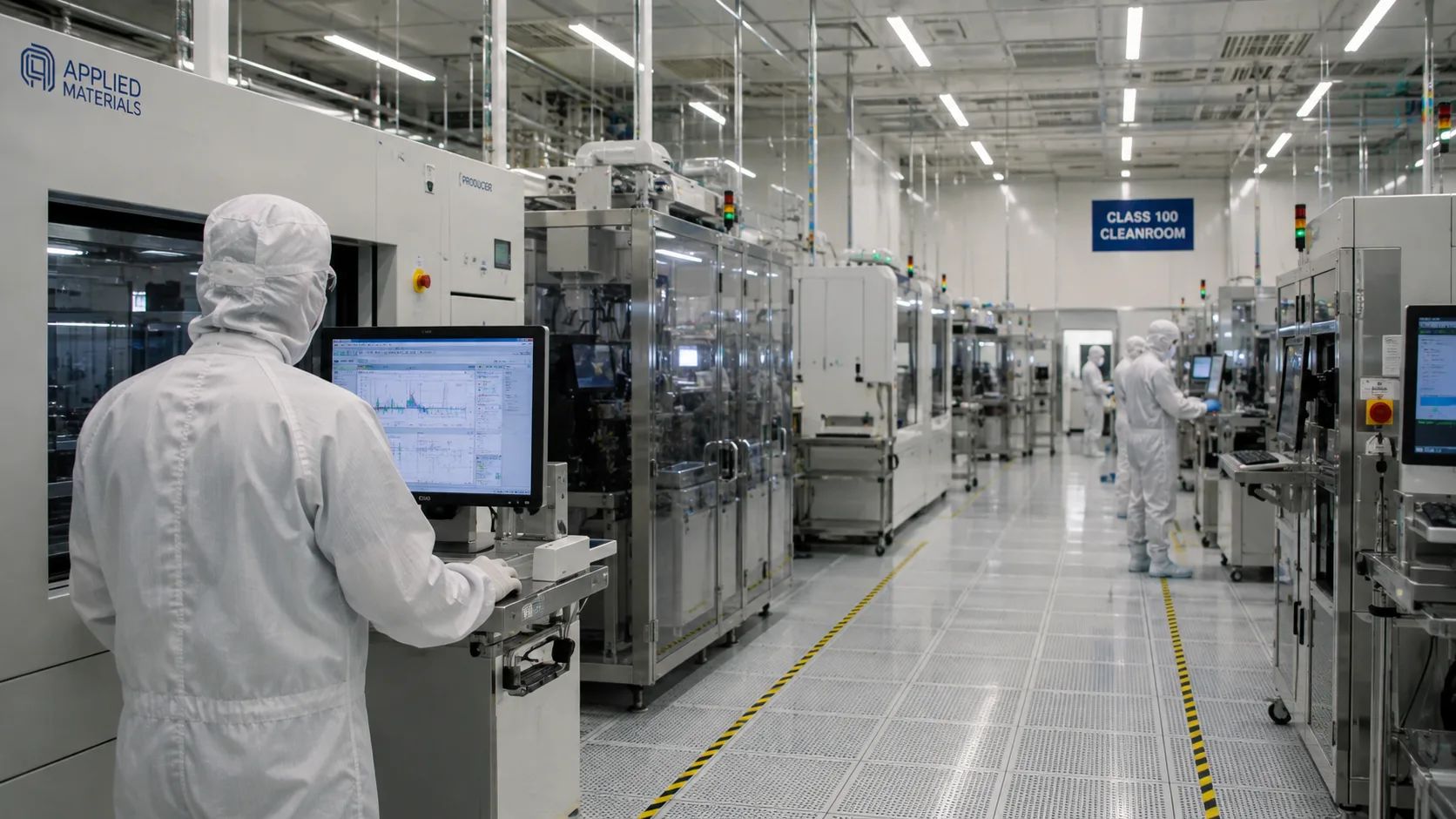
The largest analytical error made by industrial capital-goods analysts and tech equity investors in mid-2026 is viewing India's semiconductor resurgence through the lens of a binary bet on a couple of marquee foundry and OSAT announcements. Whenever a JV announces an INR 25,000 crore investment for a packaging unit in Gujarat or Assam, retail and institutional money rushes into pure OSAT equities on the assumption that owning the end operator is the best way to capture sector alpha. This obsession with headlines conceals a sobering financial fact: commercial semiconductor fabs and large OSAT facilities, by nature, are long-horizon, capital-intensive engineering risks where full commercial revenue recognition and positive free cash flow often lag initial site excavation by four to six years.
Yet at the same time, a whole investable universe of specialised cleanroom construction engineers, ultra-high-purity gas-handling infrastructure companies, and precision machine integrators is cashing out today within every single granted project — with working-capital turns that are much faster and valuations that are just beginning to capture their cash velocity.
To understand why this capital misallocation is occurring, you have to look beyond the press releases and at the land with which modern semiconductor fabs are actually built and sold in 2026. Based on the India Semiconductor Mission (ISM) and industry capital goods monitoring reports by CRISIL and ICRA, 28% to 35% of total OSAT and fab capital expenditure goes into physical shell-and-key components: ISO-certified cleanrooms, vibration-isolated sub-fabrication (sub-fabs), specialty gas-distribution piping, and environmental control systems. An OSAT company may burn through equity and government subsidies for years until it ships its first qualified ball-grid array (BGA) package, but a specialised cleanroom EPC contractor or gas-handling vendor invoices on milestone-based construction schedules, converting revenue and positive EBITDA within twelve to eighteen months from project award.
This article pushes beyond the headline narrative to fill a vital equity research question: as various OSAT and foundry projects materialise towards civil construction in 2026, which specialised cleanroom, gas-handling, and precision-equipment vendors are quietly capturing diversified cash flow across all of them? The timing of this analysis is critical since the 50% pari-passu capex subsidy of the India Semiconductor Mission, along with matching state-level fiscal incentives, has accelerated cleanroom contract awards in Dholera, Sanand, and Morigaon.
The Attribution Illusion: Why Fab Headlines Hide Ancillary Alpha
Capital markets' obsession with end-operator headlines, to the neglect of the infrastructure layer, can be explained by looking at the historical origin of purity and containment in traditional Indian architectural science. In classical Sanskrit works on Vastu Shastra and Shilpa Shastra, the essence of a sacred or precision building was ruled by the garbhagṛha — an amalgam of garbha (meaning "womb" or "innermost chamber") and gṛha (meaning "house" or "enclosure"). Classical Indian architects knew that the isolation of the inner cell relied on a robust structural formation, was fully air-tight, and was protected from any external pollution by microporous material.
Over the last three years, technology and capital-goods investing has turned this age-old wisdom on its head — glorifying what goes on in the garbhagṛha (the silicon packaging and lithography) and relegating the ultra-precise containment infrastructure that enables semiconductor manufacturing to generic, compressed multiples.
When we compare traditional industrial build versus modern Class 100 and Class 1,000 semiconductor cleanroom design and execution, the structural valuation gap is nothing less than staggering. Traditional civil construction is based on low-margin concrete pouring and standard HVAC installation, with operating margins squeezed by competitive bidding down to 6 to 8 percent. Contemporary OSAT cleanroom and specialty gas-handling design, meanwhile, is an intense, multidisciplinary art involving laminar airflow balancing, molecular-scale airborne contamination management, ultra-high-purity (UHP) electro-polished stainless steel piping, and toxic gas-scrubbing abatement. Per 2026 empirical benchmarks from the Indian Electrical and Electronics Manufacturers' Association (IEEMA) and NASSCOM, niche cleanroom and gas-infrastructure design providers report EBITDA operating margins of 16 to 22 percent — substantially higher than conventional EPC firms — while enjoying negative or near-zero net working capital cycles as a result of client mobilisation advances.
To deploy capital with accuracy, institutional investors need to use a realistic four-part model for evaluating down-line vendors:
1. Revenue-Recognition Velocity — differentiating four-to-six year OSAT operational payback cycles from twelve-to-eighteen month milestone-driven cleanroom billing cycles.
2. Customer-Concentration Risk — contrasting an OSAT's reliance on two or three global fabless chip designers with an equipment vendor's exposure to every ISM-approved fab and packaging plant.
3. Qualification Barrier to Entry — considering whether an ancillary vendor holds obligatory ISO 14644 cleanroom certifications and SEMI-S2 safety compliance that local civil contractors are unable to replicate.
4. Post-Construction Recurring Revenue — assessing a vendor's capacity to access high-margin annual maintenance, HEPA/ULPA filter replacement, and gas-calibration agreements throughout the 15-year life of the building.
When filtered through this four-part prism, the picks-and-shovels layer indeed comes out as the most defensible for risk-adjusted capital-goods compounding.
"The equity market is currently pricing Indian semiconductor buildouts as if owning the gold mine were safer than selling the shovels, ignoring that cleanroom and gas-handling vendors are paid in cash up front during construction and that the fab operator takes on all market-risk of global chip pricing."
The Physics of Cleanrooms and Specialty Gas: Why Margins Persist
The most defensible, highest-margin capital-goods play in the Indian semiconductor build-out is the cleanroom environment and the ultra-high-purity (UHP) gas management infrastructure. In high-performance packaging, silicon dies are stacked and interconnected using copper pillars, micro-bumps, and wire bonds measured in microns — where even a tiny dust particle or a part-per-billion impurity in the nitrogen or argon purge gas is capable of causing catastrophic short-circuits across an entire wafer batch.
As India moves from simple discrete packaging to complex flip-chip and system-in-package (SiP) in its OSAT lines by 2026, the physical requirements of cleanrooms and sub-fabs have been tightened significantly — representing an insurmountable engineering challenge for generalist contractors.
Upon reviewing the unit economics of specialised cleanroom and gas-handling vendors in 2026, the profit-and-loss profile looks far more like a high-technology specialty industrial business than a cyclical building company. Industry leaders in this space include:
- Sterling and Wilson — through its high-tech cleanroom engineering arm
- Blue Star and Voltas — integrated HVAC solutions and environmental containment
- Linde India and Inox Air Products — specialist chemicals and UHP gas-piping integration
Sector-wise research by IESA and CARE Ratings suggests that building a 100,000-square-foot Class 1,000 OSAT cleanroom facility with integrated gas handling requires a capital expenditure of roughly ₹350 to ₹500 crore. These systems demand stringent orbital welding, electro-polished stainless steel pipes, and dynamic chemical scrubbing to manage toxic silane, arsine, and hydrogen gases — so high-margin suppliers command a gross margin tilt of 32 to 38 percent.
To make a detailed assessment of companies participating in this essential infrastructure layer, capital-goods researchers must utilise a four-step technical-compatibility scorecard:
1. UHP Piping Electro-Polishing Certification — determining whether an engineering vendor has the capabilities to perform automated orbital-welding and surface-passivation needed for surface roughness under 0.25 microns.
2. Toxic Gas Abatement Integration — assessing a company's ability to provide and combine thermal-oxidation and dry scrubbing methods that destroy pyrophoric and toxic specialty gases.
3. Cleanroom Particle-Recovery Time Velocity — reviewing the HVAC and laminar flow design to ensure that in the event of a contamination incident, the room can be restored to Class 1,000 baseline within six minutes.
4. Localised Consumable Component Manufacturing — verifying that the vendor has been responsible for innovations enabling a shift away from import dependency, cushioning operating margins from shifts in import tariffs.
"A semiconductor cleanroom is not a building; it is a giant precision-engineered machine that actively scrubs the atmosphere on the walls, floors, and pipes to part-per-billion purity. The companies that produce this equipment are the gatekeepers to controlling yield."
Advertisement
Empirical Divergence: Single-Project Risk vs. Ecosystem-Wide Exposure
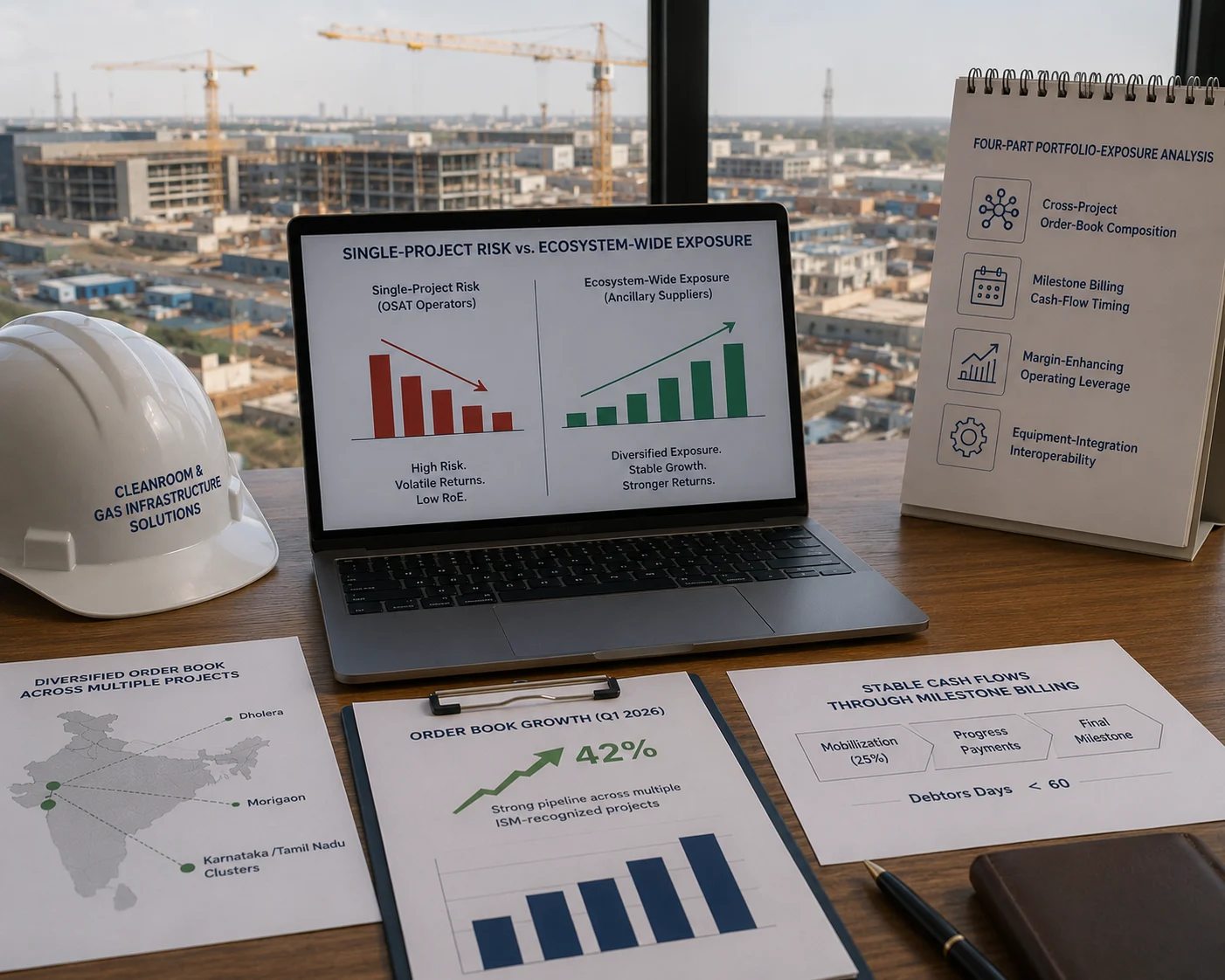
The 2026 financial reporting cycle has delivered the initial powerful empirical separation between listed ancillary suppliers that have built diversified, ecosystem-wide order books and end-operator equities exposed to single-project execution risk. Throughout 2024 and 2025, Indian financial press headlines belaboured individual OSAT joint ventures — the Tata Electronics plant in Morigaon, the CG Power-Renesas OSAT in Sanand, and prospective ATMP ventures from Micron and HCL-Foxconn.
To model these direct OSAT players, analysts have to factor in dramatic execution risks: if a single client delays product qualification or if global consumer electronics demand weakens, a single OSAT's multi-billion-rupee facility can face massive underutilisation, pulling return on equity (RoE) down to single digits for several years.
When we compare the performance trajectory of specialised cleanroom, gas-handling, and precision-equipment suppliers in the same 2026 reporting period, the difference in financial results is striking. Ancillary engineering leads are not beholden to the commercial success of any one chip package or fabless customer — they are the equivalent of utilities to every authorised project through the ISM pipeline. Based on project tracking in Q1 2026 compiled by CRISIL and Screener.in, qualified cleanroom and gas-infrastructure suppliers have witnessed their aggregate order books grow by 42%, with vendors operating in parallel in Dholera, Sanand, Morigaon, and soon in electronics clusters in Karnataka and Tamil Nadu — revenues completely insulated from single-project cancellations or technology-node obsolescence.
To empirically analyse this deviation, industrial capital-goods strategists must apply a four-part portfolio-exposure analysis:
1. Cross-Project Order-Book Composition — gauging whether an engineering vendor's order book is diversified across at least three ISM-recognised OSAT/fab sites, or concentrated within a single corporate group.
2. Milestone Billing Cash-Flow Timing — reconciling that building and piping contracts include 25% mobilisation down payments and progress payments keeping debtor days below 60.
3. Margin-Enhancing Operating Leverage — assessing whether fixed engineering design overhead will scale well over modularised cleanroom unit deployments.
4. Equipment-Integration Interoperability — ensuring the supplier's gas-handling and precision HVAC platforms are fully compatible with the dielectric-bonders and wire-bonders from leading OEMs like ASM Pacific and Kulicke & Soffa.
Vendors that score highly on this four-part scorecard should command a structural re-rating to 35x–40x forward earnings as pure structural compounders.
"In the industrial math of a semiconductor build-out, the OSAT player bets on global chip demand; the cleanroom/gas-handling vendor drafts an enforceable, cash-flow-positive invoice on the physical construction of the room itself."
Cyclical Volatility and Import Dependence: What May Derail the Ancillary Story?
Any best-in-class semiconductor capital-goods investment thesis needs to include a plain-spoken, no-holds-barred analysis of the structural weaknesses, import dependencies, and macroeconomic perils that could compress multiples. The most dangerous error industrial growth funds make is assuming that vendors of cleanroom construction and gas-handling equipment are defensive, secular growth stocks immune to global semiconductor cycles. In practice, semiconductor capital expenditure is highly volatile and cyclical.
Though the Indian sovereign fiscal shield — offering the 50% pari-passu subsidy under the ISM — currently shields domestic build-outs from global slowdowns, a sharp global memory or logic recession toward the end of 2026 or 2027 would compel multinational joint-venture partners to delay brownfield development stages, temporarily impeding order-book intake for cleanroom EPC contractors.
While civil cleanroom interiors and electrical cabling have seen rapid localisation, India continues to depend heavily on imports for ultra-high-purity gas valves, mass-flow controllers, precision cleanroom-monitoring sensors, and toxic-gas abatement systems — best sourced from Japan, Germany, and the United States. If geopolitical currency fluctuations cause a sharp devaluation of the Indian Rupee against the US Dollar or Euro, ancillary engineering suppliers on fixed-price EPC contracts face the risk of unanticipated gross margin squeeze.
Additionally, since India is building a number of greenfield OSAT and fab sites simultaneously for the first time, shortages in skilled cleanroom labour, hold-ups in state-level water and power connectivity, or bureaucratic slowdowns at customs for specialised piping may delay project commissioning timelines by six to nine months.
For a systematic capital-goods portfolio stress test against these cyclical and operational headwinds, institutional portfolio managers must implement a four-part risk-mitigation framework:
1. Fixed-Price vs. Variable-Cost Contract Audit — auditing whether an engineering vendor has baked in mandatory price-escalation clauses on imported specialty valves and UHP stainless-steel tubing.
2. Sovereign Subsidy Disbursement Dependence — simulating an EPC vendor's working-capital resilience in the event that state or central ISM subsidy disbursements lag project milestones by 180 days.
3. Import-Substitution Localisation Ratio — checking the proportion of cleanroom HVAC, HEPA filters, and distribution manifolds manufactured domestically to protect margins against currency shocks.
4. Non-Semiconductor Cleanroom Diversification — validating that the vendor has at least 35% of its order book in pharmaceutical biologics, aerospace, and solar-cell cleanrooms to weather any cyclical stall in semiconductor capital expenditure.
"The margin moat of a cleanroom engineering vendor is only as defensible as its contract terms; an unhedged exposure to imported ultra-high-purity gas valves could wipe out a year of operating profits if currency volatility hits during peak construction."
Closing Section: Reallocating Capital to Purity and Precision
India's semiconductor landscape is poised to transition from policy excitement into gruelling physical build in mid-2026, and the institutional equity market is at an analytical precipice. The seminal stage of semiconductor investing — when any listed corporate group that announced a fab or OSAT memorandum of understanding was blindly rewarded with speculative multiple expansion — has run its course. We have entered the era of physical execution and capital-goods accounting, where the economic value produced by sovereign industrial policy must be appropriately divided among long-horizon end-operators and immediate infrastructure builders.
Continuing to value the listed capital-goods and cleanroom semiconductor vendors purely as generic civil contractors would be a major structural error. In a practice where sub-micron particles can contaminate an entire production line, precision containment and ultra-high-purity gas processing are significant specialty industrial assets.
For industrial capital-goods analysts, technology-ecosystem fund managers, and institutional growth investors: the investing mandate must sharply tilt towards the picks-and-shovels infrastructure layer. A publicly traded engineering vendor that has successfully obtained Class 1,000 cleanroom certification, UHP gas piping with automated orbital welding certification, and an ecosystem-wide order book across Dholera, Sanand, and Morigaon is running a high-margin technology services business. These vendors are the ones to gain from every rupee spent under the India Semiconductor Mission, generating positive operating cash flow years before the first commercial semiconductor package is shipped.
"In the mathematics of a semiconductor renaissance, the biggest headlines are always the fabs that promise the chips of tomorrow; but the sustainable, compoundable wealth is owned solely by the engineers who build the cleanrooms of today."
Read Further
[1] India Semiconductor Mission (ISM). Official Nodal Portal — Accredited Semi Fabs, OSAT/ATMP Units, Incentive Payout Timelines, and Project Milestones — Click here
[2] Ministry of Electronics and Information Technology (MeitY). Semiconductor Policy Parameters, Design Linked Incentive (DLI), and State Infrastructure Support — Click here
Disclaimer: The above-mentioned facts, figures, data, and information have been obtained from publicly available internet sources and research. This should not be interpreted as financial, medical, or legal advice.
Advertisement