


In today's era where everything is being calculated and managed by automated monetary models, we are too much dependent on algorithmic projections — and somehow it is useful for us, and somehow it is not. Central banking frameworks were designed to make economic corrections faster and with better efficiency, but when we just ended up depending on reactive interest rate tweaks and quantitative shifts for our everything, we don't know where we actually forgot and lost old methods of structural resilience and supply-side discipline — we don't know.
So this article basically is going to get you all aware about what we should do with macroeconomic adjustments and what we should do with authentic and original structural realities of inflation tracking and recession prevention over the last five tumultuous years.
Macroeconomic Interventions and the Metrics They Provide
With modern algorithmic forecasting, tracking macro parameters has become easier and more efficient to calculate the fiscal realities of our daily day-to-day life and also in our global business domains. Quantitative monitoring tools are evolving beyond simple historical models into proactive index systems that can:
- Analyze sudden price shocks
- Forecast baseline cash flows
- Automate liquidity injections
- Optimize banking reserve ratios with minimal lag
These structural frameworks help you get analytical insights while managing country-wide growth accounts and public policy statements, making decisions on your base for your national industries or corporate pathways.
To give an accurate layout of how the global landscape has fluctuated, the data below maps out the dramatic shifts in global consumer price indices and corresponding GDP contractions since the turn of the decade:
| Year | Global Inflation Rate | US Consumer Price Index | Global Real GDP Growth | Primary Recession Threat Level |
|---|---|---|---|---|
| 2021 | 4.7% | 4.7% | 6.3% | Post-Pandemic Supply Friction |
| 2022 | 8.7% | 8.0% | 3.5% | Geopolitical Energy Shock |
| 2023 | 6.8% | 4.1% | 3.2% | Aggressive Monetary Tightening |
| 2024 | 5.3% | 3.1% | 3.1% | Sticky Core Service Pressures |
| 2025 | 4.2% | 2.7% | 3.0% | Trade Fragmentations & Tariffs |
| 2026 (Proj.) | 2.9% | 3.2% | 2.5% | Middle East Disruptions & Oil Hikes |
These are some critical macroeconomic baselines and empirical data markers which you can observe to study the global macro journey over the recent half-decade.
Cons of Relying Purely on Central Models for Budgetary Projections
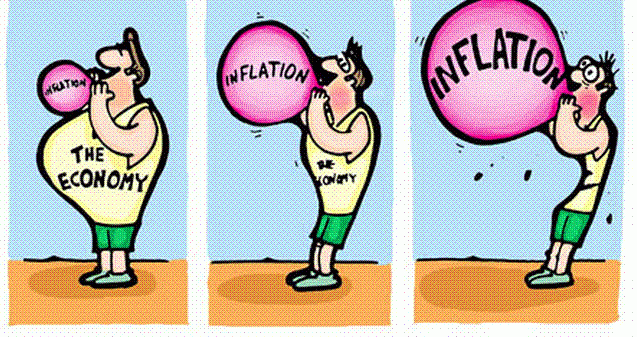
Algorithmic macroeconomics, as we know, is still baseline statistical projection — not human-based collective reality which can think alike like complex structural networks and make structural shifts after calculating endless possibilities in every local marketplace scenario. In recent economic analyses, it was seen that major central monetary models do provide target management, but with heavier and lengthier macro assumptions where every single variable is given a vast difference, a major deviation in accuracy was seen across global forecasts.
Advertisement
This calculates to an alarming reality where every 2nd out of 5th attempts in predicting localized domestic demand turns out wrong, leaving an error in national budgeting which, if not in household planning, can get small businesses in heavy loss.
Giving fixed inputs and keeping up with checking each and every record will become an endless loop of getting a few macro records wrong and getting them changed by central banks, which will become a tiresome chore of the year that will take more time and head work, causing major structural headaches and fiscal migraines in the future.
The Traditional Counter-Metric: Structural Discipline
To combat the disconnect of automated metrics, historical financial frameworks emphasize localized structural awareness. True economic resilience is built not on top-down mathematical adjustments, but on structural reflection and awareness, avoiding blind reliance on automated trends.
Traditional finance discipline dictates four foundational pillars of micro-macro balancing:
| Pillar | Description |
|---|---|
| Core Essentials | Baseline infrastructure, food distribution networks, and fundamental energy utilities |
| Structural Upgrades | Manufacturing tools, physical machinery, and asset maintenance |
| Intellectual Assets | Education investment and industrial learning processes |
| Elastic Volatilities | Unexpected luxury movements, service inflation margins, and external lifestyle adjustments |
"Spend consciously on imports, and build industrial capacity intentionally."
At the end of a multi-year cycle, when you calculate the net capital preservation and examine the true savings velocity, you realize the magic of fundamental discipline. When you write down and calculate fiscal positions within localized limits, your mind becomes aware of macro realities — whether it is sustainable or unsustainable to borrow or inflate. This eventually becomes a habit to think twice before over-leveraging or deploying national capital, which remains the core principle of success in economic management and generational wealth preservation.
Disclaimer: All the macro data and analytical trends provided above were collated from leading global financial repositories, international economic outlooks, and multi-year inflationary studies. This should not be taken as an official quote from our platform or explicit investment advice.
Advertisement