


In today's era where Indian macroeconomic indicators are hitting unprecedented historical highs, a silent structural shift is fundamentally rewriting the mechanics of our financial architecture. For decades, the traditional Indian household was the primary engine of the domestic banking sector, diligently moving their surplus earnings into fixed deposits and recurring savings accounts. This classic paradigm provided Indian commercial banks with a cheap, stable, and predictable pool of capital to fund industrial growth, infrastructure projects, and consumer retail loans. However, as we progress deeper into 2026, we find ourselves dependent on an entirely different mechanism. A profound financialization of retail wealth has taken hold, and the structural safety net of our entire banking framework is no longer domestic bank deposits—it is the Systematic Investment Plan (SIP) of the Indian mutual fund industry.
The commercial banking sector is currently experiencing a historic, highly unsustainable pressure point. Credit growth has consistently outstripped deposit mobilization for several consecutive quarters, driving the system-wide Credit-Deposit (CD) ratio to an alarming multi-decade peak of over 82.4%. Historically, whenever the domestic banking infrastructure pushed past an 80% CD ratio, immediate systemic interventions or liquidity crises would follow. Yet, the system survives today. The underlying reality is that the vast, continuous inflows from retail SIPs—now regularly breaching ₹25,000 crore on a monthly basis—act as an indirect, parallel liquidity buffer. By recycling equity and debt market capital back into the wholesale financial machinery, these inflows have become the primary line of defense protecting India's structural banking metrics from breaking entirely.
"The fundamental math of Indian banking has changed. We are no longer observing a simple competition for retail wallets; we are witnessing a structural migration where the capital market behaves as the shadow liability engine of the banking landscape."
The CD Ratio Crisis: Analyzing the Core Metrics of 2026
To truly appreciate how dangerously close the Indian banking apparatus is to an existential liquidity crunch, one must examine the raw trajectory of the Credit-Deposit (CD) ratio. The CD ratio simply calculates how many rupees a bank lends out for every hundred rupees it brings in via structural deposits. According to authoritative research data released by institutions like SBI Research and CARE Ratings in early 2026, the aggregate CD ratio escalated from a modest 69% in FY21 to 79% in FY25, before aggressively climbing to a record-breaking 82.4% in the first half of 2026. An incremental CD ratio—the ratio measuring new loans against new deposits over specific fortnights—has repeatedly broken past the 100% threshold. This means that for every ₹100 of fresh deposits entering the formal banking system, banks are extending anywhere between ₹105 and ₹115 in credit. This mathematical mismatch is unsustainable over the medium term. It forces commercial banks to draw down their surplus liquidity buffers, liquidate high-quality liquid assets, significantly reduce their excess Statutory Liquidity Ratio (SLR) holdings, and rely heavily on high-cost, short-term wholesale market borrowings. The core of this imbalance stems from two divergent growth trends. Year-on-year bank credit growth has maintained a robust pace of 13.5% to 14.5%, fueled by an insatiable domestic demand for retail credit, unsecured personal financing, MSME loans, and long-gestation infrastructure projects. Conversely, aggregate bank deposit growth has remained stubbornly tepid, hovering between 10.5% and 11.5%. The traditional relationship where deposits organically matched or exceeded credit deployment has fractured, creating a significant structural funding deficit across the entire banking landscape.
The Structural Mismatch: Bank Deposits vs. The SIP Juggernaut
Why have bank deposits failed to keep pace with credit demand? The answer lies in a permanent change in consumer behavior and retail financial awareness. For the modern Indian household, the safety of a 6.5% to 7.5% fixed deposit is no longer sufficient when compared against the historical inflation-adjusted returns of public equity markets. Retail investors have collectively embraced the doctrine of long-term compounding through Systematic Investment Plans (SIPs).
Negative Real Yields: Barely beats persistent retail and consumer inflation. System Resilience: Acts as an institutional shock absorber for banking liquidity.
This continuous movement of wealth creates an immediate dilemma for commercial banks. When a retail customer shifts ₹50,000 from their savings bank account into an equity mutual fund via an automated monthly SIP, that capital exits the bank's core, low-cost current and savings account (CASA) deposit pool. This shift deprives the bank of the baseline liability needed to expand its loan book. Instead, that capital lands directly in the asset management industry, bypassing traditional bank intermediation. This migration is the core structural driver behind the current CD ratio imbalance.
Advertisement
The Invisible Transmission: How Mutual Funds Fund the Banks
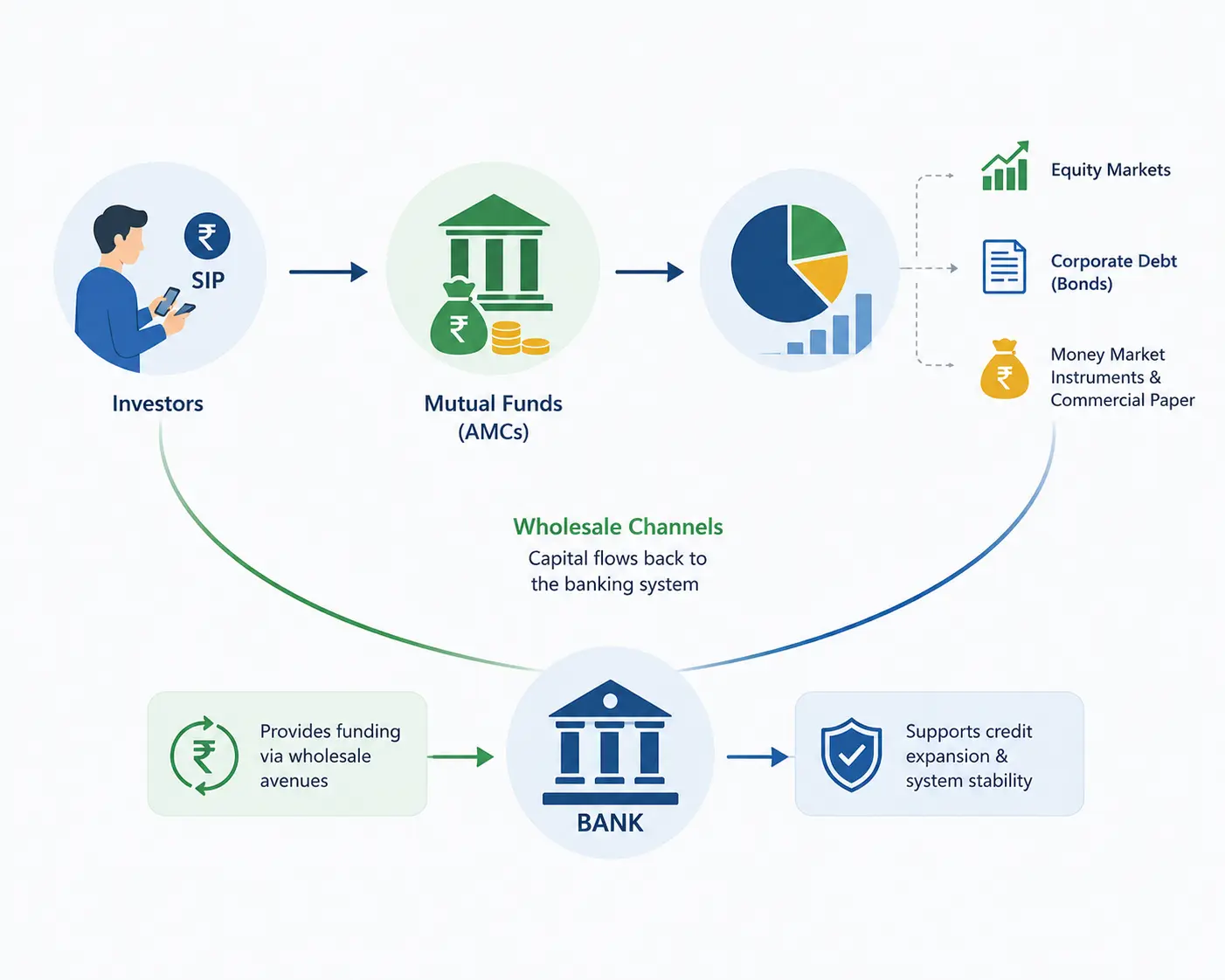
If SIPs are actively redirecting capital away from retail bank deposits, how can they simultaneously be praised as the primary mechanism keeping the banking system from breaking? This is the central structural paradox of India's current financial ecosystem. The answer lies in understanding the secondary transmission channels of capital. When asset management companies (AMCs) receive thousands of crores of retail SIP inflows every single month, they do not hold that capital as physical cash. A significant portion of these inflows is deployed into equity markets, while another massive percentage is allocated directly into corporate debt, money market instruments, and commercial paper. To maintain operational liquidity and meet potential redemption requirements, mutual funds place enormous volumes of capital back into the banking system through wholesale avenues:
| Wholesale Channel | Role in Banking System | Systemic Liquidity Benefit (2026) |
|---|---|---|
| Certificates of Deposit (CDs) | Banks issue high-yield wholesale certificates directly bought by mutual funds. | Provides immediate short-term wholesale funding to bridge the deposit gap. |
| Commercial Paper (CP) Subscriptions | Mutual funds subscribe to corporate CPs, offloading large corporate loan requirements from bank balance sheets. | Reduces credit expansion pressure on banks, keeping the CD ratio under check. |
| Tri-Party Repo (TREPS) & Call Money | Surplus mutual fund overnight cash is loaned directly to liquidity-starved commercial banks. | Prevents sudden spikes in the Weighted Average Call Rate (WACR). |
Through these mechanisms, the capital that leaves the banking system via a retail SIP returns through the back door as high-cost wholesale funding. While this wholesale funding allows commercial banks to balance their books and maintain credit expansion, it introduces a significant structural trade-off: it compresses net interest margins (NIMs) and increases the volatility of bank liabilities.
The Dangers of a High Wholesale Funding Dependence
Relying on wholesale market instruments funded by mutual funds, rather than sticky retail deposits, carries inherent structural risks. Retail deposits are highly granular, distributed across millions of individual households, and rarely withdrawn all at once during normal economic cycles. Wholesale market funding, by contrast, is highly concentrated, price-sensitive, and prone to rapid shifts in sentiment.
If global macroeconomic uncertainties escalate, or if domestic corporate earnings disappoint, mutual fund redemptions could increase. In such a scenario, asset management companies would be forced to pull back from corporate debt and wholesale bank certificates to preserve cash. This would immediately expose the underlying funding vulnerabilities of commercial banks, turning a high CD ratio from a technical footnote into an acute liquidity crunch.
Looking Ahead: Policy Imperatives and the Path to Stability
As we look toward the remainder of 2026 and into 2027, the current equilibrium remains delicate. The Reserve Bank of India (RBI) has repeatedly cautioned commercial banks against over-reliance on short-term wholesale liabilities, urging them to design innovative deposit products to re-engage traditional retail savers. Achieving long-term stability will require a structural rebalancing. Banks must accept that retail capital allocation has permanently evolved; they cannot compete with capital markets on raw returns alone. Instead, they must leverage digital transformation, hyper-personalized financial products, and hybrid savings-investment offerings to bridge the gap between traditional banking security and modern wealth creation.
References & Further Reading
- Optimum Credit-Deposit Ratio for Banks Is 76–80%, Says SBI Report — Business Standard (SBI Research)
- India Banks Hit Record Credit-Deposit Ratio, Facing Funding Strain — Whalesbook
- SIP Inflows Hit Record in Dec, But Mutual Funds See Heavy Overall Outflows — National Herald India (AMFI Data)
Disclaimer: This comprehensive macroeconomic trend report is compiled exclusively from public financial data, banking analysis papers, and historical trend trackers. The views expressed herein are strictly analytical observations of systemic liquidity patterns and do not constitute formal investment advice or policy recommendations.
Advertisement