

In today's digital era where everything is being connected, automated, and accelerated by rapid technology, we are too much dependent on messaging infrastructure and algorithmic communication. Somehow it is immensely useful for us to stay connected and coordinate, and somehow it creates massive structural vulnerabilities. Apps like Telegram were created to make our communication faster and with better efficiency, featuring cloud-based architecture, massive channel capacities, and extensive automation through programmable bots. But when an entire ecosystem ends up depending blindly on zero-censorship platforms for public operations, automated messaging, and file sharing, we create spaces where tracking and discipline become almost impossible.
This article basically is going to get you all aware about what really happened in June 2026 when the Government of India pulled the plug on Telegram under emergency provisions. We will examine the absolute facts, the secret intelligence dossiers, the structural features of the app that were manipulated, and the delicate balance between digital privacy rights and national sovereign integrity.
The June 2026 Crackdown and the NEET-UG Crisis
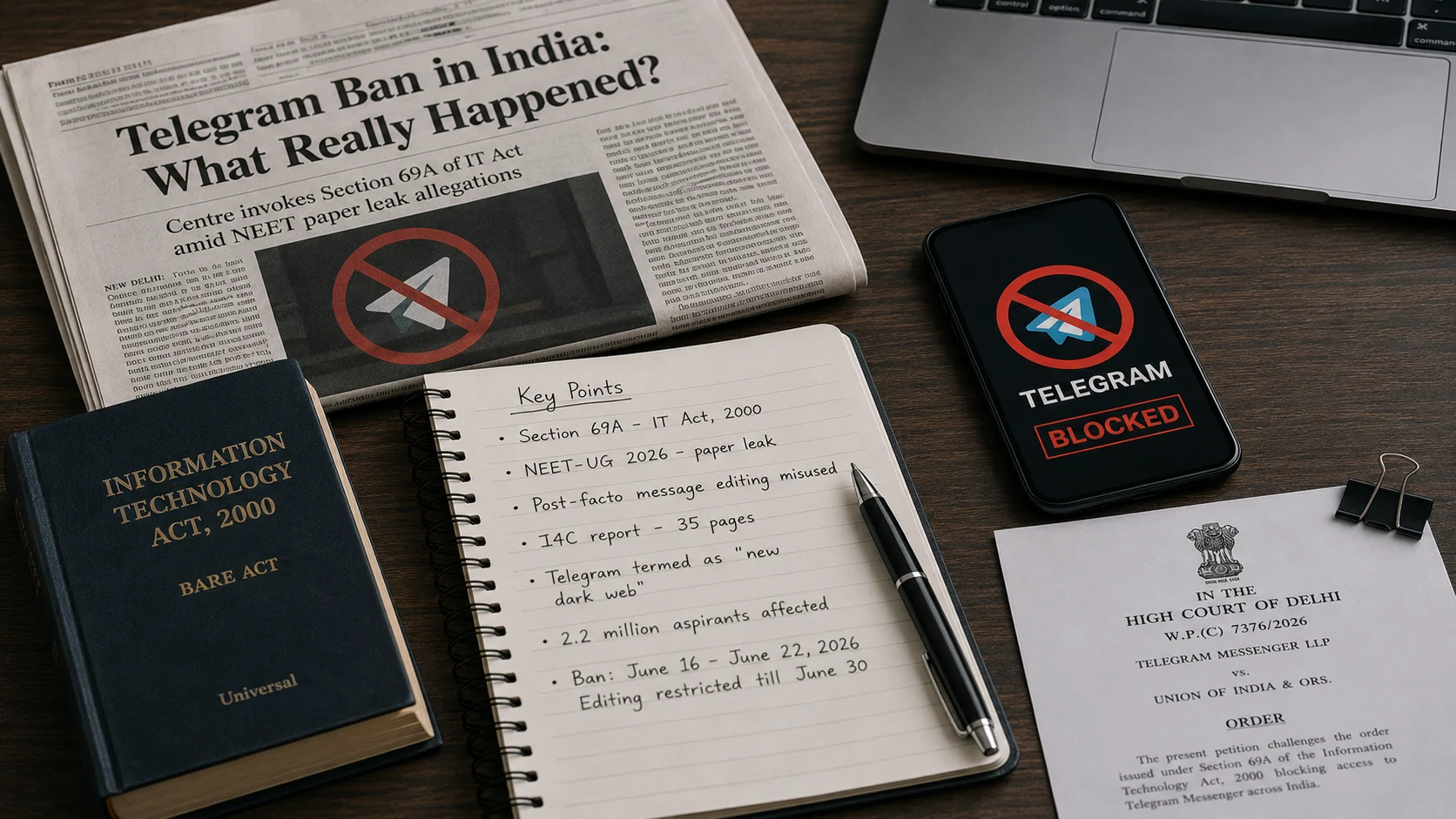
The catalyst for this unprecedented regulatory intervention was a systemic national crisis surrounding the National Eligibility-cum-Entrance Test (Undergraduate) or NEET-UG 2026. On June 16, 2026, the Ministry of Electronics and Information Technology (MeitY), acting on direct recommendations from the National Testing Agency (NTA) and cyber intelligence bodies, issued an emergency blocking order under Section 69A of the Information Technology Act, 2000. The directive shocked the nation: it ordered internet service providers and app marketplaces to completely restrict public access to Telegram across the territory of India until June 22, 2026.
What forced the government to execute such a platform-wide blackout? The immediate threat involved organized examination paper leak syndicates and systemic misinformation campaigns. The NTA had alerted MeitY that multiple Telegram groups, channels, and automated bots were actively being used to sell and distribute purported leaked question papers for the medical entrance test. However, the crisis was exacerbated by a unique technical vulnerability inherent to Telegram's platform: its post-facto message-editing feature.
"Spend consciously, communicate securely, and regulate intentionally. When platform flexibility turns into a tool for systemic national disruption, the state is forced to step in."
In a sophisticated manipulation scheme, digital fraudsters and cheating rackets exploited Telegram's architecture to alter historical timestamps and content. Threat actors would upload placeholder documents days before the exam. Once the exam concluded and actual question papers became public, the operators used Telegram's edit function to swap the placeholders with the real questions. Because the channel metadata retained the original publication date, it falsely appeared as though the papers had been leaked prior to the exam. This sparked widespread panic, institutional distrust, and public order disruptions among 2.2 million medical aspirants across India.
| Key Facts | |
|---|---|
| Aspirants Protected | 2.2 Million |
| Legal Instrument Invoked | Section 69A, IT Act, 2000 |
| Duration of Full Platform Ban | 7 Days (June 16–22, 2026) |
| Message-Editing Feature Disabled Until | June 30, 2026 |
The Secret 35-Page I4C Report and the "New Dark Web" Accusation
While the NEET-UG examination crisis was the immediate trigger for the June blocking order, the legal and operational justification presented by the government ran significantly deeper. During the subsequent judicial challenges, the Ministry of Home Affairs submitted a highly classified, 35-page comprehensive investigative report compiled by the Indian Cyber Crime Coordination Centre (I4C). The contents of this dossier, reviewed during court proceedings, painted a grim picture of Telegram evolving into what the Solicitor General explicitly termed a "new dark web."
The I4C investigation detailed how Telegram's structural configuration — specifically allowing users to communicate and manage large channels without disclosing their underlying phone numbers — made identity detection and tracking near impossible for domestic law enforcement agencies. This architectural lack of transparency contrasted sharply with other mainstream applications like WhatsApp, which mandate visible telephone identity markers. According to the data placed before the court, complaints involving Telegram on the National Cyber Crime Reporting Portal had seen an exponential, alarming rise.
Key Findings from the Home Ministry's I4C Dossier:
Exponential Complaint Surge: Reported cybercrime incidents linked to Telegram channels rose from 75,688 in 2023 to an astronomical 275,000 in 2025. By May 2026 alone, over 88,000 complaints had been registered.
Colossal Financial Losses: Since 2023, Indian citizens filed over 688,000 complaints specifically tying Telegram to sophisticated financial fraud, task scams, and extortion networks, resulting in an estimated net loss of over $750 million (exceeding ₹3,000 crore).
Mule Account Marketplaces: The platform hosted thriving, automated public marketplaces where threat actors bought and rented "mule bank accounts" to launder stolen money and move illicit funds instantly out of jurisdictional reaches.
Severe Content Violations: The report included documented evidence and screenshots of widespread distribution of Child Sexual Abuse Material (CSAM), deepfake non-consensual imagery, coordinated online harassment, and extensive intellectual property piracy — including the unauthorized distribution of major blockbuster films like the Bollywood spy movie Dhurandhar.
Legal Battlegrounds: Section 69A and the Proportionality Test
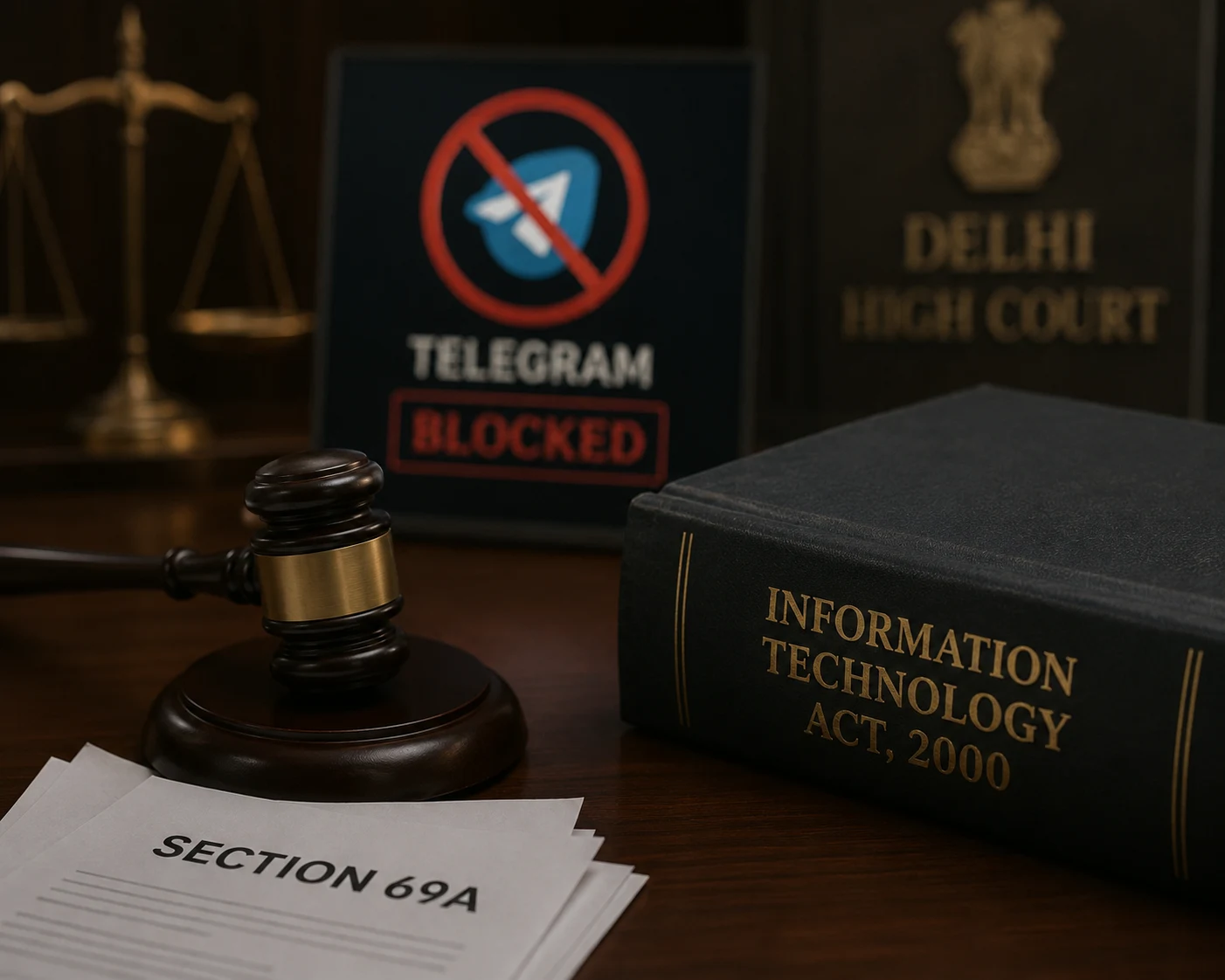
Following the sudden imposition of the ban, Telegram filed an urgent writ petition before the Delhi High Court challenging the platform-wide restriction. The legal debate centered on whether blocking access for a user base of over 150 million people — India being Telegram's largest global market — was a proportionate reaction to content-specific violations. Telegram argued that it was an intermediary entitled to safe harbor, and that illegal material constituted less than 0.1% of the overall traffic flowing through its servers.
A Bench led by Justice Tejas Kataria scrutinized the absolute limits of state censorship versus public necessity. The central government defended its action by citing the strict statutory grounds laid out under Section 69A of the Information Technology Act, 2000. The state argued that the integrity of a national exam directly impacted public order and state security, thereby satisfying the constitutional proportionality thresholds established by the Supreme Court in the landmark Anuradha Bhasin v. Union of India (2020) precedent.
In its historic ruling on June 19, 2026, the Delhi High Court upheld the Union Government's temporary emergency blocking order. The court reasoned that the severe public interest of safeguarding the competitive future of over two million students far outweighed a temporary informational disruption. Crucially, the court observed that because the full block was explicitly time-bound (terminating on June 22) and paired with a targeted surgical restriction (disabling message-editing capabilities until June 30), the state's intervention successfully avoided the vice of unconstitutional disproportionality. By treating the software application as a singular unit of hosted information within a computer resource, the judiciary normalized the legal precedent for short-term, platform-wide blocks during acute institutional crises.
Global Precedents and the Future of Platform Accountability
The events of June 2026 in New Delhi are not isolated incidents; rather, they reflect a turning point in how sovereign states interact with non-compliant, highly encrypted tech ecosystems. For years, Telegram positioned itself as an unyielding bastion of absolute free expression, frequently refusing or delaying compliance with domestic law enforcement requests for user metadata. However, this posture has triggered aggressive regulatory blowback globally.
Prior to India's 2026 intervention, France launched extensive criminal investigations into organized crime syndicates operating on the platform. South Korea initiated aggressive probes following a severe national crisis involving AI-generated explicit deepfakes circulated via Telegram chatrooms, while Spain temporarily suspended the app over systemic copyright infringements. India's latest action demonstrates that as digital communication becomes more decentralized, governments will no longer hesitate to target entire software architectures rather than individual bad actors.
The temporary ban was formally lifted on Tuesday, June 23, 2026, following the completion of the NEET re-examination schedules, but the platform remains under strict, proactive monitoring by the I4C. Telegram is now forced to re-evaluate its compliance frameworks in its largest market, proving that no platform is too large to escape sovereign accountability.
Read Further
- Delhi High Court Upholds Temporary Telegram Ban as Proportionate Under Section 69A — Full Judgment Analysis, SCC Online Blog, June 2026
- India's Telegram Ban Risks Normalizing Platform-Wide Blocking — TechPolicy Press, June 2026
- Telegram Banned in India Till June 22: NEET-UG 2026, Message-Editing Feature, Section 69A Explained — Digit, June 2026
Disclaimer: All the investigative data, factual metrics, portal statistics, and legal references provided above were synthesized from official court submissions, public judicial reporting, and internet resources tracking digital policy developments in 2026. This report should not be taken as formal legal advice or an official corporate endorsement.