

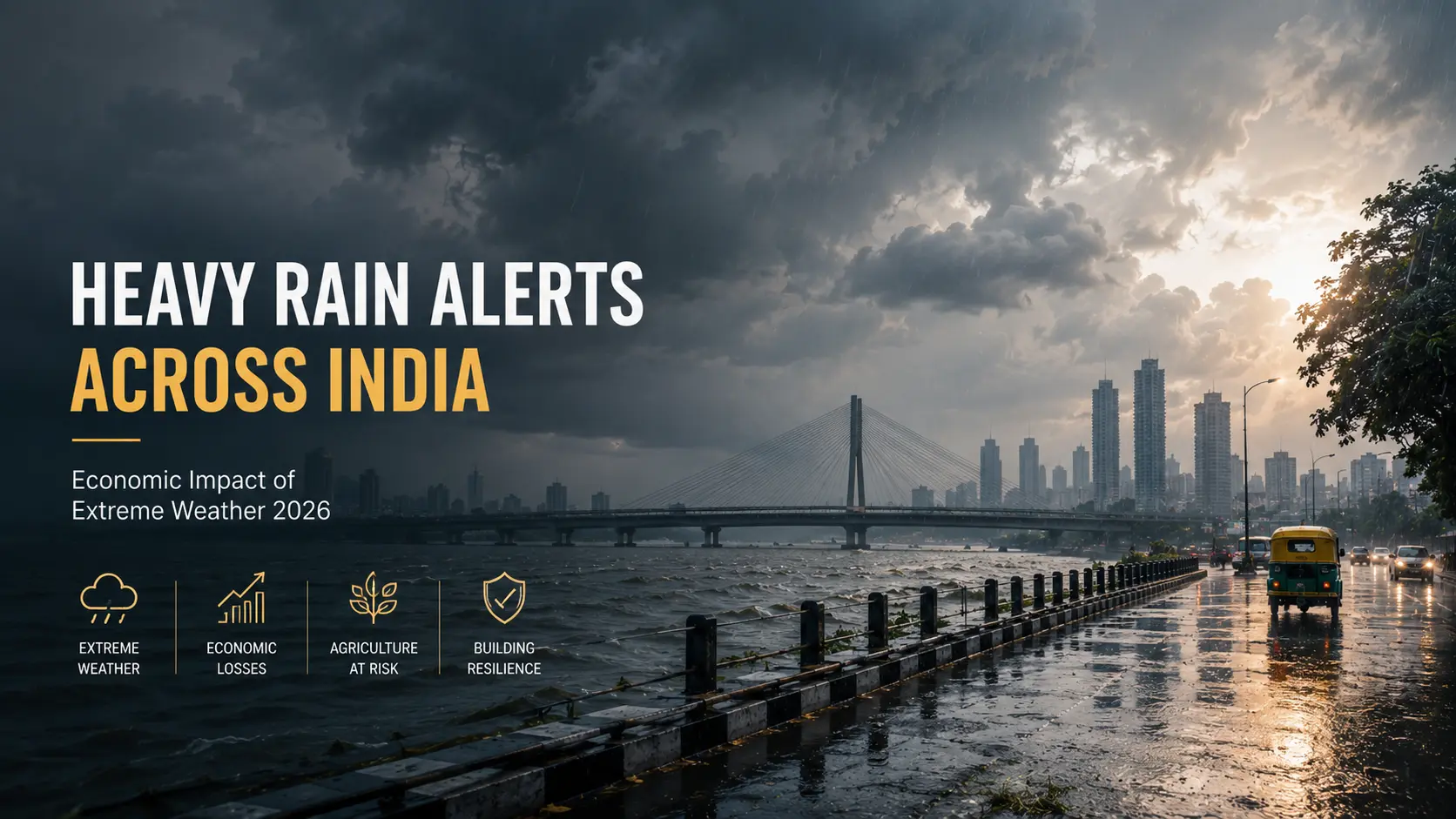
In today's era, where infrastructural development and digital economies are scaling at unprecedented speeds, we are encountering a profound vulnerability that we cannot fully manage or escape through automation: the raw, macroeconomic shock of extreme climate variability. For years, our economic planning relied on predictable seasonal grids. The annual South Asian monsoon was treated as a dependable, systemic engine driving rural consumption, filling hydro-reservoirs, and stabilizing food indices. However, as we witness the structural shifts of 2026, we are realizing that our systems are increasingly dependent on micro-forecasts, yet simultaneously highly volatile. Somehow these rapid atmospheric shifts are manageable through modern engineering, and somehow they are fundamentally altering our fiscal fundamentals without warnings.
"The climate paradigm of 2026 is no longer a linear forecasting problem; it has mutated into a non-linear economic shock amplifier where single-day precipitation events wipe out quarterly sub-continental growth metrics."
Weather resilience models were originally introduced to make financial forecasting faster, robust, and insulated against crop failures. But as we end up grappling with historic extremes — where a scorching 270.8 GW peak electricity demand in May 2026 transitions instantly into sudden cloudbursts and structural rainfall deficits over 40% across major parts of the peninsula in June — we must ask ourselves where we lost the baseline of stable agricultural growth and systemic municipal planning. This comprehensive analysis maps the deep economic costs, sector-by-sector micro-implications, and macro-policy buffers required to manage India's volatile meteorological horizon.
Analyzing the Quantitative Realities of the 2026 Monsoon Matrix
To fully grasp the magnitude of the economic impact, we must observe the stark empirical data recorded by meteorologists and financial analysts in the first half of 2026. The Indian Meteorological Department (IMD) reports that over 75% of India's aggregate landmass experienced severe distribution variations during the early phase of the monsoon cycle. Concurrently, rapid sea-surface warming has triggered highly concentrated cloudburst clusters, meaning that while seasonal aggregates might deceptively approach normalcy in certain records, the localized impact on human capital and fixed assets is catastrophic.
| Macroeconomic Variable / Indicator | Observed Metric (Q1-Q2 2026) | Fiscal/Economic Impact (Estimated Losses) | Primary Vulnerability Sector |
|---|---|---|---|
| Peak National Grid Power Demand | 270.8 GW (May 2026 Record) | Surge in high-cost emergency coal imports | Energy & Power Utilities |
| Early June Monsoon Aggregates | 40% Deficit (Subcontinental wide) | Delayed sowing across 12 million hectares | Agro-Economy & Pulses |
| Northwest Regional Precipitation | 127% of Long Period Average (LPA) | > ₹13,000 Crore asset damage (Punjab) | Infrastructure & Transport |
| Food Basket Weight in CPI Basket | 36.75% Total Weight | Suppressed rural demand, >5% structural inflation | Consumer Retail & Retail Banking |
| Long-Term Potential GDP Risk (2050) | Up to 2.8% Annual Loss (World Bank) | Cumulative $1.2 Trillion capital drag | Sovereign Credit Rating |
This variance highlights an endless loop of corrective pricing. When agricultural outputs fluctuate wildly, the corporate supply chain enters a frantic process of re-routing logistics, sourcing alternative components, and increasing hedging costs, creating a continuous head-work and tiresomeness for small and medium business owners alike.
Sectoral Deep-Dives: Where the Rain Cascades Into Balances
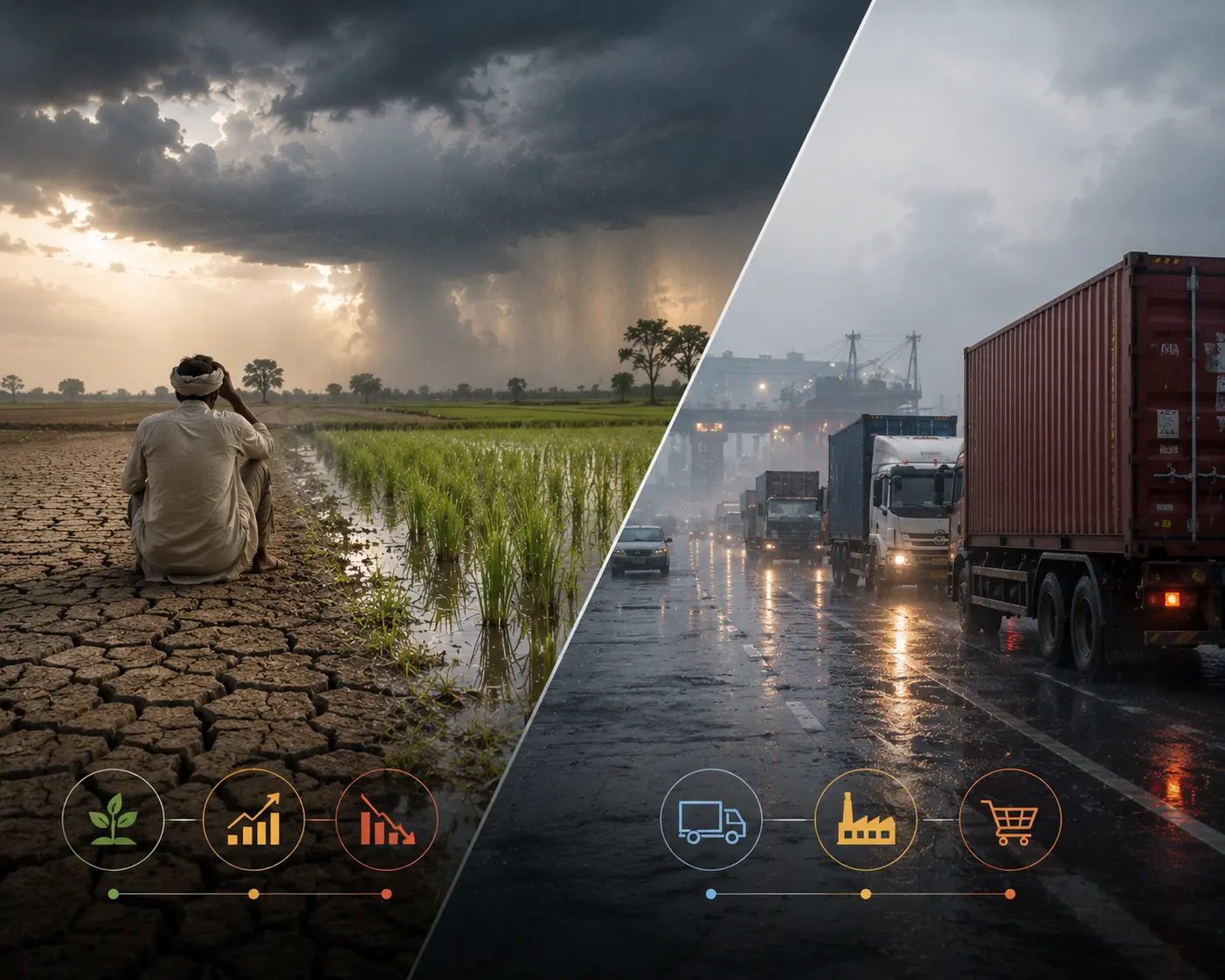
A. The $300 Billion Agricultural Engine Under Stress
Agriculture remains the most weather-exposed sector in the sub-continent, contributing significantly to employment and domestic consumption. The delayed onset of rain coupled with sudden, violent cloudbursts prevents uniform crop canopy development. In 2026, the delay in monsoon currents covering the complete landmass meant that crucial planting windows for oilseeds, pulses, and paddy were compressed. This volatility triggers several key economic phenomena:
Sowing Distortions: Farmers are forced to shift from premium long-duration crops to low-yield short-duration varieties, reducing per-hectare profit margins by up to 22%.
Input Cost Inflation: Soil moisture evaporation caused by earlier heatwaves means that even when heavy rains arrive, fields require artificial treatments, driving up fertilizer and secondary mechanical pump costs.
The Rural Demand Compress: Because the rural demographic relies heavily on harvest cycles, lower yields instantly compress disposable income, causing a cooling effect on tractor sales, consumer durables, and entry-level two-wheelers.
B. Supply-Chain Disruptions and Corporate Logistics Chaos
Heavy rainfall alerts across industrial corridors mean that logistics and transport networks face sudden, erratic standstills. National highways crossing through central and northern transit nodes frequently report water-logging and landslide blocks. For supply chains operating on modern "just-in-time" inventory systems, these delays translate into immediate operational losses. Factory floors face structural downtime due to labor absenteeism and raw material delays, forcing freight operators to increase premiums, which ultimately cascades down to the retail consumer's wallet.
The Hidden Tax on Urban Infrastructure and Energy Grids
Urban microclimates are becoming severe operational bottlenecks during heavy rain emergencies. Poorly integrated municipal drainage networks mean that cities like Mumbai, Bengaluru, and Delhi-NCR suffer immediate economic paralyzation during high-precipitation hours. The cost is calculated not just in damaged public property, but in lost labor hours and decreased productivity. Furthermore, the energy sector experiences a rapid whip-lash effect. In May 2026, utilities were stretched to their absolute physical limit, deploying high-cost thermal generation to fulfill the historic 270.8 GW cooling requirements. The sudden transition to severe rain lowers cooling demands but introduces massive network damage, transmission line short-circuits, and compromised coal-stock yards due to moisture saturation. This creates an institutional vacuum where utilities must manage high capital expenditures on infrastructure repair while suffering from immediate drops in billing volumes.
Fiscal Pressures and the Government Balance Sheet
The economic burden of these recurring weather shocks shifts heavily onto public finance frameworks. State Disaster Response Funds (SDRF) and central emergency allocations face immediate depletion during these extreme quarters. For example, legacy data reveals that severe flooding patterns require emergency packages totaling thousands of crores to restore basic civic connectivity, repair rural roads, and provide immediate credit deferrals to affected agrarian communities.
"When adaptation spending scales from historic baselines to up to 5.6% of national GDP, it represents an implicit redirection of capital away from core technology research, heavy industrial infrastructure, and long-term public health expansions."
This reality leaves less structural space for growth-inducing capital expenditures. Sovereign credit analysts closely monitor these adjustments, as persistent food inflation driven by supply bottlenecks forces central banking authorities to keep interest rates elevated, restricting corporate borrowing and dampening private capital expenditures across non-exposed sectors.
Strategic Mitigations: Transitioning from Reactive to Structural Resilience
To avoid falling into a permanent loop of economic disruption, India's financial and physical infrastructure must move away from reactive spending systems and adopt intentional, structure-dependent frameworks. Just as traditional self-discipline methodologies focus on deep conscious management, our macro-economy requires rigorous structural adjustments:
Decentralized Rainwater Infrastructure: Scaling micro-reservoir and check-dam installations across industrial zones to catch erratic precipitation, ensuring that flash floods are converted into long-term groundwater reserves.
Actuarial Realignment and Climate Insurance: Transitioning public crop and property insurance from basic legacy models to high-resolution satellite-verified parametric insurance that settles claims in hours, preserving corporate liquidity.
Climate-Resilient Urban Corridors: Mandating permeable concrete construction, dedicated subterranean drainage tunnels, and elevating critical electrical sub-stations above historical high-flood levels.
Agricultural Sowing Modernization: Leveraging localized agro-meteorological advisories to help rural communities time their sowing patterns with precision, effectively reducing the historical dependency on broad seasonal monsoons.
By implementing these systemic structures, the domestic economy can shield itself from erratic atmospheric swings, ensuring long-term fiscal stability and sustainable growth across all exposed industries.
Read Further
- India's Weak Monsoon and Preparedness — Akka IAS, June 2026: 75% of India's Land Area Facing Rainfall Deficiency
- Climate Change Could Depress Living Standards in India — World Bank Press Release: South Asia's Hotspots Report
Disclaimer: The data and synthesis presented in this document are compiled from current 2026 macroeconomic studies, public meteorological records, and institutional climate vulnerability frameworks. This document is intended solely for structural and research analysis and should not be construed as direct financial or policy advice.