


In today's global landscape where supply chain dominance dictates technological supremacy, states find themselves facing classic security dilemmas that rewrite traditional foreign policies overnight. For decades, New Delhi played a highly predictable, cautious, and state-centric game along its volatile eastern border. It engaged primarily with the Tatmadaw — the Myanmar military junta — trading diplomatic legitimacy and tactical hardware for promises of border stability and counter-insurgency cooperation against Indian insurgent groups. But as structural resource shifts alter global mathematics, we are witnessing a quiet, monumental transformation. New Delhi is hedging its bets, quietly engaging with ethnic armed organizations (EAOs) and resistance forces that have systematically dismantled the military's control across Myanmar's borderlands.
This article explores what we should understand about India's unfolding strategic pivot, reconciling old doctrines of non-interference with the raw, uncompromising realities of securing critical elements like rare earth metals, heavy minerals, and transit corridors. When an empire of processing monopolies like China closes its fist around global trade, secondary states must look to the periphery. For India, that periphery lies directly across the Arakan and Chin hills, where the soil is rich, the lines of control are fluid, and the old methods of management are breaking down entirely.
Autonomous Alliances and the Shift in Border Realities
With the post-2021 coup dynamic shifting decisively against the State Administration Council (SAC) in Naypyidaw, the structural geometry of the Indo-Myanmar frontier has fundamentally altered. Autonomous local resistance groups, operating under umbrellas like the National Unity Government (NUG), alongside seasoned EAOs such as the Chin National Army (CNA), the Arakan Army (AA), and the Kachin Independence Army (KIA), now control over 60 percent of Myanmar's total territory, including almost all major trade gates bordering India and China. For New Delhi, maintaining a policy of exclusive engagement with an isolated junta confined to central Myanmar's dry zone has become a strategic liability. The efficiency that a single military dictator once provided in suppressing border rebels has evaporated into an endless loop of unfulfilled security guarantees. Recent intelligence reports indicate that the Tatmadaw has increasingly relied on cross-border remnants of Indian insurgent groups to secure its own collapsing positions, breaking its long-standing pact with India. In response, Indian intelligence and diplomatic channels have quietly adjusted, hosting delegations from the Chin and Mizoram networks, and holding back-channel discussions regarding the security of vital multi-modal transit links like the Kaladan project. This tactical evolution is not driven by a sudden ideological fondness for democratic revolutions; it is an unyielding calculation of survival and asset protection.
Cons of Continued Stasis: The Chinese Shadow and Supply Vulnerabilities
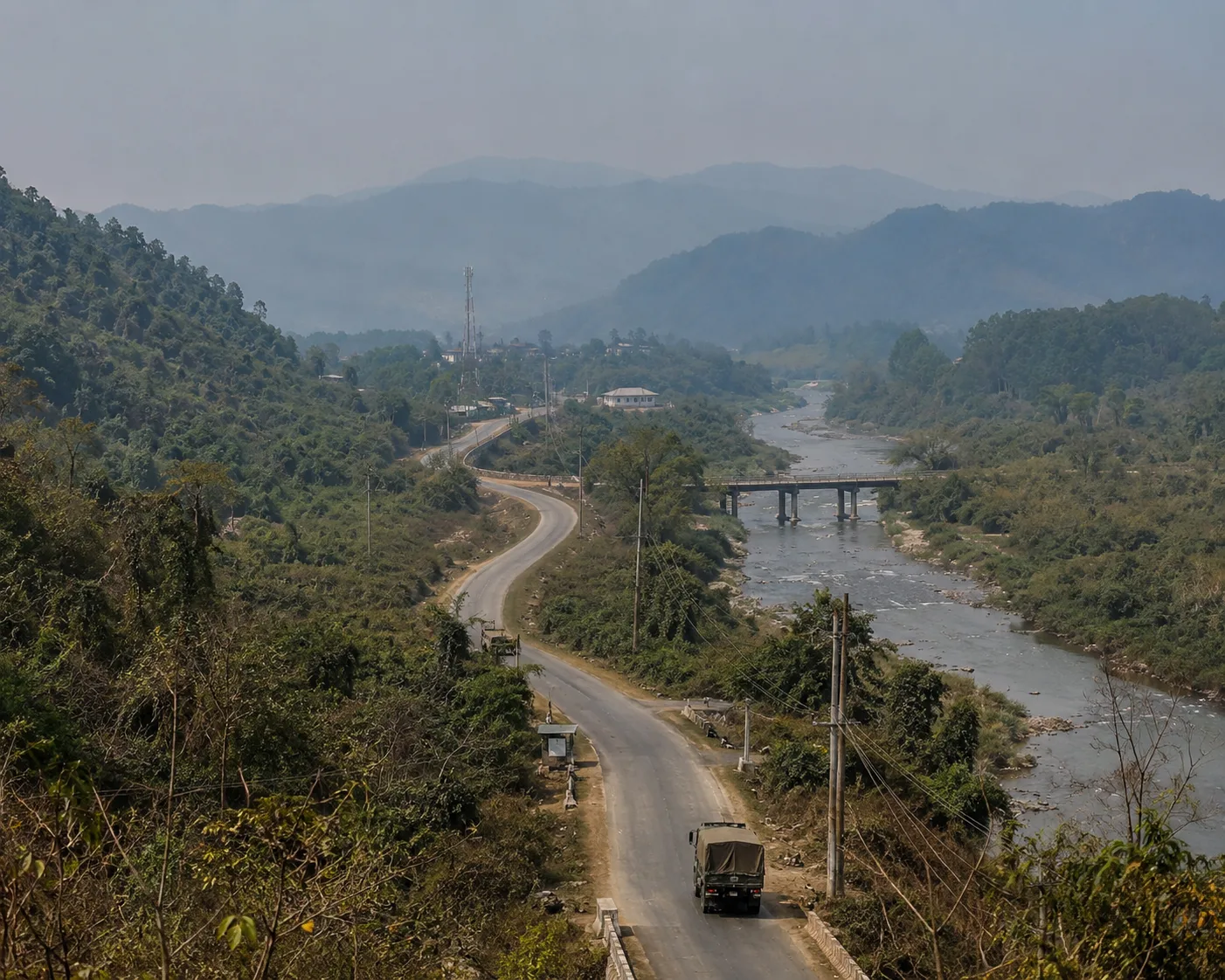
Geopolitical inertia is still a choice, and choosing to remain bound solely to a failing junta creates scenarios fraught with extreme downside risks. In recent strategic assessments, a stark reality has emerged: as the Myanmar military weakens, it grows exponentially dependent on Beijing for economic lifelines, veto protections at the UN, and advanced military hardware. China's deepwater port project at Kyaukphyu and its expanding China-Myanmar Economic Corridor (CMEC) threaten to permanently outflank India's maritime footprint in the Bay of Bengal. If New Delhi refuses to build strong, independent relationships with the emerging rebel authorities, it effectively leaves a massive geopolitical vacuum on its eastern flank that China will gladly fill. Moreover, depending blindly on a central regime that lacks real administrative control means entering a tiresome chore of securing infrastructure that is perpetually vulnerable to ambush. Every road, bridge, and pipeline built under the Kaladan Multi-Modal Transit Transport Project or the India-Myanmar-Thailand Trilateral Highway runs through territory governed by sovereign ethnic factions. Without active local compliance, these multi-million-dollar corridors become nothing more than concrete targets in an active civil war. The error margin in ignoring the actual rulers of the soil is too high — a lesson learned through bitter disruption when trade gateways like Rihkhawdar fell to resistance fighters, halting border commerce overnight unless direct arrangements were made with local rebel councils.
The Rare Earth Conundrum: Why Heavy Minerals Mandate a New Playbook
Beyond structural security and transport paths lies the most potent catalyst of all: the global war for technological sovereignty. In our current era, clean energy, semiconductor fabrication, defense aerospace, and advanced robotics are entirely reliant on Rare Earth Elements (REEs) — specifically heavy rare earths like dysprosium and terbium.
"In modern statecraft, neutrality is never the absence of action; it is the deliberate, calculated diversification of structural dependencies across competing centers of power."
While China dominates global refining capacity, its domestic extraction is supplemented heavily by mining operations located deep within Myanmar's border areas, particularly in Kachin State and areas bordering Yunnan. Consider the stark supply metrics that frame this resource dependency:
Global Strategic Mineral Metrics & Resource Imbalances:
- Chinese Global Refining Monopoly: ~70% of global mining output and nearly 90% of magnet-grade REE processing capacity.
- The Myanmar Supply Pipeline: Provides up to 60–70% of China's raw heavy rare earth feedstock during peak production cycles.
- The Vulnerability Formula: Structural vulnerability (S<sub>risk</sub>) scales as a function of the interaction between refining monopoly concentration (M<sub>monopoly</sub>) and conflict-zone instability (C<sub>conflict</sub>) — vulnerability rises sharply when refining monopolies depend on unstable conflict zones for raw extraction.
- The Indian Dependency Gap: Over 85% of India's current imports of finished electronic components and permanent magnets track back to Chinese supply chains.
When the Kachin Independence Army (KIA) or localized border guard forces seize control of these mineral-rich mountains, the supply lines to Chinese processing plants face immediate disruption. For India, this represents both a severe threat and a generational window of opportunity. To build its own domestic electronics manufacturing industry and secure its defense infrastructure, India must bypass Chinese intermediaries. The magic of resource diplomacy dictates that when you engage directly with the stakeholders who manage the mines, your supply security hardens. You become capable of building alternative, direct mineral corridors into India's refining hubs, breaking a dangerous processing monopoly at its very root.
The Rebel Governance Model: Engaging the New Frontier
Engaging with non-state actors requires an entirely different administrative vocabulary than formal state-to-state diplomacy. Entities like the Arakan Army or the Chin National Front are no longer simple guerrilla outfits hiding in the dense jungle; they have transformed into complex administrative bodies running local economies, gathering taxes, managing healthcare, and enforcing judicial codes across vast liberated zones. They are building proto-states that demand a sophisticated, nuanced approach from neighboring powers. To navigate this new frontier successfully, India's strategic establishment must implement a multipronged playbook:
1. Direct Sub-National Border Agreements
New Delhi must empower border state leadership in Mizoram, Manipur, and Nagaland to serve as primary conduits for localized cross-border administration. Because these states share deep ethnic, linguistic, and cultural ties with communities across the border — such as the Zo people — local leaders possess the natural trust required to negotiate security pacts, cross-border trade guidelines, and refugee management frameworks without triggering formal diplomatic protests from Naypyidaw.
2. Infrastructure for Security Trade-Offs
India should formally condition its future economic investments in these borderlands on explicit security guarantees from the ruling EAOs. In exchange for infrastructure development, access to medical facilities in Northeast India, and the regular flow of non-lethal humanitarian aid, groups like the Arakan Army must ensure that Indian transit assets remain unmolested and that anti-India insurgent factions are permanently evicted from their administrative territories.
3. Constructing Parallel Critical Mineral Corridors
India must leverage its public and private mining infrastructure majors to collaborate directly with rebel administrative councils governing resource-rich sectors. By offering modern, ecologically sustainable mining machinery and direct financial compensation, New Delhi can construct alternative, secure supply loops for raw lithium, cobalt, and heavy rare earths, channeling these vital inputs directly into processing plants in mainland India.
Conclusion: The Architecture of Pragmatic Neutrality
Now, it may sound like a radical, unstable departure from India's long-held principles of respecting national sovereignty, but it is not. This shift represents the emergence of a highly pragmatic architecture of neutrality. In an era where global supply lines are weaponized with absolute indifference, holding onto rigid, outmoded diplomatic formulas is a recipe for strategic containment. Writing and calculating its national interests across multiple boards allows New Delhi to remain clear-eyed and flexible, ensuring that its economic and technological sovereignty remains intact no matter who eventually holds the formal seat of power in central Myanmar. Ultimately, the core principle of success in regional money management, defense insulation, and asset protection is to look twice at the ground realities before investing your geopolitical capital. India's quiet bet on Myanmar's resistance forces is not an act of revolutionary romance; it is an unavoidable, hard-nosed strategy designed to secure its borders and vital material supply chains against a looming hegemony.
"Extract responsibly and secure strategically."
By shifting gracefully from a broken, reactive system to an intentional, structure-dependent framework, New Delhi ensures that its strategic autonomy will survive the turbulent geopolitical reorderings of the century ahead.
Read Further
- A Rebel Border: India's Evolving Ties with Myanmar after the Coup — International Crisis Group
- Rare Earths and Realpolitik: The Future of Mediation in Myanmar — Stimson Center
Disclaimer: This analysis was compiled from publicly available foreign policy research, conflict-monitoring reports, and supply-chain studies regarding India-Myanmar relations and the global rare earth trade. This content is presented for educational and geopolitical-awareness purposes only and should not be construed as an official policy position, diplomatic statement, or investment guidance. The situation on the ground in Myanmar remains fluid and contested; readers should consult current reporting for the latest developments.