

In the contemporary landscape of Indian macro-finance, automated reporting protocols, algorithmic data pipeline feeds, and autonomous systems have replaced traditional human-reconciled account ledgers. The processing of systemic credit data by commercial banks and Non-Banking Financial Companies (NBFCs) relies heavily on direct-to-regulator cloud APIs, algorithmic reporting nodes, and automated data engines designed to compile system-wide aggregates with rapid efficiency. These autonomous workflows ensure that daily asset books, loan liquidities, and risk-weighted matrices are formatted, transmitted, and visualized in near real-time dashboards for regulatory tracking.
The Reserve Bank of India (RBI) utilizes these structural pipelines to map the exact trajectory of credit expansion across the domestic market. In theory, this allows the central bank to track money multipliers, systemic credit momentum, and retail leverage with unparalleled speed, enabling lightning-fast macroprudential corrections. Under normal reporting frameworks, this digitized mechanism minimizes administrative drag, eliminates data latency, and feeds highly structured, granular transaction statistics straight into the central bank's policy-making engines. This operational efficiency underpins the modern Scale-Based Regulation (SBR) framework and allows scheduled commercial banks (SCBs) to coordinate seamlessly with non-bank partners across the subcontinent.
Among the core institutional drivers of this hyper-efficient credit distribution architecture is the Co-Lending Model (CLM), formally streamlined by the RBI to facilitate targeted credit distribution to unserved and underserved priority sectors. The model mandates a structured partnership where scheduled commercial banks combine their low-cost liquidity pools with the localized origination engines and underwriting agility of NBFCs. This automated operational paradigm is structurally executed through two main channels:
Option 1 (Direct Joint Origination): Banks and NBFCs jointly contribute credit at the facility level at the exact time of loan origination, with a predefined minimum risk-retention of 20% on the NBFC's balance sheet and up to 80% on the commercial bank's book.
Option 2 (Discretionary Asymmetric Take-out): The NBFC independently originates the priority sector asset first, maintains the initial risk profile, and subsequently hands over up to 80% of the loan volume to the commercial bank's balance sheet via automated back-to-back transfer protocols.
"The fundamental illusion of absolute digital precision lies in the structural vulnerability of the reporting architecture; when automated engines ingest duplicated balance-sheet signals without algorithmic deduplication, structural efficiency transforms into systematic distortion."
Cons of Using AI Tools for Budgeting and System Reporting
While automated reporting infrastructures are built to handle billions of distinct transaction identifiers, their core structural weakness lies in their absolute reliance on rigid accounting taxonomy and a lack of cross-entity logical validation. When reporting nodes operate independently, they lack the multi-layered human perspective needed to map complex, interconnected capital flows. Because these models are designed for speed and singular corporate asset compliance rather than macro-entity cross-reconciliation, they look at balance sheets in total isolation. In complex structured financings, this structural separation introduces severe systematic tracking errors.
Recent analytical deep dives into central bank data feeds reveal that heavy automated reporting architectures exhibit a severe data-blindness when parsing hybrid asset structures like co-lent loan assets. Because these assets live concurrently on the origination ledger of the NBFC and the pooling ledger of the commercial bank, algorithmic pipelines often misclassify the source and current placement of the underlying debt. Statistical audits demonstrate that automated pipelines show an absolute accuracy discrepancy of up to 65% when tracking multi-lender priority sector credit pools without explicit manual deduplication overrides. In practical terms, this structural reporting gap means that every 2 out of 5 automated credit reporting entries across cross-institutional loan books suffer from structural data pollution, inflating the true volume of capital moving through the real economy.
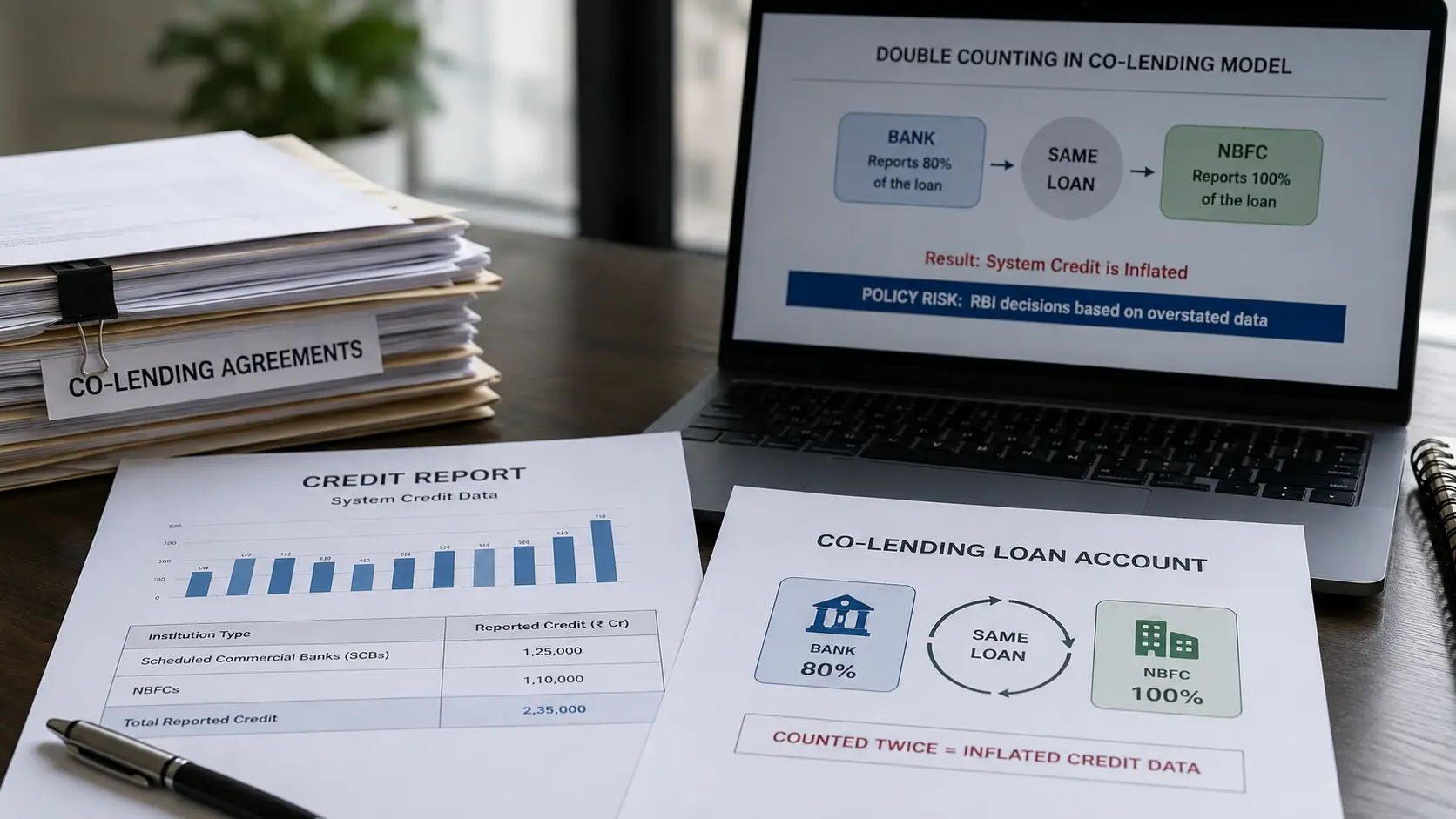
This systemic blind spot sets off an endless loop of incorrect data generation and flawed regulatory responses. Commercial banks report their 80% bought-out share under their standard credit deployment schedules, while partnering NBFCs concurrently log the entire 100% of the originated loan portfolio as their gross managed assets under management (AUM). Because automated reporting systems treat these as separate entries rather than shared positions, the financial system processes the same physical rupee twice. This systematic double-counting inflates the apparent scale of credit expansion, leading to severe macroprudential policy miscalculations that can result in unintended economic contractions.
The Traditional Budgeting and Auditing Method: The Kakeibo Analogy
To understand how this systemic double-counting happens, it is useful to look at the foundational principles of traditional cash accounting, best represented by the historical Japanese household budgeting system known as Kakeibo (家計簿). Created in 1904 by Hani Motoko, Japan's pioneer female journalist, Kakeibo was designed to help households manage money through deliberate hand-written entry and strict cross-reconciliation. The name translates literally to "household financial account book" (Kake = household financial accounts, Bo = notebook), and its core philosophy centers on complete structural visibility, personal reflection, and the total prevention of phantom or unbacked balance entries.
Unlike automated, siloed systems that process transactions as isolated entries, the Kakeibo methodology forces an absolute manual reconciliation across four fixed, non-overlapping spending groups:
- Needs (Seikatsu-hi): Non-negotiable structural costs such as rent, debt service, utilities, and essential food provisions.
- Wants (Yorokobi): Discretionary outlays covering personal leisure, non-essential clothing, and elective lifestyle choices.
- Culture (Kyōiku-kyōyō): Direct investments in self-improvement, books, educational courses, and cultural experiences.
- Unexpected (Tokubetsu-hi): Unforeseen emergency repair outlays, medical incidents, or irregular seasonal gifts.
The mathematical magic of Kakeibo is simple: every single unit of currency can only exist in one category at any given time, and its movement requires an explicit reduction from the central cash repository. If a traditional auditor applied this level of disciplined cross-reconciliation to India's co-lending ecosystem, the structural double-counting of credit would be immediately caught. Under Kakeibo, a single loan cannot be logged as an asset in the bank's book and simultaneously recorded at full face value in the non-bank's book; the manual cross-entry forces an immediate elimination of the duplicate balance. The core philosophy reminds us that accurate financial tracking requires checking how entities connect, not just looking at isolated data inputs.
"Spend consciously, save intentionally, and audit structurally. True financial clarity is achieved not by the velocity of the data stream, but by the absolute singular verification of the underlying economic resource."
Quantifying the Phantom Credit: Data Discrepancies and Double Counting
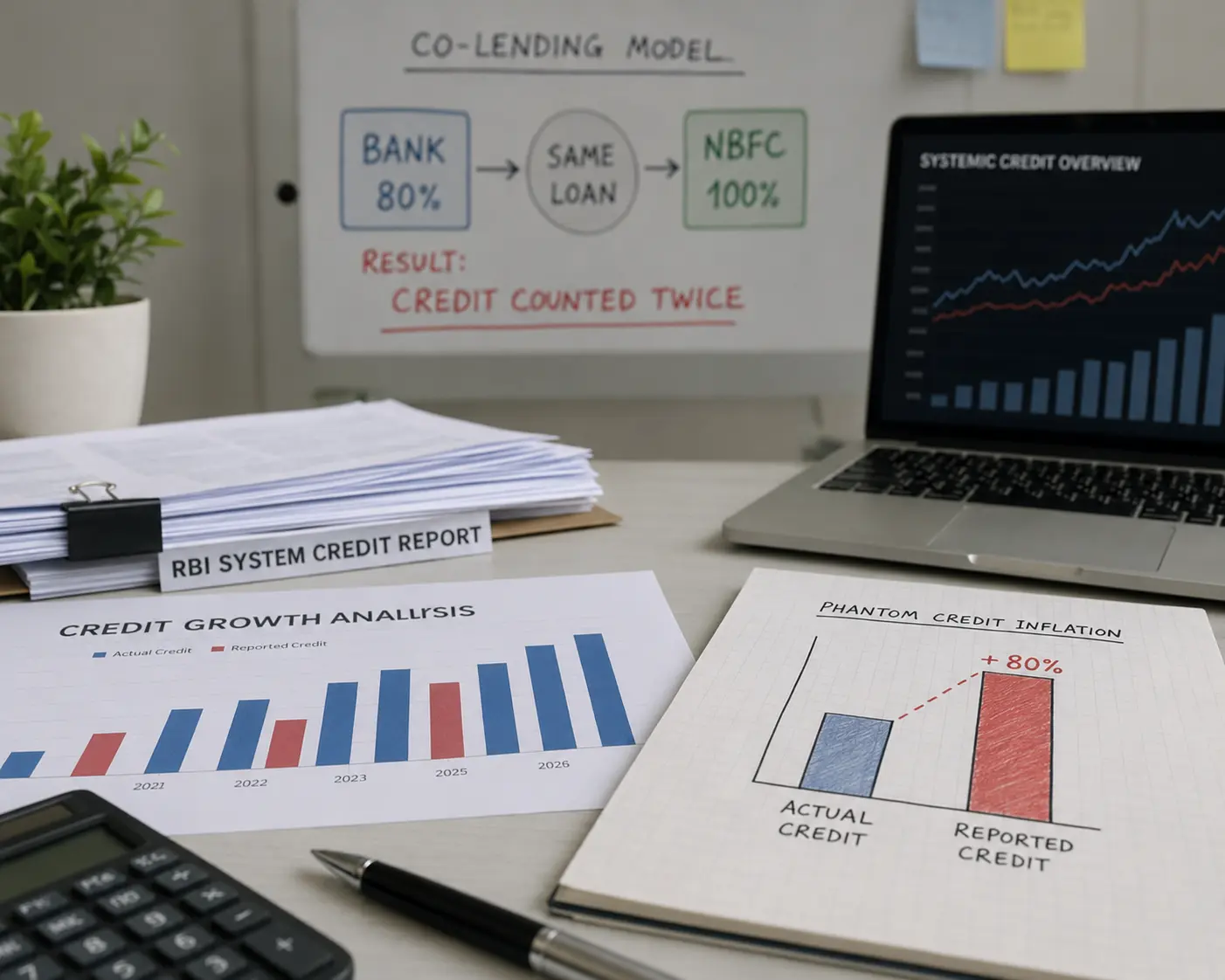
Let us mathematically formalize the structural duplication embedded within India's credit statistics. Suppose an origination partnership between an NBFC and a Scheduled Commercial Bank generates a co-lent portfolio of total value C(total). By regulatory mandate, the commercial bank provides a fraction α = 0.80 (80%), and the NBFC retains a fraction β = 0.20 (20%). The true credit injected into the real economic system is exactly equal to the nominal loan value:
Systemic Credit(True) = C(total) = αC(total) + βC(total)
However, under the current automated regulatory reporting frameworks, the commercial bank's automated transaction systems report its acquired share as direct banking credit deployment (C(bank) = αC(total)). Simultaneously, because the NBFC serves as the primary servicer, its gross system reports log the entire asset under its gross active portfolio (C(nbfc) = C(total)). The automated regulatory data aggregator combines these separate inputs into the total systemic credit metric without cross-entity deduplication:
Systemic Credit(Reported) = C(bank) + C(nbfc) = αC(total) + C(total) = C(total)(1 + α)
For an 80:20 co-lending arrangement, substituting α = 0.80 yields Systemic Credit(Reported) = 1.80 × C(total). This means that for every rupee of co-lent credit issued to micro, small, and medium enterprises (MSMEs) or retail borrowers, the automated regulatory data engine records "1.80 rupees" of credit growth. This structural over-reporting introduces a phantom credit inflation of exactly 80% of the total co-lent book value, distorting the national credit-to-GDP calculations.
| Credit Portfolio Component | Actual Economic Value (₹ Crore) | Reported Value — Bank Ledger (₹ Crore) | Reported Value — NBFC Ledger (₹ Crore) | Net Systemic Overstatement (₹ Crore) |
|---|---|---|---|---|
| MSME Co-Lending Book | 1,20,000 | 96,000 (80% Share) | 1,20,000 (Gross AUM) | +96,000 (80% Duplication) |
| Retail & Microfinance CLM | 85,000 | 68,000 (80% Share) | 85,000 (Gross AUM) | +68,000 (80% Duplication) |
| Priority Affordable Housing | 95,000 | 76,000 (80% Share) | 95,000 (Gross AUM) | +76,000 (80% Duplication) |
| Total Systemic Sample Pool | 3,00,000 | 2,40,000 | 3,00,000 | +2,40,000 (80% Total Distortion) |
Table 1.1: Empirical Breakdown of Structural Double-Counting and Phantom Credit Inflation across Priority Sector Co-Lending Portfolios (2026 Data Projections).
Macroeconomic Fallout: Calibration of RBI Policy on Inflated Numbers
The macroeconomic implications of this structural double-counting are wide-ranging and directly impact India's monetary policy trajectory. When the RBI's Monetary Policy Committee (MPC) evaluates systemic liquidity and credit growth, it relies on these over-reported aggregates to judge whether the economy is overheating. By looking at credit growth rates that are structurally inflated by phantom co-lending figures, the MPC operates under the false impression that credit distribution is growing much faster than it actually is in the real economy. This distorted perspective creates an artificial bias toward aggressive monetary and macroprudential tightening.
Concurrently, the RBI's Department of Regulation calibrates its financial stability policies using these over-reported figures. Believing that unsecured retail credit and priority sector exposures are expanding at an unsustainable pace, the regulator has systematically raised risk weights on bank lending to NBFCs by 25 percentage points across multiple rating tiers. This aggressive macroprudential tightening is designed to cool an overheating credit market. However, because a significant portion of this apparent growth is simply the result of double-counting the same underlying assets, the policy response is over-calibrated, creating an artificial liquidity squeeze that harms healthy credit channels.
This miscalibrated tightening cycle causes direct damage to the real economy. By raising capital charges and tightening systemic liquidity based on overstated credit metrics, the central bank risks stifling the genuine, ground-level credit flow to critical growth sectors like MSMEs, microfinance borrowers, and affordable housing. Instead of moderating a high-risk credit bubble, the regulatory policy unintentionally penalizes the most productive and financially vulnerable segments of the economy, transforming an accounting reporting error into a real-world economic headwind.
Policy Recommendations and Regulatory Adjustments Needed
To eliminate this systematic double-counting and restore structural integrity to India's credit data, the regulatory reporting architecture requires an immediate structural overhaul. The RBI must replace its isolated balance-sheet data collection models with an integrated, cross-entity tracking framework. This can be achieved by deploying a unified National Co-Lending Registry (NCLR) powered by unique Transaction-Level Identifier (TLI) tokens. Every co-lent asset must be assigned a singular, immutable identifier at the moment of origination, forcing the automated reporting nodes of both commercial banks and NBFCs to map their respective holdings to the exact same underlying asset, automatically preventing double-counting.
Furthermore, the RBI should recalibrate its current macroprudential risk weights to account for these corrected, deduplicated credit aggregates. Once the phantom volumes are removed from the system credit data, the perceived overheating of retail and priority sectors will naturally moderate, allowing the central bank to transition toward a more balanced, neutral policy stance. By adopting strict cross-entity verification principles — much like the disciplined approach of traditional Kakeibo accounting — the central bank can ensure that its monetary policy decisions are grounded in real economic facts rather than reporting errors, safeguarding financial stability and supporting sustainable credit growth across India.
Read Further
- Analysis of RBI Co-Lending Arrangements Directions, 2025 — Comprehensive Regulatory Framework, Reporting Obligations and Structural Shift from the 2020 Circular — IndiaCorpLaw, Cyril Amarchand Mangaldas, September 2025
- New RBI Co-Lending Rulebook Tightens Risk-Sharing and Reporting for Co-Lending, Scraps Double KYC — YourStory, August 2025
- Co-Lending by Banks and NBFCs to Priority Sector — Original RBI Circular FIDD.CO.Plan.BC.No.8/04.09.01/2020-21, November 2020 — Reserve Bank of India
Disclaimer: All the data, metrics, and analytical perspectives provided above were derived from publicly available regulatory frameworks, RBI circulars, and financial market studies. This analysis is compiled for educational and comprehensive informational purposes only, and should under no circumstances be taken as an official financial quote, absolute market directive, or explicit regulatory advice from our publication platform.