

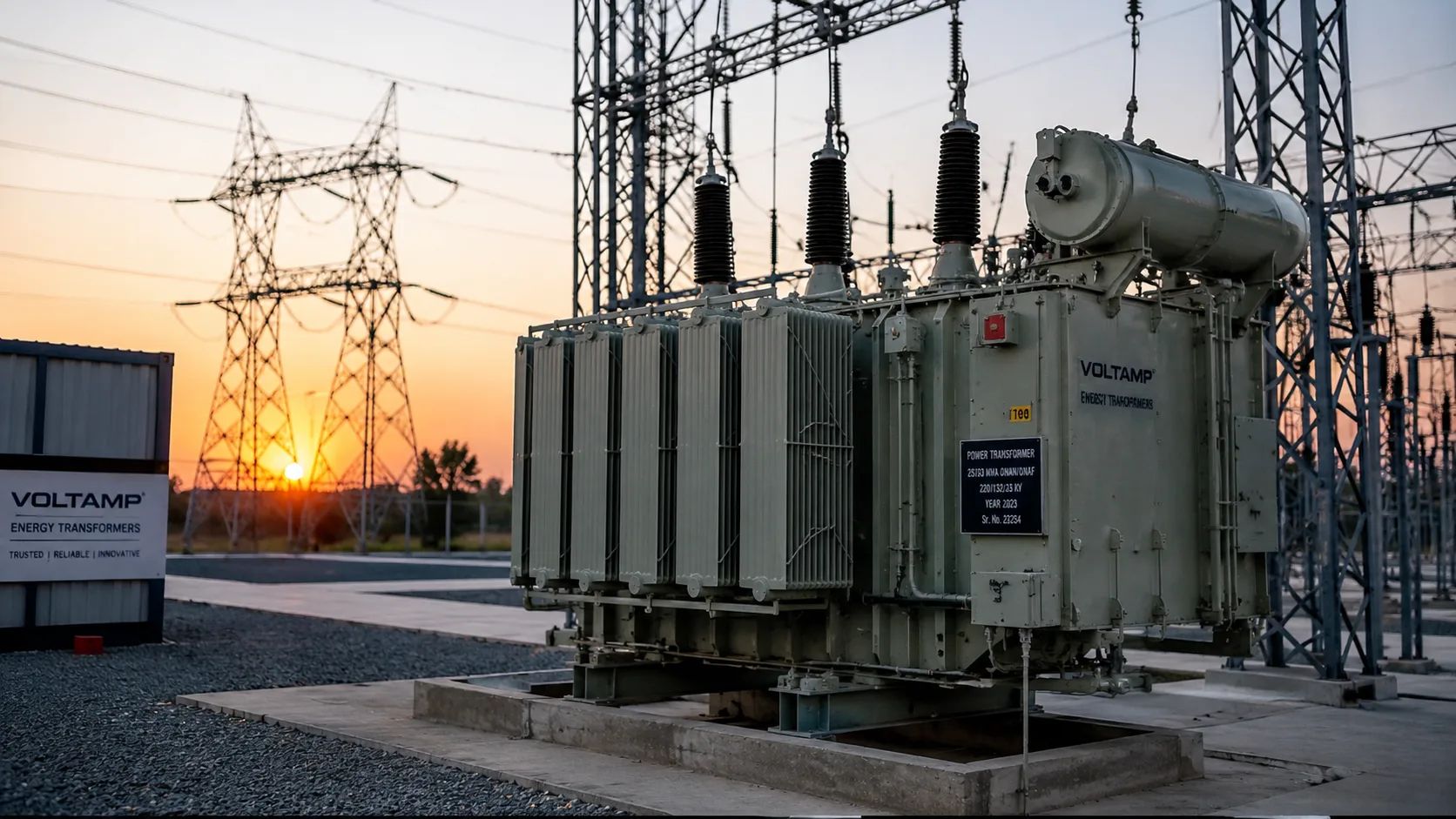
Most of those involved in trading and commenting on the global energy transition are making the critical error of believing that the bottleneck in electrical grid infrastructure is a merely localised or temporary financial issue, and not that we are experiencing a structural shortage of heavy electrical engineering capacity. When commentators mention the years-long grid crunch in utility-scale solar farms and hyperscale data centres in Northern Virginia or Frankfurt, they usually talk about permitting delays, copper shortages, or copper-to-aluminium substitution hang-ups. But the real bottleneck for the global energy transition in the 2020s is the unassuming high-voltage power transformer and gas-insulated switchgear (GIS) bay.
Legacy Western companies like Hitachi Energy, Siemens Energy, and Schneider Electric, along with East Asian giants such as Hyundai Electric and HD Hyundai, have long since sold out their capacity with firm lead times extending into a staggering 24 to 36 months. As the macro crisis of grid bottlenecks continues to dominate the attention of global energy research firms, a quieter structural trade shift is currently taking place: Indian heavy electrical equipment manufacturers are relentlessly winning export order books, turning global desperation into multi-year revenue visibility.
To understand why this moment represents a watershed inflection point for Indian engineering and capital goods, one needs to look back historically at India's heavy electrical equipment sector. Long before terms like "hyperscale data centre" or "Large Language Model training cluster" became common knowledge, India's homegrown manufacturing was developed in the crucible of massive rural electrification drives and ultra-high-voltage direct current (UHVDC) transmission corridors connecting distant thermal and hydro generation to tightly populated urban areas.
In classical Sanskrit and ancient Indian administrative tradition, the solid management of physical infrastructure was designated Sthapana (establishment and structural anchoring) and Prana-Pratistha (energisation and breathing life into dead infrastructure). Now home to hundreds of engineering behemoths, tier-2 and tier-3 companies are camped on the cusp of a globalising world eager for their skill sets in North America, the Middle East, Europe, and Southeast Asia. Listed Indian OEMs from the sector are now getting vetted for 400kV and 765kV extra-high-voltage applications to the exacting standards prescribed by tier-one global utilities.
To understand how domestic institutional investors should evaluate Indian industrial beneficiaries of global grid equipment scarcity, they must consider a four-pronged evaluation lens focusing on: Backlog Conversion Velocity, Specialty Steel Supply-Chain Security, Testing and Certification Accreditation, and Capital Expenditure Execution Risk. Market leaders today like Voltamp Transformers, Transformers and Rectifiers (India) Limited (TRIL), Shilchar Technologies, and large conglomerates Larsen & Toubro (L&T) and CG Power and Industrial Solutions have fine-tuned their manufacturing footprints. They are playing out calculated moves to de-risk their order books by giving preference to high-margin export orders over domestic utility orders, boosting their EBITDA margin and ROCE to all-time highs.
Anatomy of the Global Grid Bottleneck and India's Cost-Competitiveness Advantage
The current global shortage of power transformers is not a cyclical event that will resolve soon; rather, it is a fundamental structural disparity between booming electricity demand worldwide and decades of neglect in manufacturing capacity for heavy electrical equipment in North America and Europe. For more than two decades after the deregulation and financialisation of Western power markets, domestic transformer production capacity was gradually eliminated, consolidated, or moved offshore. US and Western European domestic producers are now confronted with a severe scarcity of grain-oriented electrical steel (GOES), a skilled copper-winding workforce, and the specific vacuum-drying autoclaves necessary for processing massive EHV cores.
As a result, lead times for large power transformers — the 345kV to 765kV units that step down transmission voltages for regional substations and hyperscale data centres — have lengthened from a historical norm of 20 to 26 weeks to a staggering 104 to 156 weeks. This stalemate has compelled US utilities and hyperscale providers such as Microsoft, Google, Amazon Web Services, and Meta to seek dependable, bankable solutions abroad.
India's manufacturing system is poised to fill this vacuum with strong structural advantages, marrying technical expertise with labour and overhead costs that are among the most competitive in the world. Unlike their Chinese counterparts, under increasing geopolitical constraints, supply-chain scrutiny, and tariff barriers in the United States and European Union, Indian producers have the advantage of strategic alignment with Western democracies through bilateral trade arrangements and reliable supply-chain solutions.
Indian manufacturers have understood the challenging engineering aspects of tropicalised and ruggedised grid solutions capable of enduring extreme thermal stress, elevated temperatures, and hostile grid voltage distortions — knowledge acquired over decades of operating one of the most challenging synchronous electrical grids in the world. As per information provided by the Indian Electrical and Electronics Manufacturers' Association (IEEMA), Indian exports of electrical equipment have witnessed a CAGR of more than 25% over the last three years, with North American utilities identified as the fastest-growing destination segment.
Another crucial aspect often neglected by equity analysts is the complex interaction between grid modernisation subsidies and equipment certification rules. Federal dollars in the US under the Infrastructure Investment and Jobs Act (IIJA) and Inflation Reduction Act (IRA) are raining down to fund regional transmission organisation (RTO) grid upgrades worth billions of dollars. Yet utilities are under strict legal requirements covering cybersecurity mandates, domestic content requirements, and intensive factory acceptance testing (FAT) protocols. Indian manufacturers have navigated these regulatory barriers by forming third-party accredited test labs, partnering with UL (Underwriters Laboratories) and Intertek, and meeting full compliance with IEEE C57.12.00 standards. This scrupulous compliance has crushed long-held disbeliefs about third-world machines, empowering Indian tier-one manufacturers to achieve price premiums against traditional European suppliers while still maintaining a decisive delivery lead-time advantage.
With hyperscale data centre operators racing against rigid power purchase agreement (PPA) deadlines to bring AI clusters online, getting transformers in 12 months rather than 36 months has catapulted Indian OEMs from backup suppliers into first-choice strategic partners.
The major threat for Indian transformer exporters is the fluctuation in raw material prices, particularly cold-rolled grain-oriented (CRGO) electrical steel, which constitutes 30 to 40% of the material cost of a transformer. India is structurally reliant on imports of high-grade CRGO steel from Japan, South Korea, and Europe because domestic production of the requisite quantity and quality (ultra-low core loss) is wanting. Anytime there is a geopolitical disruption or a trade tariff on specialised steel inputs, manufacturers' margins can be squeezed if there are no strong pass-through protections in export contracts.
Key research sources for this section:
- International Energy Agency (IEA) — Electricity Grids and Secure Energy Transitions report: global data on grid investment, transformer deficits, and T&D infrastructure needs — iea.org/reports/electricity-grids-and-secure-energy-transitions
- IEEMA — Industry statistics, order book splits, and capacity utilisation projections for Indian electrical manufacturers — ieema.org
- US Department of Energy (DOE) — Electric Power Transmission and Distribution Infrastructure Analysis — energy.gov/oe/electric-power-transmission-and-distribution
- Central Electricity Authority (CEA) of India — Transmission planning, voltage levels, testing standards, and manufacturing capacity utilisation across Indian industrial corridors — cea.nic.in
- IEEE Power & Energy Society (PES) — IEEE C57 Transformer standards, test procedures, and global conformance obligations — pes.ieee.org
"The real competitive moat of Indian manufacturing is not just low-cost labour anymore, but the ability to quickly scale high-voltage testing infrastructure and bring mission-critical electrical hardware to market faster than any Western incumbent can today."
Advertisement
The Model of Champions and the Capacity-versus-Order-Book Gap
As large-scale institutional capital floods into the Indian capital goods space, equity analysts must go beyond headline order-book disclosures and analyse companies on a stringent capacity-versus-order-book gap model. Not all listed Indian transformer manufacturers are equally placed to seize the export wave — most small regional players are capacity-constrained and risk delivery defaults if they bloat their international tenders.
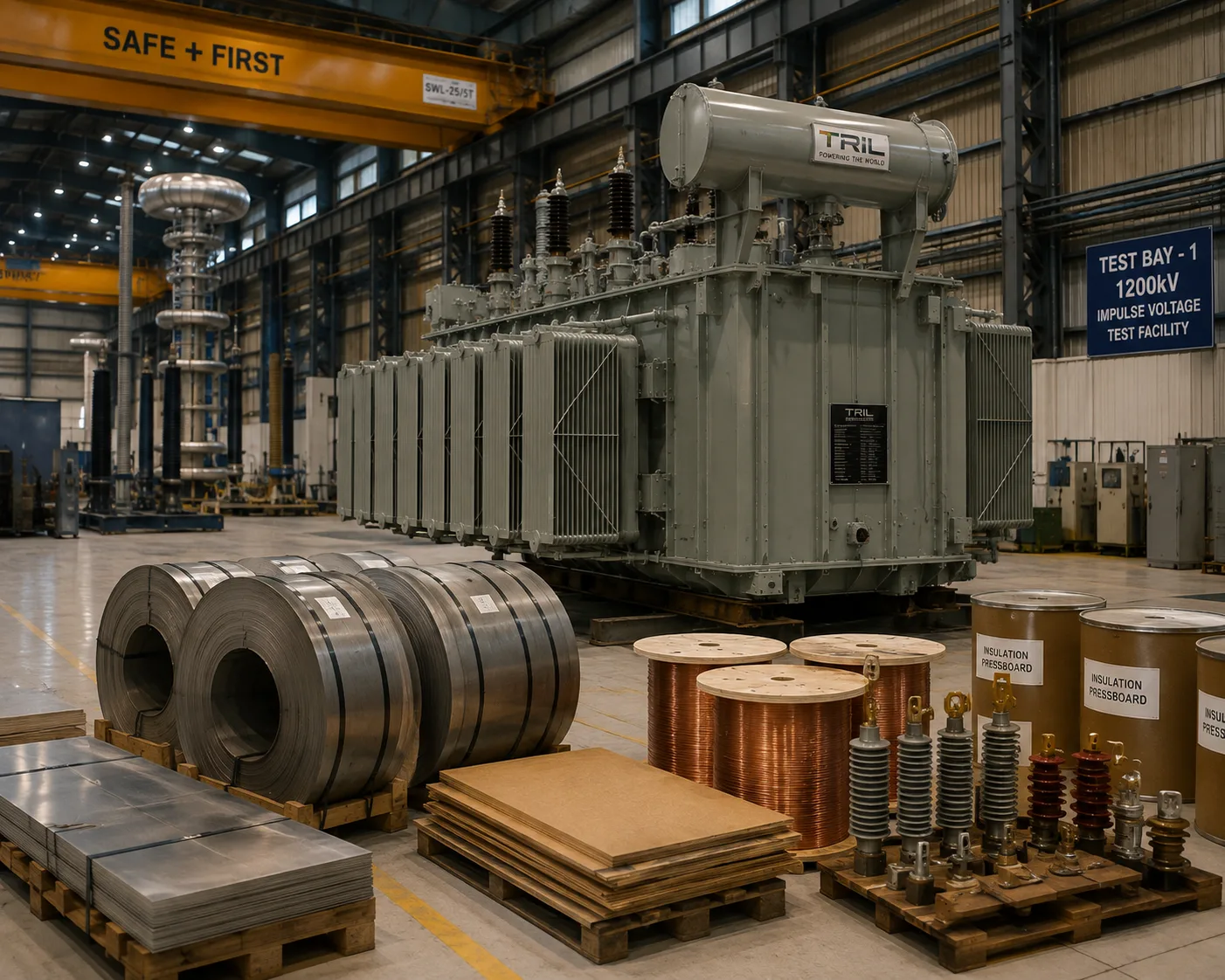
Conversely, tier-one listed champions have been on huge, multi-billion-rupee capex sprees to add vast factory floor space and acquire the latest vacuum pressure impregnation (VPI)-based plants and dedicated high-voltage testing labs, testing up to 1200kV systems in-house.
Voltamp Transformers — with its prudent balance sheet and sparkling return ratios — has traditionally been a play on industrial power and distribution transformers for domestic heavy industries, cement plants, and refineries. Over recent quarters, Voltamp has made forays into the export business by allying with global EPC contractors who need quick turnarounds for commercial and industrial microgrids.
TRIL (Transformers and Rectifiers India Limited) — in contrast, has been emphatic in its pursuit of overseas utilities, winning bulk export orders for power transformers since the 2000s, with ultra-clean dust-free winding rooms with strict humidity control, and multi-million-dollar impulse test generators.
Any delay in sourcing specialised imported machinery from European or Japanese toolmakers can push back commissioning timelines by 6 to 12 months, creating a temporary earnings disappointment for institutional shareholders who have priced in aggressive growth assumptions.
"An order book is just a promise on paper; real equity value is made in the factory testing bay in which a 400kV transformer successfully goes through its stringent lightning impulse test in one go."
Top-Tier Components, Specialised Inputs, and Supply-Chain Moats
Even though the future lies with Indian manufacturers of finished transformers, India's export boom is underpinned by an unseen, highly specialised upstream ecosystem of component suppliers, specialty steel processors, insulation material manufacturers, and copper-winding providers. In the absence of a stable, domestically based or regionally diversified supply chain for essential inputs such as CRGO electrical steel, pressboard insulation, oxygen-free high-conductivity (OFHC) copper conductors, and bushing insulators, Indian OEMs would continue to be exposed to the same supply-chain disruptions that challenge their Western counterparts.
Recognising this systemic risk, both government policymakers and private-equity-backed component manufacturers have heavily invested in upstream localisation, transforming India from a plain assembly hub to a full-service heavy electrical manufacturing plant.
The core magnetic stack, made from CRGO steel laminations, is at the heart of every power transformer. After sourcing almost all high-quality CRGO steel from specialised mills in Japan (Nippon Steel), South Korea (POSCO), and Europe (ThyssenKrupp) for decades, domestic mills have been forced to modernise with investments in high-tech CNC slitting and cut-to-length lines designed to reduce waste to the smallest core-loss targets and achieve near-microscopic accuracy. The insulation system — high-density pressboard, crepe paper, and laminated wood parts — has been greatly expanded by specialised Indian chemical and paper engineering companies.
A very significant increase in the availability of high-purity oxygen-free copper wire, fabricated into continuously transposed conductors (CTC), has also taken place because of a huge increase in production by export-focused winding shops. Though Western producers are saddled with legacy labour unions, strict environmental permitting delays, and high fixed costs, Indian component suppliers enjoy a young, highly flexible engineering workforce, a lower cost of capital for brownfield facility expansions, and aggressive state-level incentives under multiple Production-Linked Incentive (PLI) schemes.
The remaining glaring weakness is in advanced metallurgy: India does not yet have indigenous capability for manufacturing ultra-thin, high-permeability grain-oriented electrical steel grades (0.23mm and 0.20mm thickness grades for ultra-high-efficiency, low-loss transformers used in renewable energy grid integration). Closing this metallurgical gap is the final step toward fully supply-chain-autonomous completeness.
"In the design of high-voltage transmission, a transformer is only as secure as its weakest micro-laminar sheet of electrical steel; true industrial independence starts with atomic metallurgy."
Macroeconomic Challenges, Valuation Realities, and Strategic View
As institutional money managers and capital-goods equity analysts navigate the remainder of the decade, a calm, deeply objective view on macro risks and valuation realities is the best strategy. While the storyline of India walking away with the global grid equipment shortage is fairly strong, cyclical and structural risks could get in the way.
The largest macroeconomic risk is an abrupt slowdown or cutback in capital outlays for global AI data-centre deployments. If macroeconomic headwinds, regulatory delays, power generation limitations, or government objections lead major hyperscalers to curtail their data-centre expansion, demand for intermediate substation transformers and distribution gear would soften, pushing through to the highest-valued export manufacturers faster and harder.
In addition, as established Western and East Asian producers ramp up fresh greenfield capacity by 2028/2029, pricing power could weaken and impact the stellar margins currently earned by Indian exporters.
Unlike in previous years, valuation multiples for Indian listed transformer manufacturers have expanded considerably, on sky-high market expectations of high-teen earnings growth for the foreseeable future. Most tier-one capital goods companies are trading at consensus trailing and forward price-to-earnings (P/E) multiples that are more than twice their ten-year historical averages. This sets up a very high hurdle rate for equity holders — both a seismic event and a minor hiccup in execution can precipitate a significantly negative reaction in the stock.
Hence, portfolio managers need to be unflinching in valuation discipline and separate high-quality structural compounders with geographically diversified order books from second-tier commodity players whose earnings are tied entirely to cyclical domestic infrastructure execution. To translate these complex macroeconomic developments into a practical portfolio strategy, institutional investors should apply the following four-part analytical checklist:
1. Backlog Quality and Counterparty Credit Risk — determining whether export order books are supported by investment-grade North American and European utilities, or the riskier highly leveraged independent power producers (IPPs).
2. Capacity Expansion Execution Discipline — observing whether management teams are financing greenfield expansions from internal cash flow and operating cash flow, as opposed to dilutive equity issuance or onerous debt financing.
3. Currency and Hedging Robustness — assessing whether exporters have active foreign exchange risk management desks that cover their exposure to volatile USD/INR and EUR/INR rates, which could impact operating profits.
4. Sustainability of Technology-Based Moat — reviewing R&D activities on green ester-oil filled transformers, digital IoT-based smart monitoring sensors, and SF6-free gas-insulated switchgear.
Ultimately, India's transformer moment is about more than a simple trade-arbitrage play; it reflects a deep validation of India's heavy industrial might on the global stage. India is not experiencing just a momentary traffic jam — it is building out the physical enablers of the global digital and green revolution. Long-term investors with a multi-year view would find carefully picked Indian capital goods champions an interesting vehicle to play the multi-trillion-dollar global grid upgrade cycle.
"India is not the passive victim of the global grid bottleneck; it is the master builder laying the thick copper and steel sheaths of the twenty-first-century digital economy."
Read Further
[1] International Energy Agency (IEA). Electricity Grids and Secure Energy Transitions — Global data on grid investment, transformer deficits and T&D infrastructure needs — Click here
[2] Indian Electrical and Electronics Manufacturers' Association (IEEMA). Industry Report on Statistics and Export Development — Official trade data, order book splits and capacity utilisation projections — Click here
Disclaimer: All the above data was collected from publicly available internet resources and research. This is not professional financial, medical, or legal advice.
Advertisement