

Every Sunday morning at 4:30 AM, before the tropical heat of Mumbai, Delhi, or Bengaluru settles into an oppressive hum, thousands of middle-aged, upper-middle-class corporate professionals assemble at local trailheads and empty arterial avenues. They are part of India's multi-million-dollar recreational running boom—an elite, highly visible socio-economic phenomenon comprised of tech executives, investment bankers, and consultants seeking salvation from sedentary corporate burnout. Clad in neon Garmin-synced apparel and ₹18,000 carbon-plated supershoes, these amateur athletes chase personal milestones with a devotion that borders on the religious.
Yet, beneath this glossy veneer of wellness lies a deeply troubling corporate dependency. Driven by aggressive digital marketing and the deep-seated anxiety of performance metrics, India's recreational runners have turned en masse to dietary supplements. What they do not know is that the pristine plastic tubs of whey protein, pre-workout matrixes, and fat-burners stacked in their kitchens are part of a wildly lawless multi-billion-rupee marketplace. In India, nobody is reliably checking what is actually inside the tub.
To understand the scale of this public health crisis, one must look at the structural reality of the Indian wellness landscape. For generations, the average urban Indian diet has faced systemic nutritional criticism, frequently labeled as carbohydrate-heavy and protein-deficient. When the running boom hit the country over the last decade, corporate professionals were quick to adopt Western methodologies of recovery and supplementation. However, while prescription pharmaceuticals in India are subjected to strict regulatory oversights under the Drugs and Cosmetics Act of 1940, dietary supplements fall into a massive legislative gray zone under the Food Safety and Standards Authority of India (FSSAI). Legally treated as "foods" or "Foods for Special Dietary Use" (FSDU), supplements avoid the rigorous pre-market clinical trials, mandatory batch-by-batch chemical assays, and toxicological clearances required of medicine. The industry has capitalized on this structural loophole, shifting from a niche bodybuilding market into a mainstream health movement targeting vulnerable amateur runners who mistake wide commercial availability for safety.
The Structural Anarchy of India's Supplement Regulations
The core of the problem lies in the legislative definitions that govern nutritional engineering in India. Under the FSSAI framework, a dietary supplement is treated essentially no differently than a box of breakfast cereal or a carton of pasteurized milk until a formal complaint is registered. Pre-market authorization is largely a document-filing exercise. A manufacturer must simply upload their intended ingredient list to an online portal and declare that the levels of vitamins, minerals, or proteins fall within the broad Recommended Dietary Allowances (RDA) guidelines. There is no structural mechanism where regulatory scientists analyze a sample from the first production line to verify if the label matches the molecular configuration inside the container.
This lack of oversight creates an environment ripe for industrial corner-cutting and intentional fraud. The supply chains for raw materials are profoundly compromised. A typical Indian supplement company rarely manufactures its own raw whey isolate or synthesized amino acids from scratch. Instead, they source bulk industrial powders from global markets—frequently low-grade batches from secondary distributors—and blend them with flavorings, thickeners, and preservatives in local blending facilities. During this multi-tiered supply chain journey, the opportunities for cross-contamination and deliberate economic adulteration are endless. Because the industrial machinery is shared between various product lines, a single factory floor might mix a standard grass-fed whey isolate on Monday, an aggressive fat-burner spiked with illicit stimulants on Tuesday, and an unauthorized anabolic blend on Wednesday. Without absolute, pharmaceutical-grade decontamination protocols, the residues of previous batches are routinely swept into the consumer tubs destined for the local half-marathoner.
"The social acceptance of dietary supplements and their widespread use among the broader public reinforce the dangerous notion among non-elite runners that these products are objectively safe. They assume that if it is sold on a premium e-commerce platform, it must have been tested. It hasn't."
The Mathematics of Deception: Protein Inaccuracy and Amino Spiking
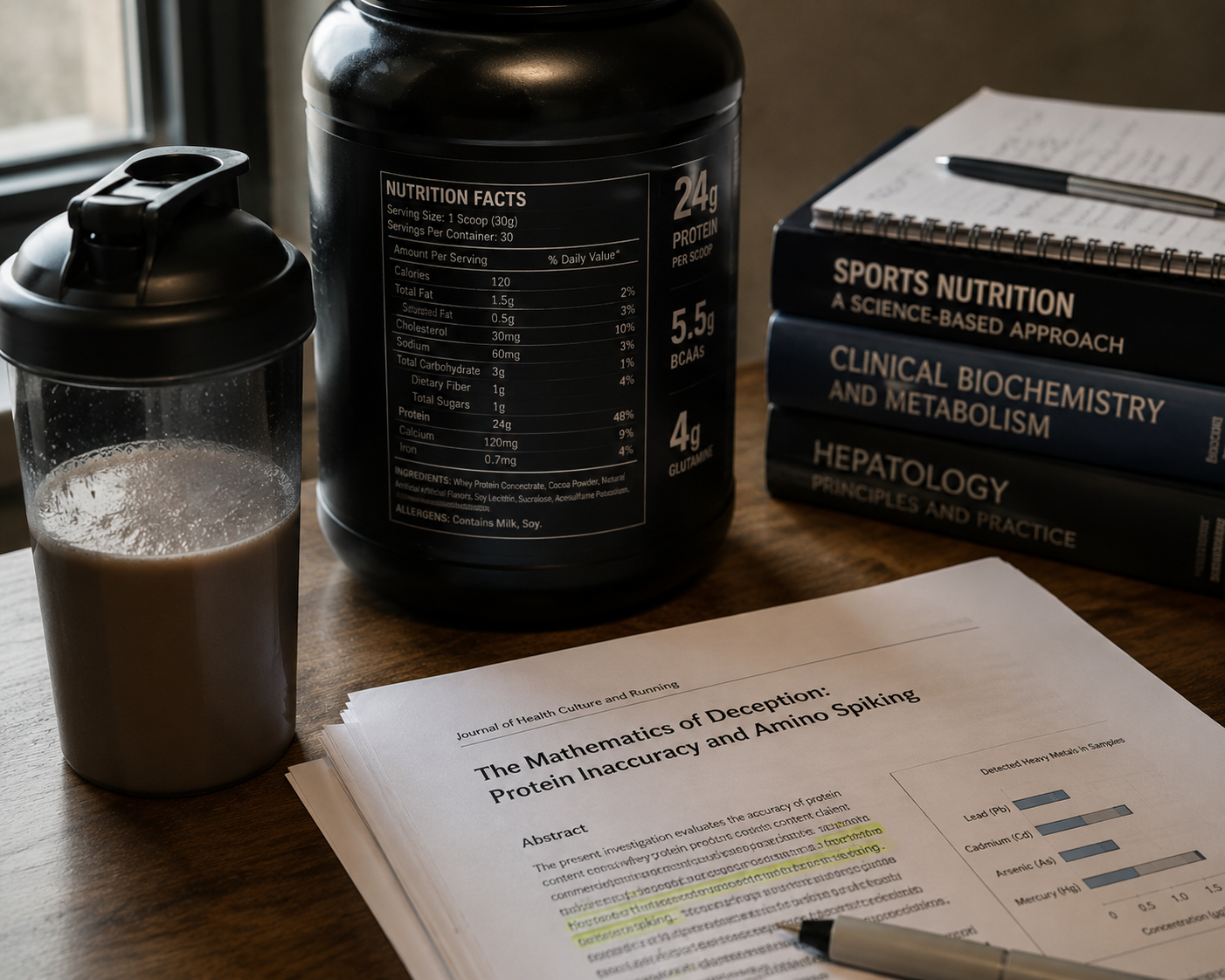
For an amateur runner training for a sub-four-hour marathon, recovery is quantified through macro-nutritional math. The runner calculates their daily requirement down to the gram, relying entirely on the back of the supplement label. If the tub reads "24 grams of protein per scoop," the runner builds their metabolic recovery around that metric. However, empirical chemical analysis reveals that this data is consistently fabricated.
In a groundbreaking, peer-reviewed collaborative clinical investigation led by independent hepatologists and public health scientists in India—colloquially known in medical journals as the Comprehensive Indian Protein Project—researchers gathered popular commercial whey protein brands sold across the country to conduct exhaustive laboratory analyses. The results shattered the marketing narratives of the Indian wellness market. Out of the top-selling commercial brands tested, a staggering 70% exhibited completely inaccurate protein declarations, with many containing less than half of the protein content stated on the label.
To hide this protein deficiency from basic regulatory checks, manufacturers employ a deceptive practice known as "amino spiking" or "nitrogen spiking." Standard laboratory tests used by basic food inspectors, such as the classic Kjeldahl method, do not measure actual intact protein structures. Instead, they calculate total nitrogen content and multiply it by a standard factor to infer the total volume of protein. To mathematically trick this equation, manufacturers fill their tubs with cheap, free-form amino acids like taurine, glycine, or creatine, or worse, non-protein nitrogenous compounds. When an inspector runs a basic test, the nitrogen spikes, and the product passes as a high-protein formulation. The formula for this mathematical deception can be conceptualized by observing how total nitrogen (Ntotal) is artificially inflated:
Ntotal = Nintact_protein + Namino_spikes + Nadulterant_fillers
Because the cost of pure, intact whey isolate is multiple times higher than free-form glycine or industrial fillers, the economic incentive to exploit this equation is immense. The runner, drinking their post-long-run shake, is not consuming the rich, bioavailable chain of branched-chain amino acids required to repair torn myofibrils; they are consuming an engineered chemical cocktail that is metabolically useless for muscular synthesis and profoundly taxing on the internal organs.
| Product Category (Tested Samples) | Protein Mislabeling Rate (%) | Detected Heavy Metals (Lead/Cadmium) | Undisclosed Herbal/Stimulant Additives |
|---|---|---|---|
| Commercial Nutraceutical Whey (n=16) | 70.0% | High (Exceeding Safe Limits in 45%) | Present in 38% of samples |
| Pre-Workout Performance Matrixes (n=12) | 83.3% | Moderate Traces Unlisted | Amphetamine Derivatives (58%) |
| Mass Gainers / Recovery Blends (n=15) | 64.0% | High (Arsenic/Lead presence) | High Sugar & Spiked Nitrogen |
| Medical-Pharmaceutical Powders (n=18) | 11.1% | Below Detectable Limits | 0% |
The Silent Destruction: Heavy Metals, Hepatotoxicity, and Liver Failure
The implications of this corporate negligence go far beyond financial fraud. For recreational runners who consume these products daily over months and years, the physiological consequences are catastrophic. The human liver acts as the primary metabolic clearinghouse for every substance ingested into the body. When an amateur runner floods their system with unsupervised, unverified supplement powders, the liver is subjected to chronic, low-grade toxic exposure.
Clinical data from top-tier Indian medical institutions, including the HCG Liver Clinic in Bangalore and Rajagiri Hospital in Kochi, indicate an alarming spike in Herb- and Dietary Supplement-Induced Liver Injury (HDS-DILI). Gastroenterologists and transplant surgeons are treating an increasing number of young, health-conscious fitness enthusiasts presenting with unexplained elevated liver enzymes, chronic hepatic inflammation, and acute-on-chronic liver failure. When alternative etiologies like viral hepatitis, autoimmune conditions, and alcohol consumption are rigorously excluded via clinical isolation, the only common denominator is the daily consumption of commercial supplement tubs.
The primary drivers of this hepatotoxicity are two-fold: toxic heavy metal accumulation and undisclosed pharmaceutical adulterants. Independent laboratory screenings of popular Indian nutraceutical whey powders have revealed dangerous concentrations of lead, cadmium, arsenic, and mercury. These heavy metals do not appear on any ingredient list; they enter the tub through contaminated raw ingredients, cheap soil-grown botanical fillers, and corroded industrial blending machinery. Over time, these metals accumulate in the hepatic parenchyma, triggering intense oxidative stress, mitochondrial damage, and cellular necrosis. Furthermore, to make their products feel more effective, some manufacturers intentionally spike their pre-workout and fat-burning matrices with undisclosed synthetic stimulants, such as ephedrine, sibutramine, or unlisted amphetamine analogs. The combinations of these compounds with high doses of concentrated herbal extracts create a toxic storm inside the liver's urea cycle, pushing the organ toward sudden, catastrophic failure.
"We have performed emergency liver transplantations on young fitness enthusiasts who suffered acute liver failure—not from lifestyle diseases, alcohol, or viral infections, but from the toxic accumulation of unsupervised, over-the-counter health supplements."
— Clinical Briefing, HCG Liver Clinic Bangalore (2026)
The Corporate Seduction: Digital Echo Chambers and Influencer Cults
If these products are so demonstrably dangerous and unregulated, why does the Indian amateur running community continue to consume them by the truckload? The answer lies in the highly sophisticated, predatory ecosystem of modern fitness marketing. The Indian supplement market is no longer driven by small neighborhood gym trainers selling tubs out of the trunk of their cars. It is powered by sophisticated multi-channel corporate conglomerates, venture capital funding, and algorithmic social media seduction.
Amateur runners are hyper-connected digital consumers. They live inside digital echo chambers dictated by Strava, Instagram, and running WhatsApp groups. Supplement brands exploit this connectivity by weaponizing "influencer culture." They do not hire traditional models; they sponsor respected community race pacers, amateur podium finishers, and charismatic wellness coaches who possess high trust metrics within local running chapters. When an amateur runner sees an elite local marathoner—someone who looks just like them, balances a corporate job, and runs a 3:15 marathon—crediting their performance to a specific brand of pre-workout or "organic plant protein," the psychological defense mechanisms drop entirely.
This marketing strategy intentionally targets the unique psychology of the amateur runner: the obsession with incremental optimization. Runners are obsessed with data metrics—heart rate variability, VO2 max, vertical oscillation, and split times. The supplement industry expertly maps its commercial products onto this data-driven mindset. They present their products not as luxury items, but as essential, scientific components of athletic engineering. The digital advertisements use advanced medical jargon, references to "clinical studies," and sleek CGI animations of cellular recovery to construct an illusion of scientific legitimacy. The amateur runner, anxious about failing to achieve a personal best in their upcoming winter marathon, looks at the tub and views it as an insurance policy. They conflate commercial polish with medical safety, completely unaware that the FSSAI license number printed on the bottom of the tub represents zero actual quality assurance.
The Elite Sieve and the Strict Liability Trap
There is a profound irony in how information about supplement contamination is distributed within the athletic hierarchy. Elite, professional Indian long-distance runners who train at national camps under the Sports Authority of India (SAI) are thoroughly educated on the dangers of supplementation. The National Anti-Doping Agency (NADA) and the World Anti-Doping Agency (WADA) enforce the uncompromising legal doctrine of Strict Liability. Under this international sports law principle, an athlete is solely and entirely responsible for any prohibited substance found within their biological samples, regardless of how it got there. If an elite runner tests positive for an anabolic steroid or an illicit stimulant due to a contaminated batch of an ordinary protein powder, their career is summarily destroyed. Ignorance of contamination is legally inadmissible as a defense.
Consequently, elite athletes are intensely paranoid; they undergo rigorous dietary monitoring and consume only specialized products that have been subjected to independent, batch-by-batch third-party chemical certification, such as the German Cologne List (Köln Liste) or Informed-Sport certification.
However, this protective circle of anti-doping education acts as an elite sieve, leaving recreational, non-elite runners entirely exposed. Because amateur marathoners do not undergo random out-of-competition urine drug testing, they operate with a false sense of absolute safety. No national athletic body holds seminars for the corporate running club in an IT park to explain that their mass-market protein powder could be cross-contaminated with banned performance-enhancing drugs or hepatotoxic compounds. The amateur runner is left completely alone to navigate a predatory marketplace, driven by an incorrect assumption that if a supplement were truly hazardous, the state would step in to remove it from the market.
The Path Forward: Systemic Reconstruction Over Consumer Awareness
The current response to this public health crisis from Indian regulatory bodies is profoundly inadequate. While the FSSAI has recently launched high-profile crackdowns on misleading label claims—targeting deceptive descriptions like "100% organic," "natural," or "zero additives"—these measures are merely aesthetic. Issuing a warning notice over marketing language on a cardboard box does absolutely nothing to stop a factory from releasing a batch of protein powder contaminated with heavy metals or laced with unlisted stimulants.
To truly protect the citizens of India from a looming epidemic of metabolic and hepatic injuries, the regulatory paradigm must be fundamentally reconstructed. The state cannot continue to outsource public safety to "consumer awareness" while allowing a multi-billion-rupee industry to operate on an honor system. A series of systemic policy shifts are urgently required:
1. Split the Legislative Classification: The FSSAI must decouple performance sports nutrition and highly concentrated dietary supplements from the broad category of ordinary food products. Any compound that is structurally engineered, concentrated, or marketed for metabolic and athletic optimization must be placed under a newly created, specialized regulatory tier—Sports Nutrition and Nutraceuticals Regulatory Division—possessing oversight mechanisms modeled after pharmaceutical standards rather than food packaging rules.
2. Mandatory Independent Batch-Testing: The state must mandate that no manufacturer can retail a sports supplement or concentrated protein powder without an independent, third-party laboratory clearance certificate stamped directly onto the packaging via a verifiable QR code. This batch-testing framework must explicitly screen for the presence of heavy metals (lead, arsenic, cadmium, mercury), fungal mycotoxins, micro-biological pathogens, and a standardized panel of WADA-banned stimulants and anabolic agents.
3. Implementation of Severe Criminal Liabilities: The penalty for amino spiking and intentional chemical adulteration must move beyond modest financial fines that corporate manufacturers treat merely as a cost of doing business. If a supplement company is caught intentionally fabricating macro-nutritional profiles or spiking fat-burners with unlisted pharmaceuticals, it must be treated as a criminal offense under the Indian Penal Code, carrying mandatory corporate license revocations and criminal prosecution for the board of directors.
4. Corporate Demystification and Independent Registries: Public health institutions and medical associations must collaborate to launch open-access, crowd-funded independent testing registries. If the state lacks the bureaucratic agility to test these products swiftly, the medical community must provide consumers with accessible, transparent chemical assay databases where any citizen can view the independent laboratory profile of a specific batch of protein powder before purchasing it.
Conclusion: Chasing Health on a Foundation of Sand
There is something deeply tragic about an amateur runner who wakes up in the middle of the night, pushes their body through grueling miles of physical exhaustion, and meticulously monitors their sleep and heart rate, all in the pursuit of absolute physical health—only to systematically poison their internal organs every single day with an unregulated chemical product. The Indian amateur running movement is a beautiful testament to human endurance, community solidarity, and a widespread cultural shift toward physical wellness. It deserves better than to be exploited by a predatory, unchecked industrial complex that views the runner's anxiety as a profit margin.
Until the day arriving when rigorous, unannounced, batch-by-batch chemical verification becomes the absolute legal standard in India, every amateur runner must step back from the digital marketing hype. True athletic optimization cannot be extracted from a beautifully polished plastic tub of questionable origin. It is built on a foundation of clean, whole foods, calculated recovery, and an uncompromising scientific skepticism that refuses to swallow what the supplement industry is selling. Until the state steps in to clean up the tubs, the golden rule of the Indian fitness movement must remain an uncompromising warning: Let the consumer, and the runner, beware.
Read Further
[1] Food Safety and Standards Authority of India (FSSAI). Health Supplements, Nutraceuticals, and FSDU Regulatory Framework — Official Category Standards and Amendments — Click here
[2] World Anti-Doping Agency (WADA). Strict Liability in Anti-Doping — Official Q&A on Athlete Responsibility for Prohibited Substances — Click here
Disclaimer: The investigative findings, clinical observations, and regulatory analyses presented in this article were compiled from independent laboratory studies, publicly available clinical hepatology reports, and official regulatory documentation. This article is intended for public health awareness and educational purposes only and should not be construed as medical advice, legal counsel, or specific product endorsement or condemnation.