

It's interesting, isn't it, how the venture capital world, and even those deep-tech growth equity folks, seem to get so fixated on just one part of the Indian space economy right now, in mid-2026? They're essentially equating the whole thing with launch vehicles and building satellite hardware. You see those slick videos, the ones showing a rocket firing its engines or a static test, and boom, suddenly it's all over the financial news. Investors pile in, offering these huge valuations right from the early stages, even for Series A funding.
But here's the thing that gets missed, the economic reality that gets buried under all the excitement about propulsion systems and getting things into orbit. Building rockets and custom satellites, that's a long game. It takes a massive amount of money upfront, and you often won't see any real commercial revenue for five, maybe even seven years, after you've spent all that capital.
Meanwhile, there's this whole other layer of the space economy that's quietly, steadily making money today. We're talking about ground stations, the infrastructure that manages communication with satellites, and then all the applications that use the data satellites collect. Think about agricultural insurance, tracking shipments at sea for maritime logistics, or keeping an eye on big infrastructure projects. These are areas where companies are already generating solid cash flow, but their valuations haven't really caught up to that potential yet.
So, why is all this money flowing into rockets when the ground and data applications are the ones actually bringing in cash right now? To really understand this, we need to look beyond the pretty pictures of rocket exhaust and actually examine how money is made across the commercial space industry in 2026. Research from places like the Indian National Space Promotion and Authorization Centre (INSPACe) and sector analysis from Arthur D. Little back this up. Their reports from early 2026 show that when you look at the global space economy's revenue potential, over 72 percent comes from downstream satellite data services and the ground segment infrastructure.
Now, consider a launch company. They get paid a fee, but only after they've spent hundreds of millions of rupees on research and development and the mission itself. Contrast that with someone running a ground station or a company that collects and analyzes Earth Observation data. They're earning predictable, recurring revenue year after year, on every bit of data that comes down from space. It's a fundamentally different business model. Yet, the private investment market seems to lump all of this together into one big "space-tech" category, ignoring these crucial differences in risk and return.
What this piece aims to do is move beyond the launch vehicle hype. We're looking at a specific research question for deep-tech: which companies in the ground station, spectrum-sharing infrastructure, and downstream satellite data application sectors are actually scaling their revenues in 2026? And more importantly, why is their potential return on investment, when you consider the risk, actually better than those focused on building things for space?
Why the Ground Segment Is Mispriced: The dūradarśana Illusion
The timing for this kind of analysis is pretty critical. India has made some significant changes to its Foreign Direct Investment (FDI) policies, part of the broader Indian Space Policy. Satellite data products, the ground segment, and user-facing applications can now receive up to 74 percent FDI through the automatic route (beyond that, government approval is required); the 100 percent automatic route is reserved specifically for the manufacturing of components and sub-systems for satellites and the ground and user segments. This has really opened the doors for businesses to adopt these technologies. By breaking down the space economy into these three distinct, investable areas, and by understanding the regulations around spectrum and data licensing, investors can actually start to capture the more immediate, lower-risk cash flows that everyone else seems to be overlooking.
There's a bit of an illusion at play here, a reason why the launch sector grabs all the attention. If we want to understand why capital markets are so drawn to rockets and tend to ignore the ground segment, we have to go back a bit in how we think about observation and connection. Think about ancient Indian administrative thought, like in Kautilya's Arthashastra. They had this concept called dūradarśana. It's a combination of "distant" and "vision" or "observation." The key takeaway is that the ancient strategists didn't actually focus on the messengers or the chariots carrying messages across the land. Their real focus was on the systems and institutions that gathered, understood, and acted on information from afar.
Fast forward to today, and the way Indian space-tech venture investing has evolved over the past few years seems to have flipped that ancient wisdom on its head. We're celebrating the "chariot" — the launch vehicle — while undervaluing the digital infrastructure, the dūradarśana, that actually turns raw data from orbit into something economically useful.
When you put the traditional model of building rockets and satellites side-by-side with the economics of modern downstream satellite data, the difference in how efficiently capital is used becomes really clear. Building rockets and satellites is dictated by the fundamental laws of physics and materials science. Creating a rocket engine capable of reaching orbit requires massive investments in physical assets, specialized testing facilities, and there's always a significant chance of setbacks during development. On the other hand, building ground infrastructure and the software layers that use satellite data operate much more like software businesses or public utilities. It's really interesting how the economics shift once you get these space ventures up and running. Imagine you've got this whole system in place, like a satellite antenna array all set to go, or maybe a slick cloud-native pipeline for handling all that geospatial data, now hooked into something like a farm lender's software. Once all that's integrated and commissioned, the cost of doing more? It practically vanishes, just shrinks down to next to nothing.
We're seeing some solid numbers coming out about this. By 2026, data from organizations like the Data Security Council of India and NASSCOM are predicting that startups focused on downstream space-data applications will be pulling in gross margins somewhere between 68% and 78%. And they hit that pretty quickly, usually within two years of getting their product out the door. Now, contrast that with the companies that are actually launching things into orbit. Even after managing ten successful flights, they're finding it tough to push their gross margins much beyond 18% to 22%. Big difference, right?
A Four-Part Framework for Mapping the Space Economy
So, how do institutional investors figure out where to put their money in this whole Indian space economy, aiming for precision? They need a solid way to break down the space layers. I've been thinking about a practical, four-part framework for this.
First off, you have Capital Intensity and Payback Horizon. This means separating out the projects that take a long time to pay back, like five to seven years, which is typical for research and development in things like launch vehicles or manufacturing. Then, you contrast that with the commercial payback cycles that are much faster, say eighteen to twenty-four months, like what you see with downstream data APIs.
Second, there's Customer Acquisition and Churn Velocity. Here, you're comparing the one-off deals, like government tenders for launches, against those really sticky, multi-year business-to-business contracts you get with software-as-a-service, or SaaS. Think about insurance companies or logistics firms — they're signing on for years.
Third, consider Regulatory Licensing Friction. This involves figuring out how much red tape a business has to cut through. Does it need really complicated approvals for launch safety and dealing with orbital debris? Or is it more about straightforward compliance, like where data can be stored and how it can be shared geographically?
And finally, Value-Capture Scalability. This is about how well a company can serve a huge number of users all at once from a single satellite pass without having to spend more money each time.
When you look at the space scene through this four-part lens, it becomes pretty clear that the part of the economy that's underneath the rockets, the layer that actually handles the data, is where the real potential is for venture growth, especially when you factor in the risk.
It kind of feels like the venture market right now is pricing Indian space companies as if the rocket itself is the ultimate goal, like it's the destination. But really, it's more like a delivery truck. They're missing the point that the real value, the economic rent, is actually captured by those ground antennas that are catching the data and by the algorithms that are doing the crucial work of pricing risk.
On the regulatory front, it's good to know there are a few key government bodies and industry associations that are centralizing information and processes for private sector participation. The IN-SPACe Digital Platform is a big one, acting as a single point of contact for everything from satellite authorizations to ground-station licensing. Then there's the Department of Space itself, which lays out the policy framework, and the DPIIT's Space FDI Portal, which is crucial for understanding foreign investment rules. The Department of Telecommunications handles the spectrum, which is obviously vital for any communication, and the Telecom Regulatory Authority of India (TRAI) is involved in consultations about spectrum pricing and licensing. NewSpace India Limited, or NSIL, is the commercial arm, handling demand-driven missions and partnerships. And on the industry side, the SatCom Industry Association of India (SIA-India) and the Indian Space Association (ISpA) are key players, publishing reports and advocating for the sector.
The Ground Segment: India's Equatorial Advantage
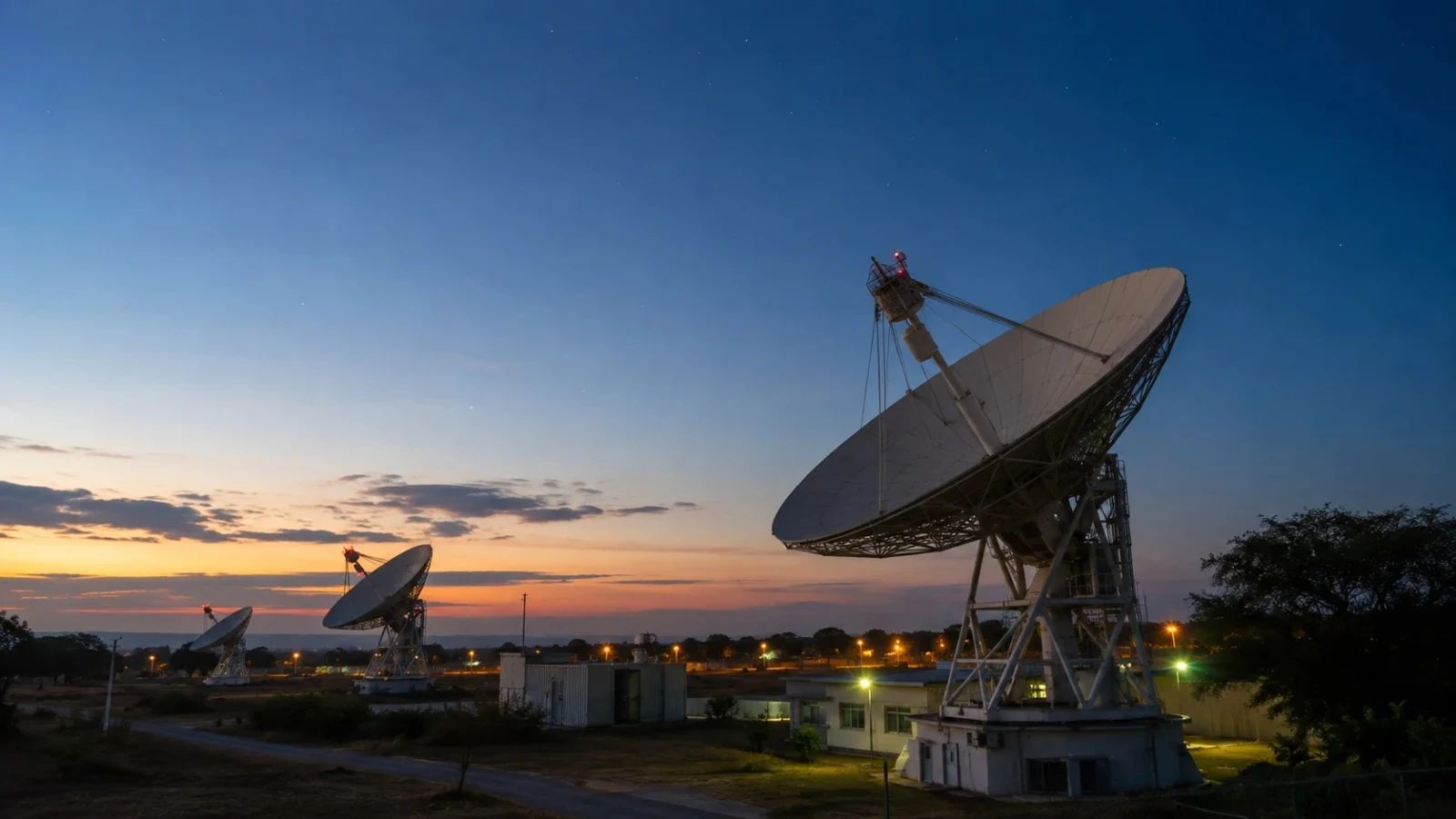
Digging a bit deeper, the entire foundation that makes all these downstream data applications actually work, the most reliable, infrastructure-like part of the space economy, is what we call the ground segment. While those rockets are busy launching satellites into Low Earth Orbit (LEO) and Medium Earth Orbit (MEO), those satellites are essentially useless from an economic standpoint if they can't reliably send their imagery and data back down to Earth. As more and more LEO constellations pop up, with thousands of active satellites expected by 2026, the global demand for ground station time has actually started to outstrip the available antenna capacity. And this is where Indian ground station operators have a really significant advantage, largely due to their geographical location near the equator.
India's geographic position, particularly its long stretch across the Indian Ocean, gives ground stations there a distinct advantage. Think about it: locations in places like Gujarat, Telangana, and Tamil Nadu can connect with satellites passing over the poles or the equator much more often than stations stuck way up north in Europe or North America. This extended reach really matters when you're trying to get data down from orbit.
Looking at the money side of things for commercial ground station providers and spectrum sharing outfits in 2026, their financial picture looks a lot more like a solid data center or a reliable fiber-backhaul business than a risky aerospace gamble. Companies that run these ground stations, like Dhruva Space, which has grown from building small satellites to offering complete ground-station-as-a-service solutions, are making their assets work for them. They, along with specialized providers of telemetry, tracking, and command (TT&C) infrastructure such as Ananth Technologies and Kawa Space, are essentially leasing out their capacity on long-term contracts backed by service level agreements. Industry research from 2026, put out by ISpA and Deloitte, suggests that setting up a modern, multi-band automated ground station in India might cost between 12 to 18 crore rupees upfront. But once it's hooked into global networks like AWS Ground Station or Microsoft Azure Space, it can pull in annual leasing revenues of 7 to 11 crore rupees. And the really interesting part? Their EBITDA operating margins are consistently sitting between 52 and 60 percent. This means these operations offer the kind of predictable cash flow you'd expect from essential infrastructure, but with the growth potential more typical of a venture-backed company.
For investors keen on diving into this "middle layer" of the space economy, understanding the companies that manage this crucial ground infrastructure requires a sharp focus. They need a kind of "ground-infrastructure scorecard" with four key areas.
First, you've got to check out Antenna Frequency and Bandwidth Versatility. Can the station handle simultaneous downlinks across X-band, Ka-band, and S-band? This is increasingly vital for those new high-resolution SAR and optical satellites.
Second, there's Optical Communications Readiness. Are these operators moving beyond traditional radio frequency dishes and adopting laser communication ground terminals that can handle gigabit-per-second data rates? That's the future of high-speed downlinks.
Third, Automated Pass-Scheduling Efficiency is crucial. This involves looking at the proprietary software that orchestrates satellite contacts, minimizing any wasted antenna time as satellites pass overhead in their various orbits.
Finally, Sovereign Spectrum-License Security is paramount. You need to confirm that the operator has clear, non-interfering authorizations from the Department of Telecommunications, whether for experimental use or commercial gateway operations.
Companies that really excel across all four of these points are the ones that essentially become the indispensable tollgates for the entire stream of data coming from orbit.
You can think of it this way: a satellite constellation without a robust network of automated ground stations, covering both high-latitude and equatorial regions, is essentially just a very expensive hard drive floating in space. The real power, and the economic control in this whole orbital data business, lies with the companies that manage the downlinks.
If you're interested in digging deeper into some of these players, here are a few places to start. Dhruva Space offers extensive technical and commercial details about their full-stack satellite platforms, solar arrays, and ground station infrastructure on their website. Ananth Technologies, a seasoned contractor in the Indian space sector, provides engineering and operational insights into their TT&C ground stations, avionics, and satellite integration capabilities. Kawa Space has research and API documentation for their automated mission control and geospatial downlink pipelines. Elena Geo Systems, a specialized firm, has whitepapers detailing their NavIC-enabled ground reference stations and precision positioning hardware. Even the big cloud players have their roles; you can find documentation on AWS Ground Station's global infrastructure and its integration with Indian operators, and Microsoft Azure Space outlines its frameworks for satellite data ingestion and ground station interconnectivity.
You know, when we talk about space, it's easy to get lost in the rockets and the big constellations. But there's a whole other side to it, a quieter but perhaps more immediately profitable one, that's happening right here on Earth, or at least, enabled by what's happening up there. Think about the International Telecommunication Union, the ITU. They're the keepers of the global master register. Everything from satellite network frequency filings, which is crucial for making sure satellites don't step on each other's toes with their signals, to how orbital slots are actually assigned. It's this incredibly detailed, almost bureaucratic, but utterly essential work that keeps the whole orbital system from descending into chaos. They also oversee the treaties that govern international radio-regulations, so when countries need to agree on how radio frequencies are used in space, the ITU is right in the middle of it.
Then you have the National Remote Sensing Centre, or NRSC, which is part of ISRO in India. This is more like the operational backbone. They're the primary hub for receiving satellite data down here. It's not just about catching the signal; it's about managing the ground stations themselves, coordinating aerial remote sensing efforts, and crucially, maintaining national geospatial archives. Think of it as the digital library and processing center for all the visual information we gather from orbit. Their work is fundamental for a lot of the applications we'll discuss.
The Downstream Application Layer: Where Data Becomes Revenue
Now, let's shift gears a bit and talk about where the real money is starting to flow, at least in the near term. It's not necessarily about launching more satellites, though that's part of the picture. The immediate, scalable cash flow is really emerging from the "downstream application layer." For a long time, the incredible data satellites capture was mostly locked away. Defense agencies and academic researchers were the main users, partly because the data was slow to arrive, incredibly expensive to license, and often came in formats that were a nightmare to work with. It wasn't exactly user-friendly for everyday businesses.
Advertisement
But things are changing, and fast. By around 2026, we're seeing a perfect storm of advancements. We have these new radar constellations, called SAR, that can see through clouds and operate day and night, providing high-revisit rates — meaning they pass over the same spot frequently. Then there's automated cloud processing, which means all that raw data can be crunched much more quickly without needing a supercomputer in your office. And layered on top of that are advanced machine-learning and computer vision models. These tools are turning those raw pixels from satellites into something businesses can actually use: decision-making APIs. It's like transforming a grainy photograph into an actionable report.
In India, this is particularly significant. Their agricultural sector is incredibly vulnerable to climate fluctuations — think droughts, unseasonal rains. And their logistics chains are vast, often crossing regions that aren't neatly formalized. This is where downstream space-data startups are really making inroads. They're securing substantial contracts with insurance companies, commodity traders, and even companies managing large shipping fleets.
To really grasp how quickly this layer is becoming valuable, let's look at crop insurance. Consider the Pradhan Mantri Fasal Bima Yojana (PMFBY) and similar private agricultural financing schemes. The old way of doing things was incredibly labor-intensive and slow. If there was a drought, or too much rain, or a pest infestation, insurance companies would have to send out thousands of human surveyors to farms. This process was not only agonizingly slow, often taking six months to a year to settle claims, but it was also prone to fraud.
Now, fast forward to today. We have these specialized geospatial analytics firms, some publicly listed, others backed by venture capital. Companies like SatSure, Pixxel (which uses hyperspectral data to get more detail than just visual information), and GalaxEye Space (working with multiple types of sensors) are providing continuous monitoring. They track things like the vegetative index of crops on a farm-by-farm basis. Imagine getting regular health updates for every field. According to industry reports from 2026, insurers in India that have adopted these automated satellite data feeds have seen their claim settlement times shrink dramatically, often to under twenty-one days. Not only that, but their costs for assessing those claims have dropped by about 45 percent. And how do these analytics providers make money? They charge insurers and banks a yearly subscription fee, typically between INR 150 to 300 per hectare monitored. This is a recurring software revenue model, and they achieve it without needing to own a single rocket or satellite launch service.
The same principle is playing out in logistics, both maritime and multi-modal. Downstream satellite applications are finding ways to monetize by providing intelligence about supply chains. Companies are combining data from satellite-based Automatic Identification System (AIS) — which tracks ships — with SAR coastal surveillance. This allows them to offer port operators and shipping lines real-time vessel tracking, predict how congested berths will be, and even issue alerts for compliance with regulations against illegal fishing.
So, if you're a venture investor looking at these downstream application startups, there's a specific framework you need to consider. It's not just about the cool technology; it's about the business model. There are four key areas.
First, the Raw-to-Refined Data Margin Lift. This measures how much extra value, and therefore price, they can charge by transforming raw satellite imagery into specific, predictive alerts. Can they take a picture and turn it into a reliable warning about crop damage or a potential shipping delay?
Second, Multi-Sensor Fusion Capability. This is crucial. Can their algorithms effectively combine data from optical sensors, hyperspectral sensors, and SAR? This is important for ensuring they have visibility 24/7, even when it's cloudy or during monsoon season.
Third, Existing Enterprise Software Integration. Do their data APIs actually plug into the existing systems that insurance companies or ERPs already use? Or do clients have to adopt a completely new, separate dashboard? Seamless integration is key.
And fourth, Customer Retention Across Commodity Cycles. This proves whether clients stick around even during good times — when weather is favorable and supply chains are stable. If customers renew their subscriptions during these periods, it shows the service has real, consistent value.
Startups that excel across all these dimensions are often the ones seeing the fastest growth in equity value within the space sector.
It really boils down to this: a raw satellite image is just a commodity. But a verified alert, telling an insurance underwriter that a large area of crops in a specific region has been irreversibly damaged just before harvest, that's a high-margin financial product. It's the intelligence derived from the data, not just the data itself, that's truly valuable.
And speaking of companies doing this well, SatSure provides some really interesting technical and commercial case studies. They're a leading Indian company focused on decision intelligence, essentially using satellite data to help banks, insurers, and climate resilience efforts make better choices. Similarly, Pixxel is at the forefront of hyperspectral Earth observation. They're using specialized satellites to detect anomalies related to chemicals, agriculture, and minerals, which opens up a whole other level of detail from orbit. They also have documentation and data access portals available.
You know, exploring the Indian space scene, especially the parts that touch agriculture and insurance, is a pretty interesting journey. You've got companies like Pixxel, an Indian startup pushing the envelope with their multi-sensor SAR and optical imaging hub, GalaxEye. They're all about creating synchronized datasets for all-weather monitoring, which sounds pretty crucial for understanding our planet better.
Then there's BlueSky, another deep-tech player focused on the insurance world. They've built a portal offering automated farm-boundary detection and flood-risk modeling, specifically tailored for Indian insurers. Imagine the kind of insights they can provide to help manage risks more effectively.
It's also fascinating to see how the regulatory side is shaping up. The Insurance Regulatory and Development Authority of India, or IRDAI, has a sandbox framework. This is a big deal because it's paving the way for insurance companies to actually start using satellite-based products, like parametric crop and disaster insurance.
The government is clearly involved too. The Ministry of Agriculture, through the Pradhan Mantri Fasal Bima Yojana, or PMFBY, has laid out technical and data standards. They're detailing exactly how remote-sensing and geospatial data need to be integrated for things like crop-cutting experiments and insurance underwriting.
And let's not forget the weather. The National Centre for Medium Range Weather Forecasting, part of the Ministry of Earth Sciences, is a key institution. They're providing satellite-derived numerical weather prediction models and atmospheric data feeds that are essential for these agri-tech startups.
Looking beyond India, Spire Global is a global player offering APIs for maritime AIS and satellite weather data. They demonstrate how space-based data, like AIS tracking and radio-occultation, can be monetized in maritime logistics and supply chains. Their documentation is at spire.com.

Regulatory Risks: Spectrum, Data Residency, and Foreign Dependency
Now, all this innovation, especially in downstream space infrastructure, comes with its own set of challenges. It's not always a smooth ride, and we need to be realistic about the hurdles. Any serious investment in this area has to consider the regulatory roadblocks, the debates around spectrum, and the very real risks associated with getting commercial products adopted. A common pitfall for venture funds is assuming that the ground and application layers of the space economy will behave like frictionless software. That's just not the case. There are significant, and evolving, regulatory battlegrounds that can really impact valuations.
At the heart of these issues are two main areas: the frameworks for spectrum allocation, governed by the Telecommunications Act, and the norms around disseminating foreign satellite data, which are managed by entities like IN-SPACe and the Ministry of Defence.
One of the most pressing concerns is the ongoing discussion about how satellite gateway and ground-station frequencies should be allocated. Should it be through administrative processes, or should it involve open auctions? While India's Telecommunications Act of 2023 does include provisions for administrative allocation, aligning with international standards, the specifics around pricing, ongoing spectrum usage charges, and how to manage interference between new satellite networks and existing terrestrial 5G/6G systems are still quite contentious, even now. If the Department of Telecommunications decides to impose hefty administrative fees or limit the ability of different commercial operators to share ground-station frequencies, the economics of offering Ground-Station-as-a-Service could really suffer.
Beyond spectrum, downstream Earth observation companies also face continuous regulatory oversight. This comes under the National Geospatial Policy and the authorization rules set by IN-SPACe. Although there have been some relaxations on data resolution limits, getting approval for high-resolution SAR and hyperspectral data from foreign-owned satellites still requires thorough compliance audits. This is to ensure that sensitive defense installations aren't inadvertently imaged.
For venture-growth investors looking to invest in space tech, it's crucial to rigorously assess these companies against these regulatory and adoption challenges. A four-part risk-mitigation framework can be really helpful here.
First, an audit of spectrum licensing cost elasticity. This means modeling how a company's profit margins might hold up if recurring spectrum usage fees jump by, say, 300 basis points over the life of the investment.
Second, verifying sovereign data residency compliance. This ensures that all downloaded imagery and any derived agricultural analytics are processed and stored on domestic cloud servers that comply with the Digital Personal Data Protection Act.
Third, tracking enterprise sales-cycle latency. This involves measuring whether potential buyers in traditional sectors like logistics or state agricultural departments are actually signing long-term SaaS contracts or just getting stuck in pilot programs.
And fourth, assessing foreign constellation dependency risk. This means evaluating if a downstream analytics firm is overly reliant on a single foreign satellite provider, whose ability to operate or land data might be impacted by geopolitical shifts.
Companies that can successfully navigate this four-part stress test are likely to be the more resilient and scalable players in the commercial space economy. Ultimately, the robustness of a downstream satellite application hinges on its spectrum authorization and its adherence to data residency rules. Relying too heavily on foreign orbital landing rights without hedging that risk can seriously hamper even a high-margin business.
Key Regulatory and Industry Resources
On the regulatory front, the Telecommunications Act of 2023 is quite significant. It's the official law that lays down the groundwork for how satellite spectrum is allocated, the rules for getting administrative licenses, and the regulations for our national telecommunications infrastructure. You can find the full text of this act on the Department of Telecommunications (DOT) website.
Then there's the National Geospatial Policy, put out by the Ministry of Science & Technology. This policy is all about liberalizing how we acquire, survey, and map geospatial data. It also carves out certain sensitive areas where private companies might face restrictions for their operations.
When it comes to data, the Digital Personal Data Protection (DPDP) Act is crucial. The Ministry of Electronics and Information Technology (MeitY) has a portal that details how companies need to comply, especially concerning cloud storage and how spatial data is processed. This act lays down the law for data residency, meaning where your data needs to be stored.
The Indian Space Research Organisation (ISRO) also plays a vital role, particularly with its technical guidelines on Orbital Debris and Space Situational Awareness. They have sovereign monitoring frameworks in place to manage space traffic and prevent collisions, which is especially important for operators in Low Earth Orbit (LEO).
Looking at the industry side, NASSCOM, specifically its Deep-Tech & Space-Tech Startup Council, offers a valuable repository. They provide data for industry benchmarking, share their submissions for policy advocacy, and conduct surveys on how enterprises are adopting these technologies. This gives us a good sense of the traction commercial space data is getting within Indian businesses.
For cybersecurity in this sector, the Data Security Council of India (DSCI) has developed a Deep-Tech Cybersecurity Framework. This outlines best practices and auditing standards to protect things like ground-station downlink terminals and cloud-based satellite data lakes from cyber threats.
The Ministry of Defence (MoD) also has its own set of regulations regarding Geospatial & Remote Sensing Security Clearances. These are sovereign guidelines that cover restricted imaging zones, rules for disseminating high-resolution Synthetic Aperture Radar (SAR) data, and overall national security oversight.
On a global scale, the International Astronautical Federation (IAF) Commercial Space Policy Monitor provides insightful research. They publish comparative analyses across different countries regarding satellite licensing, spectrum rights, and the commercialization of the space economy.
The Venture Capital Reckoning
Now, shifting gears a bit to where the money is going, let's talk about venture capital and the space economy. By mid-2026, as India's private space sector matures, the venture capital ecosystem focused on deep tech is at a significant turning point. The early days of the commercial space revolution saw a lot of generalist investors, quite fascinated by the sheer physics of space, pouring unconditional seed capital into any ambitious launch vehicle project. That phase seems to be winding down.
We're now moving into a period where institutional investors are conducting much more rigorous underwriting. The key metrics are becoming the timeline to generate commercial cash flow and how efficiently capital is being deployed, which directly impacts valuation multiples. If we continue to channel, say, 80 percent of private space capital into long-term, capital-intensive launch hardware, we're essentially ignoring the fundamental economics of the entire space value chain. Rockets will always be the exciting, essential means of transportation to space, but they aren't where the most sustainable investor returns are typically found.
For those investing in deep tech, venture-growth funds, or even specialized capital like agri-tech or insurance funds, the investment strategy really needs to shift towards the ground segment and the downstream applications built on top of it.
References & Further Reading
- The Indian Space Industry: Key Regulatory and Policy Developments from 2024 — Trilegal
- India's Space Economy Could Potentially Touch $100 Billion by 2040, Says New Global Report — Business Today (Arthur D. Little Report)
- Propelling India into a New Era of Space and Innovation — KPMG India
Disclaimer: All data provided above was sourced from publicly available internet resources and research. This should not be taken as professional financial, medical, or legal advice.
Advertisement