


Every year around March, a quiet national phenomenon occurs across the Indian subcontinent. Playgrounds grow silent, running tracks empty out, basketball hoops lose their nets, and millions of teenagers step into a state of structural house arrest. Society looks at this mass evacuation of outdoor spaces and gives it a highly sanitized, culturally celebrated label: Board Exam Preparation. For decades, this migration from the field to the study desk has been viewed as a necessary, character-building rite of passage. It is framed as the ultimate sacrifice required to secure economic stability in a hyper-competitive, developing market. However, a deeper analysis of data, systemic drop-out points, and physiological development trajectories reveals a far more sinister reality. India is not merely preparing its youth for academic success; it is systematically executing a structural cull of its domestic athletic talent. By forcing young adults into a binary, zero-sum choice between physical development and academic credentialism exactly when their physiological potential peaks, the Indian state and its cultural apparatus have broken generations of athletes. We have traded global athletic supremacy, physical robustness, and billions of dollars in sport-driven economic infrastructure for millions of identical, chronically stressed, hyper-specialized test-takers.
The Chronological Collision: Peak Physiology vs. Structural Extermination
The primary tragedy of the Indian academic system is that its structural bottlenecks collide perfectly and destructively with human biological maturation. In sports science, the ages between 14 and 18 are recognized as the critical window for motor skill refinement, aerobic base consolidation, and the neuromuscular adaptation required for elite performance. It is the time when the human body transitions from raw childhood movement into structured, high-intensity athletic efficiency.
In India, this exact chronological window is aggressively occupied by the Class 10 and Class 12 Board Examinations, immediately followed by hyper-intensive engineering (JEE) and medical (NEET) entrance filters. The collision is catastrophic. Just as a young sprinter, swimmer, or footballer requires an escalation in training volume and deliberate practice, the societal apparatus demands an absolute cessation of physical activity.
92% — Athletic attrition rate (ages 14–17)
65% — Reduction in weekly physical activity
1 in 4 — Adolescents facing lifestyle disorders
The numbers paint a bleak picture of this transition. Studies tracking youth athletic retention rates indicate that over 90% of children who actively participate in school-level sports up to the age of 13 completely abandon structured athletic development by the time they hit the 10th standard. This is not an organic drop-out driven by a loss of interest or lack of talent; it is an artificial, policy-driven structural extermination.
When a child is pulled from a sport for two consecutive years to memorize equations and practice mock tests, the physiological cost is non-refundable. Neuromuscular pathways degrade, cardiovascular VO2 max drops significantly, and the fast-twitch muscle fiber composition built through years of early childhood play reverts. You cannot hit pause on the human body at 15 and expect to resume elite-level training at 18. By the time the exams are over, the athlete is biologically dead; only the student remains.
"Spend consciously on physical health and invest intentionally in structural balance. A nation that locks its children indoors for 16 hours a day is purchasing short-term test scores by mortgaging its long-term biological vitality."
The Western Model vs. The Rote-Learning Bottleneck
To understand how fundamentally broken the domestic approach is, one only needs to compare it with the structural development tracks of global athletic superpowers like the United States, China, or Western Europe. In these regions, academic progression and athletic development are built to be synergetic or structure-dependent, rather than mutually exclusive. In the Western framework, the collegiate sports ecosystem (such as the NCAA in America) acts as a highly lucrative, socially prestigious bridge to professional athletics. A high school athlete in the United States does not have to abandon their sport to get into Stanford or Harvard; their sport is quite literally the golden ticket "into" those institutions. The system acknowledges that physical mastery and intellectual capacity can co-exist within the same individual.
| Dimension / Metric | Western / Developed System | The Indian Academic Filter |
|---|---|---|
| System Dynamic | Integrative & Portfolio-Driven | Reactive & Exam-Dependent |
| Peak-Age Alignment | Collegiate pipelines match biological peaks | Board filters dismantle physical development |
| Talent Retainment | ~68% retention through school-to-college | <8% retention post-10th standard |
| Institutional Support | Scholarships, world-class gyms, flexible credits | Attendance penalties, zero-yield sports quotas |
| Cultural Paradigm | Sports as an economic & social elevator | Sports as a dangerous, zero-sum distraction |
Conversely, the Indian system operates entirely on an extreme, reactive model of elimination. Because our universities rely almost exclusively on singular, monolithic cut-off percentages or centralized entrance ranks, a portfolio of holistic achievements carries near-zero structural value. A student who places first in a national swimming championship but scores 82% on their board exams is systematically locked out of elite domestic higher education, while a sedentary student with 99% is celebrated.
The cultural messaging this sends to parents is unequivocal: Sports have a negative return on investment (ROI). It is viewed as a high-risk gamble with a 99.9% failure rate, whereas spending ten hours a day at a coaching institute in Kota or Hyderabad is perceived as a low-risk, predictable path to white-collar security. Consequently, parents act completely rationally within a broken system when they confiscate their children's sports kits.
The Economic Illusion: The High Cost of Paper Degrees
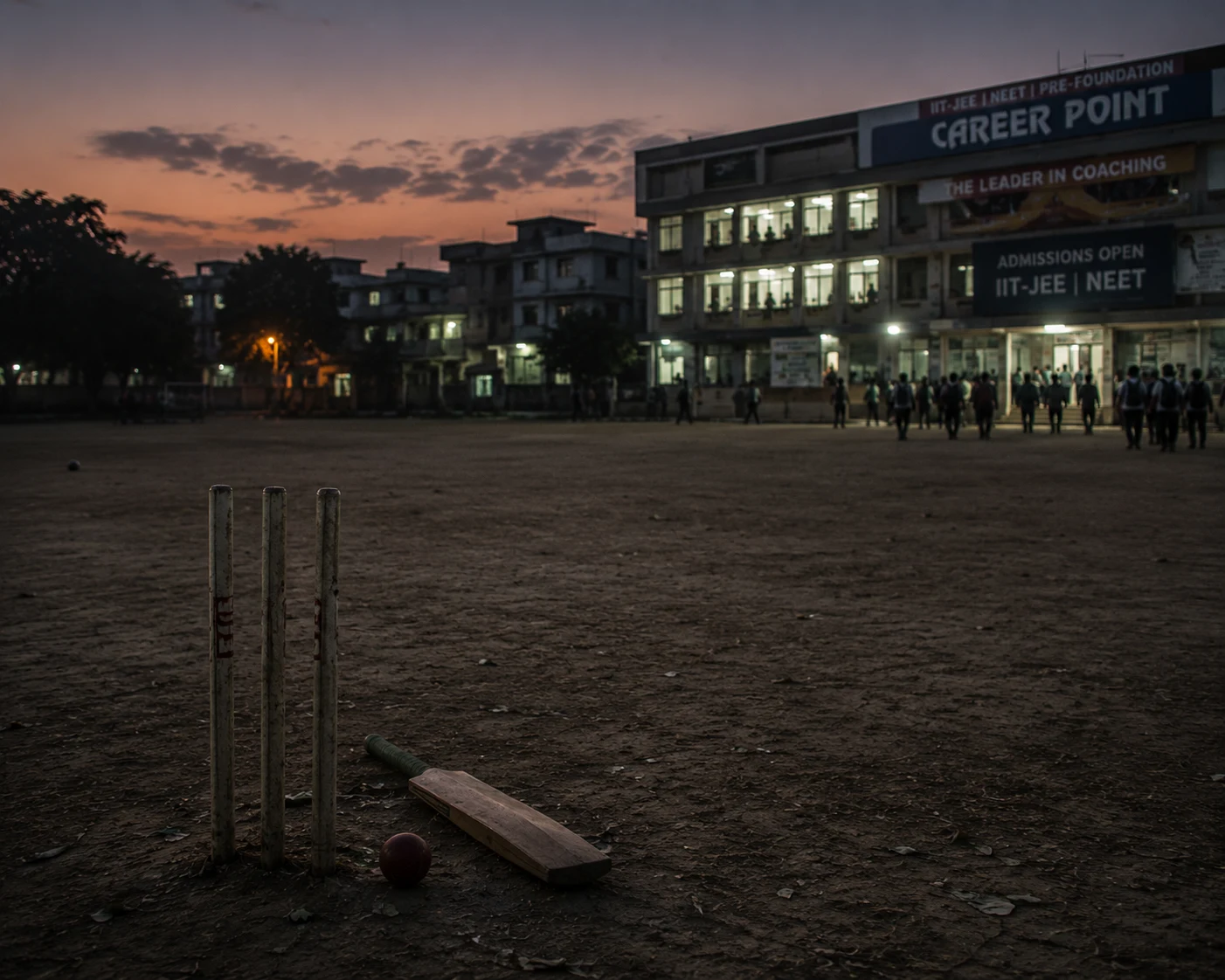
The justification for this hyper-fixation on exam scores has always been financial survival. In a nation without a comprehensive social safety net, a stable job in tech, medicine, or civil services is seen as the only bulwark against generational poverty. But this economic formula, which may have worked during the late 20th century, has broken down completely in the modern landscape, creating an immense, systemic misallocation of capital.
Advertisement
India's corporate sector is currently experiencing an unprecedented crisis of mass underemployment and unemployability. Multiple national employer surveys indicate that a substantial share of engineering graduates are unfit for modern technical roles without extensive corporate retraining. We are sacrificing our youth's health to acquire degrees that the market increasingly treats as low-value paper credentials.
Meanwhile, the global sports economy has expanded into an absolute juggernaut—encompassing media rights, sports medicine, fitness infrastructure, event management, and talent coaching. By suppressing the sports ecosystem, India has missed out on developing a massive domestic industry that could employ millions. Instead of building a vibrant, multi-billion-dollar sports sector, we have built an aggressive, parallel shadow education industry consisting of coaching centers that extract billions from families while producing immense psychological trauma.
"When you automate calculations through software, raw data processing becomes a commodity. But physical mastery, kinetic intelligence, and real-world resilience cannot be generated by a machine. We are training our youth to do what software does best, while destroying what humans do best."
The financial math of the current setup is fundamentally broken. Parents spend hundreds of thousands of rupees on private tuitions and entrance coaching, only for their children to face an underemployed corporate market. If even a fraction of that capital and disciplined focus were channeled into structured athletic development pathways, it would unlock entirely new economic opportunities, creating sustainable livelihoods across coaching, scouting, analytics, and professional competitions.
The Invisible Epidemic: Deconditioning and Mental Trauma
Beyond the loss of international medals and the economic waste, the most devastating consequence of this systemic obsession is the silent health crisis it inflicts on the general population. The human cost of removing an entire generation from physical spaces is paid out in long-term public health bills and widespread psychological trauma.
Medical data from the subcontinent reveals an alarming explosion in non-communicable lifestyle conditions among young urban Indians. Cases of juvenile diabetes, early-onset hypertension, polycystic ovary syndrome (PCOS), and severe postural deformities have risen sharply over the past two decades. The root cause is directly traceable to the structural deconditioning that occurs during the critical adolescent years when children are confined to desks for upwards of 14 hours a day.
This physical lockdown is accompanied by an unprecedented crisis in adolescent mental health. The competitive pressure of board exams and entrance filters creates a permanent state of high-cortisol stress. Lacking physical exercise—the primary biological mechanism for stress regulation and endorphin release—young students experience high rates of anxiety, clinical depression, and burnout. We have created a society where young people are taught to view their own bodies not as instruments of power, joy, and movement, but as mere life-support systems for a brain trying to pass an exam.
The Illusion of "Fit India" Campaigns
While macro-level state public relations heavily promote initiatives like the "Fit India Movement" or celebrate sporadic Olympic medals, the micro-level infrastructure tells an entirely different story. The average Indian school treats the designated physical education (PE) period as an optional luxury—a block of time that is regularly hijacked by math or science teachers looking to complete their syllabus before the exams. The message to the child is reinforced at every level:
"Your physical health is entirely disposable."
When an Indian athlete does manage to succeed on the global stage, it is almost always "in spite" of the system, rather than because of it. It is usually the result of extraordinary parental isolation, where a family completely detaches themselves from the traditional educational track, often risking their financial security to support their child's training. This is not a sustainable talent pipeline; it is an exceptional lottery system.
Reclaiming the Playground: A Structural Manifesto
If India is to transition from a nation of spectators into a true global sporting superpower, it must completely dismantle the false dichotomy between the desk and the field. This requires deep, structural changes that alter the incentives driving parental choices and school policies.
First, the country must move away from its absolute reliance on single-metric academic filters. Higher education institutions must adopt holistic admission matrices where certified athletic performance, physical fitness scores, and long-term participation in structured sports carry clear, non-negotiable credit weight. When an athletic portfolio becomes a valid pathway into an IIT, an IIM, or a central university, parental incentives will shift overnight.
Second, the school system needs a major policy shift regarding the structure of the academic day. Physical education must be integrated into core grading criteria, and schools should be legally barred from substituting sports periods for academic catch-ups. Furthermore, regional sports clubs must be established to operate independently of school boards, ensuring that a student's athletic journey can continue smoothly even during exam seasons.
Finally, there must be a cultural shift in how we define intelligence and success. Kinetic intelligence—the mastery of movement, spatial awareness, physical resilience, and deep strategic teamwork—must be recognized as just as valuable as logical-mathematical scoreboards. A healthy, physically robust nation with a strong sports infrastructure is far more resilient than an anxious, sedentary population holding paper degrees. It is time to throw open the gates, unlock the school yards, and return the playgrounds to our children. India cannot run toward its future on a broken leg.
Read Further
[1] Statista / Wheebox. Employability Among Engineering Graduates in India, 2014–2024 — Click here
[2] Fit India Movement, Ministry of Youth Affairs & Sports, Government of India. Official Fit India Movement Portal — Click here
Disclaimer: This article is synthesized based on extensive educational data, public health surveys, and comparative international athletic development templates. The views expressed herein represent a structural critique of existing systemic frameworks and do not constitute specific career, financial, or academic advice.
Advertisement