


In an age where everything is subject to scrutiny, analysis, and forecasts generated by sophisticated algorithms, neural network performance matrices, and automated tracking systems, the game of international cricket now finds itself at a historical crossroads. We have turned to data-analytics platforms and algorithmic schedulers' predictive models. This change of pace is apparently greatly beneficial to corporate stakeholders and broadcasters attempting to sell as much prime-time television inventory as possible, and is apparently going to completely undermine the romanticism and organic narrative of the sport. It was played on instinct and natural flair and long-term tactical rigidity, but as we increasingly consign tactical concepts to real-time machine-learning applications and algorithmic outlook matrices, we don't know where we actually lost the traditional soul of the craft.
This all-encompassing article is going to get you all up to speed on what to do with the modern systemic evolutions and what to do with the authentic, original, traditional methods of cricket curating, bilateral patience, and team-based evolving. We will reveal how global tournaments, multi-format series, and regional franchise networks are converging, transforming the very fabric of the international cricketing ecosystem as we dig deeply into the enormous data trails of 2026.
The Global T20 Revolution and the Automated Expansion Matrix
With 2026 featuring massive international tournaments, the growth of global short-format cricket has never been greater. The International Cricket Council (ICC) is all-in on data-driven, hyper-monetized models geared toward growing the game in non-traditional markets, mainly the Americas, Europe, and parts of East Asia. The just-completed ICC Women's T20 World Cup in June/July 2026 offers a spectacular case study of high-stakes tournament frameworks in this new era.
The tournament concluded on July 5, 2026, at the legendary Lord's Cricket Ground, London, where powerhouse Australia Women won yet another title by beating the England Women's national cricket team by 7 wickets, chasing a competitive target of 151 with 17 balls to spare. England had posted 150/4 in 20 overs, anchored by Nat Sciver-Brunt's unbeaten 58 and Freya Kemp's 44. Australia's chase was powered by Beth Mooney's composed 64 off 49 balls and Phoebe Litchfield's explosive 48 off 35, as the pair put on a 100-run partnership to seal Australia's seventh ICC Women's T20 World Cup crown. Beth Mooney was adjudged both Player of the Final and Player of the Tournament — becoming the first player to win both awards twice.
At the same time, the sport's currents are tilting hard toward automated sub-regional qualifiers based on tightly packed windows of scheduled competition. July 2026 has been the venue for the ultra-competitive 2026 Men's T20 World Cup Europe Sub-regional Qualifier B tournaments in Denmark at fine venues including the Køge Kricket Klub and Svanholm Park in Brondby. In these group stages, the margins for error are razor-thin, and electronic data centers chase anything from net run rates to individual ball trajectory vectors. We are treated to amazing contests such as Hungary edging Estonia by 6 runs after making 132 runs, or Romania holding on for a 1-wicket win against Gibraltar after hitting with only 5 balls left.
Key Match Profile: ICC Europe Sub-regional Qualifier B (July 2026)
Fixture: Hungary vs Turkey · Venue: Svanholm Park, Brondby · Result: Hungary won by 20 runs (DLS). Hungary scored 164/6 in their full 20 overs, highlighted by a brilliant match-winning show by Mohammed Maaz Bhaiji, who also earned the Player of the Match award. Turkey's innings was heavily disrupted by the weather, and they were left stranded at 30/5 in 5 overs when the DLS method determined the final adjustment.
This relentless expansionism signifies that international structures are beginning to behave more like broadcast content networks. Schedulers use predicted optimization variables to maximize television revenue from distant time zones, creating tournaments that are nearly overlapping, where human players are optimized assets rather than sportsmen. While this financial robustness gives smaller boards the ability to grow and improve, it brings into focus the important question: is there too much T20 cricket?
"Play instinctively and schedule intentionally."
The Resurgence and Struggle of Traditional Bilateral Series
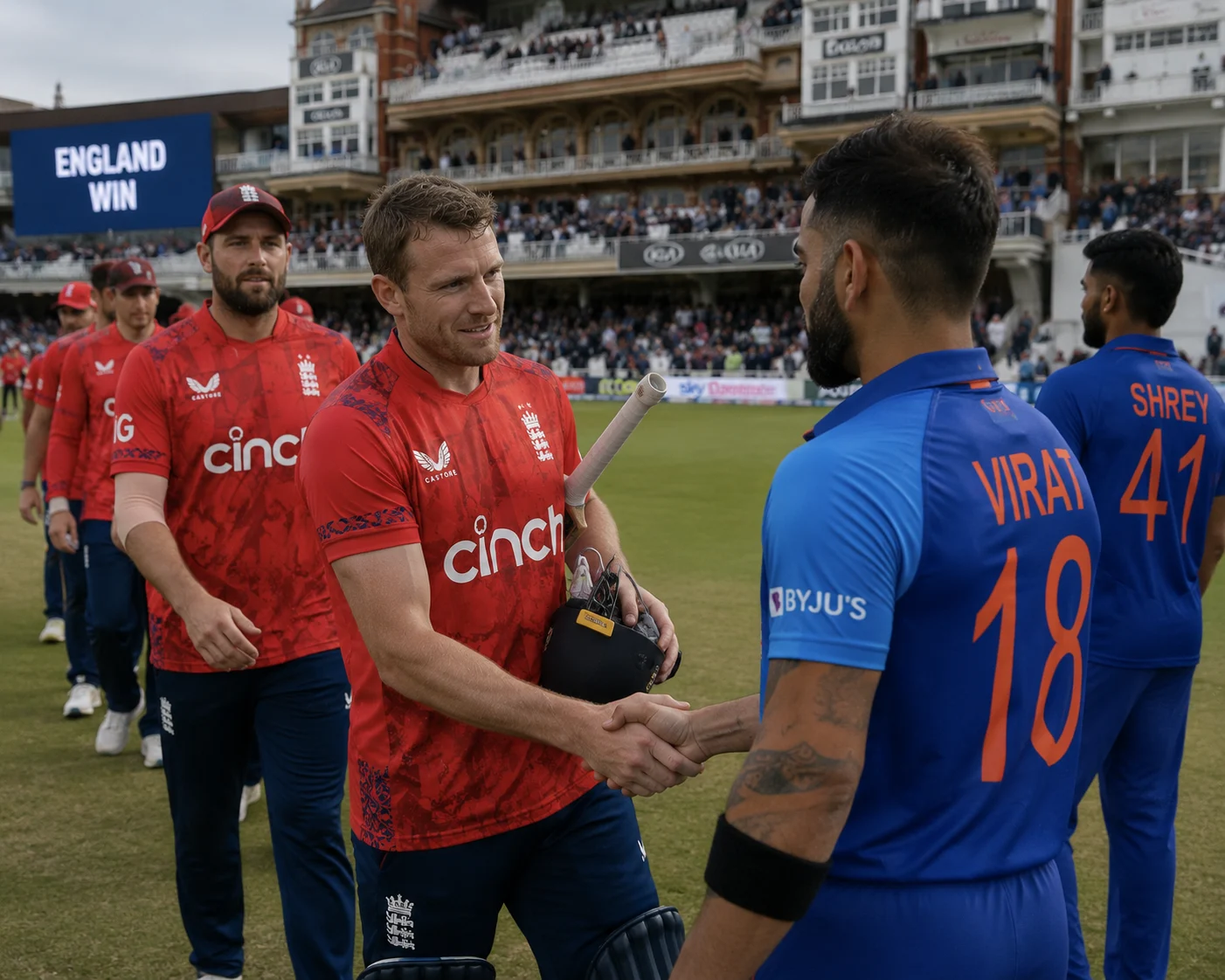
While multi-nation tournaments make billions for the global regulator, the crux of cricket's cultural legacy is bilateral tours. But with 2026 looming, the bilateral schedule is being squeezed by franchise leagues and tournament qualifiers. A notable instance is the charged bilateral contest between the England cricket team and the India national cricket team, the dramatic conclusion of which took place on July 11, 2026, at the Utilita Bowl. England won the 5th T20I by 57 runs, securing the series 3–2. India were eventually limited to 201/8, giving England a comprehensive 56-run success. England captain Jos Buttler was magnificent, striking an incredible 131 runs off a mere 64 deliveries and was adjudged Player of the Match.
At the same time, women's cricket continues to illustrate the great beauty of multi-format bilateral series that are rooted in patience and tactical adjustment over the course of multiple weeks. In the ongoing India Women's tour of England, the historic Test at Lord's Cricket Ground has become a tactical clinic on the divergent nature of tactical disposition between the instantaneous short format and the long-form survival game. In the first innings, India Women declared at an imposing 341/7, thanks to an outstanding all-round show by Deepti Sharma, who scored a brilliant 57 off 87 deliveries and bowled with great discipline, giving away only 10 runs in her first spell. Alongside her, pace bowler Sneh Rana applied unrelenting pressure from the Nursery End and sent back crucial wickets to chip away at England's middle order. England found some answers through exceptional staying power from Amy Jones, who battled for 52 runs off 62 balls, and the extraordinary Sophie Ecclestone, who took 5 wickets in the second innings.
This protracted confrontation is a stirring testament to what cricket resembles when it is taken away from the synthetic speeding-up process and is allowed to transpire naturally over the course of days. However, these long-form contests are turning into an endangered species. Outside the three big boards (India, England, and Australia), bilateral series are often abbreviated to cut costs, replacing Test matches with three-match T20I series. The just-concluded series of the Bangladesh national cricket team against the Zimbabwe national cricket team at Harare Sports Club witnessed the total exclusion of a Test match. The tour concluded on July 11, 2026, with Bangladesh clinching the final ODI by 7 wickets to seal the series 2–1, chasing down Zimbabwe's score of 199 runs, with Tanzid Hasan scoring an unbeaten knock. Though these white-ball games add instant gratification, they deprive national teams of the structural discipline required to build long-term red-ball capabilities.
Franchise Leagues vs National Duties: The Modern Player's Dilemma
The growth of domestic franchise cricket has dramatically changed the financial dynamics of the game. The Indian Premier League (IPL) showcased its unmatched financial strength in early 2026, being held from late March to end May. The tournament saw breathtaking high-scoring matches, as modern analytical coaching staffs employed algorithmic boundary-optimization data in dictating batting strategies. IPL 2026 concluded on May 31, 2026, at the Narendra Modi Stadium, Ahmedabad, in a nail-biting climax where Royal Challengers Bengaluru finally ended their title drought with a memorable 5-wicket win over the well-disciplined Gujarat Titans. The legendary Virat Kohli anchored the chase to perfection, adding another legendary chapter to his career, while emerging domestic talent Vaibhav Sooryavanshi and global superstars like Mitchell Starc and Kagiso Rabada dominated the tournament's headlines.
Even so, the rapid expansion of these lucrative T20 leagues has led to a clash of priorities with national team calendars. Players are perpetually caught in that cycle of leaping from one franchise bubble to the next, leaving them exhausted physically and mentally. Prioritizing franchise over national commitments has become the norm, causing a continual tension between player associations and national cricket boards. The effects are clearly visible: star bowlers are increasingly skipping arduous international Test tours to save their bodies for short-format leagues, while younger batters are changing their fundamental techniques to fit immediate boundary-hitting needs, forsaking the classic defense mechanisms that have long been the pillars of international longevity.
| Tournament / Series (2026) | Key Venue | Champion / Winner | Standout Performer | Format Impact |
|---|---|---|---|---|
| Indian Premier League 2026 | Narendra Modi Stadium | Royal Challengers Bengaluru | Virat Kohli | High boundary optimization; high financial dominance |
| ICC Women's T20 World Cup | Lord's Cricket Ground | Australia Women | Beth Mooney | Global visibility peak; clinical tactical execution |
| England vs India Bilateral Series | Utilita Bowl | England Men (5th T20I) | Jos Buttler (131 off 64) | Extreme strike-rate acceleration; power-hitting evolution |
| West Indies vs New Zealand ODI | Providence Stadium | West Indies Men | Keacy Carty | Classic mid-innings building vs modern aggressive intent |
The classic international cricket setup was built around the idea of institutional loyalty and national representation. Today the system is one of international commerce, with players assuming the role of independent contractors. This is freeing players to be compensated for the real value they represent as athletes, but it also shatters the continuity of international teams and turns bilateral series into makeshift affairs with constantly changing line-ups that depend on franchise availability windows.
Detailed Statistical Analysis and Key Performers of the 2026 Season
To grasp the tactical direction of modern cricket in full, it is necessary to traverse through specific empirical data gathered from major international circuits in mid-2026. The development of strike rates, bowling economies, and venue data exposes a sport being fine-tuned for speed. In the Caribbean, the West Indies cricket team made an interesting strategic reappearance in their home bilateral contest with the New Zealand national cricket team at the Providence Cricket Stadium, Guyana. On July 11, 2026, West Indies had a 7-wicket win after chasing New Zealand's strong first innings total of 267 runs with 7 balls left. The match was defined by Keacy Carty's exquisitely patient unbeaten match-winning innings, which not only anchored the chase but reinforced that even in an age of unrelenting acceleration, the competence to discern and control the mid-innings is still a powerful asset.
Statistical Performance Highlights: International Summer 2026
- Jos Buttler (England): Kept his strike rate north of 200 in his match-winning 131 at the Utilita Bowl, establishing a fresh benchmark for opening batsmen against top-tier spin-and-pace combinations.
- Deepti Sharma (India): Produced a superb economy rate of 1.42 runs per over in her main spell against England Women at Lord's, melding classic flight with modern analytical dot-ball positioning.
- Sophie Ecclestone (England): Became the first woman to take a five-wicket haul in a single Test innings at Lord's after bowling 33.3 overs, claiming 5/118 to demonstrate enduring stamina.
- Tanzid Hasan (Bangladesh): Displayed remarkable versatility on sub-continent and African pitches, becoming Bangladesh's key anchor in a triumphant away series.
Yet the results also identify a worrying trend: the gulf separating top-tier nations and the associate world. Sub-regional qualifying in Europe and Africa is highly competitive, with teams on the cusp of breakthrough. The data shows that without structural funding and guaranteed fixtures against full-member nations, associate countries will stay caught in a tertiary loop, playing one another endlessly without a sensible pathway to long-form international acclimatization.
The Future Direction of International Cricket Formats
Charting beyond the operational calendar of 2026, international cricket must decide if it will let itself be wholly determined by short-term entertainment numbers or if it will strive to maintain the multi-format structure that has underpinned the sport's history. The present reliance on data analysis tools has led to improved fitness of players, better boundary percentages, and efficient broadcasting. But it has also developed a codified version of cricket where individuality is regularly stifled by needlessly cautious algorithmic plays. The mechanized method of picking teams and tactically setting fields threatens to transform a lovely, capricious game into a predictable corporate exercise.
The answer is not to reject modern technology or the commercial expansion brought by T20 cricket, but to strike a clear structural balance between equity and participation in cricket competition. The International Cricket Council, along with the member boards, must take proactive steps to protect the long-form format and ensure that it continues to be their premier product, by giving bilateral Test and traditional 50-over formats their own dedicated, protected slots in the international calendars of the future. Cricket can only survive if the patient, strategic underpinning of the sport is protected in order for the new breed of players to acquire the full technical and mental discipline necessary to maintain the game's long-established traditions.
"Maintain the basic infrastructure, take advantage of the new technology, and keep the human spirit of the game."
Read Further
- Beth Mooney Guides Australia to ICC Women's T20 World Cup Glory with Win Over England at Lord's — ICC Official, July 5, 2026
- England vs Australia Women's T20 World Cup 2026 Final Match Report — ESPNcricinfo
- ICC Men's T20 World Cup 2026 Europe Sub-regional Qualifier B — ICC Official
Disclaimer: All statistical indices, match results, and tournament data presented in this article were gathered from official ICC records, ESPNcricinfo, and authenticated sports data models up to July 2026.