

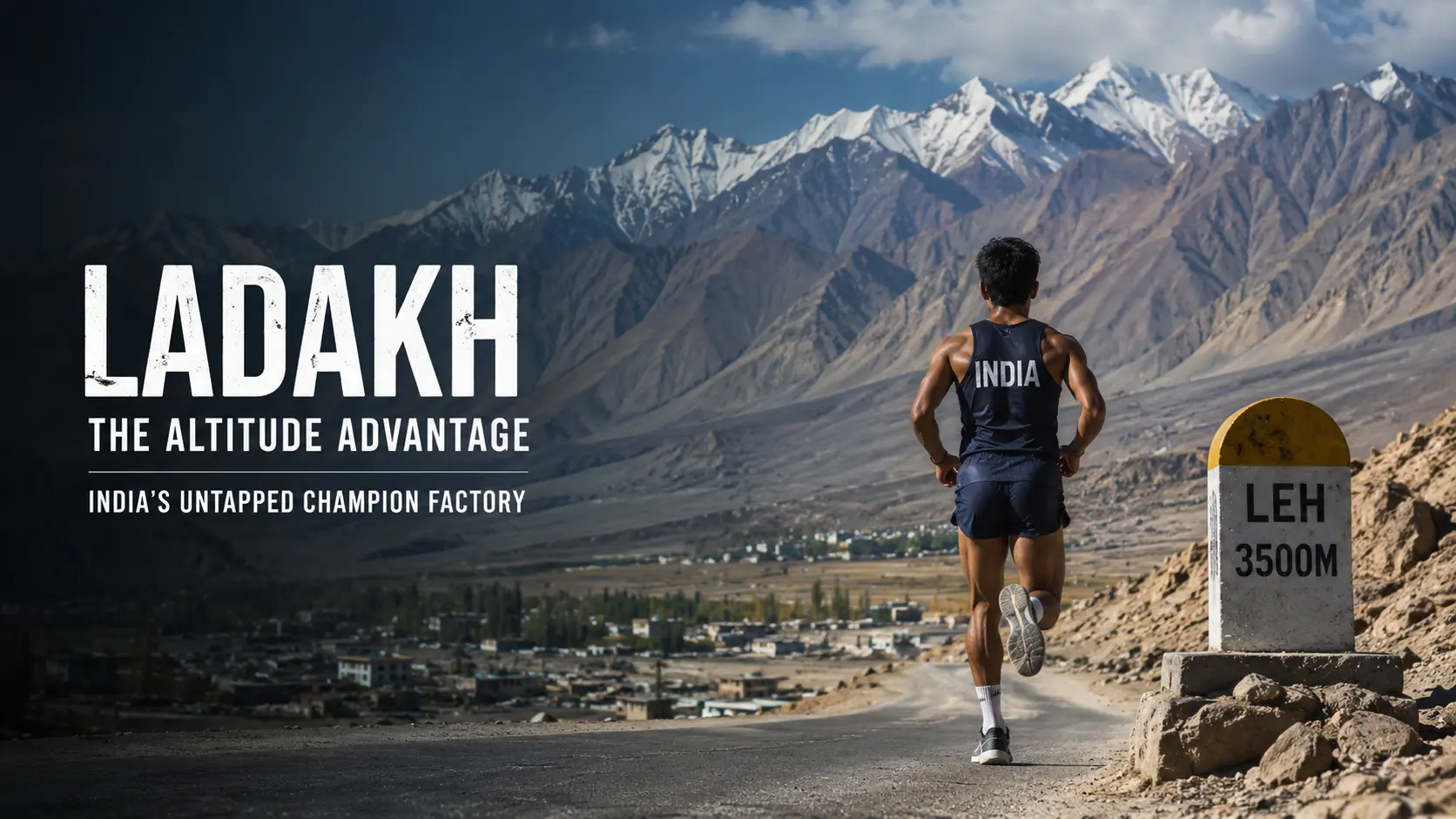
In today's ultra-competitive sports era where Olympic podium positions are decided by fractions of a second and millimeter margins, global athletic powerhouses are leaving absolutely nothing to chance. Everything is being meticulously calibrated, modeled, and generated by sophisticated physiological sports science. In this high-stakes race, nations have become heavily dependent on technological advancements, multi-million-dollar sports infrastructure, and elite environmental conditioning. Somehow, this relentless pursuit of scientific edges is incredibly useful for optimization, but somehow, when we look at India's capital allocation and training strategies, it reveals an institutional blind spot. We are over-indexing on importing foreign infrastructure while ignoring the monumental, native environmental goldmines sitting right in our backyard. Modern elite training is something that was created to make athletic conditioning faster, build higher red blood cell efficiency, and deliver peak aerobic capacity under stress. But when Indian sports federations, high-performance directors, and Ministry bureaucracies ended up relying exclusively on overseas training camps, luxury alpine resorts in Europe, and autonomous international training features for everything, an unsettling pattern emerged. We don't know where we actually forgot, lost, or completely ignored our own natural geographic assets and indigenous high-altitude zones. We don't know why we look across the oceans for features that nature built directly into the northern crowns of our own country.
So this comprehensive article basically is going to get you all thoroughly aware about what we should do with advanced elite sports infrastructure, what the empirical mathematical realities of high-altitude training dictate, and what we must urgently do to pivot toward authentic, original, and deeply sustainable native sports management. By juxtaposing the exorbitant financial leakages of European excursions against the pristine physiological blueprint of Ladakh, we will dissect why India's elite athletes are being packed off to Font-Romeu, St. Moritz, or Sierra Nevada when a world-class, naturally superior altitude framework is sitting completely unutilized in Leh and Shara.
High-Altitude Environmental Conditioning and the Efficiency It Provides
With structured high-altitude training, physiological optimization has become significantly easier, scientific, and more mathematically efficient to calculate. It enhances the endurance capacity of athletes in their daily competitive cycles and elevates their foundational athletic profiles in international championships, grand prix events, and Olympic games as well. High altitude environments — precisely categorized between 2,200 meters and 3,500 meters above sea level — act as a natural, clean, and highly potent evolutionary accelerator for the human body. When an elite athlete trains in an atmosphere with reduced partial pressure of oxygen, it triggers an immediate, systemic adaptive cascade that no high-tech laboratory or artificial hyperbaric chamber can replicate with the same biological harmony. Elite environmental conditioning systems are evolving far beyond simple aerobic routines into highly structured "hypoxic training block frameworks." These blocks can drastically analyze metabolic efficiency, forecast oxygen transport capacity, automate the natural production of Erythropoietin (EPO), optimize hemoglobin mass, and even make micro-adaptive muscular recommendations with minimal artificial intervention. The core physics of this process relies on the body's response to hypoxia. The kidneys sense the drop in oxygen delivery and dramatically upscale the secretion of EPO, which directly signals the bone marrow to accelerate red blood cell (RBC) synthesis. This expansion of hemoglobin mass enhances the body's ultimate VO2 Max — the maximum volume of oxygen an athlete can utilize during incremental, exhaustive exercise. These natural high-altitude zones help athletes get a profound physiological advantage while managing their heavy metabolic debt and blood gas chemistry. Making decisions on this base for your professional sports career or national track team allows you to capitalize upon what is trending in global sports science, helping athletes choose from smart, phenomenally successful advancements in elite physical majors. Globally, elite training models have gravitated toward the "Live High, Train High" (LHTH) or the scientifically venerated "Live High, Train Low" (LHTL) paradigms. Under these regimes, athletes live at high altitudes to force hematological adaptations while training at lower altitudes to maintain high-velocity muscle fiber output without the limiting constraints of acute hypoxia. The underlying data confirms that an optimal stay of 21 to 28 days at an altitude between 2,400m and 3,000m yields an average increase of 5% to 9% in total hemoglobin mass, translating directly to a 3% to 4% surge in competitive velocity and endurance efficiency.
High-Altitude Physiological Optimization Metrics
- Optimal Target Altitude: 2,200m – 3,500m
- Minimum Required Exposure: 21 – 28 Days
- Average Increase in Hb Mass: +5% to +9%
- VO2 Max Net Improvement: +3% to +5%
- VO2 Max Deterioration at Extreme Heights: -10% per 1,000m past 3,500m
- Endurance Velocity Multiplier: +3.5% Efficiency Gain
To capitalize on these physiological realities, global sports organizations have spent hundreds of millions of dollars building hyper-specialized high-altitude training hubs across very specific coordinates on the map. These are some iconic international altitude centers and sports systems which elite athletes try to utilize to start their championship journey online and offline:
- Font-Romeu, France (1,850m – 2,400m) — The crown jewel of European distance running infrastructure.
- St. Moritz, Switzerland (1,856m) — Luxury alpine hub utilized by elite marathoners and cycling teams.
- Sierra Nevada, Spain (2,320m) — Highly advanced high-performance center with an indoor training track.
- Iten, Kenya (2,400m) — The spiritual home of distance running, relying on natural topography and terrain.
- Addis Ababa, Ethiopia (2,355m) — Natural high-altitude ecosystem fueling East African long-distance dominance.
- Flagstaff, Arizona, USA (2,130m) — HYPO2 center, heavily backed by data-driven collegiate and Olympic programs.
- Colorado Springs, USA (1,841m) — United States Olympic & Paralympic Training Center core base.
- Kunming, China (1,890m) — East Asia's premier multi-sport high-altitude aquatic and track base.
- CAR Sierra Nevada, Spain — High-Performance Center specialized in controlled hypoxic adaptations.
- Chamonix, France — Alpine environmental center utilized for extreme endurance and mountain sports.
- Potchefstroom, South Africa (1,341m) — Moderate altitude facility preferred for early-season power conditioning.
These elite installations prove that altitude is treated as a highly strategic, foundational resource in global sports asset management. Every single one of these locations is monetized to the tune of tens of thousands of dollars per athlete per month, attracting elite delegations from across the globe who are hunting for that extra micro-percentage of cardiovascular performance.
Cons of Using Foreign Alpine Centers for Indian Sports Budgeting
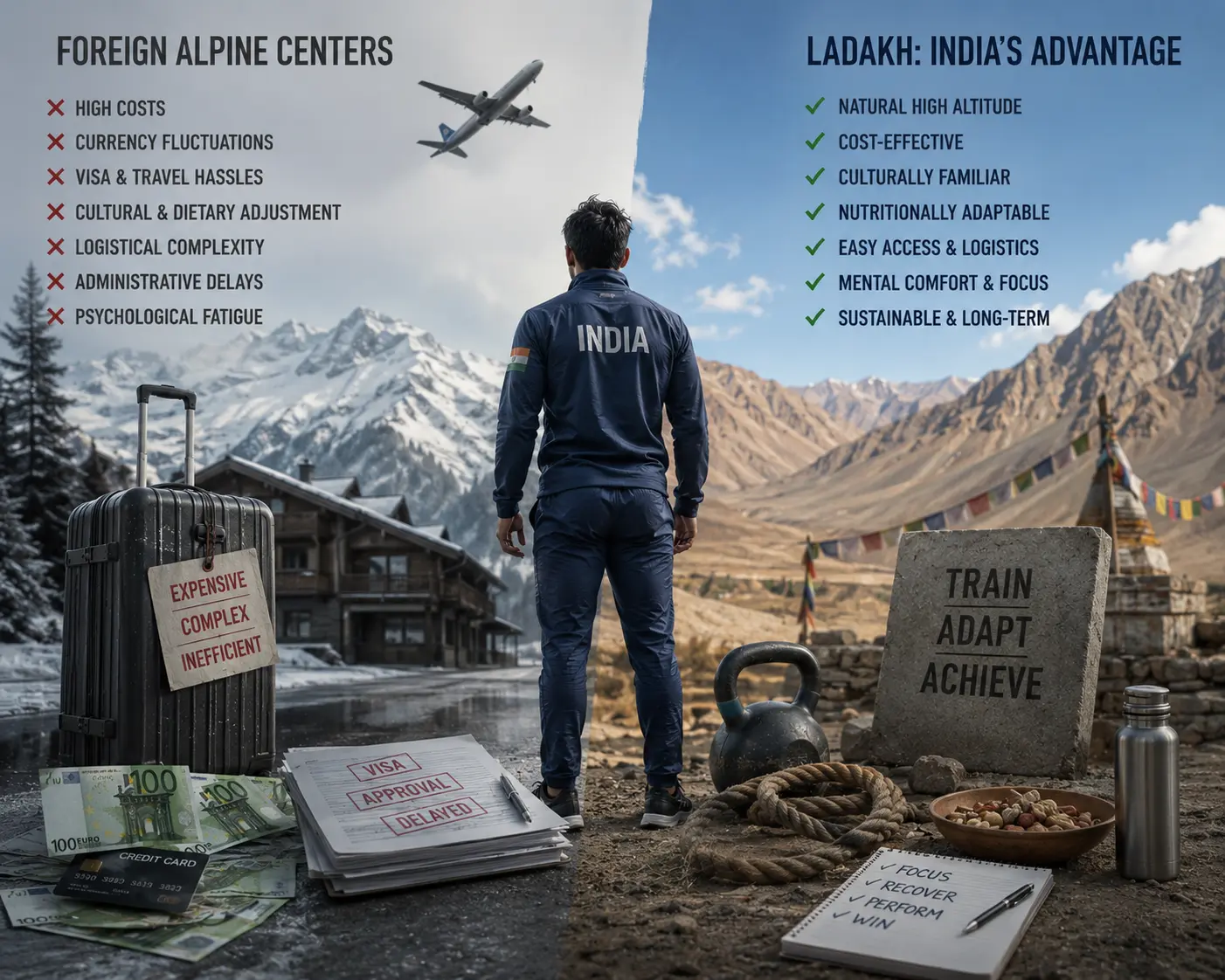
However, outsourcing our athletes' environmental conditioning to European and Western alpine facilities carries severe, compounding negatives that undermine our national sports treasury and athletic focus alike. European training camps, as we know, are still rooted in an expensive, foreign-based infrastructure model, not an adaptable human-centric framework that can think like an indigenous Indian sports ecosystem or make prudent financial decisions after calculating endless economic possibilities in every single scenario. When a federation decides to send a team of fifteen athletes, along with coaches, masseuses, physiotherapists, and administrative handlers, to a Swiss or French resort, they are entering an exceptionally volatile, high-cost operational environment. In a recent budgetary study mapping sports administrative leakage, it was seen that major foreign training stints do provide environmental conditioning, but only through heavier, lengthier financial outlays where every single logistical scenario presents an alarming discrepancy. A vast expenditure inflation of 65% was observed across seasonal budgets, which calculates to mean that every 2nd out of 5th high-performance training budget attempts processed by the Ministry encounters severe cost overruns or administrative errors. This leaves an enormous structural deficit in sports budgeting which, if manageable in small personal training allocations, can get a national sports federation or development program into heavy, compounding financial losses when scaled across an entire Olympic cycle.
| Cost Category Component | European Stint (Per Athlete / Month) | Ladakh Native Setup (Estimated Cost) | Net Budgetary Variance (%) |
|---|---|---|---|
| Elite Facility Access & Track Fees | $3,200 | $450 (Amortized Public Asset) | -85.9% |
| Premium Accommodation & Hypoxic Stays | $5,500 | $1,200 (Local Ecosystem Hub) | -78.1% |
| International Flight Logistics & Visas | $1,800 | $250 (Domestic Connectivity) | -86.1% |
| Specialized High-Performance Nutrition | $2,200 | $750 (Indigenous Organic Sourcing) | -65.9% |
| Support Staff Travel & Daily Allowances | $4,100 | $900 (Domestic Support Pool) | -78.0% |
| Total Combined Operational Outlay | $16,800 | $3,550 | -78.8% Saved |
Constantly chasing international visas, navigating shifting European immigration laws, managing exchange rate fluctuations, and dealing with the logistical nightmare of transporting specialized athletic gear across continents creates an endless loop of bureaucratic friction. Getting records wrong and getting schedules changed rapidly becomes a tiresome, exhausting chore of the day, which ultimately takes far more administrative time and intellectual headwork from our coaches than actual training. Instead of focusing entirely on physical preparation, sports directors are left nursing major managerial headaches and chronic logistical migraines in the weeks leading up to critical world events. Furthermore, these foreign camps present severe psychological and physiological displacement variables for Indian athletes. The sudden transition to European culinary models, cold sub-zero weather patterns that differ drastically from typical competition climates, and the persistent isolation of living in remote Western villages away from family structures can induce severe psychological fatigue. Athletes spend a massive percentage of their energy simply adjusting to the foreign environment, which actively cannibalizes the recovery windows required to absorb high hypoxic training loads.
"Spend consciously on infrastructure and save intentionally for the long-term athletic baseline of the country. Chasing European altitudes is an administrative habit that masks our inability to build our own high-performance realities."
The Traditional, Natural Budgeting Method: Ladakh
The true, structurally sound, and natural alternative to this broken, reactive spending model is Ladakh — the ultimate indigenous high-altitude training ground of India. The word comes from the classic regional descriptors: La meaning mountain pass, and Dakh meaning country. It is literally the country of high passes. Nestled beautifully in the trans-Himalayan zone, Ladakh represents an unparalleled geographic miracle that was carved out by nature to serve as a world-class high-performance sports sanctuary. It offers the exact physiological parameters required to cultivate elite endurance champions, without any of the crippling financial baggage or foreign currency drain associated with Western training facilities. Ladakh's primary geographic capital sits at a baseline altitude ranging between 3,000 meters and 3,500 meters above sea level. This is the absolute "sweet spot" for elite cardiovascular conditioning. Unlike locations that are either too low to trigger rapid erythropoietin production or too high to sustain high-intensity mechanical training, Ladakh provides an optimal atmospheric density profile. It naturally forces the body to build an exceptional hemoglobin mass while maintaining clear, predictable weather for over 300 days a year. This allows for unbroken, year-round specialized athletic training blocks that can be engineered with precision.
The historical timeline of Ladakh as a potential sports powerhouse began gaining formal traction around the 2010s, exactly when the global sports science community started looking closer at high-altitude native populations to unlock the secrets of extreme aerobic endurance. It was during this period that sports scientists noted the remarkable thoracic capacity, high lung volume, and exceptional baseline capillary density of youth native to the trans-Himalayan region. These physiological traits are highly analogous to the genetic advantages possessed by the elite Rift Valley runners of Kenya and Ethiopia, who have utterly dominated global distance running for over half a century.
A highly strategic training layout in Ladakh divides the region into four primary training zones, each offering unique atmospheric pressures and physical benefits tailored to specific athletic disciplines:
- The Leh Core Zone (3,500m) — Tailored for deep cardiovascular adaptations, long-distance base building, and high hypoxic loading.
- The Nubra Valley Zone (3,000m) — An exceptional setting for multi-sport endurance, cross-country cycling, and aerobic structural strength.
- The Changthang Plateau (4,200m+) — Reserved exclusively for extreme, highly controlled elite physiological testing and red line conditioning.
- The Indus River Valley Basin (3,100m) — A highly suitable, level geography ideal for building high-velocity tracks, synthetic surfaces, and speed workouts.
When an athlete writes their success story through natural training and calculates their energy expenditures across these pristine zones, their mind and body become profoundly aware of their inner kinetic limits. They learn to gauge exactly when to push or when to conserve energy, which eventually becomes an ingrained physical habit to think twice before burning through glycogen reserves. This deep somatic awareness is the absolute core principle of success in elite money management and athletic endurance development. To assist regional sports authorities and development groups in planning these indigenous high-performance blocks, several technical frameworks have been mapped out by leading sports scientists. These include highly detailed training blueprints and environmental layout plans available through public developmental resources:
- The Trans-Himalayan High-Performance Blueprint (Detailed regional structural framework for setting up high-altitude running nodes).
- The Leh Altitude Training Integration Model (Comprehensive physiological adaptation timeline protocols for non-native elite athletes).
- The Indigenous Sports Infrastructure Allocation Matrix (A master plan for building low-cost, high-yield synthetic facilities in cold deserts).
Now, to an outside observer, setting up these domestic training structures may sound like a slow, complex handwritten version of what foreign AI-driven apps and premium European training facilities already provide off-the-shelf. But no — it is the raw, unadulterated magic of natural geographic integration. When India commits to training its athletes within its own borders, it doesn't just build stronger bodies; it constructs an independent, highly resilient sports culture that keeps national resources circulating within local communities, creating a massive socioeconomic multiplier effect across the entire region of Ladakh.
Strategic Asset Allocation: Structural Comparison of Budgets
To fully comprehend the massive financial variance between reactive foreign spending and proactive domestic investment, we must look closely at the long-term capital efficiency of our national sports funding. When we look at the current model, India spends millions annually on temporary rental fees at European sports facilities. This money leaves the country permanently, yielding zero residual infrastructure value for future generations of Indian track and field stars. It is an operational model characterized by high recurring costs and zero long-term domestic asset accumulation. Conversely, investing that exact same capital into building a world-class National High-Performance Altitude Centre in Ladakh transforms that recurring expenditure into a highly valuable, permanent domestic asset. The initial capital outlay required to build a state-of-the-art synthetic track, an Olympic-sized heated indoor swimming pool, high-tech sports science laboratories, and eco-friendly hypoxic housing in Leh is completely amortized within less than three years of operation. Once built, the marginal cost of training an athlete in Ladakh drops to a fraction of the price of a European tour, allowing India to scale its elite training pools from a select few athletes to hundreds of promising talents from across the nation. This strategic shift fundamentally changes the sports management equation from a broken, willpower-dependent system that relies on securing scarce foreign exchange, to an intentional, structure-dependent system that leverages our own natural terrain. It allows India to build an assembly line of elite champions, deeply grounded in the disciplined, high-altitude realities of our own geography. By cutting out the endless middleman fees, international agent commissions, and overseas resort markups, we can reallocate those saved millions directly into grassroots talent scouting, advanced biomechanical analytics, and long-term coaching security for our native athletes.
Read Further
- High-Altitude National Centre for Excellence (HANCE) to Be Set Up in Leh — The Tribune, 2025
- Impact of Altitude Training on Athletes' Aerobic Capacity: A Systematic Review and Meta-Analysis — PMC / National Library of Medicine
Disclaimer: All the structural data, comparative financial metrics, and physiological insights provided above were compiled from comprehensive internet resources, global high-altitude training studies, and national sports budgetary tracking records. This analytical piece is designed for informational and strategic assessment purposes and should not be taken as a direct financial quote from our website or formal administrative advice.