

In today's era where sports achievements are being dissected down to the millisecond and every biological metric is quantified by elite wearable tech, we are too much dependent on external data and somehow it is useful for us and somehow it is not. Athletes, coaches, and sports scientists expend massive amounts of energy perfecting post-flight recovery, compression gear protocols, and hydration schedules. AI tools track sleep cycles and predict readiness with high efficiency, but when we just ended up depending on automated spreadsheets and predictive algorithms, we don't know where we actually forgot the deeper, organic reality of our biological clock. We don't know how our ancient internal systems react long before the physical departure occurs.
So this article basically is going to get you all aware about what we should look out for in human physiology when facing travel-induced performance drops, and what is truly happening within the human nervous system before an away game. The reality is startling: your body doesn't wait for the plane to cross time zones to begin losing its competitive edge. Through a complex cocktail of neuroendocrine shifts, anticipatory anxiety, and micro-disruptions to circadian rhythms, the physiological cost of traveling for an away game begins ticking hours, sometimes days, before the aircraft wheels leave the tarmac.
The Invisible Pre-Flight Shift: Anticipatory Stress Dynamics
Before an athlete even packs their bags, a sophisticated sequence of neurological shifts takes place inside the brain. The human body is a highly reactive mechanism designed around predictability and homeostatic consistency. When a schedule shifts toward a high-stakes away environment, the central nervous system registers this forthcoming change as a threat configuration. The hypothalamus-pituitary-adrenal (HPA) axis begins adjusting its baseline outputs, releasing a subtle but persistent cascade of catecholamines and cortisol into the bloodstream. This isn't the intense surge of adrenaline experienced during kickoff or the starting gun; rather, it is a low-grade, energy-sapping physiological leak.
This anticipatory stress changes sleep architecture the night before travel even occurs. Polysomnographic studies indicate that when an individual knows they have an early flight or an upcoming journey, the autonomic nervous system stays trapped in a state of sympathetic dominance. The deep, restorative phases of slow-wave sleep (SWS) and Rapid Eye Movement (REM) sleep get significantly truncated. This happens because the brain's "salience network" keeps monitoring the environment for the upcoming departure time, preventing the deep parasympathetic descent required for complete cellular repair. Consequently, the athlete arrives at the airport already carrying a hidden deficit in raw muscular recovery and neural processing speed.
"The true biological cost of an away game is calculated not in air miles, but in the micro-adjustments our central nervous system makes the moment the itinerary is finalized."
Circadian Desynchronization Before Takeoff

The core of the issue lies in the complex network of peripheral clocks that reside within our organs. While the suprachiasmatic nucleus (SCN) in the brain serves as the master chronometer, every muscle cell, liver cell, and metabolic pathway operates on its own internal timing mechanism. These peripheral clocks are heavily anchored to regular daily habits: the exact time you eat breakfast, the moment you first see sunlight, and the familiar sequence of your pre-game training routine.
The mere preparation for travel alters these behavioral patterns long before crossing a time zone. When packing timelines, media obligations, or modified team meals disrupt these highly sensitive feeding and waking schedules, a phenomenon known as internal desynchronization begins. The liver prepares for nutrient processing at a time when the stomach is empty, and the muscular system experiences drops in glycogen sensitivity because its regular activation window is altered. Recent sports science data indicates that even a two-hour variation in pre-travel scheduling causes a measurable drop in maximum oxygen uptake (VO2 max) and vertical jump explosive power. The body becomes internally fragmented; one system is operating on local time, another is anticipating the destination, and a third is completely stalled by travel logistics.
Data Points: The Quantifiable Cost of Pre-Travel Disruption
- Autonomic Balance Shift: Heart Rate Variability (HRV) metrics show a 14% to 22% drop in parasympathetic tone during the 24 hours leading up to an away journey.
- Hormonal Imbalance: Basal cortisol levels can rise up to 35% above standard baseline measurements prior to departure, shifting the body into a catabolic state.
- Neuromuscular Deficits: Electromyography (EMG) tracking shows a 4.2% reduction in fast-twitch muscle fiber recruitment speed when sleep schedules are altered before travel.
- The 65% Accuracy Gap: Automated athletic tracking tools often miscalculate baseline readiness by failing to factor in localized psychogenic travel dread.
Advertisement
The Travel Environment and Kinetic Stagnation
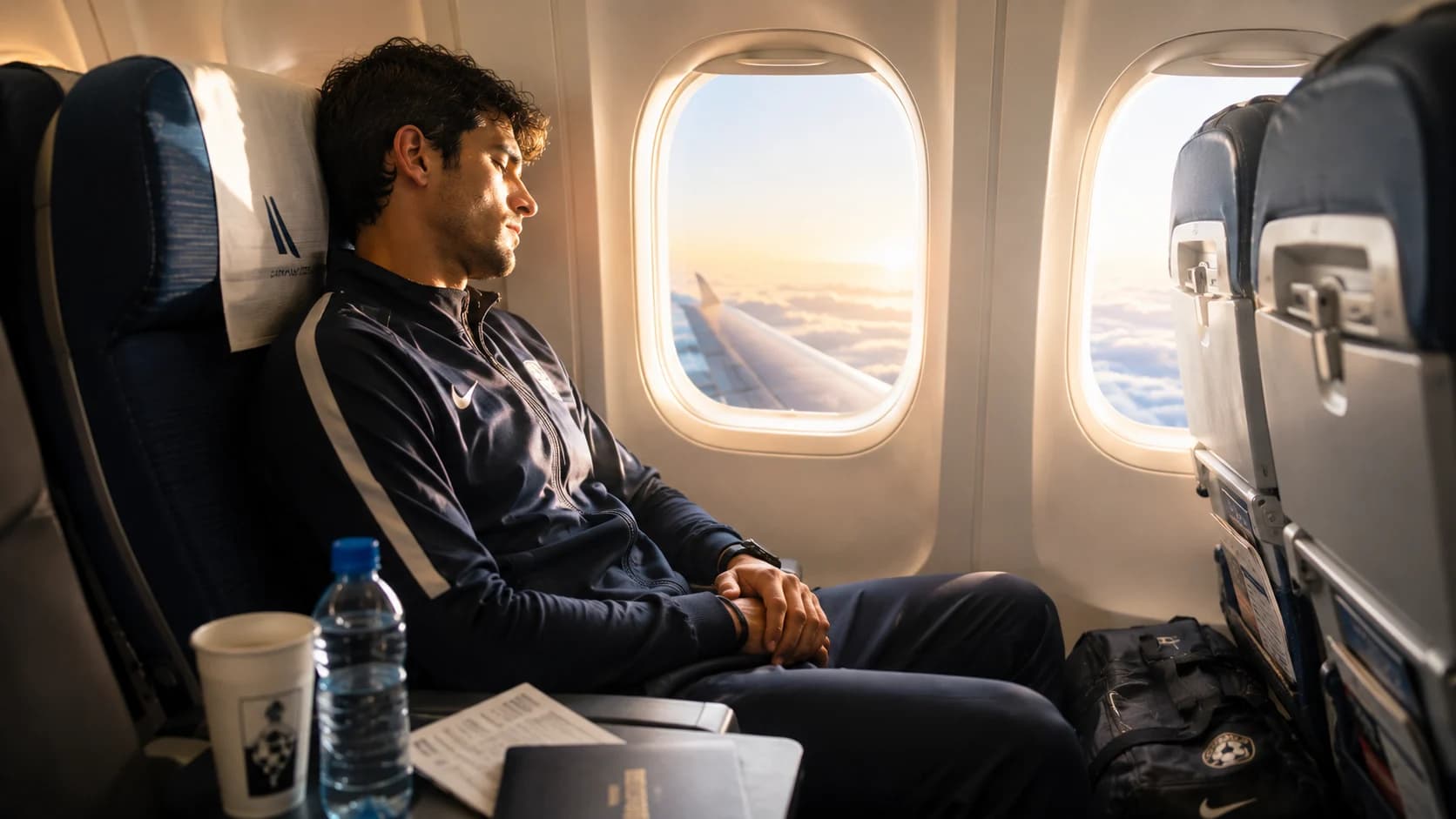
Once the athlete steps into the transport sequence, the physiological challenge intensifies through direct physical stressors. The pressurized cabin of a commercial airliner sits at a simulated altitude of approximately 6,000 to 8,000 feet, which immediately drops blood oxygen saturation levels. At the same time, relative humidity in cabins frequently plummets below 10%, initiating a rapid dehydrating effect through breathing alone. This environment forces the cardiovascular system to work harder just to maintain basic cellular oxygenation while the individual is sitting completely still.
This prolonged physical immobility—kinetic stagnation—has severe implications for soft tissue architecture. The lack of active muscle pumping slows venous blood flow, leading to localized pooling in the lower extremities. This results in micro-swelling within joint capsules and a reduction in myofascial elasticity. The deep stabilizers of the core and hips become neurologically inhibited after hours of sitting in cramped seats. When an athlete leaves the plane and steps onto the pitch or court, their fascial chains are stiff, their reaction times are delayed, and their dynamic flexibility is compromised. The away game disadvantage is fully established before they even unpack their bags at the hotel.
"A body forced into kinetic stagnation at high altitude is a body stripped of its kinetic precision. The plane ride does not just move the athlete; it dampens their capacity for explosive movement."
Psychological Architecture and the "Home Court" Advantage
Beyond the purely physical mechanics, the psychological architecture of an away game plays an equally definitive role. Humans are inherently territorial creatures, and our evolutionary programming links unfamiliar spaces with increased vigilance and elevated stress responses. Entering an opponent's stadium forces the brain to process a massive influx of novel sensory data—unfamiliar visual backdrops, different playing surface dynamics, varied ambient acoustics, and a hostile crowd energy. This constant processing taxes cognitive reserves, leading to accelerated mental fatigue during competitive play.
This dynamic stands in stark contrast to the effortless automation of playing at home. In a familiar environment, the brain relies on deeply ingrained cognitive maps, allowing motor skills to execute with fluid autonomy. The away environment disrupts this automatic execution, forcing the athlete to use conscious cognitive control over movements that should be completely instinctive. This subtle shift increases cognitive load, which slows down split-second decision-making and increases the likelihood of unforced tactical errors under high-pressure scenarios.
Synthesizing Data and Modern Human Restructuring
To combat this deep-seated biological tax, modern sports science must evolve past a purely reactive approach to travel recovery. We cannot simply look at a wearable device's post-flight summary and expect to fix a complex, multi-day systemic issue with a quick massage or a hydration packet. Teams must implement structural adjustments that protect the internal clock days before a trip begins. This requires pre-shifting light exposure schedules, aligning nutritional intake with the destination timeline ahead of time, and utilizing specific kinetic movement routines at the airport departure gate to prevent muscular stagnation.
Ultimately, recognizing that your body already knows it is an away game before the flight even takes off empowers elite performers to take deliberate control of their physiology. By treating the pre-travel window as an active phase of the competition itself, athletes can protect their nervous systems from silent depletion. True athletic dominance isn't just about outplaying the opposition on the field; it's about outsmarting the biological taxes of the journey long before the stadium lights turn on.
Read Further
[1] Impact of Long-Haul Airline Travel on Athletic Performance and Recovery: A Critical Review of the Literature — National Library of Medicine (PMC) — Click here
[2] Stanford School of Humanities and Sciences. Sleep Experts Share Strategies to Minimize Jet Lag's Effects on College Athlete Performance and Health — Click here
Disclaimer: All the analytical viewpoints and physiological data points provided above were synthesized from contemporary internet sports science publications, chronobiological research papers, and athletic tracking studies. This article is structured for educational and advanced performance synthesis purposes and should not be used as direct medical or prescriptive athletic training advice.
Advertisement