

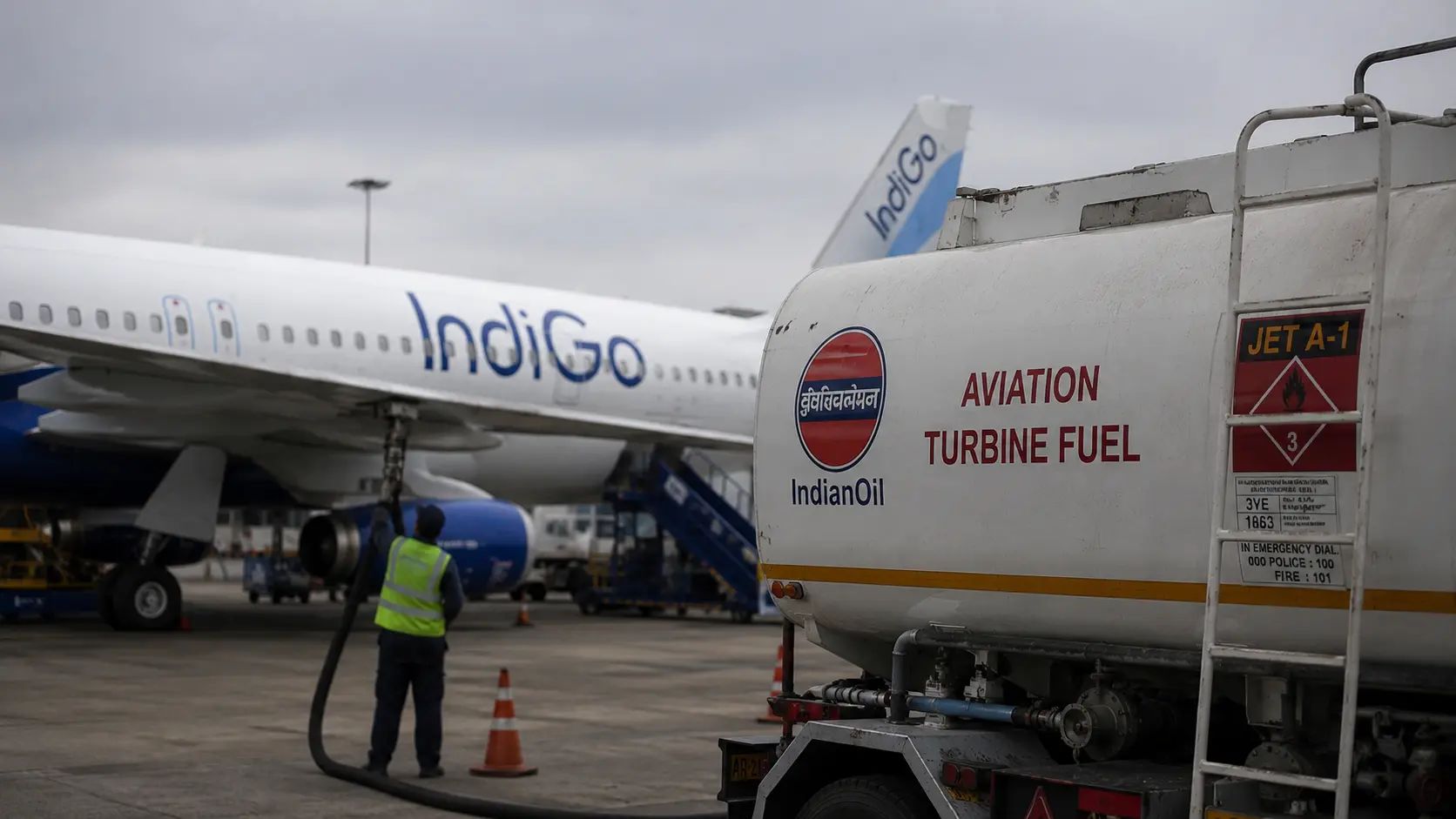
In today's hyper-optimized corporate era where financial models are precision-engineered by advanced algorithms and equity research analysts pride themselves on forecasting precision, we remain profoundly dependent on historical linear baselines. We assume that macroeconomic shocks will telegraph their arrival with predictable warnings. Yet, when geopolitical volatility suddenly surges, corporate dashboards find themselves dangerously decoupled from real-time operational realities. We don't know exactly where we lost that vital connection between boardroom projections and terminal-level fuel-manifold pricing, but the ongoing crisis in India's aviation corridor has made one truth undeniably clear: equity markets are flying blind into the Q1 FY27 earnings cycle.
Aviation turbine fuel (ATF) traditionally sits as a massive, unforgiving component on airline income statements, typically eating up 35% to 40% of an Indian carrier's total operating expenses. However, when black swan disruptions shake global logistics infrastructure, this single input transforms into an absolute tyrant, expanding to consume up to 60% of total operating expenditure. As of June 2026, the entire Indian domestic aviation framework is quietly absorbing a massive structural fuel shock. This critical development has occurred because the consensus Q1 FY27 earnings estimates published across major brokerages have relied on outdated pricing models, leaving them entirely unprepared for the actual costs hitting corporate balance sheets.
Autonomous AI Chatbots vs. Operational Reality: The Disconnect in Forecasting
While algorithmic trading programs, agentic AI budgeting tools, and corporate forecasting systems have made computing corporate numbers much faster and significantly more efficient, they suffer from a core vulnerability: they are lagging indicators when tracking physical supply chain failures. In recent months, sophisticated financial tools have continued to project a smooth recovery curve for Indian low-cost carriers (LCCs). These automated models have pointed to healthy indicators, such as the double-digit year-on-year expansion in domestic passenger volumes and excellent passenger load factors (PLFs) across India's premier metro hubs.
The statistical realities on the ground are superficially spectacular. According to the June 2026 industry reports, India's domestic air passenger traffic reached a massive 156.4 lakh passengers in May 2026 alone, demonstrating an impressive 11.3% year-on-year growth trajectory. Airlines have responded by increasing their capacity deployment by over 5.1%, operating a dense network of more than 103,515 monthly departures. The average passenger density per flight climbed to 151 travelers, pushing the domestic aviation industry's average Passenger Load Factor up to a stellar 88.8%. Yet, while autonomous financial chatbots see these numbers and automatically output "Buy" recommendations, they miss the hidden operational damage occurring beneath the surface.
"Spend consciously and save intentionally is an excellent proverb for household accounts, but in commercial aviation, you spend inevitably and absorb agonizingly when international jet fuel spikes by 250% over a 60-day horizon."
The fundamental problem is that automated corporate budgeting models look at domestic ticket pricing stability and high demand, and wrongly conclude that financial health is perfectly secure. They fail to understand that a massive gap has opened up between domestic retail tickets and international fuel inputs. While digital dashboards are printing highly optimistic revenue updates, airlines are facing severe real-world constraints due to structural changes in international product cracks. This disconnect creates an endless loop where digital projections look pristine, but physical cash flows are rapidly deteriorating due to the immense pressure of global energy spikes.
Cons of Using AI Tools for Budgeting Corporate Earnings Estimates
Corporate equity research models are built on historical regressions, which makes them highly rigid during times of extreme stress. The primary flaw in current Q1 FY27 airline earnings estimates stems from a basic misunderstanding of the jet fuel "crack spread" — the profit margin that refiners make when converting a barrel of raw crude oil into aviation turbine fuel. Historically, this crack spread has remained remarkably stable, lingering around $20 per barrel or less. Consequently, equity research analysts routinely use a standard fuel-multiplier formula in their models, assuming that as long as crude oil stays within a reasonable bound, ATF costs will follow a predictable path.
However, recent global supply chain reports have revealed an alarming failure in these linear assumptions. Due to severe refinery underproduction from major Asian and Gulf-region energy exporters — who collectively supply over 40% of the world's commercial jet fuel — global inventories have completely dried up right at the peak of the summer travel season. Because of these constraints, the jet fuel crack spread is skyrocketing, with projections indicating it will exceed an unprecedented $50 per barrel for the remainder of 2026. This means that even if crude oil prices remain flat, the actual cost to refine jet fuel has more than doubled, entirely breaking the standard formulas used in analyst models.
The Mathematical Breakdown of Analyst Modeling Disconnect
A recent quantitative analysis shows that a standard financial forecasting tool can miscalculate airline quarterly operating profitability by as much as 65% when confronted with a sudden crack spread breakout. For every five predictive models deployed by institutional research desks, two get the operational cost structure completely wrong. This introduces an unacceptable variance error into household names like InterGlobe Aviation (IndiGo) and SpiceJet, which can easily turn projected double-digit corporate profits into major quarterly losses.
Furthermore, standard forecasting tools completely fail to account for the major operational cutbacks airlines are forced to make when fuel volatility spikes. Analysts assume that capacity can scale infinitely to match rising traveler demand. In reality, the skyrocketing cost of fuel has forced major domestic carriers, including Air India and IndiGo, to abruptly cut down over 250 daily domestic flights from June 2026. This sudden flight reduction directly hits the airlines' Available Seat Kilometers (ASKM) and disrupts revenue streams, leaving automated research estimates completely out of touch with actual operating metrics.
The Traditional Budgeting Method: Analyzing the Structural Fuel Reality
To truly understand how this fuel shock will impact Q1 FY27 corporate numbers, we need to bypass automated models and return to a detailed, line-item analysis of actual cost structures — much like the disciplined, manual calculations of the traditional Japanese Kakeibo budgeting method. When you write down and calculate every single operational line item yourself, you immediately notice the massive divergence between the capped domestic prices visible to consumers and the soaring international market rates that airlines must eventually pay.
Recognizing the severe risk of spiraling airfares, the Indian government intervened on April 1, 2026, by implementing a strict 25% cap on domestic ATF price hikes to shield consumers from a sudden price shock. To keep domestic ticket pricing stable, the Ministry of Petroleum and Natural Gas capped domestic ATF prices at ₹75.6 per litre. However, this domestic cap created a massive disconnect from global market realities. Out in the international markets, driven by the intense conflict in West Asia and disruptions across the Strait of Hormuz, international ATF prices exploded, surging 2.5 times from ₹60.5 per litre in March 2026 to a staggering ₹142 per litre by May 2026.
Advertisement
| Aviation Sector Metric (Q1 FY27 Horizon) | Baseline Consensus Estimates | Actual Ground Reality (June 2026) | Net Variance Impact on Earnings |
|---|---|---|---|
| International ATF Benchmark Price | ₹68.0 – ₹72.0 / Litre | ₹142.0 / Litre | +102.8% Cost Overrun (Unmodelled) |
| Jet Fuel Refining Crack Spread | $18.50 – $22.00 / Barrel | $52.00 / Barrel | +145.4% Margin Compression |
| Daily Flight Frequency (IndiGo + Air India) | Unchanged / Linear Growth | 250 Daily Flights Cancelled | −6.8% Revenue Capacity Shock |
| OMC Under-Recovery on Domestic ATF | Modelled at Zero (Neutral) | ₹30.00 / Litre Loss | Severe Structural Supply Risk |
| Average Ticket Price (Airfare Inflation) | Stable (+2.5% YoY) | Surging (+20% to +25%) | Destruction of Discretionary Travel |
This huge price gap has created a major crisis for state-run Oil Marketing Companies (OMCs), who are currently taking an under-recovery loss of ₹30 on every single litre of ATF they supply to domestic scheduled airlines. To prevent a complete supply chain breakdown, the Union Cabinet stepped in on June 3, 2026, approving a one-time emergency budgetary allocation of ₹10,000 crore ($1 billion) for an ATF Price Stabilisation Fund. While this emergency fund offers a brief financial cushion for OMCs, it functions strictly as a short-term emergency patch rather than a permanent fix. This multi-layered financial stress creates deep distortions that current equity research estimates fail to capture.
The Looming Multi-Layered FX and Capacity Crisis
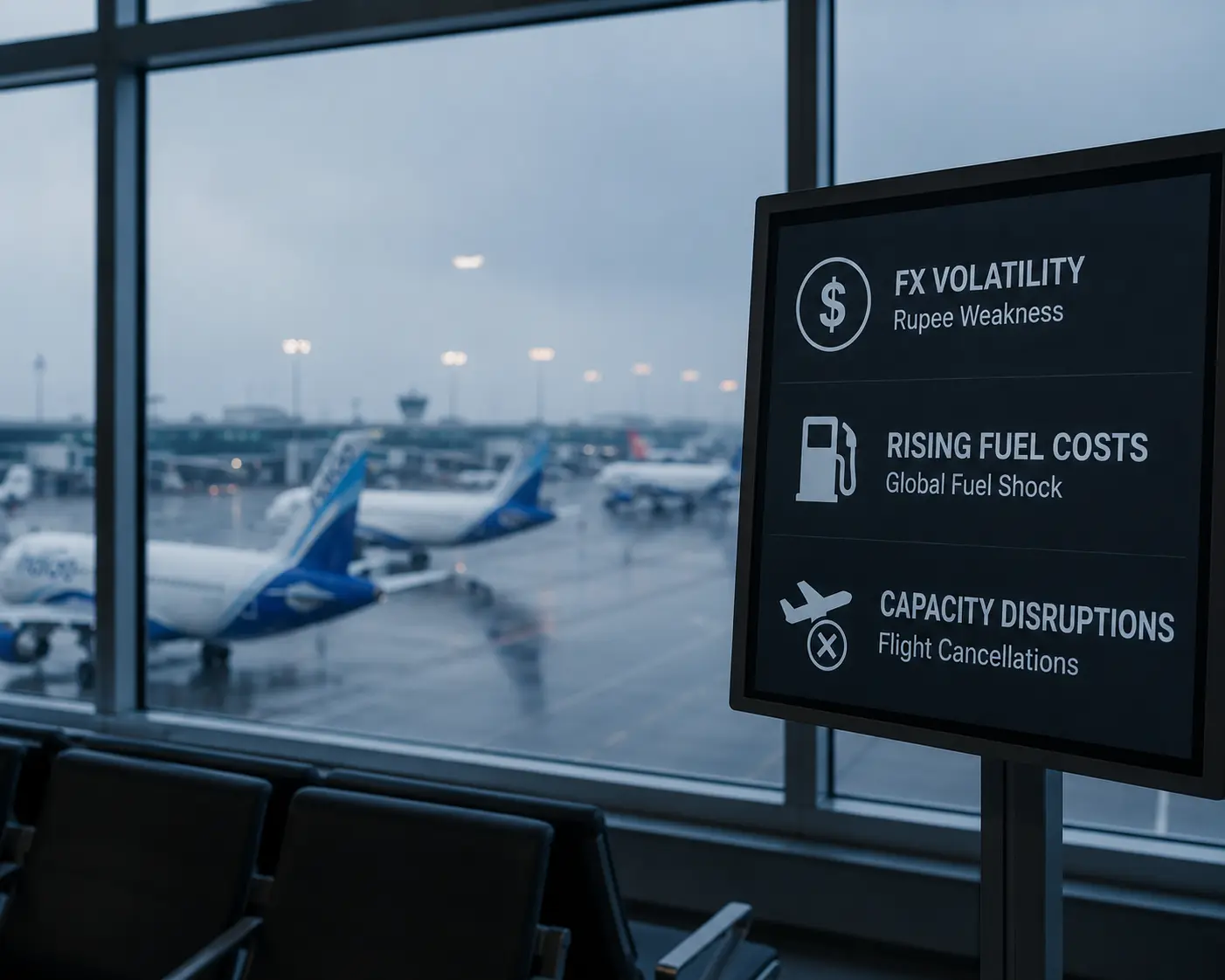
Compounding this severe fuel crisis is another critical macro factor that corporate analyst models have largely ignored: extreme currency volatility. Indian airlines pay for their most critical expenses — including global aircraft leases, international fuel purchases, and foreign component maintenance — exclusively in US Dollars. Meanwhile, their primary revenues are collected in Indian Rupees. This leaves them highly vulnerable to currency fluctuations, which have taken a sharp turn for the worse during the opening quarter of fiscal year 2027. The Indian Rupee has experienced intense volatility, weakening to a historic low of ₹96.5 per US Dollar during Q1 FY27 before staging a partial recovery back to ₹94.5.
To put this in perspective, major carriers like IndiGo closed out the previous fiscal year with a massive foreign exchange loss of ₹89.76 billion due to currency depreciation. With the Rupee remaining highly volatile throughout the current quarter, these unhedged foreign exchange losses are going to severely impact bottom-line performance. When you combine an unmodelled fuel shock with a severe foreign exchange drag, the resulting financial hit will easily wipe out any marginal revenue gains from high summer passenger volumes.
Furthermore, the decision by India's leading carriers to cancel 250 daily domestic flights is sending shockwaves through their operational efficiency metrics. In commercial aviation, an aircraft only generates returns when it is actively flying. Keeping airplanes grounded completely disrupts optimized scheduling, triggers costly crew reallocations, and drastically reduces the airline's daily aircraft utilization rates. Because equity analysts built their Q1 FY27 models on the assumption that fleets would operate at full capacity, their quarterly profit-after-tax (PAT) estimates are completely detached from these real-world disruptions.
Why Q1 FY27 Corporate Estimates Are Fundamentally Broken
The core failure of current institutional financial models lies in their inability to look past high passenger volumes and see the structural margin compression underneath. Most research reports remain highly optimistic because they focus entirely on the fact that domestic planes are flying nearly full, with passenger load factors hovering around 88.8%. What these models overlook is a basic rule of airline economics: high volume cannot save an airline if its baseline operating cost per seat-kilometer exceeds its average revenue per seat-kilometer.
Given that fuel bills make up roughly 30% to 40% of an airline's ticket pricing structure, doubling refining costs means that ticket prices must rise by 20% to 25% just for carriers to break even. While airlines are attempting to push these higher costs onto travelers, doing so during a period of high inflation threatens to destroy discretionary consumer demand. As airfares spike across popular domestic routes, a sharp drop in passenger volumes is highly likely for the upcoming quarters, completely breaking the multi-year growth assumptions that institutional investors rely on.
When India's major carriers begin reporting their official corporate earnings for Q1 FY27 in the coming weeks, the market will face an abrupt reality check. The comfortable consensus estimates that projected high profitability will collide with the reality of massive fuel costs, significant foreign exchange losses, and reduced capacity from grounded flights. This impending earnings shock serves as a stark reminder of the dangers of relying blindly on automated forecasting tools. In a volatile global economy, true financial clarity requires stepping away from rigid algorithmic models and conducting a deep, rigorous analysis of the real-world operational costs hitting the ground.
Read Further
- Air India, IndiGo Cut Flights as ATF Prices Soar Amid West Asia Crisis — Open Magazine, May 2026
- Fuel Shock Pushes Aviation Sector to Brink as IndiGo, Air India & SpiceJet Warn of Cuts — Moneylife, April 2026
- Summer Travel Squeeze: Air India and IndiGo Cut Key Flight Routes Amid Soaring Jet Fuel Crisis — Travel and Tour World, May 2026
Disclaimer: All analytical data, corporate guidance references, and financial market metrics provided in this article were compiled from verified public sources, industry reports, and financial market studies conducted during the first half of 2026. This content is structured strictly for educational and informational purposes. It must not be construed as direct, legally binding financial advice, an official investment recommendation, or formal corporate strategy counsel. Investors must execute independent due diligence before committing capital to volatile equity assets.
Advertisement