

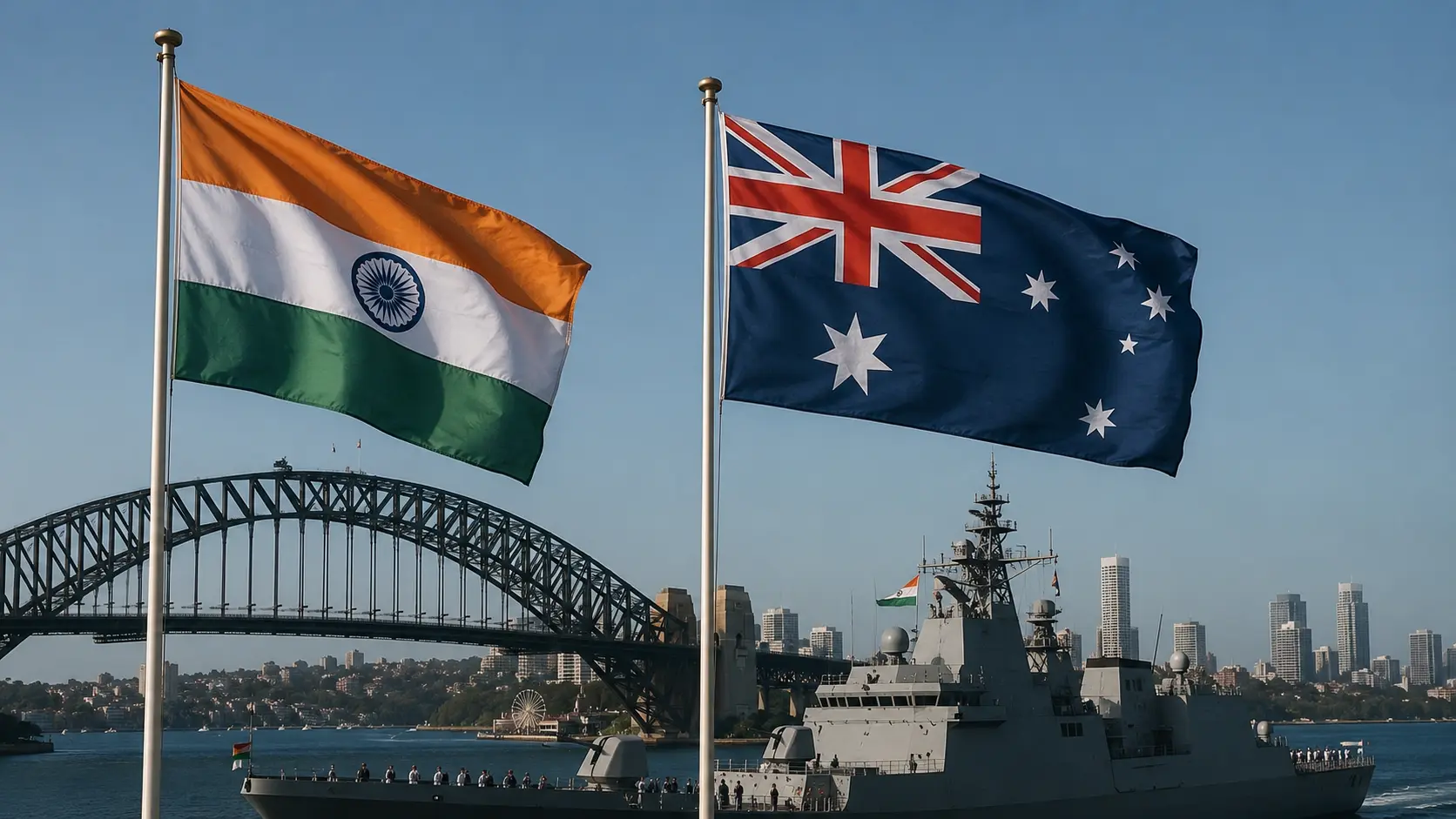
In an era when global supply chains are being rewritten, bilateral architectures are increasingly shaped by geopolitical complexities, and middle powers are realigning in an unprecedented manner. Just as technology has advanced from passive tracking to active, autonomous agentic systems, India–Australia diplomacy has transcended diplomatic platitudes to become a finely-tuned bilateral machine. The two strategic anchors in the Indian Ocean have been operating at less than their full potential for decades — an unexploited synergy obscured by historic inertia and divergent Cold War mindsets. But when countries are forced to put too much faith in fragile multilateral institutions that do not ensure their economic and territorial security, the re-emergence of strong, binding bilateral pacts becomes critical.
So this article is going to help you understand the deep structural transformation taking place in the India–Australia strategic matrix in light of the historic July 2026 Leaders' Summit in Melbourne. We'll examine the sweeping defence agreements, the intricate trade super-structure deal updates, the underlying numerical realities of their bilateral supply chains, and the sticking points that still need work from both sides of the aisle.
In Today's Era of Geopolitical Friction: The Shift Towards Hyper-Collaboration
The current transformation in the structure of the Indo-Pacific theatre is developing in tandem with two parallel dynamic trends: the acceleration of a confident regional hegemon and the increasing vulnerability of world sea lanes. The economic architecture between New Delhi and Canberra has traditionally functioned irrespective of their security architectures. Today, that construct is dead.
At the 3rd India–Australia Annual Leaders' Summit (July 8–10, 2026) in Melbourne, Prime Ministers Narendra Modi and Anthony Albanese formalised a new playbook that views economic resilience and maritime security as two faces of the same coin. Bilateral planning has become far more precise and intentional. Rather than responding defensively to one supply chain shock at a time, both governments are employing highly regimented bilateral roadmaps to project stability over ocean superhighways. It's a transition reflected in how we are moving from ad-hoc, manual, reactive procedures to integrated systemic approaches that produce predictable outcomes over extended horizons.
The scale of this pivot is evident as both bilateral trade and security undertakings are growing at rates that outpace even the most contemporary partnerships in the hemisphere. India needs clean and stable supplies of critical raw minerals, advanced energy feedstocks, and specialised materials to fuel its ambitious domestic manufacturing expansion. Australia needs a deep and diversified consumer market and robust alternative export destinations to serve as a hedge against overdependence on non-market economies. This structural complementarity has forced a comprehensive revision of the bilateral agreements so that security pacts now directly defend trade channels, and trade channels fund long-term strategic alignment.
"The defence of the oceans is no longer simply a military imperative; it is the minimum condition for economic sovereignty in a fractured world."
The Strategic Shield: Defence Agreements and the Maritime Roadmap of 2026
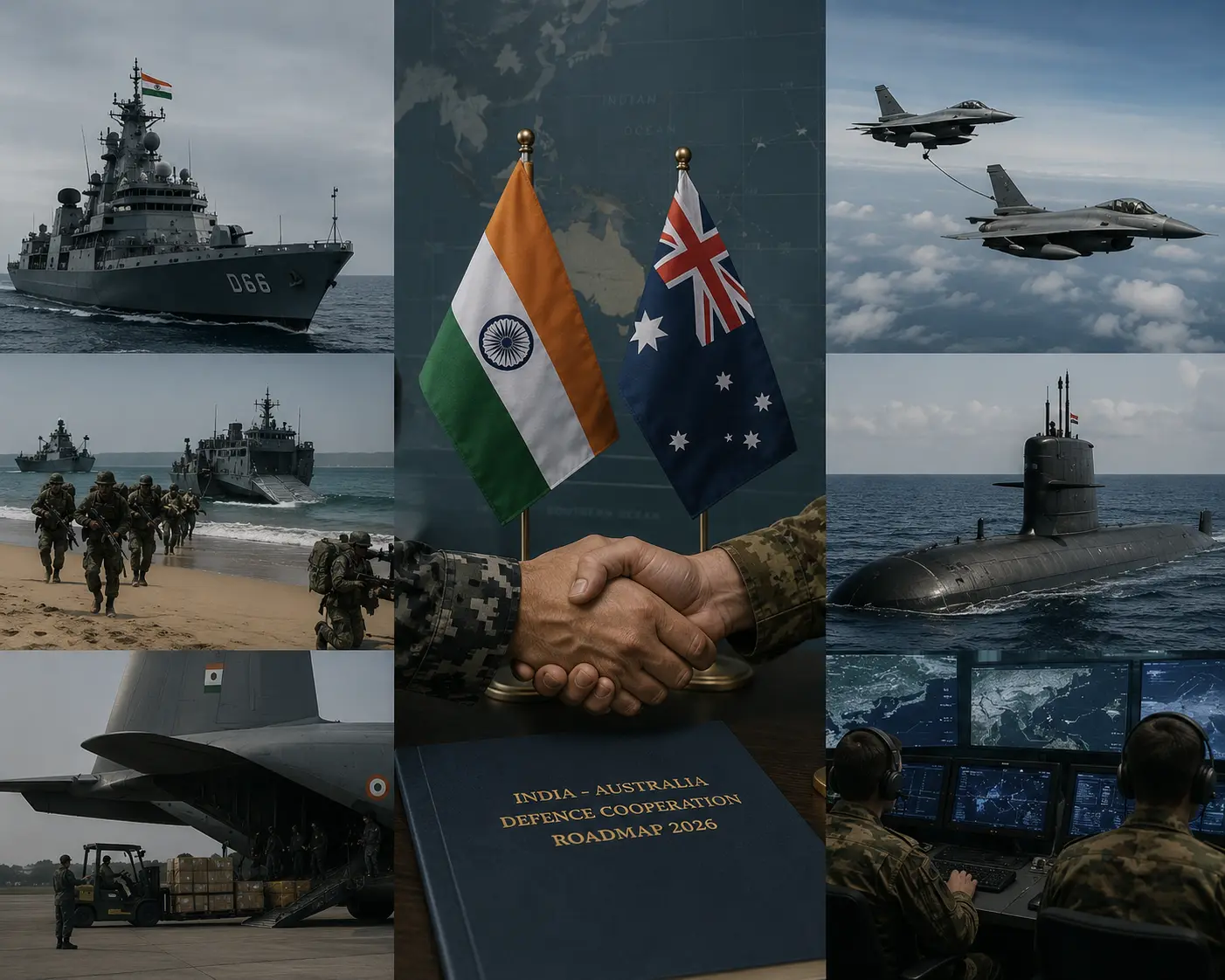
The 2026 summit was built on the adoption of an updated Joint Statement on Defence and Security Cooperation (2026) and a substantially enhanced India–Australia Maritime Security Collaboration Roadmap. These templates are significant improvements over the legacy 2009 and 2020 Comprehensive Strategic Partnership declarations. The emphasis is now unmistakably on total interoperability across every functional space, with particular concentration in underwater domain awareness (UDA), joint technology co-development, and logistics.
The operational tempo of the defence structure now spans the entire armed forces spectrum:
Multinational Maritime Integration — In the first half of 2026, naval synergy reached an unparalleled level with the Indian Navy's exercise MILAN in February 2026, followed immediately by the Indian Navy's deployment to Australia's Exercise KAKADU in March 2026.
Amphibious Combat and Littoral Manoeuvre — The annual Army Exercise AUSTHIND has been formalised as a littoral warfare and amphibious combat training exercise, focused on preparing forces for rapid-response deployment across small island states and critical choke points.
Air-to-Air Refuelling Operationalisation — The bilateral Implementing Arrangement on Air-to-Air Refuelling was successfully operationalised during multinational air exercises in 2026, strengthening the strategic reach of Indian fighter complements deep into the Southern Ocean.
Specialised Sub-Surface Warfare — India participated in Australia's Operation Render Safe 2026, as well as the classified submarine rescue exercise Black Carillon.
The Logistics Mutual Assistance Arrangement (MLAS) is being geared up to better support this high-octane operational tempo. The agreement now permits mutual access to military facilities — allowing Indian long-range maritime patrol aircraft to land and operate on Cocos (Keeling) Islands and Darwin, whilst Australian Poseidon sub-hunters make use of naval bases in the Andaman and Nicobar Islands on a regular basis. This establishes a continuous, unbroken line of sight over some major maritime choke points in the eastern Indian Ocean.
The new India–Australia Defence Innovation Corridor serves as an industrial bridge. Connecting defence technology startups from both ecosystems, this platform seeks to drive co-development of next-generation autonomous sensor arrays, drone systems, and secure quantum communication lines — maintaining the technological superiority of both armed forces without dependence on external, vulnerable supply lines.
The Economic Core: ECTA Success and the Complex Road to a Final CECA
Whereas the defence protocols furnish the required security blanket, the economic matrix embodies what the relationship is fundamentally about. Since the historic Economic Cooperation and Trade Agreement (ECTA) came into force on 29 December 2022, economic integration has accelerated at an almost unheard-of pace. As per the ECTA, 90% of Australian goods exports to India are already entering India duty-free, and 100% of Indian goods exports to Australia are subject to zero duties. This was India's first free trade agreement with a developed country for more than ten years, and the structural benefits are evident in FY 2025–26:
| Economic Indicator (FY 2025–26) | Value / Metric | Primary Content Sectors |
|---|---|---|
| Total Two-Way Bilateral Trade | USD 50.2 Billion (A$48.9B) | Goods, Institutional & Educational Services |
| Australian Exports to India | USD 32.0 Billion | Metallurgical Coal, LNG, Iron Ore, Critical Minerals |
| Indian Exports to Australia | USD 18.2 Billion | Refined Petroleum, Pharmaceuticals, Textiles, Jewellery |
| Tariff Reduction Impact (Australia) | 100% zero-tariff entry | Apparel, Engineering Goods, Agricultural Processed Products |
| Tariff Reduction Impact (India) | 90% value tariff-free | Industrial Inputs, Premium Wool, Wood Pulp, Seafood |
The success of ECTA has laid the groundwork for the current, very ambitious, negotiations on the full Comprehensive Economic Cooperation Agreement (CECA). While ECTA functioned as an early-harvest mechanism that delivered immediate gains in industrial inputs and consumer goods, CECA seeks to dismantle complicated non-tariff barriers, develop integrated frameworks for digital trade, and streamline investment routes through institutional borders. As of July 2026, 11 intense formal rounds of negotiations have been completed, with both trade ministries expected to finalise the text before the end of the current fiscal year.
Among the priorities in the CECA negotiations is the institutionalisation of the "Four Superhighways" identified in Australia's revised Economic Engagement Roadmap unveiled in February 2025: clean energy, education and skills, agribusiness, and tourism. Clean energy functions on a tightly integrated supply chain basis, with Indian state-backed companies now co-investing directly in mining assets in Western Australia under new joint venture models — securing a steady, certified supply of lithium, cobalt, and rare earth elements directly to India's industrial corridors, isolating the supply chain from third-party mediation.
Friction Points and Geopolitical Vulnerabilities: A Realist Reality Check
The summary of the India–Australia relationship is unequivocally positive, but to view the relationship objectively, two ongoing issues require honest evaluation.
Protectionism in Dairy and Agricultural Sectors The biggest stumbling block to finalising the full CECA is the extreme sensitivity of India's domestic dairy and agriculture industries. It has been politically impossible for New Delhi to open these markets to efficiently operated Australian agribusiness, irrespective of the diplomatic goodwill, given the millions of smallholder farmers who form the rural socio-economic foundation of India.
Non-Tariff Technical Barriers Indian exporters also have to deal with tough Australian sanitary and phytosanitary (SPS) requirements and non-tariff technical regulations. These strict requirements have a strong impact on Indian exports of fruits, vegetables, pharmaceuticals, and organics to Australia, causing long delays in compliance procedures at ports of entry.
Weaponised Interdependence Both economies remain heavily reliant on dominant regional manufacturers for many industrial components and consumer goods. Moving whole supply chains away from well-established legacy systems entails significant capital outlays and transition inflation on both sides, and both industries are reluctant to bear them fully.
Global Governance Gaps While institutionalisation within the Quad and the Indian Ocean Rim Association (IORA) is very strong, there are small gaps in architecture when it comes to long-term reforms in global security councils. These legacy system constraints occasionally force the two states to make trade-offs between traditional multilateralism and their immediate minilateral priorities.
To break the deadlock on technical trade, both trade ministries are now negotiating Mutual Recognition Agreements (MRAs) on professional services and technical standards — intending to methodically eliminate non-tariff barriers by standardising audit procedures and certifying compliance protocols at the source, while maintaining the regulatory integrity of each nation's domestic market.
The Way Forward: Navigating the 21st Century Indo-Pacific Superhighway
The evolution of the India–Australia Comprehensive Strategic Partnership suggests that this will be the defining feature of the next decade. The bilateral framework has demonstrated that it is not simply a reactive apparatus to external threats, but a proactive, bipolar system constructed to harness the comparative strengths of both democracies.
To keep this momentum going, future policy must have a strong emphasis on implementing the frameworks formulated at the Melbourne Summit in July 2026. The finalisation of CECA should be given top priority by settling outstanding tariff issues with appropriate safeguards — with the help of targeted tariff-rate quotas (TRQs), India can shield its most fragile agrarian population while providing market access for high-end Australian commodities. At the same time, implementation of the Maritime Security Cooperation Roadmap should be expanded to sophisticated underwater domain awareness arrays and deep-sea sensor telemetry, giving complete maritime visibility through the key choke points in the eastern Indian Ocean.
As the India–Australia partnership shows, genuine strategic resilience cannot be outsourced to automated or passive architectures. It requires constant human attention, perfect clarity of purpose, consciously chosen structural changes, and mutual dedication to regional stability. In so doing, New Delhi and Canberra are laying the foundations of a robust strategic bulwark that will guard the peace, freedom of navigation, and economic prosperity for generations along the Indo-Pacific superhighway.
Read Further
[1] Prime Minister of Australia. Visit to Australia by the Prime Minister of India — Official Statement, July 2026 — Click here
[2] Indian Masterminds. India–Australia Deal 2026: Complete List of Agreements Signed by PM Modi and Anthony Albanese — Click here
Disclaimer: The extensive geopolitical analysis, statistical data, and policy assessments provided in this comprehensive report are synthesised from current internet resources, official government press releases, and modern bilateral studies up to July 2026. This content is structured strictly for educational and strategic information purposes and should not be construed as official statutory counsel or direct financial advice from our editorial board.