


In today's hyper-accelerated corporate landscape, where professional worth is constantly metrics-driven and always-on connectivity is expected, we are facing an invisible epidemic. We talk extensively about the mental, psychological, and emotional toll of work-related stress. We talk about exhaustion, sleep deprivation, and the erosion of work-life boundaries. Yet, we rarely contextualize this phenomenon where it often strikes with brutal precision: our personal balance sheets.
Burnout is not just a physiological crisis; it is an economic drain. When human capital is pushed beyond its adaptive capacity, the resulting systemic collapse leaves a trail of financial destruction. Just as corporate entities experience decreased productivity and skyrocketing operational errors due to an overworked labor force, individuals face a parallel crisis in their private financial lives. We don't realize where we actually lose our hard-earned funds to the continuous friction of chronic stress, but the leakage is structural, systemic, and compounding year after year.
"We work under chronic exhaustion to earn more, only to compulsively spend the premium on survival mechanisms designed to temporarily mask that exact exhaustion."
The Anatomy of Convenience Buying and the "Convenience Tax"
When you are operating under acute or prolonged burnout, your cognitive bandwidth undergoes severe depletion. Executive functions — such as impulse inhibition, long-term planning, and analytical decision-making — are the first to degrade. In this depleted neurological state, your brain seeks immediate friction reduction. Survival mechanisms dictate that you will optimize for convenience at any financial price point just to navigate the day.
This reality manifests as a massive, continuous "convenience tax" levied on your everyday transactions. Cooking balanced meals, researching competitive prices, or executing basic domestic tasks becomes a monumental chore. Instead, the exhausted professional defaults to premium outsourcing. This includes recurring dynamic-priced ride-sharing because waking up early enough for public transit feels physically impossible, premium food delivery services with stacked convenience fees, and overnight shipping options for retail necessities that could have been purchased locally with minimal planning.
| Expense Class | Standard Monthly Cost | Burnout Dynamic Cost | Annual Leakage (Est.) |
|---|---|---|---|
| Nutrition & Meals | $400 (Groceries / Prep) | $950 (Delivery / Ready Meals) | $6,600 |
| Commute & Transit | $120 (Public Transit / Pass) | $450 (On-demand Ride Shares) | $3,960 |
| Domestic Maintenance | $0 (Self-managed) | $250 (Outsourced Cleaning / Laundry) | $3,000 |
| Unused Subscriptions | $30 (Active Use) | $110 (Unmonitored / Zombie Auto-pay) | $960 |
Recent microeconomic assessments reveal that individuals experiencing severe workplace distress face a vast cost variance compared to their baseline spending habits. A striking variance of up to 60% to 70% in discretionary leaks is regularly observed. This calculates to nearly 2 out of every 5 dollars spent in discretionary categories by a burned-out professional being directed entirely toward friction reduction rather than genuine utility or long-term happiness. Over a 12-month cycle, this localized inflation scales into thousands of dollars pulled directly from potential savings pools.
Doom Spending, Retail Therapy, and Dopamine Automation
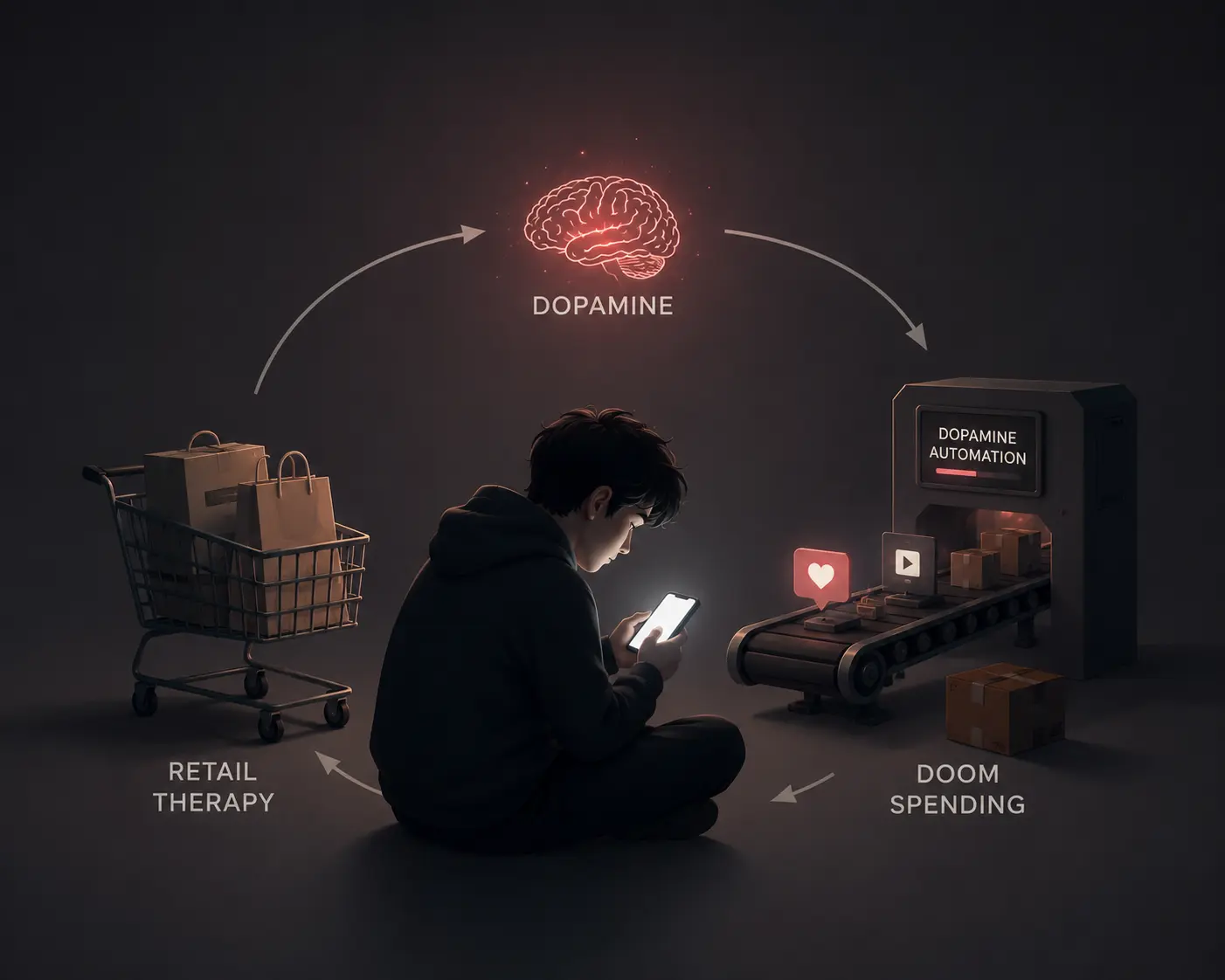
Beyond convenience, burnout triggers an emotional defense mechanism widely referred to as "Doom Spending" or compensatory consumption. When work provides zero emotional fulfillment and instead extracts an overwhelming amount of psychological energy, individuals subconsciously turn to the market to purchase short-term dopamine bursts. This is not mindful, intentional consumption; it is a reactive, willpower-dependent attempt to balance a negative emotional sheet.
The loop is as predictable as it is exhausting. After a grueling 12-hour day of high-stress client management or internal corporate friction, the quick tap of an online checkout acts as an emotional release valve. We buy high-end electronics we don't have leisure time to enjoy, wardrobe additions that remain tagged in closets, and luxury home goods designed to make an environment we only sleep in feel tolerable. This cycle quickly transforms into a tiresome chore of ordering, experiencing brief satisfaction, feeling subsequent guilt, and repeating the loop as the next workweek starts.
"Compensatory consumption is the financial interest we pay on an emotionally bankrupt career."
Furthermore, because the modern digital economy is built upon frictionless transactional architecture — one-click purchases, stored credentials, and targeted algorithm feeds — the burned-out mind is utterly defenseless against predatory marketing. The intentionality required to evaluate a purchase completely vanishes when your mind is preoccupied with an endless cycle of unresolved workplace tasks, micro-management anxieties, and impending professional milestones.
The Atrophy of Strategic Wealth Management
The most devastating, long-term financial casualty of chronic stress is not the immediate cash outflow; it is the absolute paralysis of your wealth-building infrastructure. Managing investments, reviewing asset allocation, optimizing tax exposure, and audit-checking insurance policies require high-level cognitive engagement and quiet analytical focus. When you are fighting professional burnout, your operational horizon shrinks from years to hours. You simply lack the headspace and energy to focus on anything beyond immediate survival.
This cognitive collapse leads directly to severe structural neglect in your portfolio:
Cash Drag Inflation: Significant capital sits completely idle in zero-yield checking accounts because the account holder is too mentally exhausted to research, open, and transfer funds into high-yield alternatives or index funds.
Advertisement
The Subscription Bleed: Auto-renewing corporate services, fitness memberships, SaaS tools, and lifestyle applications continue to charge accounts monthly because executing the multi-step cancellation flow feels like an insurmountable barrier.
Missed Tax Rebalancing: Forgoing strategic tax-loss harvesting, retirement match maximizations, or timely deductions simply because the paperwork or coordination with a financial planner represents additional mental overhead.
The Compounding Deficit Analysis If an average mid-career professional loses $1,200 per month to convenience taxes and compensatory spending during a prolonged multi-year burnout phase, that represents $14,400 annually in uninvested liquidity. Compounded over a standard 10-year professional window at a conservative 8% market return, the total opportunity cost escalates to over $225,000 in lost generational wealth. Burnout quite literally forces you to trade your financial freedom to sustain an unsustainable working environment.
Health System Penalties and Career Stagnation Costs
Eventually, the physiological bill for chronic stress arrives, and it always demands payment in full. Burnout systematically suppresses immune function, disrupts endocrine balances, and causes profound sleep disorders. The transition from psychological exhaustion to clinical medical intervention introduces direct, heavy financial penalties into an individual's life.
Out-of-pocket medical co-pays, specialized mental health counseling sessions not fully covered by corporate insurance plans, prescription pharmaceutical costs, and alternative therapeutic interventions add a massive structural baseline to monthly expenses. In extreme scenarios, the physical breakdown forces prolonged unpaid leaves of absence, sudden career pivots into lower-paying roles, or complete professional exits that damage lifetime earning trajectories.
Paradoxically, while professionals sacrifice their well-being to protect their standing or accelerate their income within an organization, severe burnout actively causes catastrophic career stagnation. An exhausted mind cannot innovate, cannot build high-value corporate alliances, and cannot command authority during critical promotion cycles. You become functionally trapped in a defensive survival stance, performing just enough to avoid termination, while missing out on high-advancement trajectories and wealth-generating equity events that require creative vitality and sharp strategic thinking.
For a deeper breakdown of how chronic stress structurally degrades the sleep quality that your body depends on for cognitive recovery, see You're Sleeping 7 Hours But Waking Up Exhausted. India Has a Recovery Problem, Not a Sleep Problem.
Reclaiming Autonomy: Breaking the High-Stress Expenditure Cycle
To break this structural drain, we must treat financial management not as an isolated spreadsheet exercise, but as a direct reflection of our physiological energy reserves. Relying on sheer willpower to curb spending while maintaining an environment that systematically guts your willpower is an exercise in absolute futility. True financial defense requires systemic design, behavioral guardrails, and radical lifestyle intentionality.
First, automate your financial boundaries to protect your capital from your own exhausted mind. Shift from a reactive spending system to a structured, automated distribution framework. Configure your payroll infrastructure to route specific percentages of your income directly into locked investment vehicles and high-yield savings accounts immediately upon receipt. By removing the decision-making step entirely, you ensure that your wealth-building occurs independently of your daily cognitive state.
Second, audit your lifestyle dependencies. Acknowledge the categories where you are paying a "convenience tax" and systematically build non-negotiable physical buffers around them. If dinner delivery is your financial structural leak, explicitly build a simplified, highly predictable meal template or source a fixed-price healthy subscription model that undercuts erratic on-demand delivery apps. Most importantly, realize that the most effective financial optimization strategy is sometimes the most radical one: addressing the root cause of your energy depletion.
Transitioning to a professional role with lower cognitive friction — even if it features a nominal salary reduction — can frequently result in a net-positive financial return due to the immediate elimination of burnout-driven consumption patterns.
Read Further
- The Health and Economic Burden of Employee Burnout to U.S. Employers — American Journal of Preventive Medicine, 2025
- Doom Spending and Financial Health Among Millennials and Gen Z in the Digital Era — International Journal of Economics, Business and Management Research, 2026
- Burnout: An Occupational Phenomenon — World Health Organization ICD-11 Classification
Disclaimer: All data, cost frameworks, and contextual analysis presented in this article were synthesized from contemporary workplace stress research, microeconomic consumer behavior studies, and personal finance literature. This content is intended purely for educational and analytical awareness purposes and should not be taken as formal financial, investment, or medical advice. Individual financial outcomes vary by geography, income level, and personal circumstances.
Advertisement