

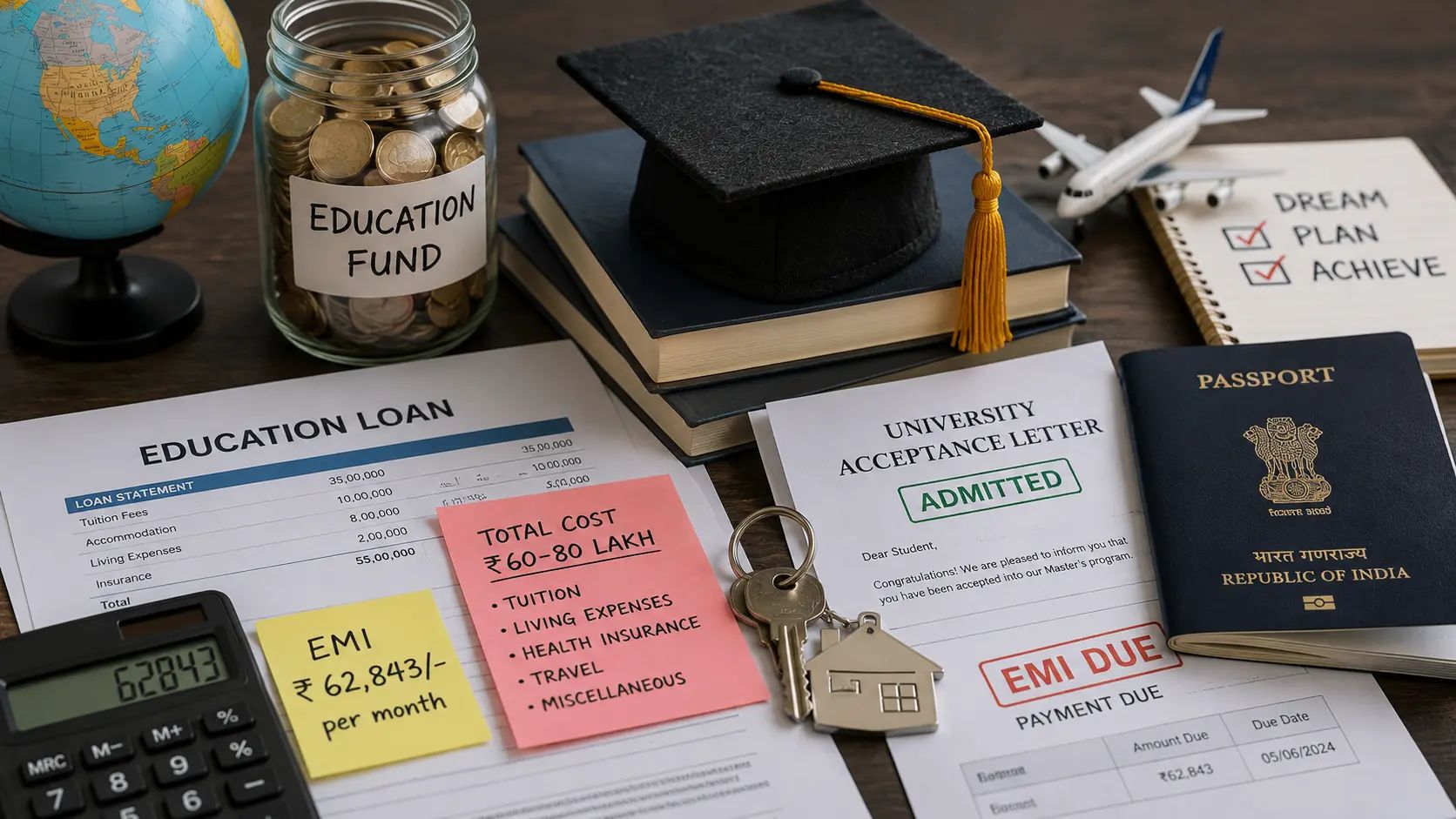
In today's era where everything is being commoditized and globalized, the aspiration for a foreign degree has transformed from a rare luxury into an absolute necessity for middle-class Indian households. We have become too much dependent on the premise that an international diploma guarantees a gilded career path, and while it is undeniably useful for some global exposure, for the vast majority, it is not.
Higher education overseas was historically funded through scholarships or generational corporate wealth. However, as millions of students flock to autonomous university application systems and competitive international visa pipelines, we don't know where we actually forgot the old rules of financial management and household safety nets. In the absolute rush to secure a stamp from a university in the US, UK, Canada, or Australia, parents are liquidating their lifetime savings, breaking long-term Public Provident Funds (PPF), and taking out massive loans collateralized against their only residential assets — forgetting the severe mathematics of compound interest and retirement timelines.
So this article is going to get you all aware about what we should calculate before signing away a financial future, and what we must understand regarding the cold reality of traditional budgeting versus emotional investments.
The Ballooning Expenses and the Illusions of Global Returns
With international education systems shifting their revenue models heavily toward high-paying international tuition fees, calculating the true expenses of a student's daily life abroad has become critical. The sticker price of tuition is merely the tip of an expansive financial iceberg. When Indian parents look at university brochures, they see base tuition figures; they rarely factor in the aggressive currency inflation, localized housing crises, rising healthcare costs, and basic survival expenses that compound exponentially over a 2 to 4-year tenure.
| Metric | Figure |
|---|---|
| Average cost of a 2-year Master's degree | ₹60 – 80 Lakh |
| Funded via retirement savings or loans | 65 – 70% |
| Students who secure a sponsored work visa | 1 in 5 |
Autonomous financial planning dictates that an investment must be weighed against its realistic internal rate of return (IRR). The actual expenditure layout across popular international education destinations as experienced by middle-class Indian families today:
| Destination | Avg. Annual Tuition (INR) | Living Expenses & Health Cover (Annual) | Typical Funding Profile |
|---|---|---|---|
| United States | ₹35,00,000 – ₹55,00,000 | ₹12,00,000 – ₹18,00,000 | 40% PPF / Savings + 60% Property Loan |
| United Kingdom | ₹25,00,000 – ₹40,00,000 | ₹11,00,000 – ₹15,00,000 | 50% Retirement Corpus + 50% Personal Loan |
| Canada | ₹20,00,000 – ₹35,00,000 | ₹10,00,000 – ₹14,00,000 | 30% Agricultural Land + 70% Student Loan |
| Australia | ₹22,00,000 – ₹38,00,000 | ₹12,00,000 – ₹16,00,000 | 45% Mutual Funds + 55% Bank Co-sign |
These international configurations demand a massive capital layout. For a typical double-income middle-class household in India, whose peak savings aggregate to a retirement corpus of approximately ₹1 Crore to ₹1.5 Crores, a single child's foreign master's program routinely claims up to 60% to 80% of that entire pool. The core rationale provided by families is that the student will earn in foreign denominations (USD, GBP, CAD) post-graduation, instantly liquidating the liabilities and replenishing the parental accounts. However, this is exactly where the mathematical framework collapses entirely.
"Spend consciously and save intentionally — yet when emotion masks itself as education, the basic safety of a family's financial future is entirely abandoned."
Cons of the Over-Leveraged Educational Gamble
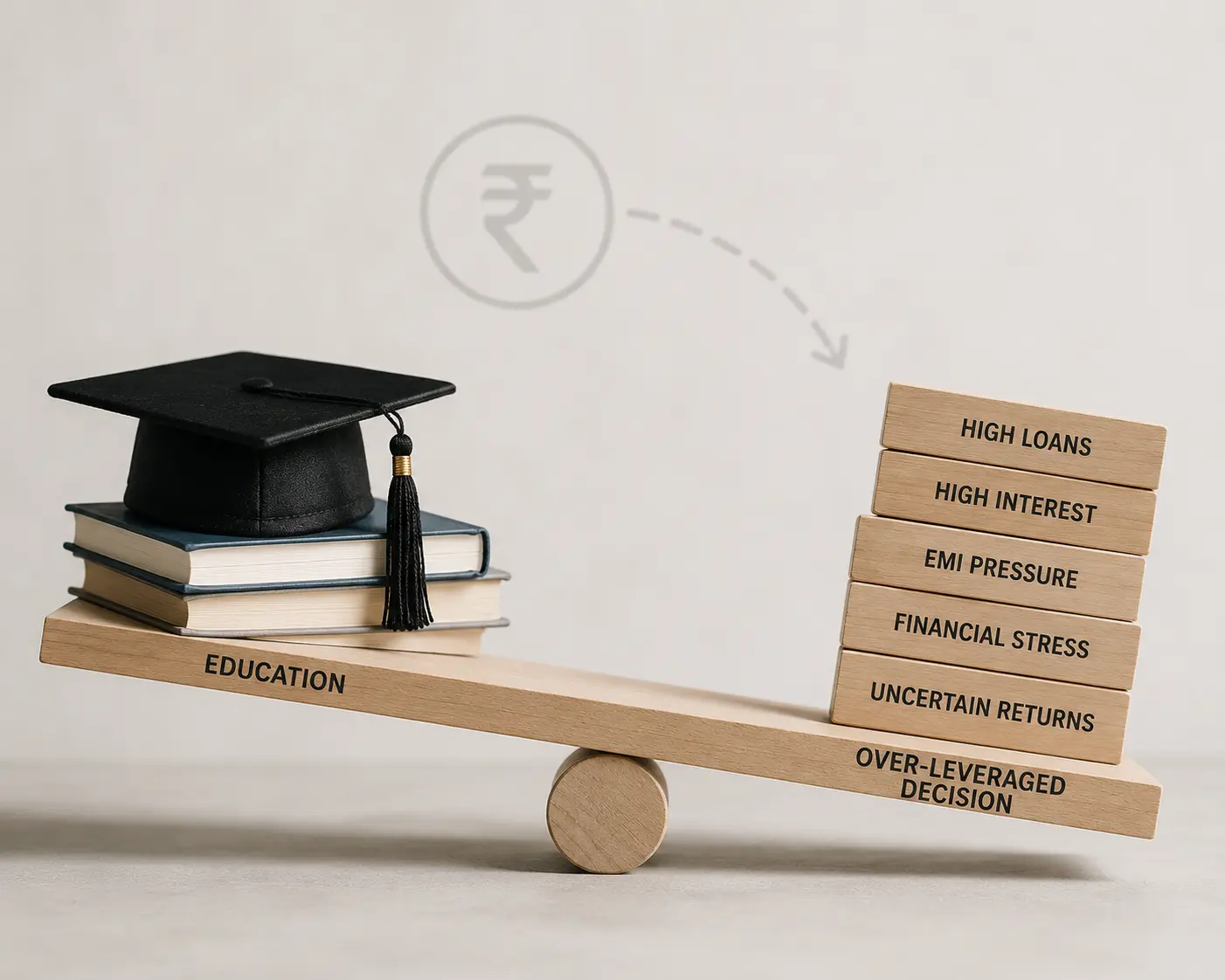
The core issue is that global job markets are no longer predictable entities that operate on human-based mindsets of absolute loyalty or guaranteed entry. Macroeconomic factors — ranging from localization laws to tight work-visa policies — mean that the probability of an international student securing long-term sponsorship has seen a severe downward shift. Recent data indicates that a vast difference of 65% is seen between student expectations of working abroad and the actual number of individuals who manage to secure visa conversions.
Mathematically, the calculation breaks down when we model the scenario of a student who is forced to return to the Indian domestic job market due to visa expirations. Using standard variables:
Advertisement
Total Liability (L) = ₹75,00,000 at Rate (r) = 11.5% p.a. Education Loan
If the student returns to India, the average starting salary for a foreign-returned graduate without prior extensive corporate experience hovers between ₹8,00,000 to ₹12,00,000 per annum. After deducting standard domestic taxes and living costs in Tier-1 Indian tech cities, the maximum disposable income available for loan servicing is approximately ₹40,000 per month (₹4,80,000 annually).
However, the annual interest accumulation alone on a ₹75 Lakh loan at 11.5% is ₹8,62,500. This creates a devastating debt trap where the annual domestic repayment does not even cover the interest accrued on the foreign degree asset. Use the EMI Calculator to model your own repayment scenario before committing to any education loan. This leaves an error in budgeting which, if not rectified early, can get a household into a state of structural insolvency and permanent asset loss.
Giving up parental assets and continuously paying off high-interest EMIs during one's late 50s and early 60s turns retirement from a peaceful phase into an endless loop of financial panic. Parents find themselves working way past their physiological capacities, taking up arbitrary consulting roles, or drastically cutting down on necessary daily healthcare expenditures just to keep up with the bank's demands. It becomes a tiresome, stressful chore of the day which takes more mental toll and headwork, providing major headaches, family strain, and deep psychological distress in the twilight years of life.
The Traditional Budgeting Lens: Reclaiming Financial Discipline
If we view this crisis through the lens of ancient financial systems like the Japanese Kakeibo, the focus shifts immediately back to awareness, reflection, and absolute structural discipline. Kakeibo teaches us to pause before any significant outflow and face four explicit questions: How much money do you actually have? How much would you like to save? How much are you actually spending? And how can you improve?
When applied to the foreign degree dilemma, a disciplined financial framework demands that we classify the expenditure strictly across sustainable lines instead of relying on pure speculative optimism. A foreign degree must not be treated as a magical lottery ticket; it must be classified under strict capital expenditure boundaries:
1. The Boundary of Net Worth No single educational expenditure should consume more than 25% of a household's total liquid retirement net worth. The remainder must stay locked in secure compounding assets to maintain parental independence.
2. The Emergency Contingency If the student cannot secure a foreign placement, the household must possess a secondary, autonomous income stream or cash buffer to service the loan without touching the primary residential home.
3. The Realist Valuation Aligning the specific field of study with verified global visa quotas rather than generic brand prestige or emotional narratives.
Now, it may sound like an over-conservative version of wealth management, but no — it is the foundational truth of sustainable finance which dictates that when you calculate and balance the downside risk yourself, your mind becomes completely aware of what you are sacrificing. It forces families to ask whether it is right or wrong to buy into a premium brand at the absolute expense of medical security and retirement peace.
To spend twice before deploying your life's earnings is the core principle of success in money management and saving. Indian parents must stop treating their retirement corpus as an expendable educational subsidy. Ultimately, protecting the family's financial core is the truest gift of stability a parent can provide to the next generation.
Read Further
[1] Reserve Bank of India. RBI Guidelines on Education Loans — Model Education Loan Scheme (MELS) 2022 — Click here
[2] Ministry of Education, Government of India. All India Survey on Higher Education (AISHE) 2021–22 — Click here
Disclaimer: All the analytical data, formulas, and structural patterns provided above were compiled from general personal finance methodologies, global visa success rate metrics, and standard education loan frameworks. This analysis is for educational purposes and should not be taken as formal legal or individualised financial advice.
Advertisement