

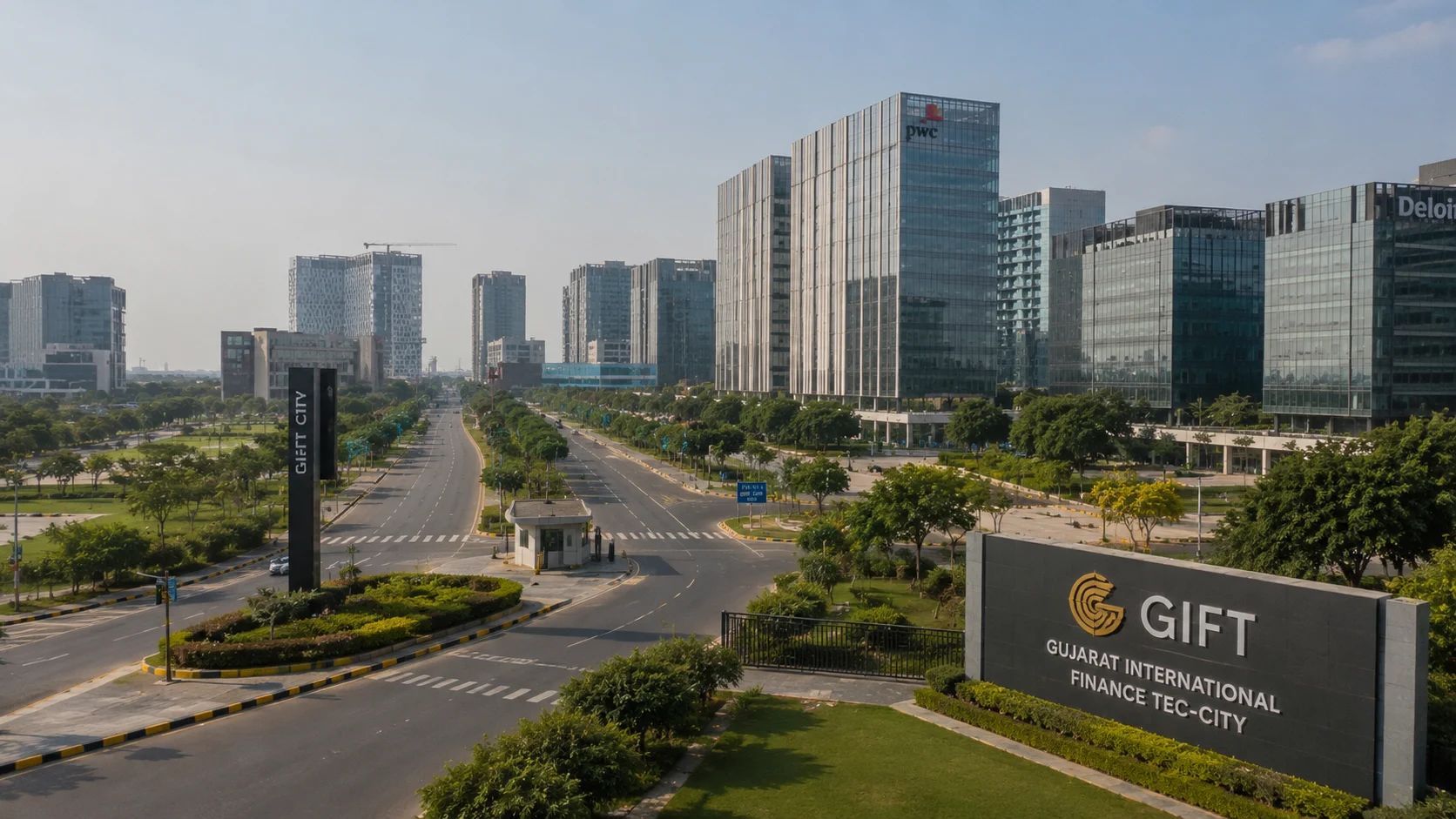
The biggest myth about the Gujarat International Finance Tec-City (GIFT City) in 2026 is that its success is solely due to tax arbitrage and real-estate absorption. Analysts and institutional investors regularly count the number of sparkling glass towers going up in Gandhinagar, salivating over headline-grabbing announcements like that of global reinsurers taking their International Financial Services Centre Authority (IFSCA) licences. However, to think of global reinsurance hubs as real estate or a pure regulatory play is to miss the vital, underlying plumbing of the industry. The real bottleneck to building an offshore insurance market isn't square footage; it's the intensely specialized, intellectually rich human capital it takes to operate a reinsurance node. You can legislate a tax haven into existence overnight, but you can't conjure the actuaries, catastrophe modelers, and specialty legal structures needed to underwrite multi-billion-dollar parametric risks.
Understanding this problem requires an examination of both the history and culture of risk itself. The derivation of the word "actuary" is from the Latin actuarius, which is related to actus—a political functionary or a bureaucrat—in this sense the word connotes a very particular identity, necessitating trust and significant precision. In the ancient Indian treatises on administration of state, including Kautilya's Arthashastra, the idea of handling the risk of the state and collective treasuries was dependent on elite mathematician clerks who performed Ganana (गणना), the science of calculation. This tradition of structured administrative accounting is said to date back several centuries. Today, modern Ganana takes the form of stochastic modeling and Monte Carlo simulations.
Over 20 global behemoths in reinsurance have committed to set up as IFSC Insurance Offices (IIOs) by mid-2026, with booked premium volumes amounting to several billions. However, the unpriced risk in this whole macro argument is whether India's domestic supply of these modern record-keepers can keep pace with the parabolic demand curve. Without a strong team of local analytical talent, a reinsurer is nothing more than a very costly post office.
This reality requires us to pivot in our analysis of the investable landscape in GIFT City. The alpha is not in purchasing the equity of the insurers themselves, who are subject to fierce global pricing competition, but rather in business process management (BPM) service providers, Global Capability Centers (GCCs), and niche professional services firms that are located just beneath them. If the reinsurers are the gold miners of this new financial frontier, the services layer is the company selling the proverbial picks and shovels—and, increasingly, the complex ground-penetrating radar. We will have to map exactly what this second floor of GIFT City needs, against the existing lack of domestic capacity and the anticipated needs for three to five years, and pick out the companies that could fill the gap.
The IIO Surge and the Solvency-Equivalence Amplifier
The surge of reinsurers into GIFT City didn't come about in a vacuum; it was engineered by a very particular regulatory catalyst: the IFSCA solvency-equivalence regulations. In conventional tax havens offshore in the 1990s and 2000s, an insurer could establish a shell company, book huge premium amounts, and conduct risk modeling in home offices in London or New York. Modern-day financial regulations (in the global BEPS frameworks) have extinguished the post-box model. The 2026 IFSCA rules stipulate that for an IIO to avail itself of the jurisdiction's capital efficiencies, it must have a demonstrable local economic presence and operational self-sufficiency. If a reinsurer's domestic regulator recognizes the IFSCA regime as "solvency-equivalent," it may do so with a reduced level of local capital — yet, paradoxically, this increases the local operational substance hurdle. They have to show that the underwriting, risk modeling, and fund administration are all taking place physically within the bounds of GIFT City. It is this regulatory nuance that largely dictates the hiring patterns on the ground. A Tier-1 reinsurer opening an operation in Gandhinagar today cannot simply outsource its core actuarial work to its main office without violating substance requirements.
If you look at offshore reinsurance hubs such as Bermuda, Singapore, and Dublin, the staffing ratios are telling. In Singapore, for every $100 million in localized reinsurance premium, there is already an ecosystem that needs close to 15–20 highly specialized personnel in actuarial, legal, and compliance areas. Applying this ratio to the premium volumes now flowing into GIFT City points to a significant unaccounted-for talent gap. The Institute of Actuaries of India (IAI) has traditionally been oriented primarily towards the domestic life and general insurance sectors. Producing fully credentialed actuaries is a gruelling, cost- and time-intensive process, and pass rates are notoriously low. The current domestic system is ill-suited to suddenly produce hundreds of specialists versed in complex international reinsurance treaties, alternative risk transfer mechanisms, and the like.
And because the organic growth of talent is too slow, we are seeing a dramatic acceleration in corporate training academies and the expansion of existing GCCs. Global BPM leaders that have spent two decades building deep back-office processing expertise for US and European insurers are now scrambling to elevate their Indian workforces to meet the still-emerging demand for front-office services in GIFT City. Moving from legacy claims handling to sophisticated predictive analytics means building entirely new technology stacks and training models, and swapping out traditional spreadsheet-based underwriting for Python-scripted catastrophe models.
"You can bring in capital through a wire transfer, you can bring in technology through an API key, but you can't bring in five years of localized actuarial judgment. That needs to be built, and right now the people who can build it, the builders, are setting the price."
To keep track of the evolving IIO registrations and the evolving substance requirements behind this talent demand, analysts use the following critical tools:
- IFSCA Official Portal (
www.ifsca.gov.in): The main regulatory dashboard for following fresh IIO licenses, solvency norms, and official circulars relating to economic substance requirements in GIFT City. - Institute of Actuaries of India (IAI) (
www.actuariesindia.org): Vital for gauging the domestic supply of actuarial talent, pass rates, and new curricula designed for international reinsurance. - GIFT City Official Website (
www.giftgujarat.in): Tracks the macro-level physical absorption of real estate and maintains the master list of financial institutions functioning within the SEZ. - IRDAI (Insurance Regulatory and Development Authority of India) (
irdai.gov.in): While IFSCA has jurisdiction over GIFT City, IRDAI's figures on domestic reinsurance cessions shed light on the extent of risk being moved to the offshore hub. - Bermuda Monetary Authority (BMA) (
www.bma.bm): The gold standard for offshore reinsurance regulation; examining their solvency-equivalence models provides a predictive path for IFSCA's development. - Monetary Authority of Singapore (MAS) – Insurance (
www.mas.gov.sg/regulation/insurance): Singapore is the nearest Asian rival to GIFT City; following their talent programmes provides a straight comparative measure for staffing ratios. - OECD BEPS Guidelines (
www.oecd.org/tax/beps): The underlying global tax rule set that insurers must comply with to demonstrate true operational substance and physical talent in offshore jurisdictions.
The Four-Part Supply-Demand Gap Model for Analyzing the Supply Chain
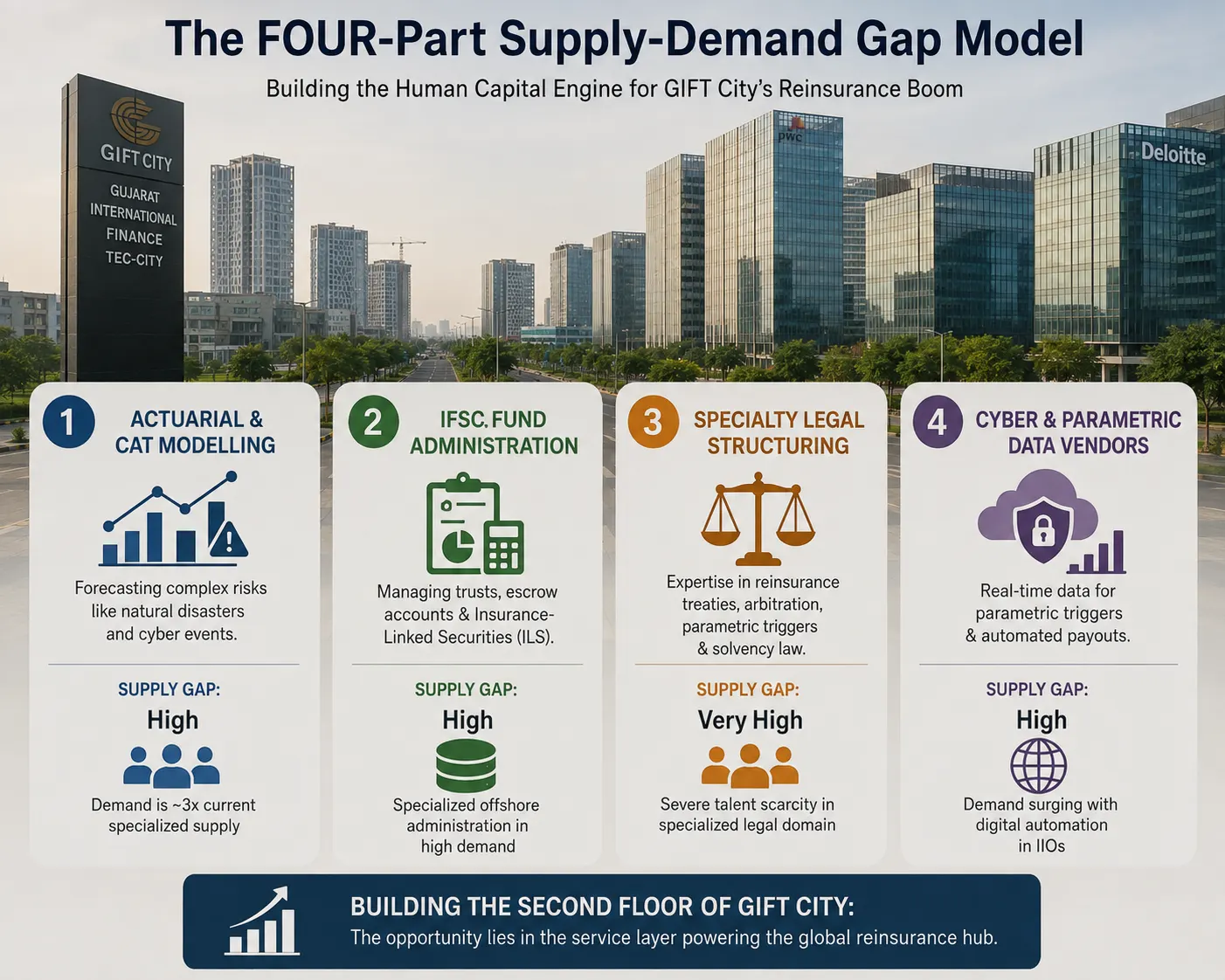
To be able to compare the different investible propositions inside the GIFT City services arbitrage, we can translate this talent necessity into a sensible four-part supply-demand gap model. This model enables us to rate the present level of domestic supply against 3–5 year forecasts in each critical vertical.
1. Actuarial and Cat (Catastrophe) Modelling. This is the intellectual heart of reinsurance. Cat modelers apply advanced geophysical modeling techniques to forecast the potential loss from a hurricane, earthquake, or cyber event. The Indian domestic supply is pretty strong and voluminous in 2026, but it mainly caters to standard life and health tables. The gap is there, in P&C and specialized cat modelling. The anticipated demand over the next three years is around three times the existing specialized supply, resulting in unparalleled pricing power for listed BPMs such as WNS and EXL, which have internal academies for this niche.
2. IFSC Fund Administration. Reinsurance is based on trusts, escrow accounts, and securitizing risk into Insurance-Linked Securities (ILS). Running an ILS fund, in particular, involves a very specialized form of multi-currency fund accounting integrated with complex collateral management. Traditionally, the majority of these activities took place with companies based in the Caymans or Dublin. The Indian domestic market has enormous mutual fund administration capacity (juggernauts like KFintech and CAMS), yet high-precision, high-velocity administration of offshore reinsurance vehicles remains a hole in the market. Domestic supply is currently scaling, but the immediate demand for turnkey IFSC fund administration is providing significant momentum for specialized global administrators looking to expand their local presence.
3. Specialty Legal Structuring. Reinsurance treaties are not run-of-the-mill contracts; they are customized, multi-national legal documents needing specialized expertise across international arbitration, parametric triggers, and solvency law. The Indian legal market is immense, yet the pool of lawyers conversant with the specific mechanics of offshore reinsurance syndication is shockingly tiny. Current domestic capacity is severely limited, creating a restrictive but profitable bottleneck for specialist corporate law firms developing dedicated GIFT City practices.
4. Cyber and Parametric Data Vendors. Contemporary reinsurance is dependent on real-time data streams to trigger payouts — such as a smart contract that pays out automatically if a particular weather station detects wind speeds greater than 150 km/h. Supplying and auditing this data involves a merging of cybersecurity and meteorological data science. The need for these expert tech vendors is soaring as IIOs look to automate their claims within the IFSC.
"You can't run a 21st century parametric reinsurance node out of 20th century spreadsheet analysts. The arbitrage is not just about labor cost anymore—it's also about how quickly an economy can produce specialized data scientists."
To track this four-stage model and see which firms are closing the talent and technology divide, analysts follow these operators and sources of data:
- WNS Global Services (
www.wns.com): Leading listed BPM player with a sizable, dedicated insurance vertical, rapidly growing its analytics and actuarial support functions for global reinsurers. - EXL Service (
www.exlservice.com): A leader in predictive analytics with a strong presence in P&C catastrophe modeling and capacity building in India. - Genpact Insurance Services (
www.genpact.com): With a history rooted in GE Capital, Genpact offers a window into how enterprise-scale GCCs move from rudimentary processing to complex underwriting support. - KFin Technologies (
www.kfintech.com): A leading domestic fund house administrator now looking to bridge the gap between administration for alternative investment funds (AIFs) and IFSC vehicles. - Apex Group India (
www.apexgroup.com): A global financial services provider whose venture into GIFT City demonstrates the demand for specialized offshore fund administration for intricate structures. - Cyril Amarchand Mangaldas (CAM): A top-tier Indian law firm with a dedicated IFSC practice, offering a glimpse into specialty legal structuring and regulatory advisory work.
- RMS (Risk Management Solutions) – Moody's (
www.rms.com): The de facto standard in catastrophe modeling software; monitoring their talent alliances and deployments in India acts as a proxy for cat-modeling maturity.
Advertisement
The Dublin Playbook and the GCC/BPM Arbitrage
To get a real sense of the direction of GIFT City's services layer, we need to examine the historical example of the International Financial Services Centre (IFSC) in Dublin, Ireland, in the late 1990s and early 2000s. Dublin was not fashioned into a global center for aviation leasing and reinsurance just for its low corporate tax rate. Its actual lasting moat was the frenetic, state-subsidized growth of a narrowly skilled talent pool. The Irish government, working in partnership with universities, specifically trained tens of thousands of fund accountants, specialized tax lawyers, and actuaries to cater to the influx of foreign capital. They built the second floor before the first floor was even fully occupied. This created a sticky ecosystem; even when other jurisdictions offered marginally better tax rates, reinsurers stayed in Dublin because leaving would mean losing access to a unique workforce capable of comprehending even the most complex portfolios of almost all of the world's reinsurers.
We are witnessing this exact playbook repeat in Gandhinagar, but supercharged by the sheer scale of the Indian IT and BPM arbitrage. But the model is evolving. A global reinsurance giant would typically establish its own Captive Global In-house Center (GIC) in Bangalore or Pune to handle the back-office work. Now, reinsurers need to move at the speed of a herd of antelope — not of a turtle. Deploying in GIFT City makes the captive model too slow and unwieldy. Building out physical infrastructure, hiring niche talent, and navigating local HR laws can take 18 to 24 months. Instead, we are witnessing an enormous migration to third-party, specialized GCC-as-a-service models. Listed BPMs and other niche talent aggregators are effectively creating plug-and-play actuarial/modeling shops within the GIFT City SEZ, enabling incoming reinsurers to rapidly achieve operational substance for day-one compliance.
This dynamic exchange shifts the balance of power more in favor of the services vendors. And since the availability of such talent is highly inelastic for the near future, the BPM and niche staffing companies emerging within GIFT City enjoy significant margin premiums over traditional IT services. They're no longer selling hours of labor; they are selling regulatory compliance and speed to market. Investors in the mid-cap IT and BPM space need to be able to distinguish between firms that are playing in the commoditized BPO space and those that have actually built the specialized, domain-heavy moats necessary to service the IIO boom. They are buffered from the deflationary forces of pure AI automation, as the regulatory schemes mandate certified human review in catastrophic risk models.
"Tax incentives bring the capital, but the presence of complex, domain-specific skills is what retains it. Dublin demonstrated that if you control the back-office, you set the rules for the front-office."
To study the development of the GCC model, talent upskilling, and historical comparables such as Dublin, the following resources are vital for the analyst:
- NASSCOM GCC Hub (
nasscom.in/gcc): Leading industry body for macroeconomic analysis on the transition from conventional IT outsourcing to high-value Global Capability Centers in India. - IDA Ireland (International Financial Services) (
www.idaireland.com): Historical case studies and talent development models published by Ireland's inward investment promotion agency offer a roadmap for offshore hub upscaling. - Xceedance (
xceedance.com): A global leader in insurance consulting and managed services, representing the focused, domain-specific assistance that contemporary reinsurers require. - Anakin (Pricing & Data Intelligence) (
anakin.ai): Emergent data platforms used to monitor wage inflation and hiring patterns in real time across specialized financial hubs — critical to services-arbitrage modeling. - CAS (Casualty Actuarial Society) (
www.casact.org): The international credentialing organization for P&C actuaries; monitoring their testing volumes in India signals the long-term pipeline of non-life risk talent. - Symbiosis School of Banking and Finance (SSBF) (
ssbf.edu.in): Increasingly collaborating with the banking sector on customized curricula for the specific demands of IFSC operations. - Gujarat Maritime University (Commercial Law) (
gmu.edu.in): A homegrown example of academia grappling with the specialized legal void, primarily in areas interfacing with marine insurance and international trade structuring.
Risks, Lateral Hiring, and the Capacity Ceiling
While the underlying value proposition for the GIFT City services arbitrage is extraordinarily compelling, investors will have to stare down the structural risks and constraints that can foil or compress that thesis. The greatest danger to the domestic services players is the prospect of more aggressive poaching by rival hubs. If the talent crunch at Gandhinagar gets too severe, causing excessive wage inflation, IIOs may instead decide to bring in experienced actuarial talent directly from Singapore, Dubai, or London. While this meets the regulatory substance criteria, it effectively bypasses Indian BPM and GCC operators, closing the talent gap not through domestic upskilling but expensive expatriate deployment. If this happens at scale, the expected margin expansion for listed Indian services firms would rapidly get squeezed, as they would be forced into cut-throat bidding wars to keep their specialized staff.
Moreover, the whole growth model is subject to the whims of the IFSCA and international regulators. There is a real risk of a slowdown in reinsurer entry associated with changes to solvency equivalence. If major global regulators (the UK's PRA, the EU's EIOPA, etc.) are reluctant to extend full equivalence to the IFSCA regime, reinsurers will have to hold more capital for their Indian operations. This would substantially undermine the financial attractiveness of channeling premium volumes through GIFT City, leading to a sudden stop in IIO registrations. In this case, the BPMs and specialized GCCs that went on a capacity-expansion rampage in anticipation of a multi-year boom would be left holding extremely costly, idle talent, crippling their margins.
On a more cautionary note, there is strong customer concentration risk to be found in the initial years of any offshore hub. The current tide of IIO registrations is led by a small number of huge, Tier-1 global reinsurers. A mid-cap services firm or specialty legal practice that derives most of its revenue from servicing just one of these giants carries excessive concentration risk. If a major global player were to shift its strategic focus to another emerging market, switch to a faster in-house IFSC vendor, or cancel its third-party contracts, the blow to the local services provider would be massive. Investors need to do some serious vetting of the contract models to ensure they look like satisfactory, multi-year engagements rather than ephemeral consulting work.
"The final cap to how much GIFT City can grow is not regulatory permission; it is the domestic labour market's ability to take in and train up to such an extreme level of financial complexity without blowing up in a geyser of wage inflation."
Specialized tracking platforms are employed by fund managers to keep a scrupulous eye on these risks, on the pace of lateral hiring, and on changes in regulatory status internationally:
- LinkedIn Talent Insights (
business.linkedin.com/talent-solutions): The best real-time resource for tracking where actuarial and cat-modeling talent is moving to and from between Singapore, Dubai, and GIFT City. - EIOPA (European Insurance and Occupational Pensions Authority) (
www.eiopa.europa.eu): Necessary for keeping an eye on official pronouncements and assessments on things like third-country regime solvency equivalence — e.g., India's IFSC.
In conclusion, GIFT City hype in the media will no doubt continue to revolve around the skyline and the total number of registered insurers. But the real savvy investment idea is hidden in plain sight: the services supply chain. This is a labor-market-constrained expansion narrative trapped within a real-estate headline. The global reinsurers are locked in a race to develop mathematically rigorous, compliant nodes in India's premier offshore jurisdiction, but they are wholly reliant on an acutely constrained domestic talent pool to do so. By directing capital toward the specialized BPMs, niche fund administrators, and domain-intensive technology vendors best equipped to address this talent crunch, investors can participate in the most compelling, risk-adjusted margin-expansion story of the whole GIFT City experiment. The towers are built; the real money is in the people who know how to work in them.
"We waste our time arguing about which reinsurer will come out on top of the market, and in doing so we ignore the inevitable — that they all have to pay the company who gives them the math the very same toll."
References & Further Reading
- GIFT City Lands Another Major Reinsurer as Santam Opens Branch — Insurance Business Magazine
- Global Reinsurers Move to Establish Presence in India's GIFT City — Life Insurance International
- GIFT City Insurance and Reinsurance Hiring — EliteRecruitments
Disclaimer: All the information above was obtained from public internet resources and studies. Please do not take this as financial, professional, medical, or legal advice; it should not be considered as such.
Advertisement