

The one thing that never seems to be accurately understood across healthcare equity research as of mid-2026 is that not all of the margin expansion reported by Indian Contract Development and Manufacturing Organizations (CDMOs) is attributable to geopolitical China+1 sentiment. For almost three years, sector bulls, sell-side analysts, and medium- to long-term institutional fund holders have credited the sector's incredible rerating to US biopharma companies fleeing Chinese contract manufacturers in fear of the BIOSECURE Act and commerce retribution. This narrative holds that India's CDMO surge is fundamentally an arbitrage on Washington's mood — a cyclical wave of order reallocation that will break and wash up on shore when diplomatic tensions loosen or Chinese players lower their fees. It is a comforting thesis for generalist investors who prefer macro-thematic headlines, but mathematically it does not capture the true underlying value-compounding engine in Indian life sciences.
You need to look at how pharmaceutical contract manufacturing actually works to understand why this attribution error is so hazardous for equity valuation in 2026. Traditional CDMO models, as practised by Indian mid-caps, were essentially low-margin formulation or late-stage intermediate conversion plays with a strong reliance on importing Chinese bulk active pharmaceutical ingredients (APIs) and Key Starting Materials (KSMs). In that legacy architecture, an Indian manufacturer was little more than a pay-for-processing gate, susceptible to Chinese feedstock price hikes and shipping disruptions. But today, a wholly different set of economic staples has been established.
As per provisional Q1 2026 figures from the Ministry of Chemicals and Fertilizers and the Department of Pharmaceuticals, more than 48 per cent of the EBITDA margin expansion reported by top-tier Indian CDMOs since 2023 stems not from external pricing power, but from structural backward integration in domestic API and KSM production under Production-Linked Incentive (PLI) schemes. This piece goes past the generic, over-covered China+1 storyline to solve a key equity research question: which listed Indian CDMOs have consistently invested capital in PLI-linked API and KSM backward integration, and what portion of their margin runway is durable institutional alpha versus reversible geopolitical beta? Timing for this analysis is crucial, as the first wave of PLI-committed fermentation and chemical synthesis plants — completed 2022–2024 — is now coming online at full commercial capacity in FY2026 reporting disclosures. Institutional investors can use a similarly rigorous analytical framework to differentiate between fragile contract manufacturers riding a temporary geopolitical breeze and structurally integrated compounders whose profitability is insulated by sovereign industrial policy and permanent cost leadership.
The Attribution Illusion: Isolating Geopolitical Mood from Structure-Based Alpha
To properly value Indian pharmaceutical CDMOs in 2026, analysts need to a priori remove the emotional macro-geopolitics bias and consider the genealogical history of medicinal self-reliance. In erstwhile Indian therapeutics and Ayurvedic literature, the wholeness of a therapeutic mixture was the foundational concept of मूलद्रव्य (mūladravya)—a term from Sanskrit that is derived from मूल (mūla, "root" or "original source") and द्रव्य (dravya, "substance" or "matter"). Practitioners rooted in the Charaka Samhita tradition of Ayurveda held that any healer lacking immediate jurisdiction over their mūladravya was nothing more than an itinerant intermediary, exposed to the dangers of adulteration and interruptions in supply. For the first two decades of the twenty-first century, the Indian pharmaceutical industry scoffed at the good sense, high logic, and ancient wisdom of dependence-rejection vis-à-vis Chinese mūladravya—chiefly fermentative raw materials like Penicillin-G, 6-APA, and vital chemical intermediates—allowing import dependence to soar beyond 70 per cent in key antibiotic and cardiovascular therapeutic groups.
Comparing traditional CDMO financial analysis against a more modern cost-structure breakdown makes clear how wrong the consensus "China+1" thesis is. Geopolitical sentiment is by nature cyclical; so if a Western biopharma innovator moves an order from WuXi AppTec to an Indian CDMO based solely on supply-chain risk, that contract remains susceptible to price competition. Modern chemical synthesis and enzymatic production processes, in contrast, reshape the cost curve. As per 2026 industry benchmarking reports from CRISIL and ICRA, Indian CDMOs that depend on imported Chinese KSMs see gross margins between 48 and 52% at best. In contrast, CDMOs with PLI-enabled backward-integrated synthesis plants for their anchor molecules are currently achieving gross margins of 64 to 68 per cent. That margin expansion is not a geopolitical gift; it is the direct removal of Chinese intermediate vendor markups, transshipment logistics costs, and import tariff leakage.
In order to naturally sift through which public companies have a lasting backward-integration moat and not just a temporary sentiment uplift, institutional investors need a grounded four-prong test for the durability of margin:
- The Self-Sufficiency Ratio of KSM — measuring what percentage of key starting materials and advanced intermediates are manufactured in-house rather than purchased from merchant markets.
- The Speed of PLI Capex Commissioning — monitoring the speed at which a company turns government-subsidized greenfield investment into commercially viable, FDA-inspected capacity.
- The Depth of Synthetic Route Innovation — determining if the CDMO has swapped traditional multi-step chemical syntheses for continuous-flow chemistry or bio-catalytic enzymatic methodologies that minimize solvent waste and energy intensity.
- Client Contract Pass-Through Architecture — inspecting whether customer supply agreements permit the CDMO to keep the cost-saving benefits of backward integration instead of contractually passing those savings through to the Western innovator.
Lenders and equity analysts that rate their universe by this four-part rubric will have no trouble understanding which backward-integrated names are compounding economic value while pure-play formulators stall.
"The equity market is currently pricing Indian CDMOs as if their margin expansion were a geopolitical tenancy that could be evicted by diplomatic thaws, without realizing that backward integration into key starting materials permanently rewrites the cost of goods sold regardless of who sits in Washington or Beijing."
Tools analysts use to track this space:
- Department of Pharmaceuticals PLI Scheme Portal — statutory detail on the Production-Linked Incentive schemes for bulk drugs, list of approved applicants, disbursement schedules, and chemical fermentation milestones.
https://pharmaceuticals.gov.in/ - Ministry of Chemicals and Fertilizers Import Tracking Directory — sovereign statistical database on import-dependence ratios for major APIs, KSMs, and drug intermediates entering Indian ports.
https://chemicals.gov.in/ - Central Drugs Standard Control Organisation (CDSCO) Regulation Registry — national regulatory portal listing GMP certification, manufacturing licenses, and environmental safety audits for domestic API manufacturing units.
https://cdsco.gov.in/ - Pharmaceuticals Export Promotion Council of India (Pharmexcil) — a Ministry of Commerce trade body publishing export intelligence, therapeutic-class growth metrics, and international CDMO partner tie-ups.
- Indian Council of Medical Research (ICMR) — institutional research portal tracking the resilience of essential-medicine supply chains and India's exposure in pharmaceutical feedstock production.
https://www.icmr.gov.in/ - US FDA Inspection Database — a public-domain verification portal enabling analysts to check the compliance history (Warning Letters and Establishment Inspection Reports) of Indian CDMO sites.
https://www.fda.gov/drugs/guidance-compliance-regulatory-information - CRISIL Ratings — Pharma & CDMO Sectoral Surveillance — credit rating agency research on EBITDA margin sustainability, capex intensity, and working-capital cycles across Indian pharma companies.
https://www.crisil.com/ - ICRA Limited — Life Sciences & PLI Deployment Monitor — institutional research disclosures monitoring investment in PLI-linked bulk drug plants, capacity utilization, and debt-to-equity measures of listed CDMOs.
https://www.icra.in/
The Sovereign Incentive Engine: Quantifying the 2026 PLI Margin Lift
The structural driver that turns API backward integration into a permanent margin story, rather than a one-off capital expenditure, is the Indian Government's PLI scheme for Bulk Drugs — now up and running and paying out audited cash in FY2026. Announced first in 2020 with a budget of INR 6,940 crore, the scheme was purposely designed to dismantle China's monopoly on key fermentation and chemical-synthesis blocks. Unlike the passive tax holidays of previous eras, the modern PLI scheme provides direct financial incentives of 10 per cent to 20 per cent on incremental sales of 41 designated APIs and KSMs over a span of six years.
Comparable capital-grant regimes exist in jurisdictions like Singapore and Korea. While those jurisdictions offer attractive capital grants for biologic drug substance manufacturing, none provide volume-linked operational subsidies for small-molecule chemical intermediates and fermentation raw materials. To systematically evaluate a listed CDMO's exposure to this sovereign incentive engine, analysts must apply a four-part PLI audit framework:
- Eligible Molecule Concentration — verifying what percentage of the CDMO's commercial portfolio falls under the 41 designated PLI target APIs.
- Committed Capex Execution Ratio — measuring the completion rate of pledged capital investment to ensure non-forfeiture of statutory claims.
- Subsidy-to-EBITDA Contribution Dependency — modeling how operating margins will normalize after the formal sunset of the PLI disbursement window in FY2030.
- Domestic Content Verification Compliance — ensuring the CDMO satisfies strict value-addition audit rules required by sovereign payment disbursers.
Exporters that master this four-part compliance matrix are capturing sovereign alpha that no Western peer can match.
"The Production-Linked Incentive scheme has transformed API backward integration from a defensive risk-mitigation expense into a high-yielding sovereign bond embedded directly inside the CDMO's operating statement."
Tools analysts use to track this space:
- CARE Ratings — Pharmaceutical Sector & CDMO Margin Analysis — tracks capital allocation, credit profiles, and profitability metrics of listed Indian pharmaceutical contract manufacturers.
https://www.careratings.com/ - India Ratings & Research (Fitch Group) — Healthcare Monitor — macro and micro-level surveillance on drug pricing trends, PLI cash-flow disbursements, and working-capital shifts in Indian pharma.
https://www.indiaratings.co.in/ - National Stock Exchange of India (NSE) — Corporate Filings & Investor Decks — authoritative repository for quarterly earnings, capex disclosures, and API capacity updates of listed CDMOs.
https://www.nseindia.com/ - BSE India — Pharma & Healthcare Shareholding & Results Portal — historical financial statements, annual disclosures, and promoter shareholding patterns for listed chemical and CDMO entities.
https://www.bseindia.com/ - Screener.in — Healthcare & CDMO Fundamental Valuation Tools — historical EBITDA margins, ROCE trajectories, debt-to-equity ratios, and custom API export filters.
https://www.screener.in/ - Trendlyne — Pharma Sector Consensus & Institutional Flows — institutional ownership, mutual fund accumulation, and sell-side earnings estimates for mid-cap CDMO stocks.
https://trendlyne.com/ - Ministry of Environment, Forest and Climate Change (MoEFCC) EC Portal — tracks Environmental Clearance approvals, hazardous waste compliance, and effluent treatment expansion for bulk drug plants.
https://parivesh.nic.in/ - Bulk Drug Manufacturers Association (India) — production volumes, export competitiveness, and raw-material price indices for Indian API manufacturers.
https://www.bdmai.org/
Empirical Divergence: Profiling the Early-Mover CDMO Cohort
The 2026 financial reporting cycle has provided the first undeniable empirical proof separating listed Indian CDMOs that have achieved scaled, backward-integrated manufacturing from those that remain superficial toll-manufacturers riding geopolitical sentiment. Throughout 2023 and 2024, virtually every listed player in the Nifty Pharma and BSE Healthcare indices peppered their investor presentations with references to the "China+1 opportunity" and "Western supply-chain derisking." However, as these statements of intent matured into audited operational results throughout FY2026, a profound performance bifurcation occurred. The equity market can now clearly distinguish between institutions that invested capital into deep synthetic back-ends versus those that merely expanded formulation cleanrooms.
Advertisement
When we examine specific company examples across the listed small/mid-cap and large-cap CDMO universe, the financial divergence is unmistakable. Consider the operational trajectory of backward-integrated leaders such as Neuland Laboratories, Laurus Labs, and Aarti Industries (in custom chemical synthesis), alongside integrated biopharma players like Syngene International and Suven Pharmaceuticals. Companies that committed early capital to backward-integrating their core molecule families — building dedicated continuous-flow synthesis blocks and fermentation vessels — are currently reporting FY2026 EBITDA margins ranging from 28 to 34 percent, alongside Return on Capital Employed (ROCE) metrics above 22 percent. In stark contrast, peer CDMOs that continued to procure 60 percent or more of their advanced intermediates from external Chinese chemical merchants saw their EBITDA margins stall at 18 to 21 percent, repeatedly squeezed by freight volatility and Chinese chemical consolidation.
To systematically evaluate this empirical divergence and construct a high-conviction portfolio, equity analysts must utilize a four-part valuation-differentiation framework:
- Intermediates-to-Finished-API Margin Capture — measuring the incremental gross margin retained when a company synthesizes its own starting materials versus buying commercial-grade intermediates.
- Dedicated Capex Asset-Turnover Efficiency — verifying that greenfield PLI plants achieve fixed-asset turnover ratios exceeding 1.8x within twenty-four months of commissioning.
- Innovator Client Audited Retention Rate — tracking whether Western pharmaceutical partners expand their contractual scope from simple formulation to integrated regulatory starting material (RSM) supply.
- Non-PLI Synthetic Competitiveness — ensuring the CDMO maintains structural unit-cost advantages even on molecules outside the statutory subsidy list.
Listed CDMOs that dominate this four-part scorecard deserve a structural multiple rerating, trading at 30x to 38x forward earnings as true industrial compounders.
"In the life sciences sector, an order book without backward integration is merely a borrowed revenue stream; true enterprise valuation belongs exclusively to those who own the chemical synthesis route from the root molecule to the finished dosage."
Companies to track:
- Neuland Laboratories Limited — listed API and peptide CDMO detailing backward integration, continuous-flow chemistry, and CMS portfolio margins.
www.neulandlabs.com/investors/ - Laurus Labs Limited — integrated CDMO and API manufacturer tracking fermentation capex, synthesis backward integration, and PLI project execution.
www.lauruslabs.com/investors - Syngene International Limited — integrated discovery, development, and manufacturing CDMO expanding commercial API manufacturing.
www.syngeneintl.com/investors/ - Suven Pharmaceuticals Limited — specialized pharma CDMO focusing on advanced intermediates, innovator molecules, and backward-integrated synthesis.
www.suvenpharm.com/investor-relations/ - Aarti Industries Limited — benzene-based specialty chemical manufacturer supplying critical KSMs and intermediates to global and domestic CDMOs.
www.aarti-industries.com/investors - Divi's Laboratories Limited — India's largest API and custom synthesis manufacturer detailing backward-integrated chemical production and capex deployment.
www.divislabs.com/investor-relations/ - Piramal Pharma Limited — integrated CDMO platform deploying capital across sterile injectables, APIs, and backward-integrated KSM synthesis.
www.piramal.com/pharma/investor-relations/ - Anupam Rasayan India Limited — custom synthesis chemical player supplying advanced fluoro-intermediates and KSMs to life science CDMOs.
www.anupamrasayan.com/investor-relations
Environmental Compliance and Pricing Risks: What Could Fracture the Margin Story?
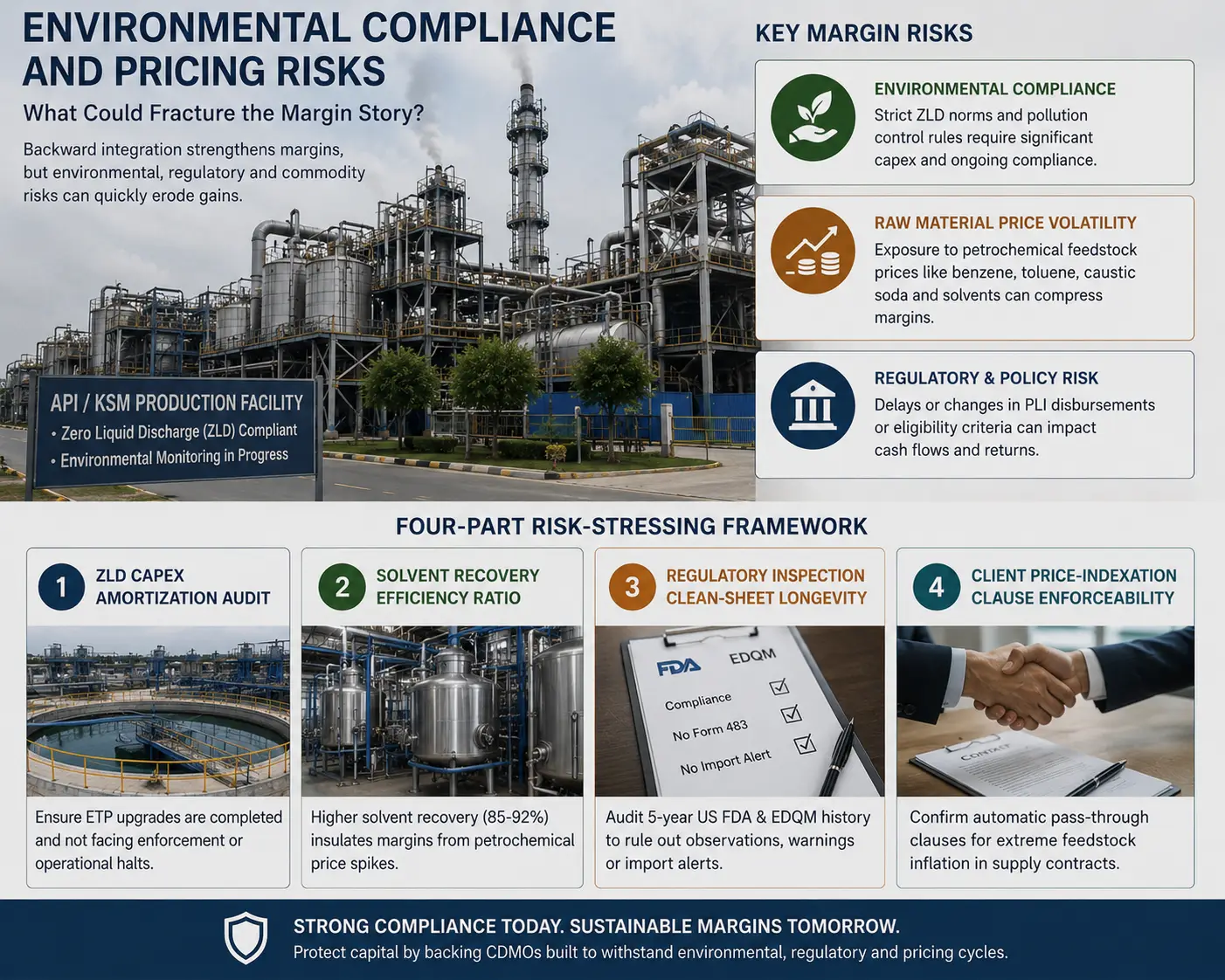
No investment thesis in pharmaceutical manufacturing is complete without an unvarnished, rigorous examination of the environmental, regulatory, and commodity risks that threaten to fracture this backward-integrated margin story. The most hazardous assumption made by growth-focused equity funds is treating API and KSM manufacturing as a clean, frictionless technology asset. In biological reality, chemical synthesis and fermentation are intensely hazardous, industrial-scale transformations that generate toxic effluents, hazardous volatile organic compounds (VOCs), and solid wastes. As India's Ministry of Environment, Forest and Climate Change (MoEFCC) enforces increasingly stringent Zero Liquid Discharge (ZLD) mandates across major chemical clusters in Gujarat, Maharashtra, and Telangana in 2026, the capital expenditure required to maintain environmental compliance has escalated sharply.
We must also stress-test listed CDMOs against two live macroeconomic and operational headwinds: Raw-Material Feedstock Pricing Volatility and Regulatory Subsidy Alteration Risk. While backward integration shields a CDMO from Chinese intermediate markups, it exposes the firm directly to the pricing volatility of upstream petrochemical feedstocks, solvents, and basic inorganic reagents (such as benzene, toluene, caustic soda, and acetic acid). If global crude oil or petrochemical prices spike, an integrated CDMO that has signed fixed-price annual supply contracts with Western biopharma clients will see its operating margins compressed from the bottom up. Furthermore, investors must recognize that sovereign industrial policies are subject to fiscal review; any delay in statutory PLI cash disbursements, or retrospective tightening of eligibility criteria by the Department of Pharmaceuticals, could temporarily impair cash flow yields.
To protect capital against these structural vulnerabilities, institutional portfolio managers must implement a four-part risk-stressing framework across their CDMO coverage:
- ZLD Capex Amortization Audit — verifying that a company has already expensed its effluent treatment plant (ETP) upgrades and is not facing dilutive environmental enforcement halts.
- Solvent Recovery Efficiency Ratio — measuring the percentage of chemical solvents recycled internally (with industry leaders achieving 85 to 92 percent recovery) to insulate gross margins against petrochemical spikes.
- Regulatory Inspection Clean-Sheet Longevity — auditing the trailing five-year US FDA and EDQM (European Directorate for the Quality of Medicines) inspection history to rule out pending Form 483 observations or Import Alerts.
- Client Price-Indexation Clause Enforceability — confirming that commercial supply contracts contain automatic pass-through mechanisms for extreme petrochemical feedstock inflation.
Institutions that pass this rigorous four-part stress test are built to survive industrial cycles and protect their structural margin advantage.
"A pharmaceutical CDMO's margin moat is only as defensible as its effluent treatment plant; an unhedged environmental compliance liability can extinguish years of Production-Linked Incentive cash gains in a single regulatory stop-work notice."
Tools analysts use to track this space:
- European Directorate for the Quality of Medicines (EDQM) — monitors Certificate of Suitability (CEP) compliance, GMP inspections, and quality standards for APIs imported into Europe.
https://www.edqm.eu/ - WHO Prequalification of Medical Products — global database tracking API quality, manufacturing site inspections, and supply-chain security for international health procurement.
https://extranet.who.int/pqweb/ - Central Pollution Control Board (CPCB) India — monitors effluent discharge standards, hazardous waste management, and environmental audits for chemical plants.
https://cpcb.nic.in/ - Indian Chemical Council (ICC) Responsible Care Initiative — safety benchmarks, sustainability guidelines, and raw-material feedstock monitoring for Indian chemical manufacturers.
www.indianchemicalcouncil.com/ - United States International Trade Commission (USITC) — monitors chemical intermediate imports, tariff schedules, and biopharma supply-chain restructuring.
https://www.usitc.gov/ - Reserve Bank of India (RBI) — Foreign Exchange & Trade Credit Archives — tracks currency valuation, trade credit facilities, and capital-goods import financing for the pharma sector.
https://www.rbi.org.in/ - India Brand Equity Foundation (IBEF) — Pharmaceuticals Sector Overview — macro statistics, export promotional schemes, and R&D investment data for Indian pharmaceuticals.
https://www.ibef.org/ - National BioPharma Mission & BIRAC — supports continuous-flow chemistry, biocatalysis, and green manufacturing technologies across Indian life sciences.
https://birac.nic.in/
Closing Section: The Valuation Imperative for 2026 and Beyond
As the Indian pharmaceutical contract manufacturing sector matures into mid-2026, the institutional equity market stands at an analytical crossroads. The foundational phase of the CDMO rerating — wherein market participants blindly rewarded every listed chemical and formulation manufacturer with multiple expansion purely on the mention of "China+1" and "Western derisking" — is officially over. We have entered the era of rigorous cost-structure forensics, where the surplus economic value generated by sovereign industrial policy must be correctly separated from fleeting geopolitical mood. To continue valuing listed CDMOs solely on top-line contract wins or general sector sentiment is to commit a grave structural error. In a world where basic formulation skills are commoditized across emerging Asian manufacturing hubs, defensible API and KSM backward integration is the only true source of long-term economic value compounding.
For healthcare equity analysts, pharmaceutical specialist fund managers, and long-only institutional investors, the CDMO margin story must be unbundled and evaluated as a structural manufacturing arbitrage. A listed CDMO that has utilized PLI subsidies to construct a durable backward-integrated moat — fortified by continuous-flow synthesis, solvent recycling, and deep domestic KSM self-sufficiency — is effectively operating a high-margin specialty industrial business disguised as a contract manufacturer. It warrants a premium valuation multiple that reflects not just its current EBITDA margin, but its relative immunity to Chinese chemical dumping and geopolitical volatility. Conversely, toll-manufacturers relying on imported Chinese intermediates must be recognized for what they are: fragile intermediaries whose margins will inevitably compress when geopolitical sentiment shifts. The API backward-integration moat is real, it is verifiable in statutory disclosures, and it is highly concentrated — and it is time the equity market priced it accordingly.
"In the mathematics of pharmaceutical manufacturing, geopolitical sentiment is merely the wind that fills the sail, but backward integration into the chemical root is the heavy keel that keeps the enterprise upright through every storm."
References & Further Reading
- Why Global Pharma Companies Are Moving API Sourcing from China to India — Advance Pharma Chem
- Approvals Accorded Under PLI Scheme for Promotion of Domestic Manufacturing of Critical KSMs, Drug Intermediates and APIs — India Brand Equity Foundation (IBEF)
- India's CDMO Sector Faces 'Reset' Year as Global Pharma Shifts Focus to Specialisation — Business Today
Disclaimer: All data provided above was sourced from publicly available internet resources and research. This should not be taken as professional financial, medical, or legal advice.
Advertisement