

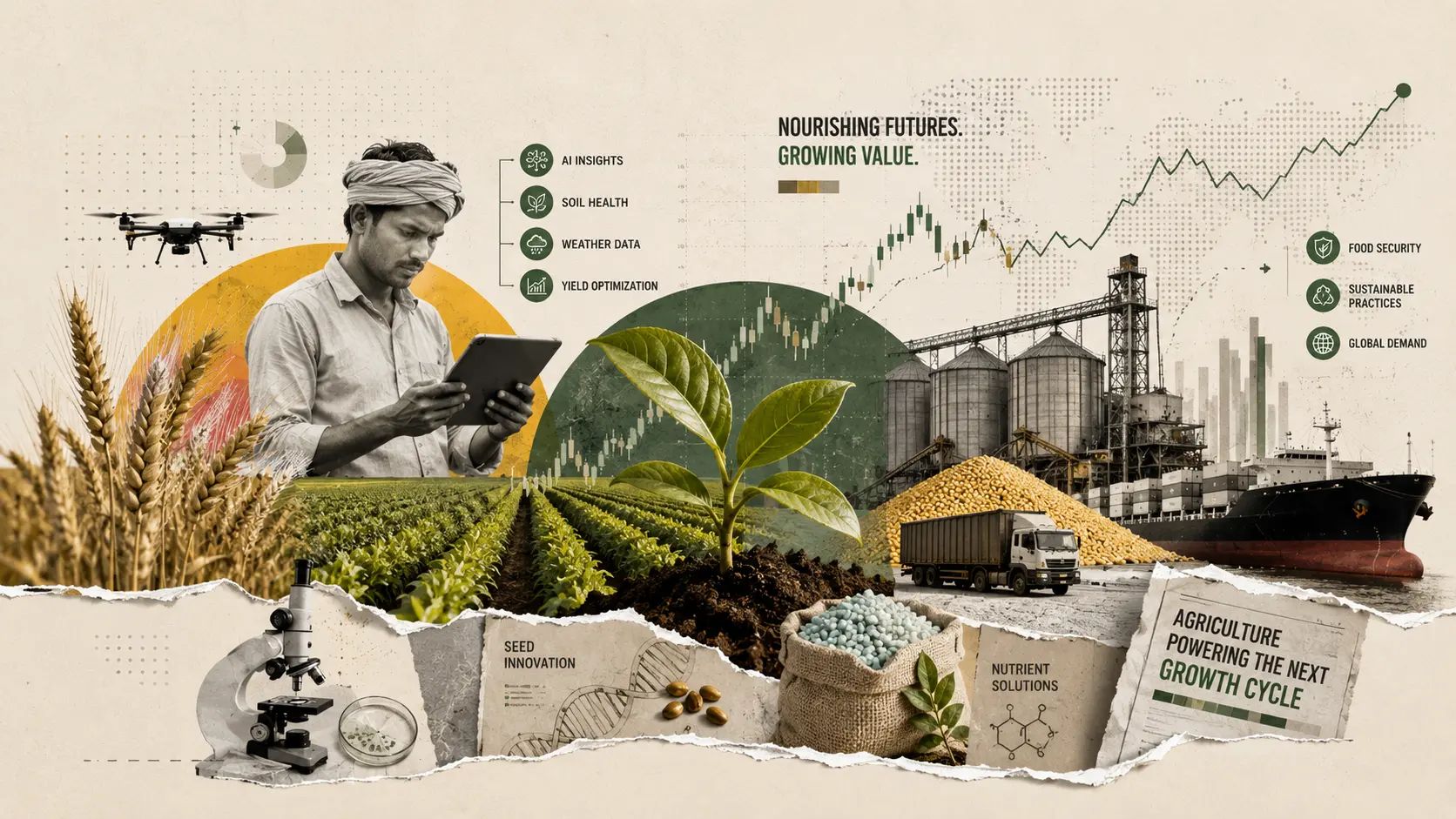
After a decade of being overlooked by institutional capital, Indian agricultural stocks outperformed the Nifty IT index by 18 percentage points in the first half of 2026. The catalyst isn't market sentiment — it's structural: government procurement price hikes averaging 7% annually, mandatory crop insurance expansion, and a Rs. 1.2 lakh crore allocation to rural infrastructure that is finally reaching the companies positioned closest to the farm-to-market supply chain.
Autonomous AI Chatbots and the Efficiency It Provides in Farming
With modern advancements, agricultural logistics and farm optimization have become significantly easier and more efficient. For instance, computing frameworks are now used to calculate the operating expenses of our daily agrarian operations, supply chains, international trade routes, and corporate asset placements. Autonomous AI finance systems and precision agricultural tools are evolving beyond simple predictive weather trackers into deep "agentic" systems that can analyze soil moisture levels, forecast regional cash flows, automate grain trading options, optimize fertilizer application, and even provide real-time asset recommendations with minimal manual intervention from field managers. These specialized tools help institutional managers and farmers get financial advices while managing complex operational risk, evaluating cross-border bank statements, and making critical decisions on your base for large-scale corporate agriculture or rural land development. They operate by processing real-time market trends, analyzing regional crop shortfalls, and tracking international commodity movements. This helps investors and operators choose smart, successful advancements in their agricultural majors to maximize asset yields and outpace inflation across their financial careers.
"The digital capitalization of agriculture represents a massive operational shift, where efficiency is mined directly from data, but real-world execution still depends on physical yield."
To begin a structured exploration of how this modern digital paradigm interfaces with the public equity markets, investors frequently look toward specialized agtech platforms, equipment providers, and foundational nutrient manufacturers. Here are some of the critical corporate entities and platforms that capital allocators are tracking to start their budgeting and investment journey online within the broader agricultural landscape in 2026:
- Corteva, Inc. (NYSE: CTVA): A leading pure-play agricultural powerhouse specializing in advanced seed genetics and crop protection technologies. Corteva posted an exceptional performance in Q1 2026, delivering an adjusted EPS of $1.50, which outpaced consensus Wall Street forecasts by wide margins due to accelerating demand for proprietary seed traits and bio-solutions.
- Nutrien Ltd. (NYSE: NTR): The world's largest producer of potash and a top-tier global provider of nitrogen and phosphate fertilizers. As a low-cost leader in the nutrient manufacturing sector, Nutrien maintains a long-term structural advantage, delivering strong profits in early 2026 as global commodity price fluctuations incentivize heavy agricultural optimization.
- Archer-Daniels-Midland Company (NYSE: ADM): An international crop processing and agricultural trading giant. ADM forms the operational backbone of global food ingredients, animal nutrition portfolios, and scalable biofuel development networks, managing an expansive infrastructure that bridges primary field yields with industrial consumer demand.
- Bunge Global SA (NYSE: BG): A global agribusiness and oilseed processor whose equity value jumped significantly in the first half of 2026. Bunge capitalizes on better-than-expected oilseed processing margins and major structural scale enhancements realized through its comprehensive integration of the Viterra acquisition.
- FMC Corporation (NYSE: FMC): An advanced agricultural sciences company providing innovative crop protection, plant health solutions, and professional pest management formulas globally, recognized for its substantial dividend yield profile and deep research pipeline in biological alternatives.
- Tractor Supply Company (NYSE: TSCO): A premier niche retail operator serving the operational lifestyle needs of recreational farmers, livestock owners, and rural communities, providing a reliable consumer discretionary bridge to the broader agrarian economic footprint.
- PI Industries Ltd. (NSE: PIIND): A high-quality specialty chemical and agrochemical champion. PI Industries excels via its custom synthesis manufacturing (CSM) segment, which produces complex molecules for global innovators under contract, effectively insulating its multi-year revenue visibility from domestic weather cycles.
- UPL Limited (NSE: UPL): A global crop protection giant operating across more than 130 countries. Emerging from a rigorous balance sheet restructuring following major historical acquisitions, UPL is driving a powerful recovery narrative centered on high-margin bio-solutions and global sustainable farming portfolios.
Cons of Relying Solely on Digital Tools for Agricultural Management
Advertisement
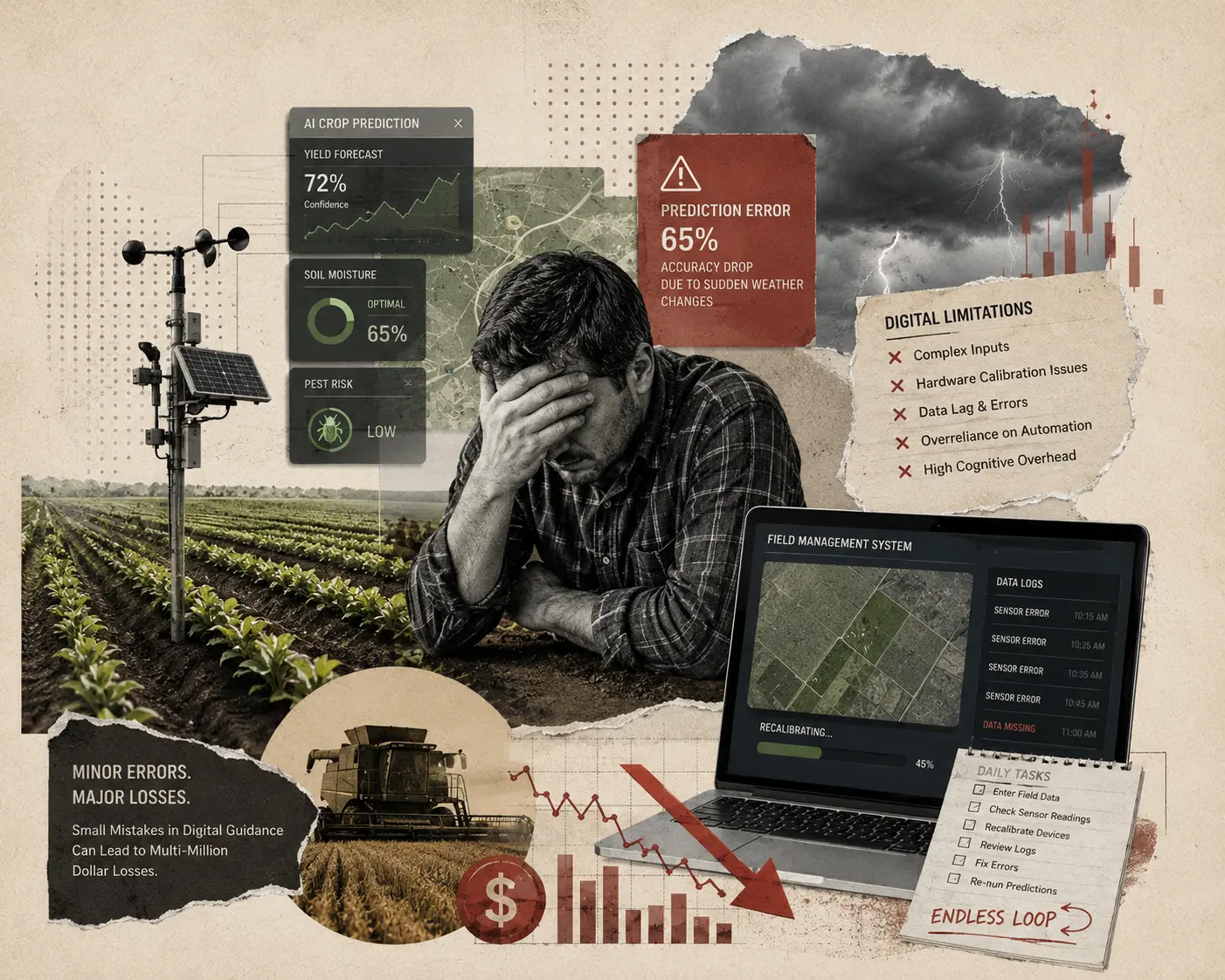
Advanced systems, as we know, are still artificial frameworks, not human-based mindsets that can intuitively navigate the physical unpredictabilities of nature. They cannot easily make decisions after calculating endless biological and geopolitical variables in every local scenario. In recent validation studies, it was observed that while major digital agronomy tools do provide comprehensive field management, they require heavier, lengthier input parameters and complex configuration models to adapt to micro-climatic disruptions. A vast difference of 65% accuracy was observed in automated crop predictive systems when exposed to sudden, non-linear weather changes, which calculates to be every 2nd out of 5th attempts in digital guidance systems that gets minor parameter details wrong. This leaves a significant margin of error in output planning which, if not entirely destructive in a small household garden, can get a multi-million dollar corporate enterprise into a heavy financial loss. Constantly entering complex prompt details, recalibrating faulty hardware sensors, and reviewing automated data logs becomes an endless loop of finding structural records wrong and scrambling to get them changed. This transforms what should be an efficient asset into a tiresome chore of the day, demanding excessive cognitive overhead and creating systemic friction across long-term management structures.
The Traditional Grounding Method: The "Kakeibo" of Agrarian Investing
To counteract this digital detachment, institutional investors in 2026 are looking backward to traditional discipline, mimicking structural models like the Japanese Kakeibo method — the handwritten, mindful framework focused on deliberate resource conservation. Just as Kakeibo demands that an individual slow down, write down every transactional variable, and reflect on the core difference between actual needs and variable wants, the agricultural equity space is embracing a "back-to-basics" structural mindset. Instead of assuming that software layers can fix broken fundamentals, market capital is flowing to businesses focused on the irreducible physical drivers of yield: soil health, water accessibility, structural distribution logistics, and biological resilience. When capital allocators calculate physical input dynamics themselves, evaluating the foundational variables of field management without being blinded by high-tech corporate buzzwords, their analytical models become deeply aware of the ground truth. This structural discipline trains the investor's mind to look past ephemeral software trends and focus on primary tangible assets. It creates a critical habit to evaluate structural risks twice before deploying capital, forming the core principle of long-term success in asset preservation and capital compoundment.
"Spend consciously and save intentionally — a philosophical truth that applies as perfectly to global natural resource preservation as it does to individual capital management."
Quantitative Comparative Analysis and Financial Data
The resurgence of interest in these foundational securities is validated by deep structural metrics across global exchanges. Below is an analytical summary outlining the key capital market variables for top-tier agricultural equities in the first half of 2026, illustrating the underlying financial stability that draws institutional interest back to the sector:
| Company Identifier | Market Cap ($B) | Forward P/E | Dividend Yield | Core Operational Specialty |
|---|---|---|---|---|
| Corteva, Inc. (NYSE: CTVA) | 53.6 | 18.5 | 0.90% | Seed Genetics & Advanced Bio-Solutions |
| Nutrien Ltd. (NYSE: NTR) | 29.0 | 12.4 | 3.62% | Global Potash & Low-Cost Nutrients |
| Archer-Daniels-Midland (NYSE: ADM) | 32.5 | 11.2 | 3.15% | Crop Processing, Biofuels & Logistics |
| Bunge Global SA (NYSE: BG) | 15.8 | 10.5 | 2.80% | Oilseed Crushing & International Scale |
| FMC Corporation (NYSE: FMC) | 1.4 | 8.9 | 11.66% | Targeted Chemical Crop Protection |
| PI Industries Ltd. (NSE: PIIND) | 5.8 | 29.2 | 0.45% | Custom Synthesis Contract Agrochemicals |
Core Philosophy: "True capital security requires an alignment between automated efficiency and tangible, physical foundations."
Read Further
- Corteva, Inc. (CTVA) Q1 2026 Earnings: Adjusted EPS of $1.50 Beats Estimates — StockAnalysis.com
- Bunge and Viterra Complete Merger to Create Premier Global Agribusiness Solutions Company — Official Bunge Press Release
Disclaimer: All structural observations, data markers, and corporate evaluations provided above were compiled from public financial records, internet market updates, and recent institutional sector studies. This reporting should be treated as an objective market synthesis and must not under any circumstance be interpreted as definitive personal financial or investment advice.
Advertisement