

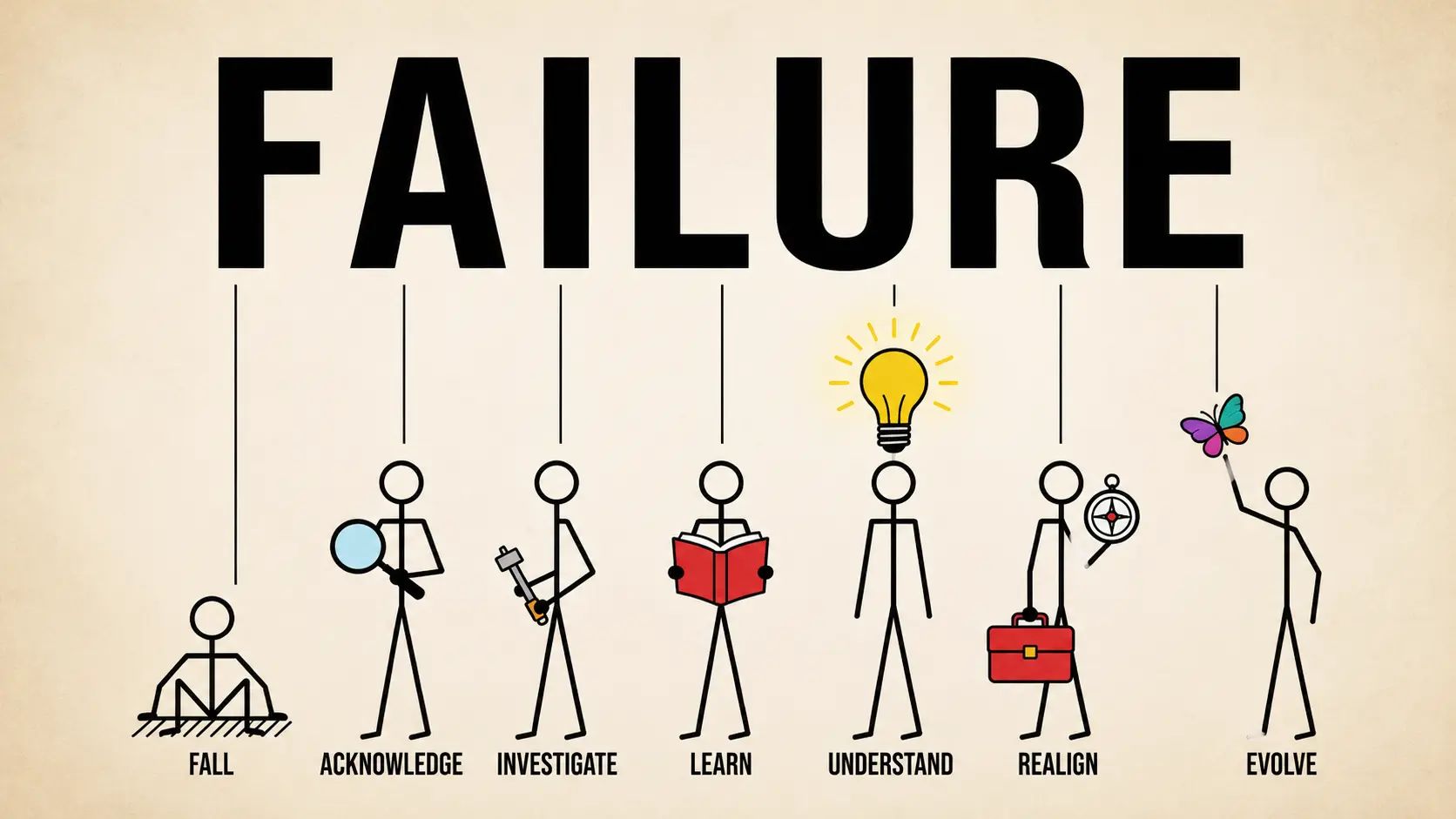
In today's era where everything is being created and generated by AI and instant access technologies, we are too much dependent on immediate correctness. We expect our search engines, our automated tools, and our software systems to provide us with the right answer on the first attempt. Somehow it is useful for us, saving seconds in our daily routines, and somehow it is not.
AI is something that was created to make our work faster and with better efficiency, but when we just ended up depending on immediate accuracy and frictionless retrieval for everything, we don't know where we actually forgot the lost methods of deep cognitive processing and mental discipline. We don't know how much we are weakening our own organic architecture of memory by avoiding mistakes at all costs.
So this article basically is going to get you all aware about what happens inside the human brain when we make errors, and why forcing yourself to risk getting the wrong answer first is scientifically proven to build faster, more robust learning systems than flawless execution from day one.
The Mechanics of Generative Error and Cognitive Friction
When you attempt to solve a problem without initially knowing the exact answer, your brain enters a state of active generation. In cognitive psychology, this is known as the "pre-testing effect" or "generative learning." Unlike modern educational shortcuts that feed students formulas to memorize, forcing a baseline guess — even a completely incorrect one — creates a powerful structural framework in the mind.
When we look at how traditional systems outlive modern automation, the core reason is the deliberate inclusion of cognitive friction. Consider how writing down numbers manually in a financial planner forces an acute neural awareness that an automated app lacks. In the exact same way, guessing an answer forces your memory architecture to search its existing internal networks, mapping out pathways and identifying structural gaps. When the correct answer is subsequently revealed, the brain does not merely log the data; it aggressively patches the empty network framework it just created during the struggle.
"Mistakes are not merely path corrections; they are the exact physiological triggers that signal the brain's synapses to modify their structural density."
Recent studies in neurobiology demonstrate that when an individual makes an incorrect prediction and receives immediate, corrective feedback, the memory retention for that specific data point increases exponentially compared to when they are simply told the correct answer from the start. This happens because the premature error creates a state of high cognitive curiosity and neural alertness, leaving a clear "dendritic footprint" that makes the correct information highly adhesive.
The Hypercorrection Effect and Neural Rewiring

One of the most fascinating phenomena in cognitive science is the Hypercorrection Effect. This principle states that the more confident you are in a wrong answer, the more deeply the correct answer will be embedded in your long-term memory once the error is corrected.
In a series of landmark trials conducted by cognitive researchers, it was shown that when individuals were certain of their financial or factual assertions and were subsequently proven wrong, a massive spike in attention-related brain waves (such as the P300 wave complex) occurred. This physiological reaction acts like a biological highlighter, forcing the medial temporal lobe to prioritize the incoming corrective data above all else.
Advertisement
Statistical Reality of Error-Based Learning
- Retention Performance: Pre-testing with incorrect guesses yields up to a 45% increase in subsequent retrieval scores compared to passive studying methods.
- The Prompts Paradox: Relying purely on external accuracy engines (like complex AI prompts) drops long-term natural human recall by nearly 60% over a 90-day period due to cognitive atrophy.
- The 65% Accuracy Rule: Systems or minds that experience a baseline failure rate of roughly 15% to 20% during initial training adapt to volatile environments twice as fast as systems optimized for zero-error training.
Giving commands to an external tool and continuously receiving flawless records can become an endless loop of surface-level engagement. It will eventually become a tiresome chore of the day that takes away real head-work, giving major technical dependencies and leaving your organic cognitive faculties underutilized. When your mind is protected from making mistakes, it never triggers the release of neuromodulators like acetylcholine and dopamine, which are absolutely required to open up neural plasticity and lock in true expertise.
Traditional Discipline vs Frictionless Friction
Now it may sound paradoxically inefficient to actively encourage wrong answers, but no — this is where the true magic of human learning dictates its terms. When you write, predict, and calculate things yourself, your mind becomes completely aware of what it is doing and whether its underlying logic is right or wrong. This eventually develops into a deep habit of structural thinking before execution, which is the core principle of success in any high-stakes analytical field.
To implement this methodology in your daily life, business, or educational journey, you must shift away from the "reactive information intake" system that characterizes modern life. Instead, adopt a "structure-dependent" predictive workflow. Before looking up a metric, utilizing an optimization tool, or reading a report, force yourself to write down an educated guess or sketch an approximate projection. Confronting your own wrong answer first primes your brain to receive the subsequent truth with absolute clarity.
"Guess boldly, fail immediately, and correct intentionally."
By shifting our perspective to view mistakes not as broken attempts but as necessary biological catalysts, we transition from fragile learners into highly adaptive intellectual systems. We learn faster, remember longer, and build a mind that is fundamentally independent and resilient.
Read Further
- Errors Committed With High Confidence Are Hypercorrected — Butterfield & Metcalfe, Journal of Experimental Psychology: Learning, Memory, and Cognition, 2001 / PubMed
- Neural Correlates of People's Hypercorrection of Their False Beliefs — Metcalfe, Butterfield, Habeck & Stern, 2012 / Columbia Academic Commons
- The Hypercorrection Effect in Younger and Older Adults — Eich, Stern & Metcalfe, 2012 / PMC
Disclaimer: All data presented in this article was synthesized from neurocognitive studies and research papers focused on human learning systems and educational psychology. This should not be taken as formal clinical advice or a definitive prescription for any specific educational or therapeutic methodology.
Advertisement