


In today's modern era, where high-level national educational architectures are being conceptualized, redrafted, and celebrated under the banner of revolutionary long-term reforms, we are becoming increasingly dependent on grand policy declarations. We find ourselves completely absorbed by the sophisticated jargon of global parameters, digital integration, and multi-disciplinary pathways, assuming that administrative frameworks will naturally translate into systemic efficiency. Somehow, this top-heavy policy push is visually convincing for us, and somehow it is not. It creates a gilded facade of structural progress, but when we look closely at the grassroots realities of our primary schooling ecosystem, the numbers completely shatter our expectations. We don't know where we actually got lost, buried under the weight of lengthy programmatic goals, while completely dropping the ancient, fundamental rule of elementary education: regular, uncompromised, and absolute mastery over basic text and numbers.
This comprehensive diagnostic article is designed to uncover the stark realities of our rural primary education framework. It draws a clear, uncompromising comparison between what we intend to achieve on paper with modern national policies and what is actually happening within our under-resourced classrooms. The historical release of the Annual Status of Education Report (ASER) 2024 by the Pratham Foundation offers an unvarnished, empirical mirror to the nation, providing undeniable data that challenges the prevailing narrative of educational progress. It forces us to ask a critical question: are we building an equitable future, or are we trapping millions of children in an endless cycle of instructional neglect?
The Illusion of Modern Educational Frameworks and the Stark Numbers They Hide
With massive public infrastructure layouts and historic allocations toward modernizing curriculum standards, tracking learning pathways has theoretically become more organized. Administrative metrics suggest that universal school enrollments are at their peak. However, when autonomous, citizen-led evaluations step directly into rural households to measure raw, unpolished learning achievements, the entire illusion of institutional success dissolves. The ASER 2024 nationwide survey — which meticulously mapped over 649,491 children across 17,997 villages in 605 rural districts — reveals an alarming systemic disconnect. It shows that our elementary education structure is experiencing a profound crisis of foundational capabilities. The core finding of the report is deeply unsettling: an overwhelming 76.6% of children enrolled in Standard III across rural India cannot read a simple text of Standard II difficulty. When rounded out to the absolute baseline of national achievement, nearly 77% of third-grade students are locked out of basic literacy. They are sitting in classrooms, looking at textbooks they cannot decipher, and falling behind an inflexible, grade-driven curriculum. This structural failure does not merely signify a temporary post-pandemic lag; it points to a deep, underlying operational deficiency. The educational system continues to push children through grades based on age, completely ignoring their actual learning levels. This creates an endless loop of instructional exclusion, where a child who cannot read basic words in third grade is expected to digest complex science, social studies, and environmental concepts in fourth and fifth grades.
76.6% — Class 3 Students Who Cannot Read a Class 2 Text Nationally
23.4% — The Tiny Fraction of Class 3 Children Attaining Basic Text Literacy
66.3% — Class 3 Students Unable to Perform Basic 2-Digit Subtraction
The operational machinery of modern primary education operates like an automated conveyor belt. It focuses on administrative checkboxes — such as school infrastructure updates, mid-day meal logs, and teacher training certifications — while ignoring the core essence of real human learning. A closer look at the ASER data reveals that even though national enrollment figures have stabilized comfortably at 66.8% for government institutions, the actual return on instructional time remains incredibly low. This is not a failure of student capability; it is a failure of a rigid, top-heavy design. The system prioritizes finishing a predefined textbook over ensuring that every child sitting on the classroom floor can read the sentences written on the blackboard.
Broken Policy Implementation vs. Grassroots Classroom Realities
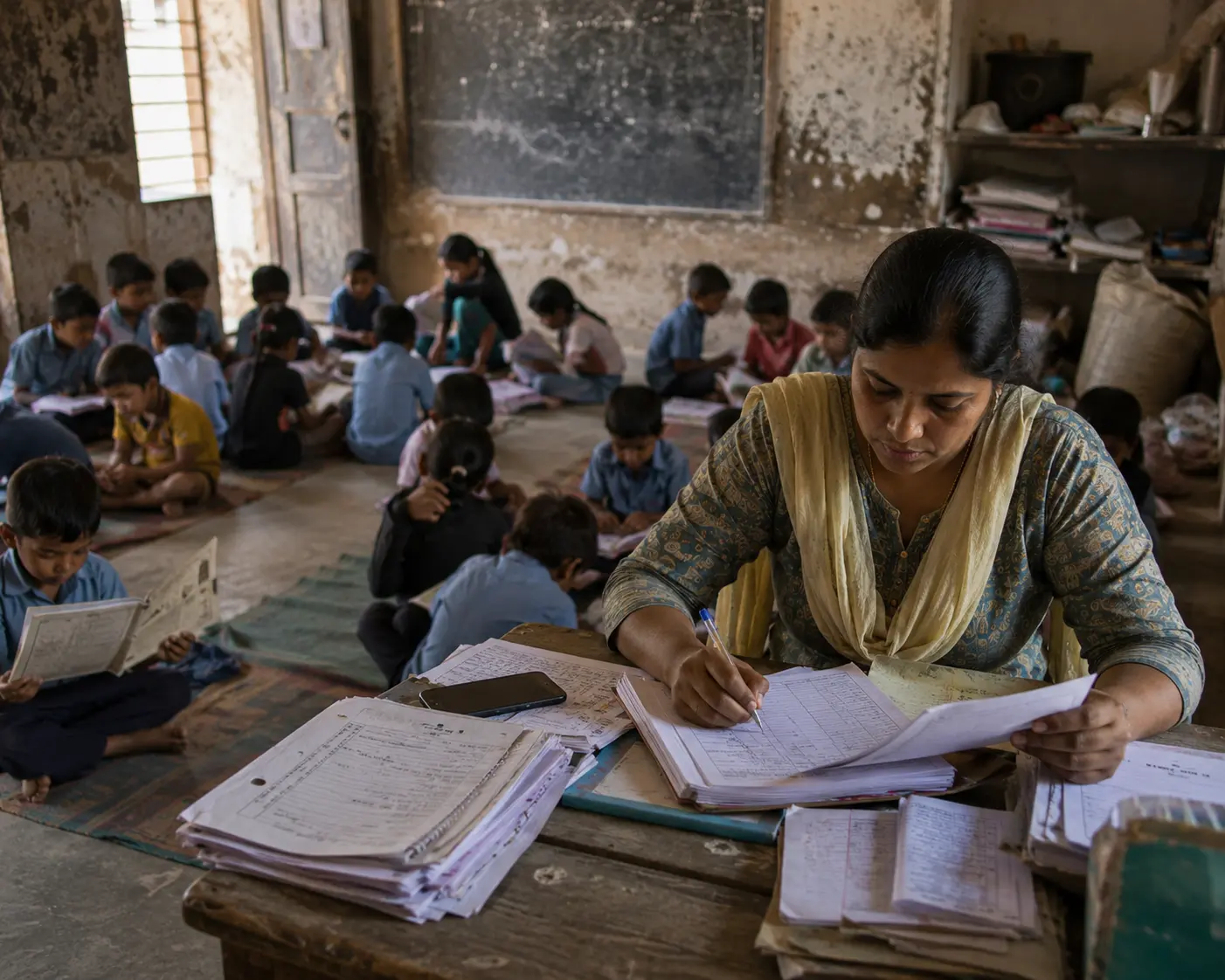
To understand why five years of the National Education Policy (NEP) 2020 have failed to spark a foundational learning revolution, we must contrast policy intent with classroom reality. The table below uses the exact analytical framework of systemic friction to highlight why our approach to educational reform remains fundamentally broken.
| The Broken Status Quo | The Effective Foundational Path |
|---|---|
| Textbook-Driven Pace: Teachers are pressured by administrative timelines to complete the grade-level syllabus, leaving struggling students behind. | Instruction Based on Level: Grouping children by their actual reading and math abilities rather than their age or grade. |
| Age-Grade Automation: Children are automatically promoted based on age rather than proven learning mastery, compounding reading deficiencies over time. | Reflective Learning: Focusing heavily on comprehension, self-expression, and daily verbal reading exercises. |
| Multigrade Classrooms: Over 52.1% of primary schools face severe resource constraints, forcing multiple grades to sit and learn together. | Targeted Resource Focus: Consolidating small, under-enrolled schools and deploying specialized foundational educators. |
| High Attrition in Skills: Without regular, hands-on practice, minor post-pandemic learning gains quickly disappear. | Continuous Assessment: Moving away from stressful end-of-year exams to simple, daily individual check-ins. |
The National Education Policy 2020 correctly identified Foundational Literacy and Numeracy (FLN) as an urgent national mission. It explicitly stated that the ability to read and write, along with performing basic math, is a necessary prerequisite for all future school learning. Yet, five years after this major declaration, the implementation strategy remains stuck in an endless loop of administrative reporting. State departments have rolled out the NIPUN Bharat guidelines, distributed extensive teacher resource kits, and arranged massive training workshops. Yet, the ASER 2024 report indicates that while 80% of surveyed schools claim to be implementing FLN activities, the actual classroom experience has barely shifted. The focus remains on compliance rather than genuine learning outcomes. The main issue is that the system treats policy implementation like a compliance exercise. Teachers are required to document FLN hours, fill out extensive progress cards, and upload classroom photos onto centralized digital portals. This creates a stressful, administrative routine that takes away valuable teaching time. Instead of sitting down with a child to guide them through a paragraph, teachers are stuck managing endless paperwork. This bureaucratic load drains their energy and distracts them from their primary goal: fostering a love for reading and helping students build foundational skills.
Advertisement
"True learning requires immediate human reflection and real-time adjustment; when policy is reduced to a digital compliance ritual, the classroom empties of its purpose."
The Traditional Crisis: Multi-Grade Classrooms and Structural Neglect
While the top-level administration discusses advanced digital learning materials and smart classrooms, rural schools face a much more basic, physical problem. The ASER 2024 report highlights a stark, growing trend: small government primary schools with fewer than 60 total students enrolled have spiked from 44% in 2022 to an alarming 52.1% in 2024. This structural shift has created a tough pedagogical challenge: the widespread rise of multigrade classrooms. Nationally, nearly two-thirds of Standard I and Standard II classrooms are combined. This means a single teacher is expected to simultaneously teach children who are just entering school, children who missed pre-primary preparation, and children who are struggling with basic second-grade letters. This structural arrangement makes traditional textbook-focused teaching completely ineffective. A teacher cannot deliver a standard, grade-specific lesson when the children sitting in front of them have completely different learning needs. The ASER data shows that within any single classroom, student learning levels vary enormously. Without a structured way to group children by their actual learning levels rather than their age, the teacher naturally defaults to the easiest option: reading out loud from the textbook to the entire room. The few children who can already read follow along, while the rest are left completely disengaged. This environment does not build foundational skills; it actively discourages students and reinforces an early sense of failure.
| Key Educational Metrics | 2018 Baseline | 2022 Post-Pandemic | 2024 Latest Findings | The 5-Year Net Trend Analysis |
|---|---|---|---|---|
| Class 3: Can read Class 2 text | 20.9% | 16.3% | 23.4% | Stagnant recovery; 76.6% remain completely illiterate. |
| Class 5: Can read Class 2 text | 44.2% | 38.5% | 44.8% | Flatline growth; over half leave primary school illiterate. |
| Class 3: Can do basic subtraction | 28.1% | 25.9% | 33.7% | Minor improvement, but 66.3% still fail baseline arithmetic. |
| Primary schools with < 60 students | 39.2% | 44.0% | 52.1% | Severe institutional fragmentation and resource strain. |
Furthermore, the crisis is made worse by a growing imbalance in student enrollment trends. Government schools are carrying the entire weight of this foundational learning crisis. The ASER 2024 report notes that while learning levels in government schools showed a slight post-pandemic recovery, private school performance has completely stalled. This flatline in private school outcomes shows that the problem is not limited to a specific type of school administration; it is a broader, systemic issue that affects our entire approach to early childhood education across rural India.
The Core Principle of Learning: Conscious Engagement and the Path Forward
Now, this persistent crisis might sound like a problem that can be easily solved by throwing more money at school infrastructure or buying more digital devices. But the data shows that is a false promise. The core principle of successful money management and saving — which is built entirely on conscious awareness and daily discipline — applies directly to human learning. Learning to read is not an automated process that happens just by sitting in a classroom for a set number of days. It requires a conscious, active connection between the teacher and the child. It demands a learning environment where a child is encouraged to speak, stumble, correct themselves, and build real confidence. When a child writes and calculates by themselves, their mind becomes actively aware of what they are doing. This hands-on engagement helps them understand whether their reasoning is right or wrong. This intentional practice eventually becomes a habit — a mental routine of thinking twice before simply guessing an answer. This basic psychological process is exactly what is missing from our automated, textbook-driven primary school classrooms today.
To fix this deep learning crisis, we must look beyond grand policy announcements and focus on three practical, evidence-based steps:
First, we must commit to grouping children by learning level rather than age. For at least two to three hours every school day, regular grade-level textbooks must be put aside. Classrooms must be reorganized so that all children who are at the same reading level — whether they are in third, fourth, or fifth grade — can work together using appropriate learning materials. This breaks the automated conveyor belt of age-based promotion and ensures that no child is forced to sit through a lesson they cannot understand.
Second, we must simplify and declutter the role of our primary school teachers. State education departments must stop burdening teachers with endless digital compliance tasks, administrative data tracking, and non-educational duties. A teacher's performance should be evaluated on a single, clear metric: the actual, verifiable progress of their students from non-readers to fluent readers. We must give teachers the time, trust, and professional space to focus on the human side of teaching.
Third, we must launch targeted community literacy campaigns that actively involve parents. The ASER 2024 report highlights that parental involvement is a powerful, underutilized asset in rural education. We need to move away from intimidating, formal parent-teacher meetings and instead create simple, accessible community scorecards. By giving parents clear, straightforward updates on whether their child can read a basic story or subtract simple numbers, we empower families to support foundational learning at home.
If we refuse to make these fundamental changes, the National Education Policy will simply become another well-written historical document. It will join a long list of noble intentions that failed to make a difference because they never changed the daily reality of the classroom floor. It is time to step away from administrative compliance, look past the polished policy declarations, and focus on the real work of helping our children learn.
Read Further
- ASER 2024 National Findings — Official Report, ASER Centre / Pratham Foundation
- Leap in Rural School Enrollment: Annual Status of Education Report (ASER) 2024 — Press Information Bureau, Government of India
Disclaimer: All the educational data, statistical percentages, and regional insights provided above were compiled directly from the official Annual Status of Education Report (ASER) 2024 national publication and associated research studies on foundational literacy and numeracy in rural India. This comprehensive analysis is intended for educational and policy awareness purposes and should not be taken as an official direct quote from the survey center or as formal legal-administrative advice.
Advertisement