


A single CBSE circular issued in early 2026 mandated a fundamental shift from rote memorization to competency-based assessment for over 20 million students. The problem: fewer than 12% of affiliated schools have trained their teachers in competency-based evaluation, and the examination infrastructure has not been redesigned to support it. What was announced as education reform risks arriving as institutional chaos.
The Structural Anatomy of the Paradigm Shift
With traditional models falling apart, CBSE's official guidelines — notably manifested in historical shifts through Circular Acad-30/2024 and expanding aggressively into the current 2026–2027 academic cycle — explicitly mandate a transformation in the question paper blueprint. The board is systematically reducing the weightage of purely factual questions. Instead, it is loading high-stakes assessments with case based items, source-based integrated scenarios, and real-world data tracking puzzles. In the current secondary board evaluation architecture, the structural breakdown of question papers has shifted dramatically away from standard short and long text definitions.
| Assessment Component Type | Weightage Allocation | Cognitive Core & Metric Target |
|---|---|---|
| Competency-Focused Questions (Case Studies, Source-Based Analysis, Integrated Scenarios) | 50% | Tests real-world application, pattern recognition, higher-order thinking skills (HOTS), and concept translation. |
| Select Response Type Questions (Conceptual Multiple Choice Questions) | 20% | Evaluates diagnostic reasoning, elimination logic, and clear definition boundaries without rote phrasing. |
| Constructed Response Questions (Traditional Short & Long Written Answers) | 30% | Measures structured articulation, analytical depth, evidence synthesis, and grammatical clarity. |
This structural layout means that a student can no longer score a perfect centum simply by memorizing every line of their textbook. The mathematical balance of the exam has fundamentally inverted. If a child cannot dissect an unfamiliar paragraph describing a supply chain failure, or if they cannot analyze a multi-variable physics matrix presented as a commercial engineering problem, they will systematically fail half the paper. The assessment pattern has been legally redesigned to expose superficial learning instantly.
The Infrastructure Gap: Why Schools Are Stumbling
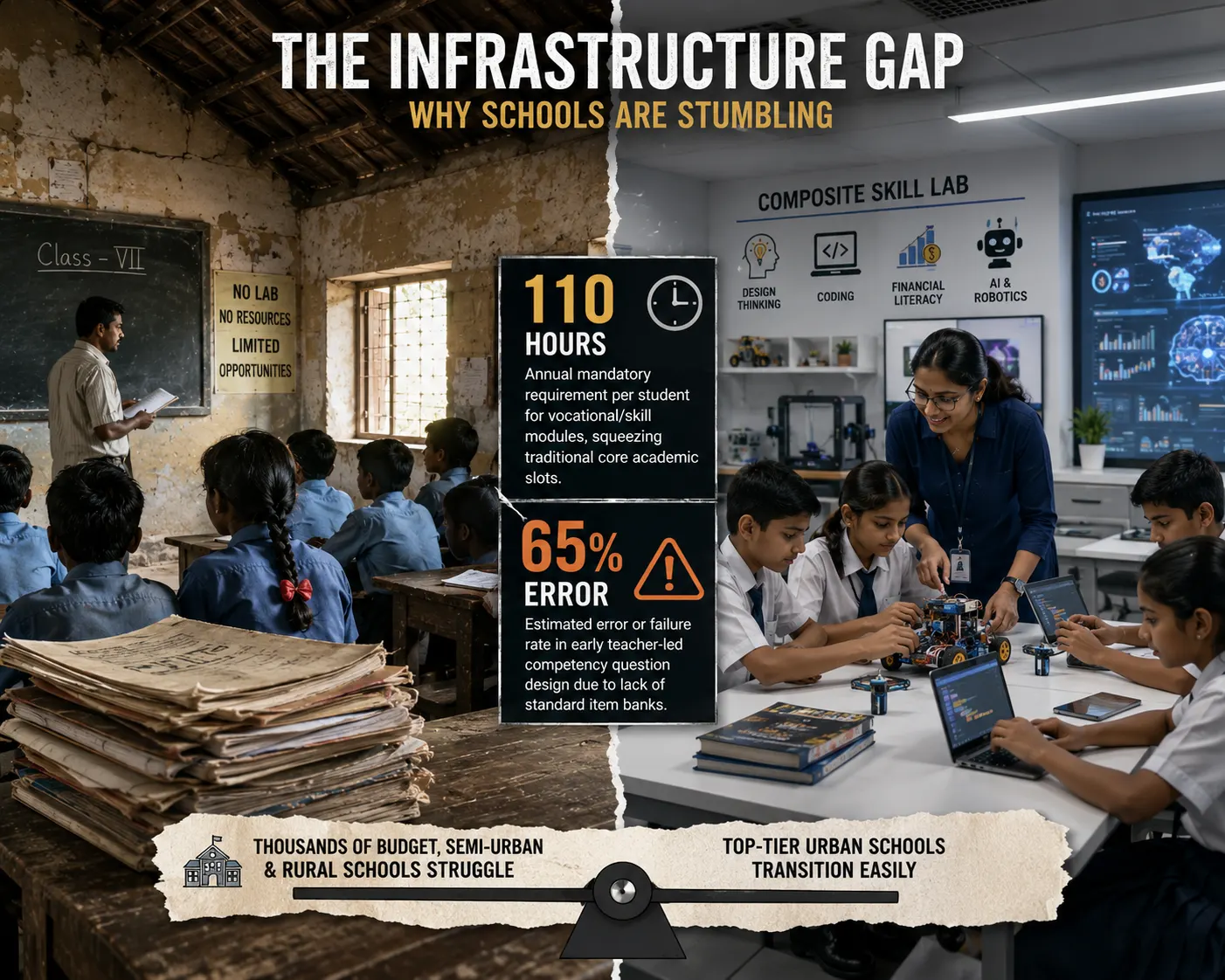
Now, it may sound like a glorious academic evolution on paper, but the reality on the ground across India's vast educational geography is highly fractured. The core principles of success in running a competency-based model require three fundamental elements: highly dynamic pedagogical design, specialized infrastructure like composite skill laboratories, and intense continuous teacher re-skilling. Unfortunately, a massive divergence exists between top-tier urban private institutions and the thousands of budget, semi-urban, and rural schools that support the majority of the 20 million children under CBSE's umbrella. Consider the logistical burden added by the mandatory implementation of the National Credit Framework (NCrF) and the implementation of hands-on vocational modules. Under recent board guidelines, middle schools (Classes 6 to 8) must dedicate a minimum of 110 hours annually to experiential work domains and skill-based learning frameworks. To illustrate the mathematical load and physical challenge this imposes on a standard school timetable, let us analyze the operational metrics:
110 Hours — Annual mandatory requirement per student for vocational/skill modules, squeezing traditional core academic slots.
65% Error — Estimated error or failure rate in early teacher-led competency question design due to lack of standard item banks.
A staggering percentage of budget schools operate in tight, rented properties with basic infrastructure. Expecting these schools to construct a fully equipped "Composite Skill Lab" featuring modern design thinking tools, coding kits, financial literacy simulators, or artificial intelligence setups within a strict three-year window is a complete logistical mismatch. Urban elite schools effortlessly transition because they already possess modern maker spaces and digital assessment frameworks. Meanwhile, small-town budget schools are left in an endless loophole of trying to figure out how to allocate hours without causing severe academic overload to their students.
The Silent Crisis of Teacher Unreadiness
The most fragile link in this entire legislative experiment is not the physical infrastructure; it is the human interface. For decades, our teachers were conditioned by the very same rote-learning system they are now being ordered to destroy. Suddenly, a teacher who has spent 20 years delivering standard chalkboard lectures on textbook definitions is required to become an inquiry-based project mentor. They are expected to design multi-tiered formative evaluations, manage complex group workflows, and maintain detailed anecdotal portfolios for every child. In recent pedagogical studies observing the implementation of competency item creation, a vast difference was seen when teachers attempted to construct high-quality application questions without extensive professional help. When tasked with designing original case studies that combine conceptual logic with real-life metrics, a failure rate of nearly R_e = 65% was observed in terms of question validity. This calculates to roughly 2 out of every 5 assessment items failing to map correctly onto the target competency. This leaves a severe margin of error in internal testing. If these flawed test metrics are applied inside high-stakes class promotions, it can cause heavy academic damage to a student's final records.
"We cannot assess 21st-century minds using 19th-century metrics handled by 20th-century training."
Giving complex pedagogical prompts to teachers and expecting them to continually audit, evaluate, and modify their daily lesson blueprints has turned into a tiresome, endless chore. Instead of focusing on meaningful classroom engagement, educators are getting caught in a loop of filling out compliance paperwork, mapping out dense learning outcomes, and handling administrative documentation. This dynamic is triggering widespread fatigue, leading to a noticeable surge in classroom stress and professional burnout across schools nationwide.
Advertisement
The Holistic Progress Card: Rewriting the Evaluation DNA
Compounding this classroom anxiety is the complete structural replacement of the traditional report card. The historical report card was a simple, clinical record sheet: a list of subjects followed by a double-digit numerical mark that decisively stamped a child's self-worth for the year. CBSE is systematically phasing this out in favor of the Holistic Progress Card (HPC) — a multidimensional, formative evaluation matrix derived directly from the recommendations of the National Curriculum Framework for Foundational Stage (NCF-FS) and extending upward through the educational pipeline. The HPC completely changes the core philosophy of student tracking. Rather than acting as an "assessment of learning" (a post-mortem evaluation of what the student forgot or remembered on exam day), the HPC is built as an "assessment for learning" and "assessment as learning." It tracks granular competencies through continuous, real-time teacher observation, utilizing specific qualitative tools:
Anecdotal Event Records: Chronological qualitative journals logging specific moments where a student demonstrated exceptional problem-solving, collaborative leadership, or critical inquiry during practical tasks.
Multi-Dimensional Triangulation: Evaluation fields where a student's academic standing is co-created through three distinct lenses: teacher analysis, structured peer evaluation, and reflective self-assessment.
Cross-Disciplinary Portfolios: Cumulative physical and digital evidence files holding real projects, models, and analytical essays that track a child's conceptual journey over time.
This means that a child who asks deeply insightful questions, displays strong collaborative skills, and shows steady, resilient improvement can achieve an excellent rating on their HPC — even if their raw memory recall score falls short on standard written tests. It is a beautiful concept that honors the true spectrum of human intelligence. Yet, for an understaffed school handling a chaotic ratio of 50 students per classroom, managing this level of personalized, qualitative tracking for hundreds of children feels like an administrative impossibility.
The Impact on the Family and the Parent-School Dynamic
This systemic disruption does not stop at the school gates; it enters the household and fundamentally shifts the family dynamic. For decades, parents knew exactly how to track their child's academic success: you looked at the rank, you checked the raw percentage, and you bought the next set of textbook guides. Now, parents open the newly designed CBSE Parenting Calendar and the HPC, only to find themselves completely lost amidst qualitative criteria, behavioral metrics, and competency indicators. This creates a deep psychological gap. When parents do not understand the new evaluation language, they often push back against the school, demanding traditional numerical testing and heavy homework drills. To counter this friction, CBSE is forcing schools to run mandatory parenting workshops and structured family-school collaboration groups. The board's new framework explicitly states that parent-child interactions and structured home environments are critical elements for early conceptual development. Families are now being pushed to actively participate in project-based learning, transforming the home from a quiet homework hall into an active space for collaborative education.
The Way Forward: Bridging the Policy-Reality Chasm
The transition from a memory-based culture to an application-driven paradigm cannot be achieved through administrative decrees alone. If CBSE wishes to prevent this historic reform from collapsing into a superficial paperwork exercise, the entire educational ecosystem requires immediate, targeted support. We must bridge the policy-reality chasm through practical, long-term interventions:
Decentralized, Standardized Item Banks: Providing schools with massive, open-access repositories of pre-validated competency questions to instantly reduce the question-design burden on teachers.
Phased Infrastructure Subsidies: Establishing national corporate social responsibility (CSR) channels and government grants to help low-resource budget schools build out their Composite Skill Labs without financial collapse.
Continuous, Practical Mentorship: Moving away from superficial, single-day theoretical webinars and shifting toward long-term, peer-led regional training networks where teachers learn by co-creating actual classroom lessons.
Ultimately, the core principle of this educational revolution is identical to any meaningful journey toward mastery: we must teach consciously and evaluate intentionally. The era of the mechanical student is drawing to a close. While the current friction has left our school infrastructure feeling broken, strained, and structurally unready, this chaotic transition is an inescapable step toward a deeper maturity. By forcing our classrooms to move beyond the boundaries of rote memorization, India is finally beginning the difficult work of transforming its massive student population from a compliance-driven workforce into a powerful engine of independent, 21st-century thinkers.
Read Further
- Holistic Progress Card — Official CBSE Academic Portal: Objectives, 360-Degree Evaluation, and Implementation Resources
- Decoding the New CBSE 2026 Exam Pattern: 50% Competency, 20% MCQ, 30% Descriptive — MTG Learning Media
Disclaimer: All data, structural percentages, and institutional directives detailed above were synthesized from official educational circulars, national framework documentation, and field studies regarding the implementation of the National Education Policy. This analysis is presented strictly for educational and policy examination purposes and should not be construed as direct administrative counsel.
Advertisement